
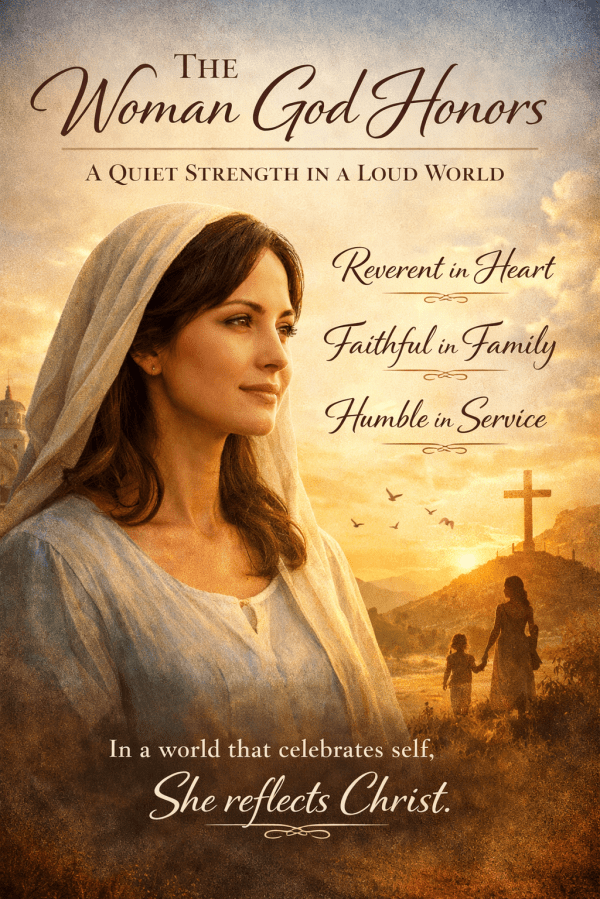
There has always been a cultural narrative telling women who they should be.
In our world today, it often sounds like this: Be louder. Be independent at all costs. Put yourself first. Define your own truth. Don’t let anything—or anyone—limit you.
But this isn’t new.
Long before modern feminism took center stage, there was another movement shaping the identity of women—one that looked strikingly similar.
A Look Back: The “New Roman Woman”
In the days of Paul the Apostle, a cultural shift was taking place across the Roman Empire. Scholars often refer to it as the rise of the “new Roman woman.”
Wealthy women were gaining social and financial independence. With that freedom, many began to step outside the traditional structure of family life—not simply to contribute, but often to abandon it altogether. Some pursued multiple sexual relationships. Others avoided marriage entirely. Still others sought influence in public spaces while neglecting the responsibilities within their own homes.
This movement grew so prominent that Augustus himself enacted laws to try to slow the moral and familial decline. Birth rates were falling. Marriages were weakening. The foundation of the family was beginning to crack.
Sound familiar?
Paul’s Response: A Different Kind of Freedom
When Paul wrote to Titus, he wasn’t giving random instructions—he was offering a God-centered response to a culture in confusion.
In his Epistle to Titus, particularly in chapter 2, Paul outlines a vision for women that stands in stark contrast to both the ancient Roman movement and much of what we see today.
3 Older women likewise are to be reverent in behavior, not slanderers or slaves to much wine. They are to teach what is good, 4 and so train the young women to love their husbands and children, 5 to be self-controlled, pure, working at home, kind, and submissive to their own husbands, that the word of God may not be reviled.
He speaks of women who are:
Reverent in the way they live Self-controlled, Pure, Devoted to their families, Kind and intentional in their influence.
At first glance, this might feel restrictive to some. But when we look deeper, we see something radically different from oppression—we see purpose, dignity, and eternal impact.
Two Voices, Two Visions
The world often defines a woman’s worth by how loudly she asserts herself, how much independence she claims, or how little she needs anyone else.
Biblical womanhood, however, tells a different story.
It says:
-Your strength is not proven in self-promotion, but in self-control. Your value is not found in independence from others, but in faithfulness to God. Your influence is not diminished in the home—it is multiplied there.
-Modern feminism, at its core, often elevates the individual woman above all else—her desires, her ambitions, her autonomy. And while there are elements that rightly acknowledge dignity and value, it can easily drift into a self-centered pursuit where serving others is seen as weakness.
But the Kingdom of God flips that completely.
The Beauty of a Servant’s Heart
Jesus Himself modeled this truth—greatness is found in serving.
A Christian woman who walks in reverence toward God carries a quiet strength the world cannot manufacture. She understands that caring for her family, loving well, living with purity, and walking in obedience is not lesser work—it is holy work.
This kind of life may not always be applauded by culture, but it is deeply honored by God.
And it is powerful.
Throughout Scripture, we see women who embodied this beautifully:
Lydia of Thyatira, whose faith and hospitality helped establish the early church Priscilla, who labored alongside her husband in ministry Phoebe, commended as a servant of the church Junia, recognized among the apostles
These women were not insignificant. They were not silenced. They were faithful—and their faithfulness shaped the Church.
What This Means for Us Today
As women of different ages, backgrounds, and seasons of life, we all feel the pull of culture in one way or another.
Some of us are raising children.
Some are working demanding jobs.
Some are doing both.
Some are in seasons of waiting, healing, or rebuilding.
The call of God is not one-size-fits-all in appearance—but it is unified in heart.
We are called to live in reverence.
To love deeply.
To serve willingly.
To walk in purity and self-control.
To reflect the goodness of God in how we move through the world.
Not because we are less—but because we belong to Him.
A Better Way
The question isn’t whether women have value—we absolutely do. That is not up for debate.
The question is: Where does that value come from?
Is it rooted in self, constantly striving to prove worth?
Or is it anchored in God, already secure, already known, already loved?
The woman who fears the Lord doesn’t need to fight for significance—she lives from it.
And in a world that tells her to grasp, she chooses to give.
In a culture that tells her to elevate herself, she chooses to serve.
In a moment that celebrates self, she reflects Christ.
And that… is a beauty the world cannot replicate.


 The Meek Momma