Diagnoses Arenโ€™t Prophecy

Yesterday, Jackson had a neuropsychological evaluation.

His autism diagnosis was not new. He has been diagnosed with autism since he was two, and that has been a consistent part of our understanding of him.

What was new was a diagnosis of intellectual disability.

I had wondered about this possibility because, as Jackson has grown, I have noticed areas of executive functioning, learning, problem-solving, and adaptive functioning that seem different from what I would expect for his chronological age. Still, hearing a new diagnosis attached to your child is a different experience than simply wondering about something.

My heart is heavy.

Not because I believe this diagnosis makes Jackson less capable or less valuable. It doesnโ€™t.

But because as his mother, I immediately start thinking about his future.

Will people understand him?

Will he have lasting friendships?

Will he find places where he belongs?

Will he receive the accommodations and support he needsโ€”or will people assume he doesnโ€™t need enough help because his challenges arenโ€™t considered โ€œsevereโ€?

I think this is one of the most misunderstood things about developmental disabilities.

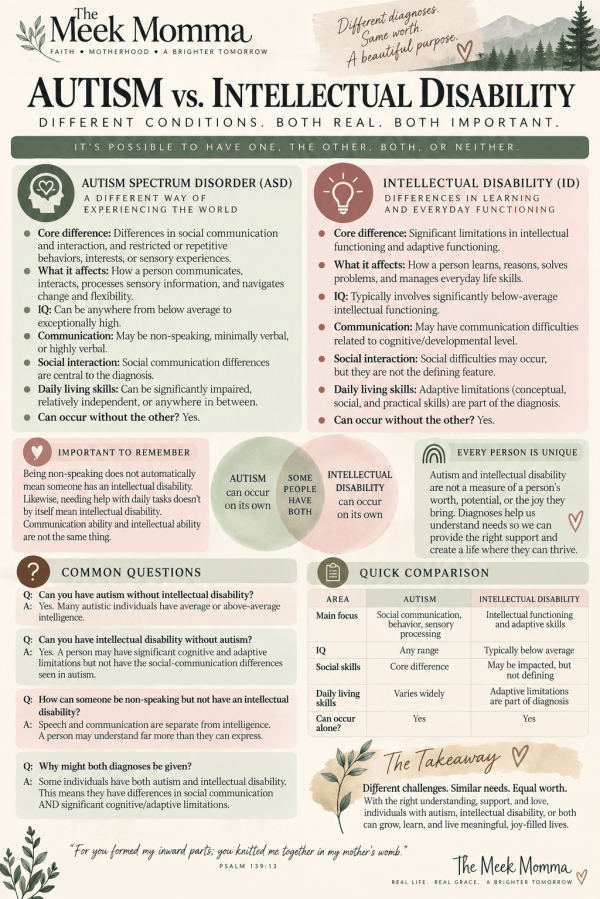
Autism and intellectual disability are not the same thing.

Autism primarily involves differences in social communication and interaction, along with restricted or repetitive behaviors, interests, or sensory experiences.

Intellectual disability involves significant limitations in intellectual functioning and adaptive functioningโ€”things like learning, reasoning, problem-solving, communication, and managing everyday life.

You can have autism without intellectual disability.

You can have intellectual disability without autism.

And you can have both.

And perhaps most importantly:

Communication ability and intellectual ability are not the same thing.

A person can be non-speaking and understand much more than they can communicate. A person can have significant sensory or social challenges and have average or above-average intellectual ability. And a person with intellectual disability may have strengths and abilities that arenโ€™t captured well by a standardized test.

That distinction matters because a diagnosis is supposed to help us understand what support a person needs, not determine their worth or write their future for them.

And this is where my heart has been wrestling.

Jackson is getting older.

He is too big to simply be included with much younger children, but developmentally he may not yet be ready to participate in the same way as many children his age.

Weโ€™ve seen glimpses of this already.

The last two Sundays at church, Jackson tried to engage groups of older boys. He approached them because he wanted to play. But they backed away awkwardly or simply told him, โ€œNo, I donโ€™t want to play with you,โ€ and walked away.

Iโ€™m sure those boys werenโ€™t trying to wound him.

They probably didnโ€™t know what to do.

But I was his mother, standing there watching my child reach for friendship and not quite know how to bridge the gap.

And that hurts.

It makes me think about the spaces Jackson will encounter throughout his life where he may be too old for one group, but not developmentally ready for another.

Where does a child belong when the world has categories for age, but development doesnโ€™t always follow those categories?

Where does he fit when he needs more support than some people realize, but doesnโ€™t fit the picture people have in their minds of someone with a โ€œsevereโ€ disability?

Those are questions Iโ€™m still learning how to answer.

But there is something I want to remind myselfโ€”and perhaps another parent needs to hear it too:

Diagnoses arenโ€™t prophecy.

A diagnosis describes something important about a personโ€™s functioning today.

It can help us understand.

It can help us advocate.

It can help us access accommodations.

It can help us stop blaming a child for something that isnโ€™t simply a matter of trying harder.

But it does not tell me everything about Jacksonโ€™s future.

It doesnโ€™t tell me what relationships he will have.

It doesnโ€™t tell me what he will learn.

It doesnโ€™t tell me what strengths will emerge.

It doesnโ€™t tell me who will love him.

And it certainly doesnโ€™t tell me what God intends to do with his life.

The evaluation may give us information about Jackson that we didnโ€™t have before.

It doesnโ€™t give us a prophecy.

And I am grateful that God knows the whole story when I can only see the next page.

He knows every part of Jacksonโ€”the things the evaluation measured and the things no evaluation could ever measure.

He knows what Jackson understands when he canโ€™t communicate it.

He knows the desires of his heart.

He knows the friendships he will have.

He knows where Jackson will struggle and where he will flourish.

He knows what support Jackson will need.

And He knows the future.

So today, Iโ€™m allowing myself to feel the heaviness.

Iโ€™m also grateful.

Grateful that we have more information.

Grateful that we can better understand how Jackson learns and functions.

Grateful that there were no additional diagnoses, including ADHD.

Grateful that his evaluation did not paint the severe picture my fearful heart sometimes imagines.

And grateful that a diagnosis gives us another tool to advocate for our son.

Most of all, Iโ€™m reminding myself:

Jackson is not his diagnoses.

He is not a score.

He is not a developmental age.

He is not a list of limitations.

He is my son.

And he is fearfully and wonderfully made.

โ€œFor you formed my inward parts; you knitted me together in my motherโ€™s womb.โ€
โ€” Psalm 139:13

So we will keep learning.

We will keep advocating.

We will keep making room for him.

We will keep looking for ways to help him communicate, connect, learn, and belong.

And when I canโ€™t see what comes next, I will remind myself:

Nothing about Jackson is a mystery to God.

โ€œThe LORD is my strength and my shield; in him my heart trusts.โ€
โ€” Psalm 28:7

Diagnoses arenโ€™t prophecy.โ€จThey are information.โ€จAnd information can help us build better support for the child God has already entrusted to us.

โ€” The Meek Momma

A Place at the Kingโ€™s Table

What Leviticus 21โ€“22, David, and the Gospel Teach Us About Holiness, Grace, and Belonging


A Note Before We Begin

As I have been studying through Leviticus 21โ€“22, I have found myself slowing down over some passages that can be difficult for modern readers to hear.

The Lord gives Moses instructions concerning the descendants of Aaron who would serve as priests. Among those instructions, we read that a priest with certain physical blemishes or disabilities was not to approach the altar to offer the Lordโ€™s food offerings or go through the veil.

At first glance, these passages can be jarring.

And because of that, I think we need to slow down and let the text say what it actually says rather than allowing our first reaction to determine what we believe it means.

Leviticus 21 is not teaching that a person with a disability is less valuable, less loved, or somehow unacceptable to God.

The restriction concerns the priestly function of approaching the altar and performing particular sacred duties.

In fact, there is a detail in this passage that is easy to miss.

The priest who had a physical blemish was still permitted to eat the bread of his God, both the most holy and the holy things (Leviticus 21:22).

He was restricted from performing a particular priestly function.

He was not cast away from Godโ€™s provision – This to me reveals the heart of our God.

The priesthood and sacrificial system communicated through visible, tangible realities. The sacrifices were to be without blemish. The priests who approached the altar were given corresponding physical qualifications. These requirements belonged to the symbolic language of Israelโ€™s worship and helped communicate the holiness, completeness, and sacredness of the work being performed.

The priesthood was pointing beyond itself.

Hebrews tells us that Jesus is our perfect High Priest:

โ€œHoly, innocent, unstained, separated from sinners, and exalted above the heavens.โ€
โ€” Hebrews 7:26

What Israelโ€™s priesthood could only imperfectly portray, Christ fulfills completely.

And yet, as I sat with these passages, I kept thinking about someone else.

Mephibosheth.

And that is where this study took me next.


A Man Who Was Far Off

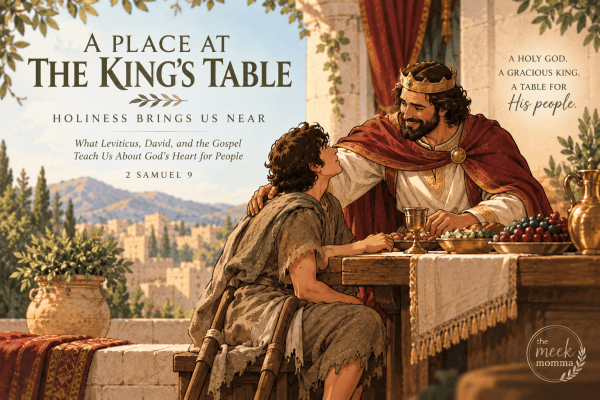
Mephibosheth was the son of Jonathan and the grandson of Saul.

When he was five years old, news came that Saul and Jonathan had died in battle. His nurse picked him up and fled, but in the process he fell and became disabled in both feet (2 Samuel 4:4).

Years later, David became king.

And David did something unexpected.

He asked:

โ€œIs there still anyone left of the house of Saul, that I may show him kindness for Jonathanโ€™s sake?โ€
โ€” 2 Samuel 9:1

Eventually David learns about Mephibosheth.

And Mephibosheth is brought before the king.

Imagine what that must have felt like.

He was the grandson of Saul, the former king. His father, Jonathan, was dead. His grandfather was dead. He was living in Lo-debar, far from the center of the kingdom.

And now he was being summoned into the presence of David.

He falls on his face.

David tells him not to be afraid.

Then David gives him something he could never have secured for himself:

his inheritance.

David restores to Mephibosheth all the land that had belonged to Saul.

But David doesnโ€™t stop there.

He says:

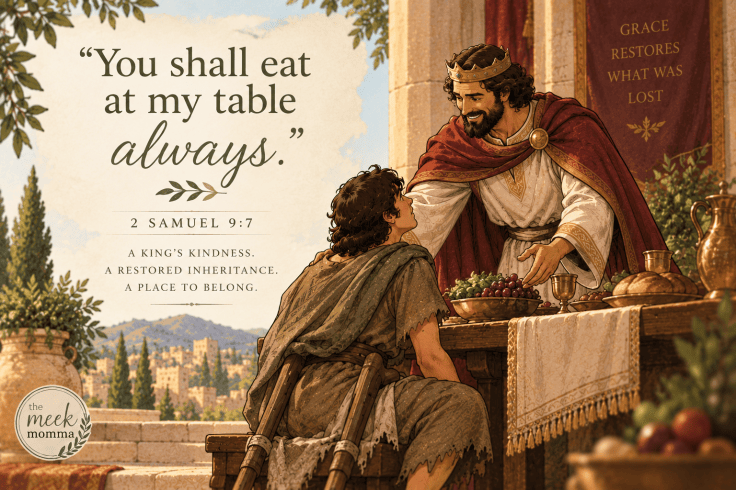
โ€œYou shall eat at my table always.โ€
โ€” 2 Samuel 9:7

And the text repeats the picture:

โ€œSo Mephibosheth ate at Davidโ€™s table, like one of the kingโ€™s sons.โ€
โ€” 2 Samuel 9:11

That is the part that stopped me.

Because Mephibosheth did not walk into the kingโ€™s presence because he had made himself worthy.

He didnโ€™t restore his own inheritance.

He didnโ€™t earn his invitation.

He didnโ€™t change the condition of his feet before he was welcomed.

The king extended kindness to him.


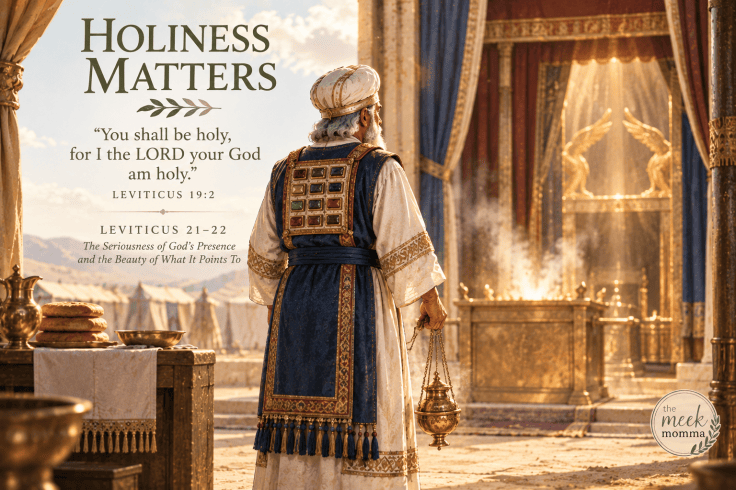
Holiness Matters

At this point, it would be easy to make the story of Mephibosheth into a simple illustration about acceptance. However, Leviticus is teaching us something we desperately need to remember:

Holiness matters.

God is holy.

His presence is holy.

His worship is holy.

His sacrifices are holy.

His priesthood is holy.

And approaching Him is not something to be treated casually.

Leviticus 21โ€“22 reminds Israel that the things associated with Godโ€™s presence were not ordinary things.

The priests were not ordinary representatives.

The sacrifices were not ordinary meals.

The altar was not an ordinary place.

God was teaching His people through physical realities that He is holy.

And that holiness ultimately points us toward Christ.

The priests of Israel were not the final answer.

The sacrifices were not the final answer.

The earthly tabernacle was not the final answer.

They were shadows and signs pointing forward to the One who would perfectly fulfill what they could only portray.

Jesus is the spotless sacrifice.

Jesus is the perfect High Priest.

Jesus is holy, undefiled, and without sin.

And because of Him, something extraordinary happens.


From Far Off to Near

Paul writes to the Ephesians:

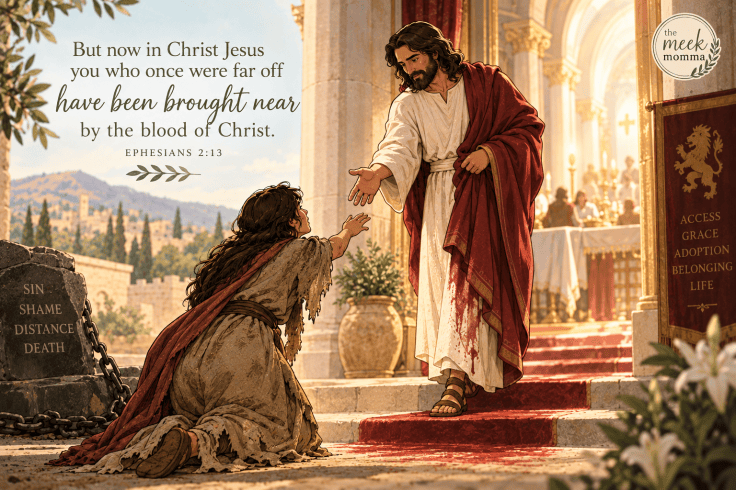
โ€œBut now in Christ Jesus you who once were far off have been brought near by the blood of Christ.โ€
โ€” Ephesians 2:13

There it is.

Far off.

Brought near.

That language ignites a fire within me as I reflect on the profound movement we’ve witnessed throughout Scripture!

Genesis introduces the problem.

Exodus establishes Godโ€™s presence among His people.

Leviticus teaches Israel how to live in the presence of a holy God.

And then, throughout the rest of Scripture, we begin to see Godโ€™s redemptive plan unfold until we arrive at Christ.

The God who dwells among His people makes a way for sinners to draw near.

Not because we have made ourselves clean.

Not because we have made ourselves worthy.

Not because we have repaired everything that is broken.

But because Christ has made a way.

Paul says that those who were once far off have been brought near by the blood of Christ.

That is not sentimental language.

It is sacrificial language.

It takes us right back to the world of Leviticus.

Blood mattered because life mattered.

Sacrifice mattered because sin mattered.

Holiness mattered because God Himself is holy.

And all of those things ultimately point us toward Jesus.


A King Who Welcomes the Unworthy

This is where I think 2 Samuel 9 becomes such a beautiful companion to what we are seeing in Leviticus.

I donโ€™t mean that Mephibosheth is a direct prophecy of Jesus.

Scripture doesnโ€™t tell us to read the story that way.

And I donโ€™t want to force a connection simply because it makes for a beautiful illustration.

But Scripture does allow us to trace themes.

And one of those themes is gracious welcome.

Mephibosheth comes before the king knowing he has nothing to offer.

At one point he even describes himself as a โ€œdead dogโ€ (2 Samuel 9:8).

Yet David restores what was lost and gives him a permanent place at his table.

There is something profoundly beautiful about that picture.

The kingโ€™s kindness creates belonging.

And that makes me think again about the difficult passage in Leviticus.

The priest with a physical blemish was not worthless.

He was not beyond Godโ€™s provision.

He was still permitted to eat the holy things.

His restriction concerned his priestly function.

And Mephiboshethโ€™s disability did not prevent him from being welcomed to the kingโ€™s table.

These truths belong together.

Holiness does not mean that people with disabilities are less valuable.

And grace does not mean that holiness doesnโ€™t matter.

Both are true.

God is holy.

And God is gracious.


The Table

There is something about a table that communicates belonging.

To eat at someoneโ€™s table is to be welcomed.

To have a place at the table is to belong.

And David doesnโ€™t merely tell Mephibosheth that he may visit.

He says:

โ€œYou shall eat at my table always.โ€

And the narrator emphasizes it again:

โ€œLike one of the kingโ€™s sons.โ€

Mephiboshethโ€™s identity at the table was no longer defined by what he had lost.

He was defined by the kindness that had been extended to him.

And this is where my thoughts eventually move from David to Christ.

Because the gospel tells us that we, too, were once far off.

We were separated from God.

We could not make ourselves worthy of His presence.

We could not repair the breach ourselves.

But God did what we could not do.

Christ brought us near.


A Better High Priest

Leviticus teaches us to take holiness seriously.

Hebrews teaches us why.

The priests of Israel were imperfect.

Their sacrifices had to be repeated.

Their service was temporary.

But Jesus is different.

He is the perfect High Priest.

He does not need to offer sacrifice for His own sin.

He does not need to repeat His sacrifice.

He does not enter an earthly sanctuary that will eventually pass away.

He enters the true presence of God on our behalf.

And His sacrifice is sufficient.

The spotless Lamb became the sacrifice.

The perfect High Priest offered Himself.

And through His blood, those who were far off are brought near.

That changes everything.


From the Kingโ€™s Table to the Great Banquet

The Bible begins with humanity separated from God because of sin.

But Scripture doesnโ€™t end there.

It ends with Godโ€™s people dwelling with Him.

And the language of Scripture eventually brings us to another table.

A greater banquet.

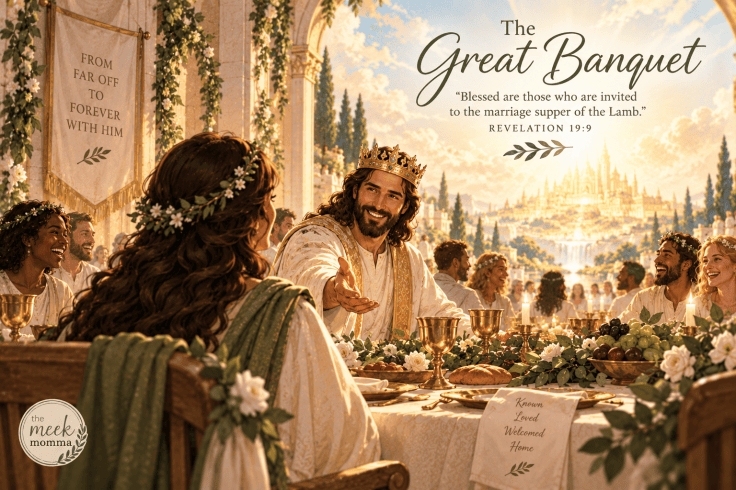
Revelation 19:9 says:

โ€œBlessed are those who are invited to the marriage supper of the Lamb.โ€

The invitation is not something we earned.

It is grace.

The table is not something we built.

The King prepared it.

And the One who makes our invitation possible is the Lamb who was slain.

This is why I donโ€™t want to rush past the difficult passages in Leviticus.

They teach us something precious.

Godโ€™s holiness is not a small thing.

His presence is not casual.

Sin is not insignificant.

Sacrifice is not meaningless.

The Scriptures are the story of a holy God making a way to bring His people near.


Come Near

Maybe that is the question I am left with after studying these passages:

Do I really understand what it means that I have been brought near?

We can become so familiar with the language of Christianity that we forget how astonishing it is.

I was far off.

You were far off.

And Christ brought us near.

Not through our goodness.

Not through our religious performance.

Not through our ability to make ourselves whole.

By His blood.

That is grace.

And perhaps this is part of what makes the story of Mephibosheth so beautiful.

He didnโ€™t have to become worthy of the table before he could sit at it.

The kingโ€™s kindness gave him a place.

And while Davidโ€™s table was only a small picture within the larger story of Scripture, it gives us a glimpse of something wonderful:

There is a King who welcomes the undeserving.

There is a King who restores what was lost.

There is a King who brings the far-off near.

And there is a King who has prepared a table that will never end.

So let us not diminish holiness.

Let us not minimize sin.

Let us not make the cross small.

Instead, let the holiness of God make the grace of God even more astonishing.

Because the greater our understanding of Godโ€™s holiness, the greater our wonder should be that He has made a way for us to come near.

And one day, by the grace of Christ, we will see the fulfillment of it all.
Not merely a place at an earthly kingโ€™s table.

But a place at the marriage supper of the Lamb.

Come hungry.

The King has made a place.

Learning to Run Toward Christ When Life Is Hard

Philippians 3:12โ€“16

This morning, I found myself especially grateful for Paulโ€™s honesty.

In Philippians 3:12, he says:

โ€œNot that I have already obtained this or am already perfectโ€ฆโ€

Paul admits that he hasnโ€™t arrived.

I donโ€™t know about you, but I find that incredibly encouraging.

Sometimes we can think that following Jesus means we should eventually have everything figured out. That if weโ€™ve been Christians long enough, we should be past the struggle, past the weakness, past the areas where God is still working on us.

But Paul, one of the greatest apostles who ever lived, says essentially, Iโ€™m not there yet.

Neither am I.

When we come to Christ, we receive salvation by grace. But salvation isnโ€™t the end of our journey; itโ€™s the beginning of a lifelong process of becoming more like Christ.

We strive toward holiness, not salvation.

We arenโ€™t working so that Christ will choose us. We pursue Him because He has already made us His own.

Paul uses the Greek word teleios (ฯ„ฮญฮปฮตฮนฮฟฯ‚) for โ€œperfectโ€ in verse 12. The word can mean complete, mature, or brought toward an intended goal.

Then Paul uses that same word again in verse 15:

โ€œLet those of us who are mature think this wayโ€ฆโ€

Thereโ€™s something wonderfully humbling about that.

One mark of Christian maturity is recognizing that we havenโ€™t arrived.

There is still more of Christ to know, more holiness to pursue, more sin to put to death, and more grace to receive.

Paulโ€™s confidence isnโ€™t in how far he has come.

His confidence is in Christ, who has already taken hold of him.

Paul continues:

โ€œBut one thing I do: forgetting what lies behind and straining forward to what lies aheadโ€ฆโ€

Paul had a lot behind him.

He had religious credentials, accomplishments, zeal, suffering, and failures. Earlier in this chapter, he lays out his impressive Jewish rรฉsumรฉ and then calls it loss compared with the surpassing worth of knowing Christ.

He refused to allow either his accomplishments or his failures to become the place where he lived.

Sometimes what lies behind us is shame. Sometimes itโ€™s grief. Sometimes itโ€™s success. Sometimes itโ€™s the version of ourselves we wish we could get back. And sometimes itโ€™s simply everything weโ€™ve already carried.

Paul doesnโ€™t pretend the past didnโ€™t happen.

He simply refuses to let it determine the direction heโ€™s going.

His eyes are forward.

The Greek word Paul uses for โ€œstraining forwardโ€ gives us the picture of a runner stretching toward the finish line.

William Barclay describes it as a racer going hard for the finishing line, with his eyes fixed on the goal.

Paul says:

โ€œI press on toward the goal for the prize of the upward call of God in Christ Jesus.โ€

The prize is not simply getting through our present circumstances.

The prize is Christ and the fullness of life with Him.

Scripture gives us glimpses of what awaits us: an imperishable inheritance, the kingdom prepared for Godโ€™s people, and the day when death, mourning, crying, and pain will be no more.

That is where weโ€™re headed.

And knowing where weโ€™re going changes how we walk through where we are.

This Week Has Felt Heavy

This passage felt especially personal to me this morning because this last week has been a lot.

I lost a dear friend who leaves children behind, and my heart has been breaking for them.

I spent part of the week walking through an incredibly difficult trial connected to one of the children I advocate for.

Then my mom ended up in the emergency room, and Iโ€™ve needed to stay close by, helping with medications and keeping an eye on things while also continuing to care for everything at home.

And life at home hasnโ€™t exactly slowed down.

For my son, difficult events often show up later through increased anxiety and a greater need for control. After the hospital visit, weโ€™ve been navigating some of those things tooโ€”difficulty focusing, increased activity, changes in eating, and struggles around routines.

Itโ€™s been a full week.

And honestly, Iโ€™m tired.

Iโ€™m someone who can usually carry a lot. But there is a difference between being strong and being exhausted.

This week has reminded me that Iโ€™m not perfect. Iโ€™m still being sanctified, and Iโ€™m still learning what it means to trust Christ in difficult places.

Thatโ€™s one reason Paulโ€™s words meant so much to me this morning.

He doesnโ€™t tell us that mature Christians never struggle. He shows us what it looks like to remain focused on Christ while we are still struggling.

One thing that has kept me anchored through this week is simply getting up and opening my Bible.

Not because every morning has felt profound. Sometimes it has simply been obedience. Sometimes it has been the only quiet moment I could find.

But I keep coming back because I know where my strength comes from.

โ€œThe joy of the Lord is your strengthโ€ (Nehemiah 8:10).

My circumstances arenโ€™t necessarily joyful right now.

But Christ is still faithful.

And that gives me a hope the world cannot offer.

We donโ€™t suffer as people who have no hope.

We grieve, but not without hope.

We hurt, but not without Christ.

We become exhausted, but we are not abandoned.

Iโ€™ve found myself thinking often this week about the words at the end of Revelation:

โ€œSurely I am coming soon.โ€

And Johnโ€™s response:

โ€œAmen. Come, Lord Jesus!โ€

There are days when I understand that prayer more deeply than others.

I long for the day when there will be no more tears, no more pain, no more death, and no more brokenness.

But until that day comes, I want to be found faithful.

Paul says in Philippians 4:11:

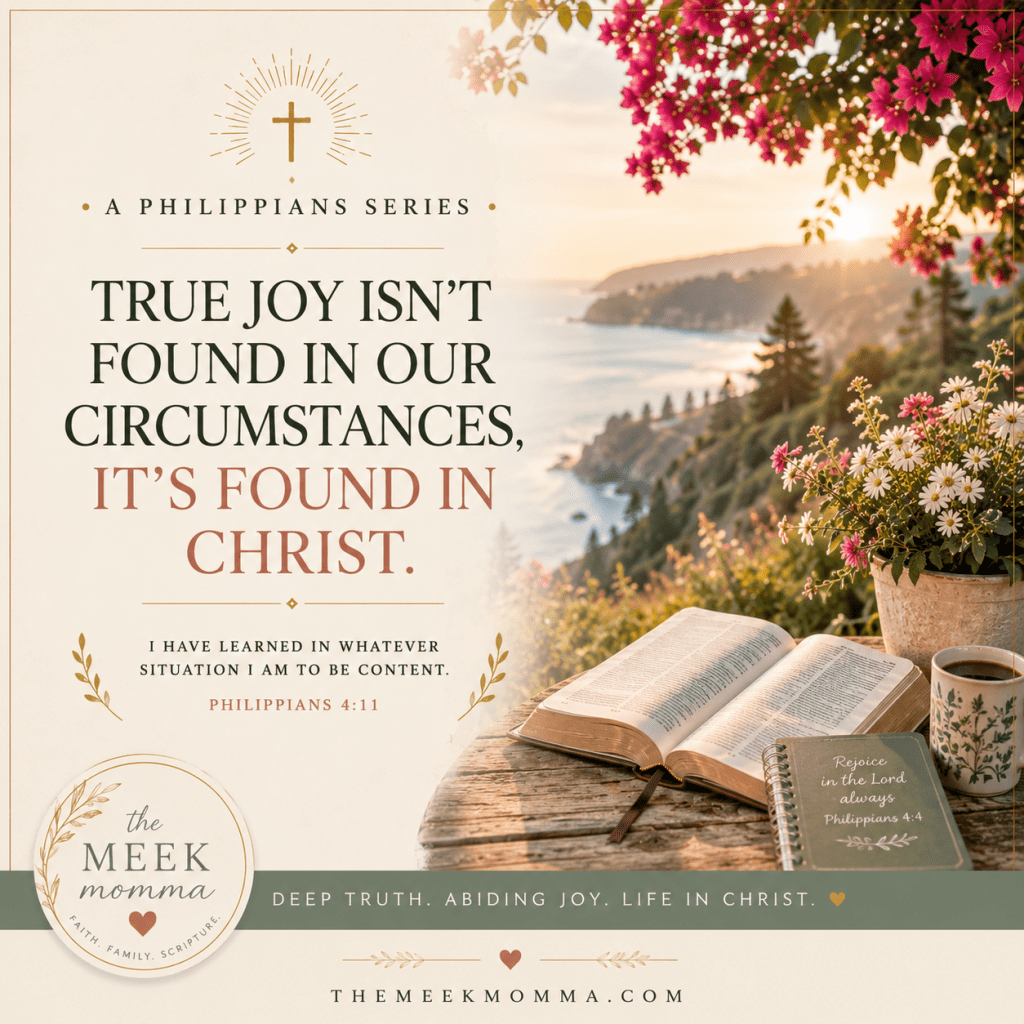
โ€œI have learned in whatever situation I am to be content.โ€

I love that word: learned.

Contentment wasnโ€™t something Paul simply possessed.

He learned it.

And Iโ€™m still learning it tooโ€ฆ

Maybe thatโ€™s why Philippians 3 has been so timely for me.

Paulโ€™s identity wasnโ€™t ultimately defined by his accomplishments, his suffering, his failures, or his circumstances.

His identity was rooted in Christ. And mine is too.

Who I am isnโ€™t ultimately determined by what has happened to me.

It isnโ€™t determined by what I accomplish or by the season Iโ€™m walking through.

Who I am is based on whose I am.

I belong to Christ.

And because I belong to Christ, I can face the next thing in front of me without having to pretend that Iโ€™m strong enough for all of it.

Paul doesnโ€™t tell us to press on because weโ€™re strong. He tells us to press on because Christ has already made us His own.

We arenโ€™t running to prove ourselves worthy or to earn salvation. Weโ€™re running toward the One who pursued us first.

So when the road feels heavy, we fix our eyes on Christ.

When the past tries to define us, we look ahead.

When suffering exhausts us, we remember the prize.

We havenโ€™t arrived.

But Christ has made us His own, and He will bring us safely to the goal.

One day, the race will be finished.

The tears will be gone.

The suffering will be over.

And we will finally see the One toward whom we have been running all along.

Until then, Iโ€™m pressing on toward Christ.

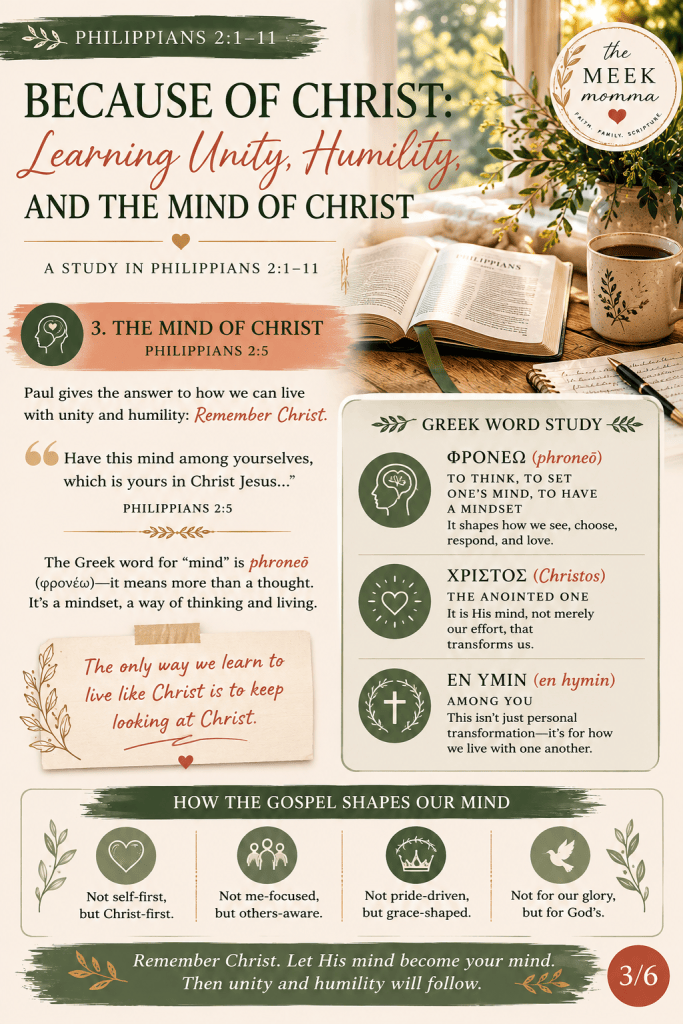
Because of Christ: Learning Unity and Humility

Philippians 2:1โ€“11

What does it look like to live a life worthy of the gospel?

In Philippians 1:27, Paul calls the church to live in a way worthy of Christ. As we enter chapter 2, he begins to show us what that looks like in our relationships with one another.

Philippians 2:1โ€“4 gives us the foundation: because of what we have received from Christ, we can learn to live with greater unity and humility. Then, in verses 5โ€“11, Paul points us to Christ Himself as the perfect example.

Because Christ Has Changed Us

Paul begins:

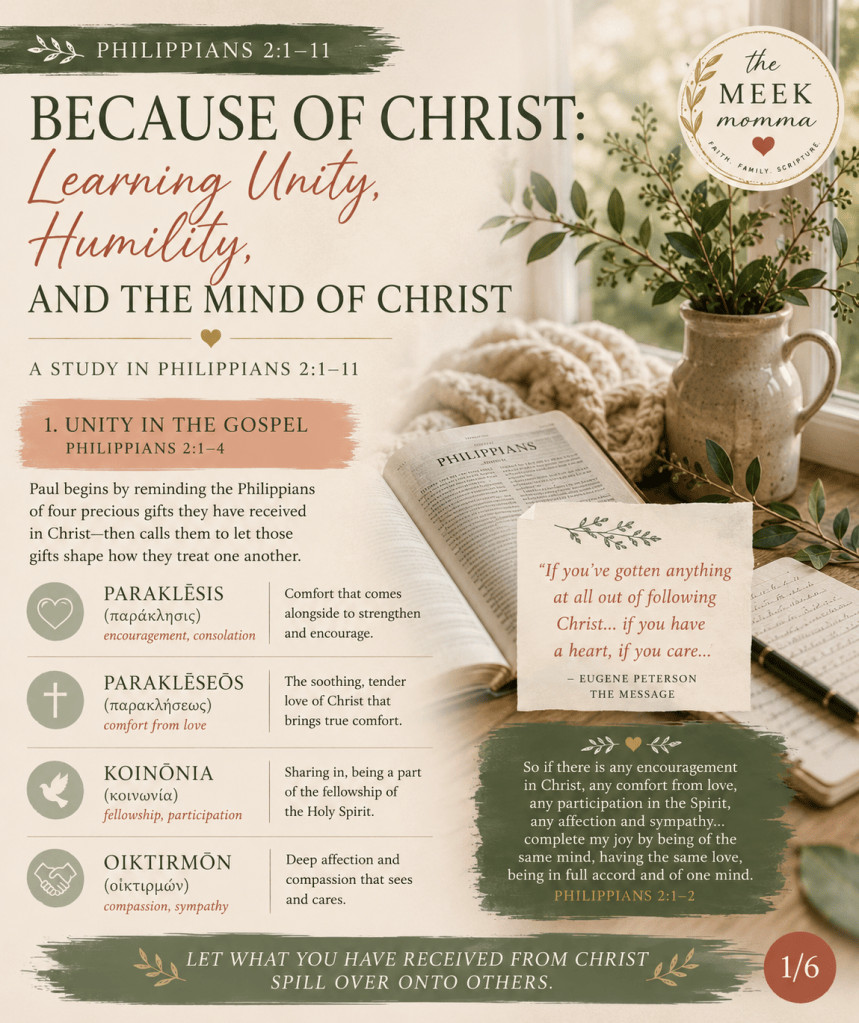
โ€œSo if there is any encouragement in Christ, any comfort from love, any participation in the Spirit, any affection and sympathyโ€ฆโ€

The word if here is not expressing doubt. Paul is essentially saying, โ€œSince these things are trueโ€ฆโ€

Since you have experienced encouragement in Christ, comfort from His love, fellowship in the Spirit, and His compassion, let those things shape the way you treat other people.

Eugene Peterson paraphrases the thought in The Message: โ€œIf youโ€™ve gotten anything at all out of following Christ, if his love has made any difference in your life, being in a community of the Spirit means anything to you, if you have a heart, if you careโ€ฆโ€

I love the simplicity of that. Paul isnโ€™t asking the Philippians to manufacture unity and humility on their own. He is reminding them of what they have already received.

We have been loved, so we learn to love. We have been shown grace, so we extend grace. Christ has served us, so we learn to serve others.

That is the motivation behind Paulโ€™s instruction.

Unity Without Sameness

Paulโ€™s desire is that the Philippians would be โ€œof the same mind, having the same love, being in full accord and of one mind.โ€

This does not mean they must all be identical. G. W. Hansen explains that Paul is not squelching human creativity or prohibiting personal diversity; he is calling believers to seek the same goal with a like mind.

Christian unity does not require uniformity. We can have different personalities, gifts, backgrounds, and perspectives while still being united around Christ and the gospel.

Revelation 7:9โ€“10 gives us a beautiful picture of this: people from every nation, tribe, people, and language worshiping together before the throne. They are wonderfully diverse, but their worship is centered on the same Lord.

Paul wants the Philippians to share the same gospel-centered purpose, and he knows that humility is essential to maintaining that unity.

The Humility That Protects Unity

Paul continues:

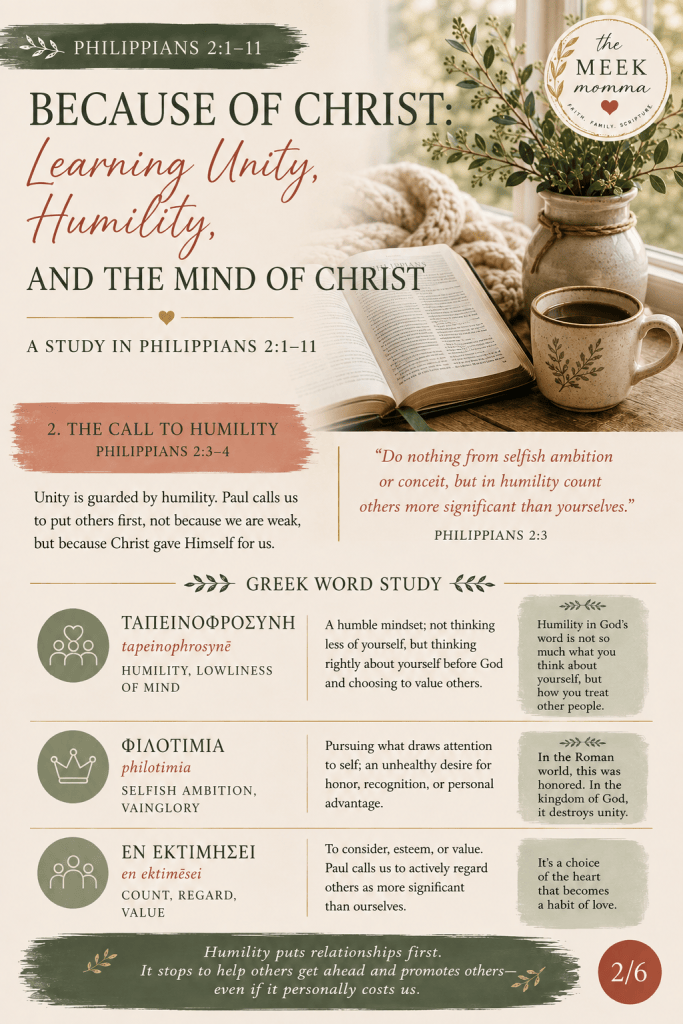
โ€œDo nothing from selfish ambition or conceit, but in humility count others more significant than yourselves.โ€

This is where Paulโ€™s teaching becomes very practical. Unity is difficult when we are primarily concerned with ourselvesโ€”our preferences, our recognition, our comfort, our rights, or our desire to be right.

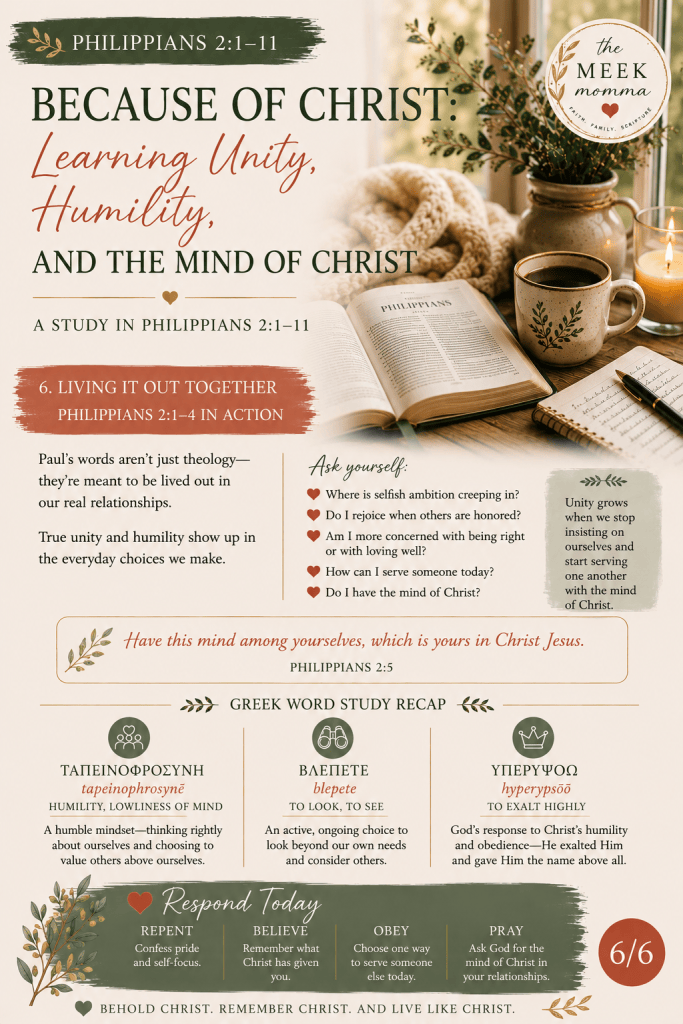
The Greek word translated humility is tapeinophrosynฤ“ (ฯ„ฮฑฯ€ฮตฮนฮฝฮฟฯ†ฯฮฟฯƒฯฮฝฮท), carrying the idea of lowliness of mind or a humble disposition.

Biblical humility does not mean believing that we have no value. It means learning to think rightly about ourselves before God and allowing that right understanding to change how we treat others.

Humility makes room for another person. It is willing to listen, serve, yield a preference, celebrate someone elseโ€™s success, or use what God has given us for another personโ€™s good.

That would have sounded radically different in the ancient world. Humility was not generally admired as a virtue; it was associated with low status and weakness. Yet Christianity placed humility near the center of Christian character because our Savior Himself chose the path of humility.

Pastor Dan Hamel summarizes Paulโ€™s logic well: in order for the Philippians to live a life worthy of the gospel, they must be united; and in order for them to be united, they must treat one another better than they treat themselves.
Gospel-shaped living produces gospel-shaped relationships.

Looking to the Interests of Others

Paul makes the application even clearer:

โ€œLet each of you look not only to his own interests, but also to the interests of others.โ€

I think the word also is important. Paul isnโ€™t telling us that our own needs donโ€™t matter. He is telling us that they cannot be the only needs we see.

This is where Philippians 2 meets ordinary lifeโ€”in marriage, parenting, friendship, church, work, and family. Humility becomes visible when our preferences are challenged and we have an opportunity to choose between self-interest and self-giving love.

Where might I need to listen instead of insist? Where might I need to yield? Whose needs have I overlooked because I have been too focused on my own?

At this point, Paulโ€™s instructions could feel almost impossible. Unity. Humility. Considering others more significant than ourselves. Looking to their interests.

How do sinful and self-protective people actually live this way?

Paul doesnโ€™t tell us to try harder.

He says:

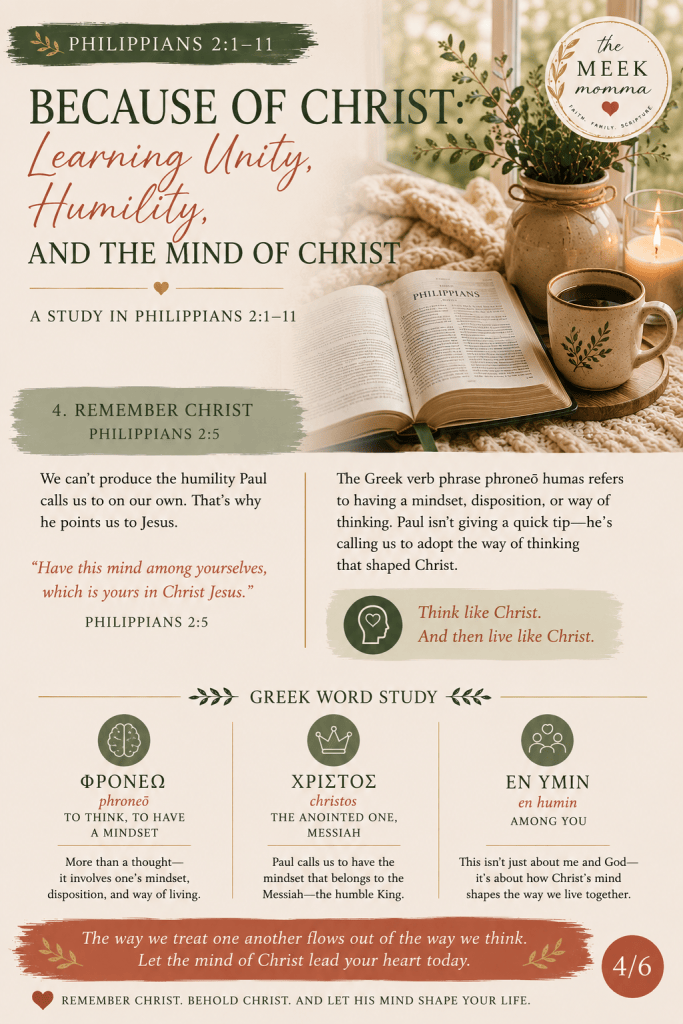
โ€œHave this mind among yourselves, which is yours in Christ Jesusโ€ฆโ€

And now Paul takes our eyes off ourselves and puts them on Christ.

Behold Christ

Philippians 2:5โ€“11 is one of the most profound Christological passages in the New Testament. Paul has just told us to consider others more significant than ourselves, and then he shows us the One who did this perfectly.

William Barclay described this as one of the greatest and most moving passages Paul ever wrote about Jesus.

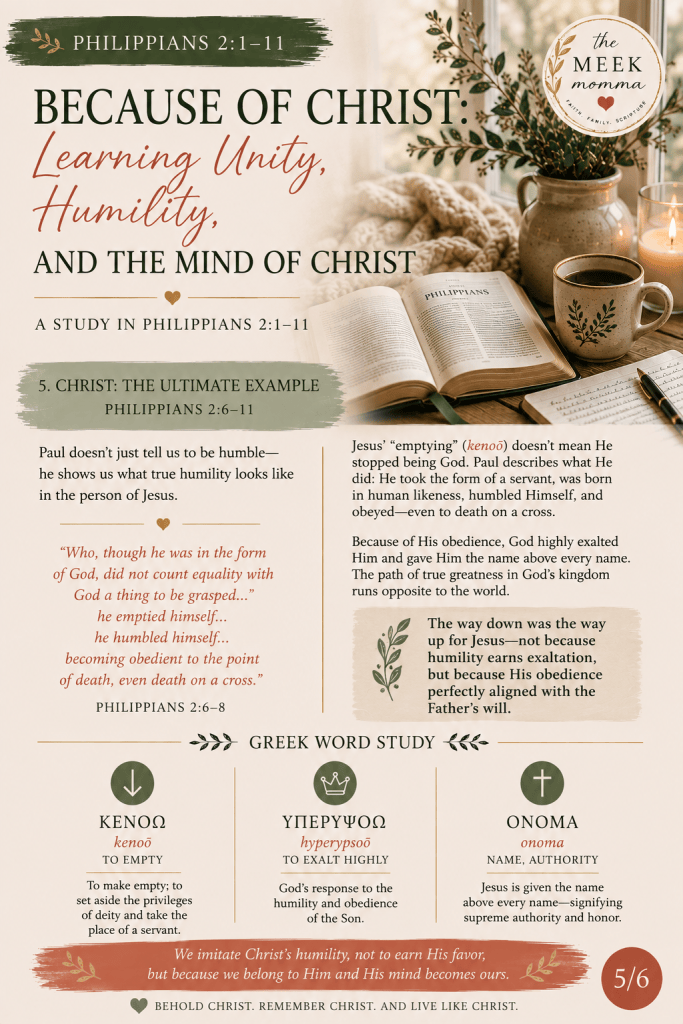
Christ, who existed in the form of God, humbled Himself. He took the form of a servant, became obedient, and went all the way to deathโ€”even death on a cross.

This is essential to understanding Christian humility. Paul is not simply giving us a moral example and saying, โ€œBe nicer.โ€ He is showing us the mindset of our Savior.

And when Paul says Christ โ€œemptied himself,โ€ we should not understand this to mean that Jesus stopped being God or surrendered His deity. The passage explains His self-emptying through what follows: He took the form of a servant and humbled Himself in obedience.

Christโ€™s humility was not a denial of who He was. It was the willing expression of who He was.

โ€œTherefore God has highly exalted himโ€ฆโ€

Christ humbled Himself, and the Father exalted Him.

The point isnโ€™t that humility is a strategy for becoming important. The point is that Christโ€™s obedience was perfectly pleasing to the Father, and He is worthy of our obedience even when that obedience requires us to lay down our own desires.

This brings us back to verse 5:

โ€œHave this mind among yourselves, which is yours in Christ Jesus.โ€

The Greek verb phroneล (ฯ†ฯฮฟฮฝฮญฯ‰) refers not merely to a passing thought, but to a mindset or dispositionโ€”a way of thinking that shapes how we live.

Paul is calling believers to develop a Christ-shaped way of thinking.

Instead of always asking, โ€œWhat do I want?โ€ we begin asking, โ€œHow can I serve?โ€ Instead of being consumed with recognition, we learn to rejoice when someone else is honored. Instead of insisting on our own way, we begin asking what love requires of us.

This is where theology becomes practice. The gospel changes how we see Christ, and seeing Christ changes how we see ourselves and others.

Philippians 2 makes me want to slow down and examine my own relationships.

This is especially worth considering in our homes. Paulโ€™s teaching belongs in our marriages, our parenting, our friendships, and the everyday moments when we have to decide whether our own comfort or another personโ€™s good will have greater weight.

Philippians 2 begins with unity and humility, but Paul doesnโ€™t leave us staring at a command that feels impossible.

He gives us Jesus.

Christ is the pattern for our humility, but He is also the One we are ultimately called to behold. He humbled Himself, became a servant, obeyed the Father, and went to the cross. And the Father exalted Him.

So when humility feels difficult, we donโ€™t simply look harder at ourselves. We look again at Christ.

He is worthy when we donโ€™t get our way. He is worthy when serving costs us. He is worthy when obedience requires us to lay down our own desires.

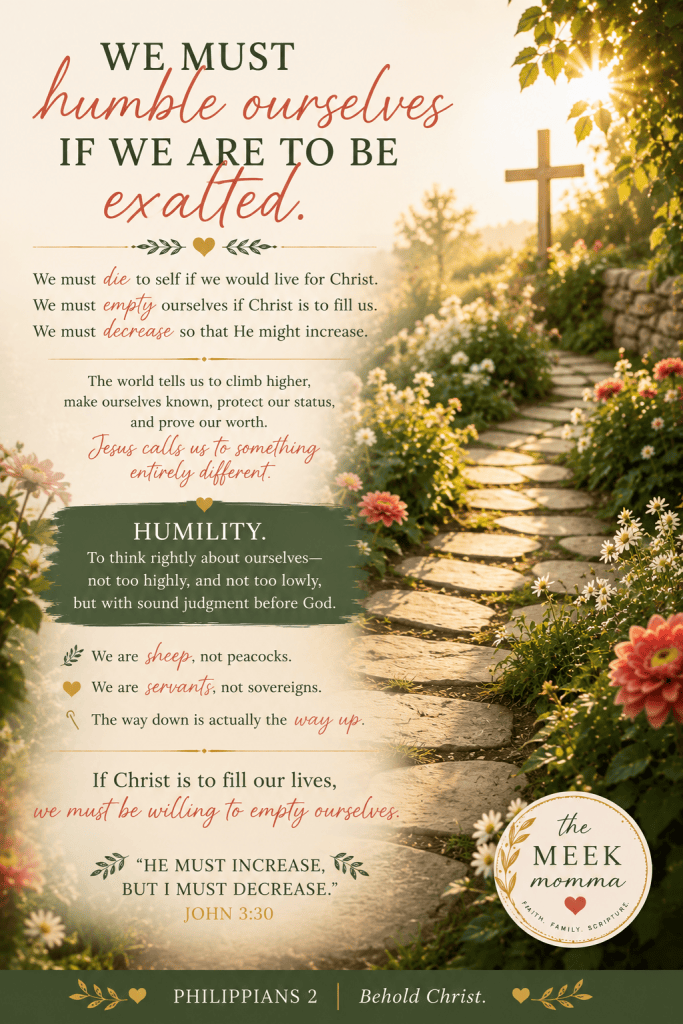
We are sheep, not peacocks. We are servants, not sovereigns. And if Christ is to fill our lives, we must be willing to empty ourselvesโ€”not because we are worthless, but because He is worthy.

The Roots of the Meek Momma

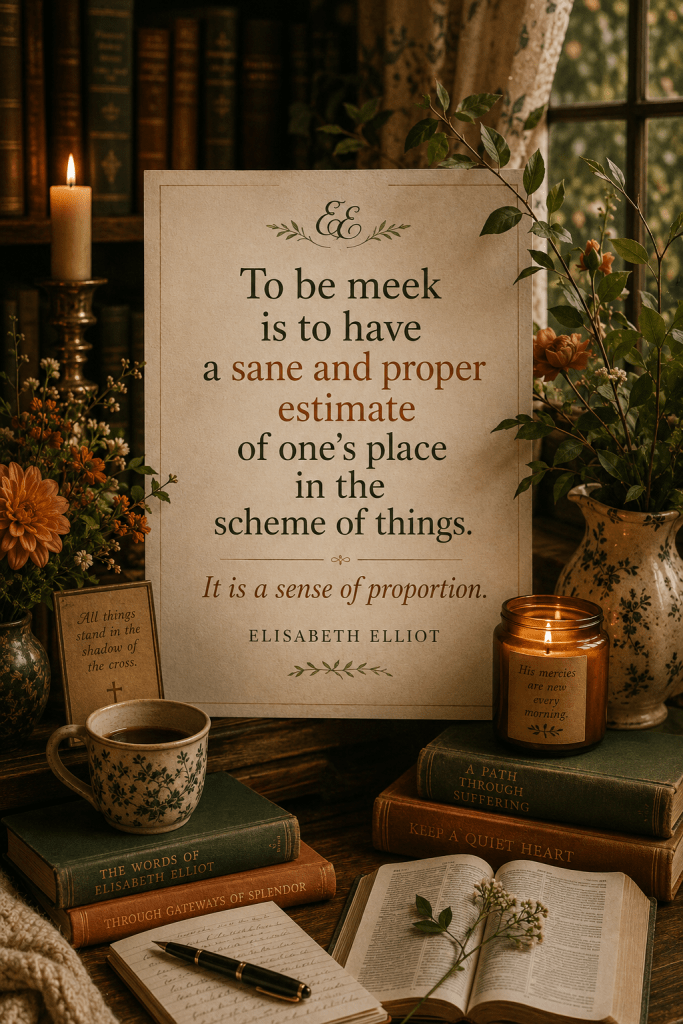
One of my favorite Elisabeth Elliot quotes has always been this:

โ€œTo be meek is to have a sane and proper estimate of oneโ€™s place in the scheme of things. It is a sense of proportion.โ€

Elisabeth Elliot has been something of a spiritual mother to me. I have read her words in many different seasons, and depending on where I was in life, they have felt like correction, a lecture, encouragement, or sometimes simply a soft place to land. There were times I read her words and felt as though I were being lovingly disciplined by an older woman who had walked through suffering and knew something I desperately needed to learn.

One of the things she helped me understand was that meekness is not weakness. It is strength under control. It is having a right understanding of who I am in relation to God: I am the created, and He is the Creator. I am not sovereign, I am not in control of everything, and I donโ€™t have to be.

That realization changed the way I looked at my life, particularly motherhood.

When my son was very young, during the isolation of COVID and the months surrounding his autism diagnosis, his needs and behaviors were becoming increasingly difficult to understand. He was nonverbal at the time, and sleep became almost nonexistent. There were months when I was getting less than ten hours of sleep in an entire week.

Looking back, it is remarkable to me that I was still functioning. I was caring for my son, tending to our home, continuing to work, and trying to learn everything I could about autism while running on almost nothing.

But I know now that it wasnโ€™t because I was strong enough. God was sustaining me.

I remember one particular night, around three in the morning, after two days without sleep. My son woke me by slapping me in the face. He wasnโ€™t being aggressive or disobedient. He was nonverbal and simply trying to wake Mommy because Mommy wasnโ€™t waking up.

For the first few seconds after waking, I had an overwhelming urge to hit him back.

I was angry. I was exhausted. I was completely at the end of myself.

And as painful as it is to admit that, I am grateful for what God showed me in that moment. I saw my flesh in a way I donโ€™t think I ever had before. I saw how quickly my exhaustion could expose the sinfulness of my heart. I saw how desperately I needed a Savior.

Being at the end of myself became an invitation to stop pretending that I could be sufficient for myself.

I began learning to pursue the Lord even when I didnโ€™t feel like pursuing Him. Sometimes all I had to offer was five minutes of Scripture or ten minutes of prayer. Then five minutes became ten, ten became twenty, and eventually those small pieces of time became hours.

Some of my sweetest times with the Lord happened in the middle of the night while my son paced back and forth or watched the same short documentaries over and over again. I would sit with my Bible and pray, asking God to change me and make me the mother my son needed.

And then there were the bathtubs.

For a long time, water was one of the few things that helped my son regulate and feel safe in his body. So I spent a lot of time sitting beside the bathtub. Sometimes for hours. Sometimes more than once a day. Because of the safety concerns, I couldnโ€™t simply leave him there. I had to stay.

I remember lying beside that bathtub and thinking about all the things I was missing out on. Motherhood was supposed to look so different. I had imagined something quieter and more predictable.

But somewhere in those long hours of forced stillness, I began to realize that maybe motherhood hadnโ€™t gone wrong. Maybe this was simply what motherhood needed to look like in that particular season.

And I remember what felt like the quietest conviction from the Lord:

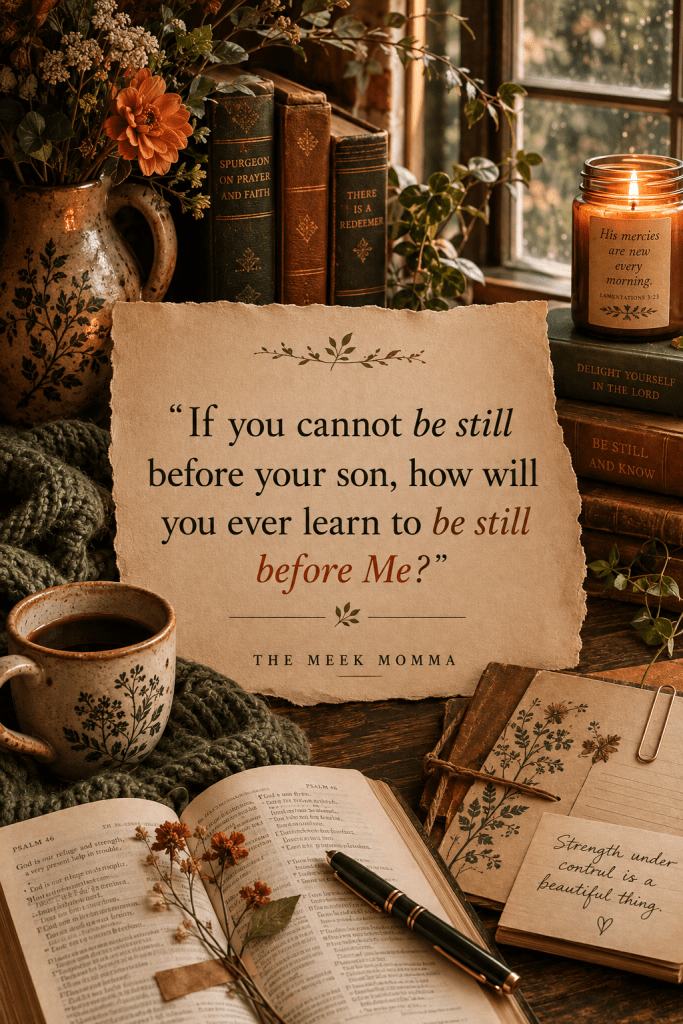
If you cannot be still before your son, how will you ever learn to be still before Me?

Those moments of stillness, along with the long nights of being completely dependent upon Godโ€™s grace, eventually became the beginning of The Meek Momma.

I didnโ€™t start this blog because I had figured motherhood out. I started it because I hadnโ€™t.

I needed somewhere to put the honest emotions, the questions, the Scripture I was wrestling through, and the things God was teaching me. I hoped that perhaps another woman could read those words and find encouragement before she reached the same place of exhaustion and desperation.

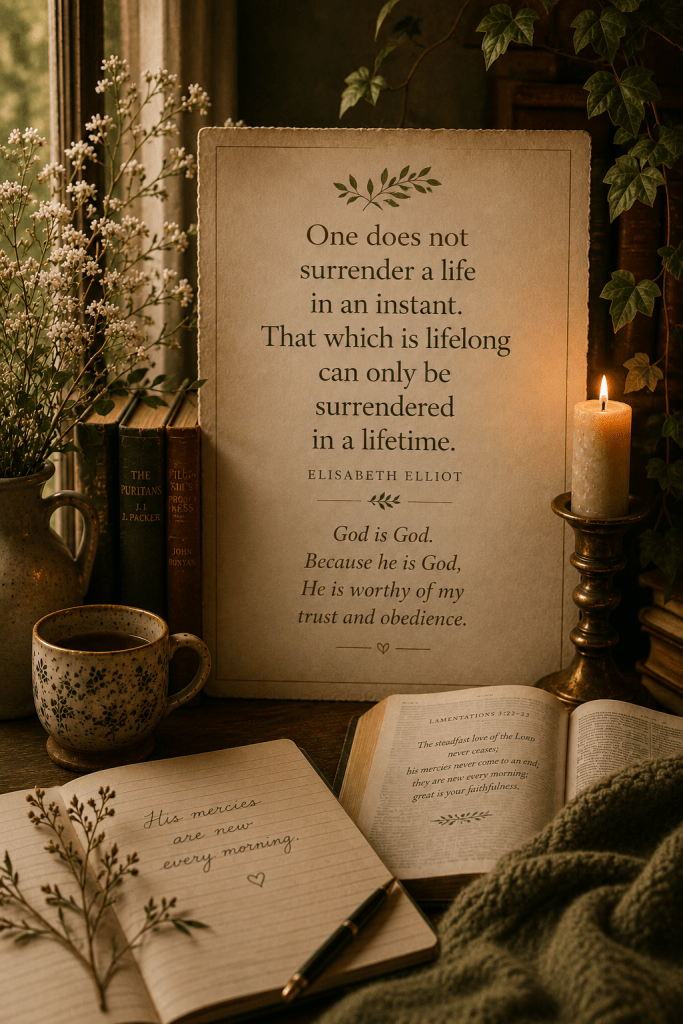
Because the Lord gives us opportunities every day to turn toward Him. His mercies are new every morning.

And I think that is part of what meekness has come to mean to me.

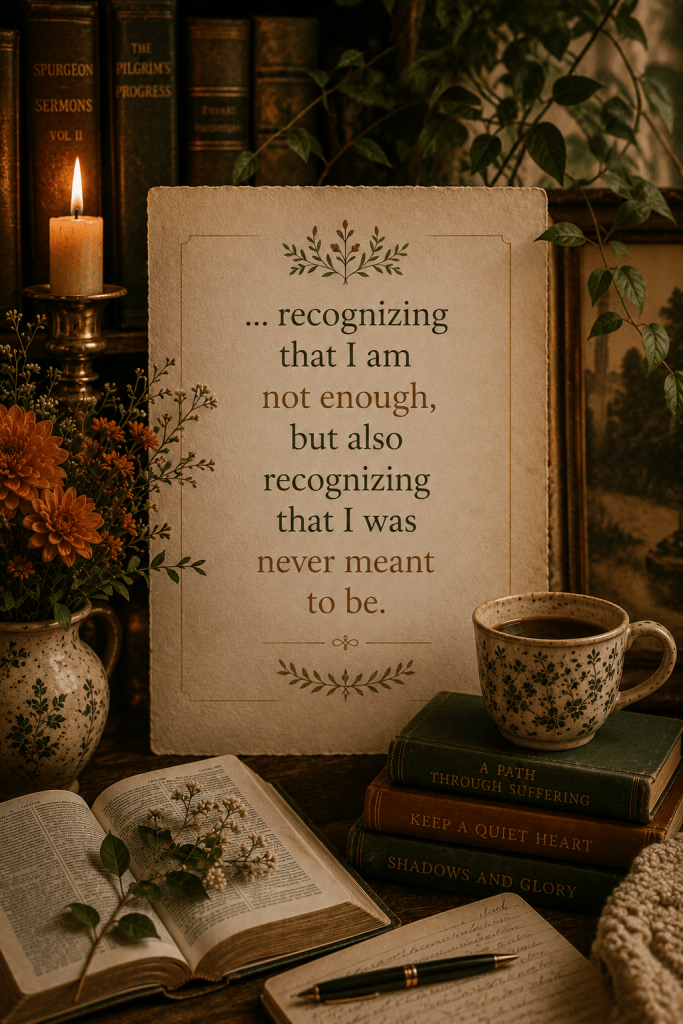
It is recognizing that I am not enough, but also recognizing that I was never meant to be.

It is learning to live within the boundaries of my created place rather than constantly fighting to take Godโ€™s place. It has changed the way I think about my marriage, my motherhood, my work, my leadership, my finances, my service to others, and even the way I respond when I believe I know what should happen next.

It has also changed the way I understand submission.

I believe submission to a husband, rightly understood through Scripture, is a beautiful thing. It does not require a woman to become voiceless, passive, or insignificant. It is not an erasure of strength. Rather, it is one of the places where strength can be brought under control and entrusted to God.

There is something beautiful about a woman who doesnโ€™t have to dominate every room, win every argument, control every outcome, or prove that she is the strongest person present.

There is strength in knowing when to speak and when to be quiet. There is strength in yielding. There is strength in serving. There is strength in trusting Godโ€™s order when our flesh would rather insist on our own.

That is why I love this definition of meekness so much.

A sane and proper estimate of my place in the scheme of things.

Not thinking too highly of myself, but not thinking too little of myself either. Simply understanding that I am Godโ€™s creation, He is my Creator, and my life makes the most sense when I live within that reality.

I am still learning this.

I am learning it in my home, in my marriage, in my work, in the courtroom, in leadership, and in the way I serve families and volunteers. I still wrestle with my desire to control. I still have moments when my flesh gets the better of me. But now I know where to take those things.

Back to Him.

Elisabeth Elliot taught me that suffering is never for nothing. She helped me understand that all things stand in the shadow of the cross, and that when I keep my eyes there, I can begin to count even the hardest things as joyโ€”not because suffering is enjoyable, but because God is faithful to use even what I would never have chosen.

This is why I chose the name The Meek Momma all those years ago.

Not because I had mastered meekness.

Because I needed to learn it.

And, by Godโ€™s grace, I am still learning.

Come Study With Me 2: Notes from Leviticus

Notes on the Sacrificial System

Sacrifice of some kind was a nearly universal practice among ancient peoples. Israelโ€™s sacrificial system shared certain similarities with the practices of surrounding nations, but it was also distinctly different in several important ways.

1. Israelโ€™s Absolute Monotheism

Israel worshiped one true God, Yahweh. The sacrificial system was not created by Israel as a means of manipulating multiple competing gods. God Himself gave Israel specific instructions for worship and sacrifice as part of His covenant relationship with them.

2. Sacrifice Was Connected to Holiness, Ethics, and Obedience

Israelโ€™s worship was rooted in the character of God Himself. Because God is absolutely holy, His people were called to holiness.

The sacrificial system was therefore connected to sin, repentance, atonement, forgiveness, and obedience to Godโ€™s covenant commands. Sacrifice was never intended to replace faithful obedience.

โ€œYou shall be holy, for I the LORD your God am holy.โ€
โ€” Leviticus 19:2

The prophets repeatedly reinforce this truth: God does not delight in ritual performed apart from righteousness and obedience (1 Samuel 15:22; Isaiah 1:11โ€“17; Hosea 6:6; Micah 6:6โ€“8).

3. Israel Was Forbidden to Incorporate Magic and Occult Practices

Israelโ€™s worship was not to be blended with the religious practices of the surrounding nations. God explicitly prohibited magic, sorcery, divination, necromancy, and related practices (Leviticus 19:26, 31; 20:6; Deuteronomy 18:9โ€“14).

Biblical sacrifice was never magic. It was not a technique for manipulating God or forcing Him to provide a desired outcome.

4. Israelโ€™s Sacrificial System Had a High Moral Character

The biblical sacrificial system was fundamentally different from fertility religions and other surrounding practices. Israel was prohibited from incorporating ritual prostitution, sexual immorality, occult practices, and human sacrifice into its worship (Leviticus 18:21; Deuteronomy 18:9โ€“14).

Israelโ€™s worship was to reflect the holiness of the God they worshiped.


Sacrifice Before Sinai

Sacrifice did not begin with the Mosaic covenant.

Long before Leviticus, Scripture records people offering sacrifices to God:

  • Cain and Abel โ€” Genesis 4:3โ€“5
  • Noah โ€” Genesis 8:20โ€“22
  • Abraham โ€” Genesis 12:7โ€“8 and following
  • Job โ€” Job 1:5

The biblical record clearly demonstrates that sacrifice was practiced among Godโ€™s people long before the detailed sacrificial laws given through Moses.

The Mosaic covenant therefore revealed and regulated Israelโ€™s sacrificial worship within their covenant relationship with God.


Cain and Abel: The Importance of the Worshiper

Genesis 4:3โ€“5 gives us one of Scriptureโ€™s earliest accounts of sacrifice.

Cain brought an offering from the fruit of the ground, while Abel brought the firstborn of his flock and their fat portions.

God regarded Abel and his offering, but did not regard Cain and his offering.

The text does not explicitly state that Cain offered his โ€œsecond best.โ€ What it does emphasize is that Abel brought the firstborn and the fat portionsโ€”the valuable portions of his flock.

The following conversation with Cain makes clear that the issue was not merely the physical offering. God addresses Cainโ€™s conduct and heart:

โ€œIf you do well, will you not be accepted?โ€
โ€” Genesis 4:7

The story therefore establishes an important biblical principle:

God cares about both the offering and the heart of the worshiper.


Why Cain and Abel Matter

The story appears remarkably early in Scripture, before Sinai, the tabernacle, the priesthood, or the Levitical system.

Already, Scripture is asking:

What does it mean to approach God rightly?

Cain and Abel introduce a theme that will continue throughout Scripture:

Worship cannot be separated from the heart and conduct of the worshiper.

This becomes essential for understanding the sacrifices of Leviticus. The sacrifices were not empty rituals performed mechanically. They belonged within a relationship of covenant faithfulness, holiness, repentance, and obedience.


Noah: Sacrifice and Covenant Grace

After the flood, Noah built an altar and offered burnt offerings to the LORD (Genesis 8:20โ€“22).

The LORD received Noahโ€™s offering as a pleasing aroma and then declared His commitment to preserve the regular rhythms of creation:

โ€œWhile the earth remains, seedtime and harvest, cold and heat, summer and winter, day and night, shall not cease.โ€
โ€” Genesis 8:22

The passage should not be understood as though Noahโ€™s sacrifice manipulated God or changed Him from anger to mercy.

Rather, the sacrifice occurs within the larger story of judgment, grace, and covenant promise. God graciously commits Himself to sustaining His creation despite humanityโ€™s continuing sinfulness.

This gives us an early biblical pattern:

Judgment โ†’ Sacrifice โ†’ Covenant Promise โ†’ Sustaining Grace


A Foundation for Studying Leviticus

As we enter Leviticus, we should first ask what each sacrifice meant within Israelโ€™s own covenant relationship with God.

For each sacrifice, consider:

  1. What was being offered?
  2. Who brought the offering?
  3. What was the worshiper required to do?
  4. What did the priest do?
  5. What happened to the blood and offering?
  6. What portion belonged to God?
  7. What portion, if any, belonged to the worshiper or priest?
  8. What problem or need did the sacrifice address?
  9. How did it relate to holiness, sin, forgiveness, fellowship, or thanksgiving?
  10. How does the rest of Scripture develop this theme?
  11. Where does the New Testament explicitly connect these themes to Jesus Christ?

This allows us to trace the sacrificial system toward Christ without forcing meanings onto the text that Scripture itself does not establish.


Key Thought

Sacrifice was never merely about putting something on an altar.

From the earliest pages of Scripture, sacrifice is connected with approaching God, responding to sin, worshiping rightly, honoring Godโ€™s holiness, and living in covenant relationship with Him.

Israelโ€™s sacrificial system was not unique simply because Israel sacrificed. It was unique because Yahwehโ€”the one true and holy Godโ€”revealed how His covenant people were to worship and approach Him.

As we study Leviticus, we will see the altar continually teaching Israel that:

sin is serious, God is holy, forgiveness is costly, and fellowship with God is a gracious gift.

COME STUDY WITH ME

Notes from Leviticus

Post 1 โ€” Meet the Book

The book of Leviticus begins precisely where Exodus leaves off.

The tabernacle has been completed, and the glory of the LORD has filled it. Godโ€™s presence is so overwhelming that Moses is unable to enter the tent of meeting (Exodus 40:34โ€“35).

That detail is important.

Leviticus begins with a question:

How can a holy God dwell among an unholy people?

Leviticus breaks from much of the narrative structure of Genesis and Exodus and moves primarily into instructions concerning sacrifices, priesthood, purity, holiness, worship, and covenant life.

But these laws are not random regulations.

Mosesโ€™ inability to enter the tabernacle establishes the theological problem that drives the book:

God is holy, and His people are not.

God desires to dwell among His people, yet His holiness cannot simply overlook sin and impurity. Leviticus therefore explains how Israel is to approach God, worship Him, deal with sin and ritual impurity, and live as a people set apart for His presence.

The sacrificial system provided God-appointed means of atonement, purification, forgiveness, and restored fellowship within the Mosaic covenant.


Three Major Areas of Leviticus

The laws of Leviticus can broadly be understood through three overlapping areas:

1. Ritual

These instructions govern Israelโ€™s worshipโ€”particularly sacrifices, offerings, festivals, holy days, and other prescribed rituals.

2. Priesthood

These laws concern the ordination, qualifications, responsibilities, and conduct of the priests, who served in Israelโ€™s worship and ministry at the sanctuary.

3. Holiness

These instructions teach Israel what it meant to live as a people set apart to God. They address worship, morality, relationships, sexuality, food, ritual purity, justice, and everyday life.

And this is important:

Ritual impurity is not necessarily the same thing as moral sin.

Something could make an Israelite ritually unclean without that person having committed a moral offense. The purity laws distinguish between categories of clean and unclean, while the holiness laws also address moral obedience and covenant faithfulness.

Together, these laws teach Israel that life in the presence of a holy God requires distinction, reverence, and holiness.


What Do These Laws Have in Common?

Though the laws of Leviticus address many different subjects, several themes continually emerge.

They call Israel to be holy.

โ€œYou shall be holy, for I the LORD your God am holy.โ€
โ€” Leviticus 19:2

They set Israel apart from the surrounding nations.

Israel was not simply another ancient nation with another religious system. They belonged to Yahweh and were called to reflect His character.

They continually remind Israel of their covenant relationship with God.

Their worship, daily lives, bodies, homes, food, relationships, priests, festivals, and sacrifices all existed within the reality that they belonged to God.

And they prepare us to understand the need for a greater and final atonement.

The New Testament explicitly develops the sacrificial and priestly themes of Leviticus and shows their fulfillment in Jesus Christ (Hebrews 9โ€“10).

We should be careful, however, not to force Christ into every individual detail of Leviticus. Instead, we watch for the connections that Scripture itself develops and allows the biblical storyline to lead us to Christ.


The Day of Atonement

At the center of Leviticus stands Leviticus 16โ€”the Day of Atonement, or Yom Kippur.

This was the great annual ceremony in which atonement was made for the sins and impurities of Israel and the sanctuary.

Two goats were selected.

One was offered as a sin offering.

The other became the scapegoat. The high priest confessed the sins of Israel over the goat, symbolically placing their iniquities upon it, and the goat was sent away into the wilderness.

These two goats vividly communicate two dimensions of atonement:

sin requires dealing with, and sin is removed from Godโ€™s people.

The New Testament helps us see the greater fulfillment of these realities in Christ, whose sacrifice is not repeated annually but is once for all (Hebrews 9:11โ€“14; 10:10โ€“14).


Why Leviticus Matters

Leviticus may require a little more work to understand and apply than some of the more narrative books of Scripture.

But it gives us a profound picture of Godโ€™s character and His purposes.

It teaches us that:

God is holy.

Sin and impurity matter.

God desires to dwell with His people.

Atonement is necessary for sinners to approach a holy God.

God Himself provides the way for His people to draw near.

And as the biblical story continues, these themes lead us toward the ultimate fulfillment of Godโ€™s provision:

Jesus Christ, our perfect and once-for-all sacrifice.


A Simple Outline of Leviticus

Chapters 1โ€“7 โ€” The Sacrificial Offerings

Instructions concerning Israelโ€™s various offerings, including the burnt, grain, peace, sin, and guilt offerings.

Chapters 8โ€“10 โ€” The Priesthood

The ordination of Aaron and his sons, their responsibilities, and the judgment that falls on Nadab and Abihu for unauthorized worship.

Chapters 11โ€“15 โ€” Clean and Unclean

Instructions concerning clean and unclean animals, bodily conditions, skin diseases, bodily discharges, and other matters of ritual purity.

Chapter 16 โ€” The Day of Atonement

Instructions for Israelโ€™s annual Day of Atonement and the cleansing of the sanctuary and people.

Chapter 17 โ€” The Holiness of Blood and Sacrifice

Instructions concerning where sacrifices may be offered and the sacred significance of blood.

Chapters 18โ€“20 โ€” Holiness in Everyday Life

Commands concerning sexual morality, family relationships, idolatry, justice, and separation from the practices of the surrounding nations.

Chapters 21โ€“22 โ€” Priestly Holiness

Additional requirements concerning the holiness and conduct of the priests and regulations concerning acceptable offerings.

Chapter 23 โ€” Feasts and Holy Days

Israelโ€™s appointed times, including Passover, Unleavened Bread, Firstfruits, Weeks, Trumpets, the Day of Atonement, and Booths.

Chapter 24 โ€” Holy Things and Covenant Community

Instructions concerning the lampstand, the bread of the Presence, and the consequences of blaspheming Godโ€™s name.

Chapter 25 โ€” Sabbath Year and Jubilee

Instructions concerning the Sabbath year, the Year of Jubilee, land, property, debt, and care for fellow Israelites.

Chapter 26 โ€” Covenant Blessings and Curses

A covenant call to obedience accompanied by promises of blessing and warnings concerning covenant disobedience.

Chapter 27 โ€” Vows and Dedicated Things

Regulations concerning vows, dedications, valuations, and things devoted to the LORD.


The Big Picture

Leviticus is not simply a book of strange rules about sacrifices, food, priests, and purity.

It is a book answering a profound question:

How can a holy God dwell among a sinful people?

And as we study it carefully, we begin to see the answer unfolding:

God makes a way for His people to dwell in His presence.

The temporary and repeated provisions of the Mosaic covenant ultimately point us toward the greater reality revealed in Christโ€”the One whose sacrifice is sufficient once for all.

โ€œFor by a single offering he has perfected for all time those who are being sanctified.โ€
โ€” Hebrews 10:14

In Christ Jesus: The Little Phrase That Changes Everything

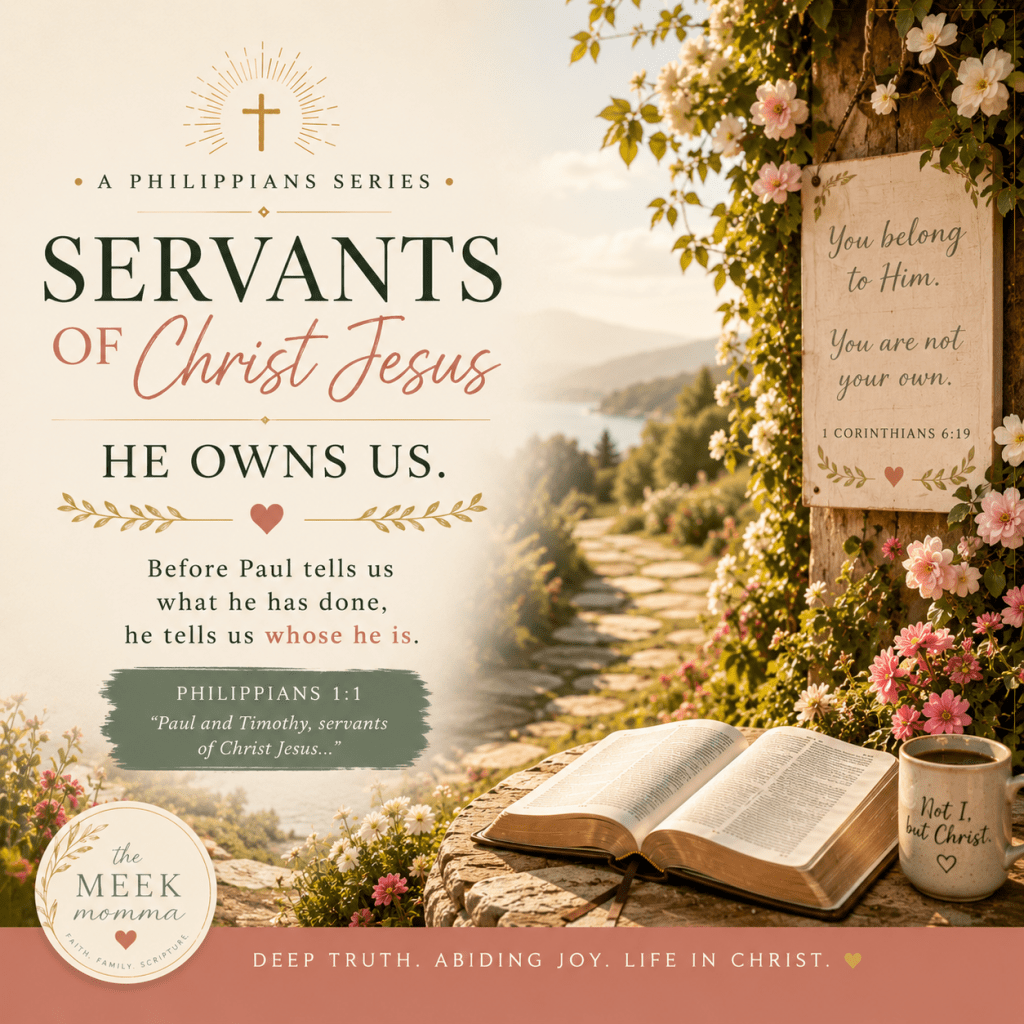
Before Paul teaches us about joy, suffering, humility, contentment, or living worthy of the gospel, he begins by telling us who we are, whose we are, and where everything we need for the Christian life comes from.

โ€œPaul and Timothy, servants of Christ Jesus,
To all the saints in Christ Jesus who are at Philippi, with the overseers and deacons:
Grace to you and peace from God our Father and the Lord Jesus Christ.โ€

โ€” Philippians 1:1โ€“2

There are places in Scripture where it is tempting to read quickly.

The opening greetings of New Testament letters can be one of those places.

We see the names of the author and recipients. We read the familiar words grace and peace. Then we hurry ahead, looking for the teaching we assume will begin a few verses later.

But there are no wasted words in Scripture.

Before Paul writes about joy in suffering, the advancement of the gospel, living worthy of the gospel, the humility of Christ, working out our salvation, pressing toward the goal, our heavenly citizenship, or learning the secret of contentment, he begins with two sentences that quietly establish the theological foundation beneath the entire Christian life.

Paul and Timothy are servants of Christ Jesus.

The believers in Philippi are saints in Christ Jesus.

Grace and peace come from God our Father and the Lord Jesus Christ.

Servants of Christ.

Saints in Christ.

Grace and peace from Christ.

These small words reveal an enormous reality.

The Christian life is a life that belongs to Christ, is found in Christ, and is sustained by what comes from Christ.

Servants of Christ Jesus: He Owns Us

Paul begins:

โ€œPaul and Timothy, servants of Christ Jesusโ€ฆโ€

The Greek word translated servants is douloi, the plural form of doulos.

The word can be translated servant, bondservant, or slave. While each English word carries different associations, the central idea is one of belonging.

A doulos lives under the authority of another.

Paul could have introduced himself in many ways.

He was an apostle.

He was a church planter.

He had suffered for the gospel.

He had received extraordinary revelation.

He had been entrusted with a significant ministry.

He had theological training, Jewish ancestry, religious accomplishments, and a testimony of radical conversion.

But Paul begins Philippians by identifying himself as one who belongs to Jesus Christ.

A servant of Christ Jesus.

Before Paul tells us what he has done, he tells us whose he is.

This confronts one of the deepest assumptions of the human heart: the belief that we belong to ourselves.

Our culture tells us to discover ourselves, define ourselves, express ourselves, protect ourselves, and build lives centered around the fulfillment of ourselves.

The gospel tells us something radically different.

โ€œYou are not your own, for you were bought with a price.โ€

โ€” 1 Corinthians 6:19โ€“20

Jesus Christ does not merely improve our lives.

He claims them.

He does not become one priority among many competing priorities.

He becomes Lord.

To belong to Christ means that our bodies belong to Him.

Our time belongs to Him.

Our homes belong to Him.

Our marriages, motherhood, work, ministry, gifts, suffering, ambitions, possessions, and plans all come under His authority.

This is not the language of oppression.

It is the language of redemption.

We were once enslaved to sin, unable to free ourselves from its dominion. Christ purchased us with His own blood, brought us under His gracious rule, and made us His own.

The Christian has not moved from belonging to a cruel master to belonging to no master at all.

We have been brought under the lordship of Jesus Christ.

The question is no longer merely:

What do I want to do with my life?

The better question is:

Lord Jesus, what would You have me do with the life that belongs to You?

Saints in Christ Jesus: He Defines Us

Paul continues:

โ€œTo all the saints in Christ Jesus who are at Philippiโ€ฆโ€

The word translated saints is hagioi, the plural form of hagios, meaning holy ones or those set apart for God.

Paul is not writing to a small group of spiritually exceptional Christians.

He is writing to all the saints.

Every believer in Philippi is addressed this way.

The struggling believer.

The mature believer.

The suffering believer.

The believer still learning obedience.

The believer who will need correction.

The believer involved in disagreement.

All the saints.

Why can Paul call ordinary Christians saints?

The answer is found in the three words that follow:

โ€œin Christ Jesus.โ€

Their holiness is inseparable from their relationship to Christ.

They have been set apart by God and brought into union with His Son.

Steven Lawson writes:

โ€œBeing in Christ Jesus makes all the difference to everything.โ€

Before their conversion, the Philippians belonged to this present evil world and lived under the dominion of darkness. But through the saving work of God, they had been delivered from darkness and brought into vital union and communion with Jesus Christ.

They had been washed in His blood.

Given a new standing in grace.

Made citizens of the kingdom of God.

They were no longer defined by who they had been apart from Christ.

They were now in Christ Jesus.

This little prepositional phrase carries enormous theological weight.

Paul does not merely say that the saints believe about Christ.

Or admire Christ.

Or follow the teachings of Christ.

They are in Christ.

The New Testament repeatedly uses this language to describe the believerโ€™s union with Jesus.

We have died with Christ.

We have been raised with Christ.

We are seated with Christ.

Our lives are hidden with Christ.

We are justified in Christ.

We are being sanctified in Christ.

We will be raised because we belong to Christ.

Christianity is not fundamentally the renovation of the old life.

It is not God helping us become improved versions of ourselves.

The gospel brings us into an entirely new realm of existence.

Once we were in Adam.

Now we are in Christ.

Once we belonged to the kingdom of darkness.

Now we have been transferred into the kingdom of Godโ€™s beloved Son.

Once we stood condemned in our sin.

Now there is no condemnation for those who are in Christ Jesus.

The Philippians lived in a real city.

They lived under Roman authority.

They had families, responsibilities, occupations, struggles, relationships, suffering, weaknesses, and disagreements.

Geographically, they were in Philippi.

But their spiritual location was somewhere else.

They were in Christ Jesus.

Where they lived was not the same thing as where their lives were found.

Later Paul will remind them:

โ€œBut our citizenship is in heaven, and from it we await a Savior, the Lord Jesus Christ.โ€

โ€” Philippians 3:20

The Philippians lived in Romeโ€™s world.

But they belonged to Christโ€™s kingdom.

They lived in Philippi.

But they were in Christ.

The same is true for every believer today.

We live in homes and communities.

We are wives, mothers, daughters, friends, employees, church members, caregivers, and neighbors.

We carry histories.

We experience failures.

We endure suffering.

We receive responsibilities.

We walk through circumstances that profoundly affect us.

But none of those things occupies the position Christ occupies.

Our circumstances describe where God has placed us.

Our responsibilities describe where God has called us to faithfulness.

Our past may explain some of the battles we fight.

But Christ defines who we are.

The Christianโ€™s deepest identity is not found by looking inward.

It is found by looking to Christ.

Grace and Peace From Christ: He Sustains Us

Paul finishes his greeting:

โ€œGrace to you and peace from God our Father and the Lord Jesus Christ.โ€

The Greek word translated grace is charis.

The word translated peace is eirฤ“nฤ“.

These words were familiar features of Paulโ€™s letters, but familiarity should not cause us to overlook their theological significance.

Grace and peace have a source.

They come from God our Father and the Lord Jesus Christ.

The Christian life begins with grace.

We are saved by grace.

We stand in grace.

We are strengthened by grace.

We are sanctified by grace.

We serve by grace.

We persevere by grace.

And one day, we will be brought safely into the presence of Christ because the God who began His work in us will bring it to completion.

Everything begins with Godโ€™s initiative.

Everything depends upon Godโ€™s provision.

Everything ends with God receiving the glory.

The Christian life is not merely difficult without the grace of God.

It is impossible.

We cannot manufacture the resources necessary to sustain ourselves.

We cannot produce our own righteousness.

We cannot regenerate our own hearts.

We cannot sanctify ourselves through willpower.

We cannot preserve ourselves by determination.

We cannot carry ourselves into glory.

We need grace.

Grace upon grace.

Grace that saves.

And from reconciliation with God flows peace.

Later in Philippians, Paul will write about the peace of God that surpasses all understanding.

Then he will speak of the God of peace who will be with His people.

But here, at the very beginning of the letter, Paul pronounces grace and peace over the saints.

The Christian does not live from an empty supply.

The fullness of Christโ€™s all-sufficient life flows to those who belong to Him.

We do not begin by grace and then continue by our own strength.

The same Christ who saves us sustains us.

Of Christ. In Christ. From Christ.

The late British theologian J. Alec Motyer draws attention to the exclusive place Jesus Christ occupies in relation to the Christian.

Paulโ€™s opening greeting presents this relationship through three small but significant words:

We are servants of Christ Jesus.

We are saints in Christ Jesus.

We receive grace and peace from the Lord Jesus Christ.

We belong to Him.

We are found in Him.

We receive everything necessary for life with God from Him.

The Christian life is Christ-centered from beginning to end.

Jesus is not merely the One who saves us and then sends us away to build our own lives.

He is not an addition to an identity we have already created.

He is not one relationship among many equally defining relationships.

He occupies an exclusive place.

He is our Lord.

He is our righteousness.

He is our life.

He is our peace.

He is our hope.

He is our sufficiency.

When Something Else Takes the Place That Belongs to Christ

The truth of Philippians 1:1โ€“2 does more than teach us doctrine.

It examines us.

If Christ occupies an exclusive place in relation to the Christian, then we must ask what we are tempted to place where only Christ belongs.

What defines you?

Is it your marriage?

Your motherhood?

Your children?

Your appearance?

Your ministry?

Your success?

Your failures?

Your suffering?

Your past?

Your political identity?

The approval of other people?

Even good gifts become crushing masters when we ask them to tell us who we are.

Motherhood is a gift.

Marriage is a gift.

Ministry is a gift.

Work is a gift.

Friendship is a gift.

But none of them can bear the weight of becoming our deepest identity.

Only Christ can occupy that place.

Perhaps you are exhausted because you are trying to produce what can only be received from Christ.

You are trying to make yourself righteous enough.

Strong enough.

Useful enough.

Disciplined enough.

Loved enough.

Holy enough.

You are trying to sustain by human effort a life that can only be sustained by divine grace.

Philippians begins by redirecting our eyes.

Before Paul tells us what to do, he reminds us whose we are.

Before he commands Christian obedience, he establishes Christian identity.

Before he teaches us how to rejoice, suffer, serve, persevere, or live worthy of the gospel, he points us to Jesus Christ.

Behold Christ

Look again at Philippians 1:1โ€“2.

Christ is the Master to whom Paul belongs.

Christ is the One in whom the saints are found.

Christ is the Lord from whom grace and peace come.

Everything leads us back to Him.

The Christian life cannot be understood apart from Jesus Christ because the Christian life does not exist apart from union with Jesus Christ.

We belong to Christ.

We are in Christ.

We receive from Christ.

And perhaps this is where we should begin our journey through Philippians.

Not first by asking how to become happier.

Not first by searching for the secret of contentment.

Not first by learning how to endure suffering.

But by asking a more foundational question:

Do I understand what it means to belong to Jesus Christ?

Because before Paul teaches us about joy, he reminds us where true joy must begin.

In Christ.

Do I think of my life as belonging entirely to Jesus Christ, or are there areas I still insist belong only to me?

What identity am I most afraid of losing?

Where am I trying to manufacture strength, peace, righteousness, or perseverance that I can only receive through the grace of God?

Lord Jesus, forgive me for the ways I have lived as though my life belonged to me. Forgive me for allowing created things, even good gifts, to occupy the place that belongs to You alone.

Behold Him, Not Me: Part Seven

When Israel Became Sodom

Judges 19

Content note: This study discusses sexual violence, physical abuse, and trauma in the context of Judges 19 and includes a personal testimony of surviving abuse.

There are chapters of Scripture that comfort us.

There are chapters that encourage us.

There are chapters that strengthen our hope, remind us of Godโ€™s faithfulness, and give us words to pray when our own words fail.

Judges 19 is not one of those chapters.
Judges 19 is meant to horrify us.

There is no deliverer.

There is no victory.

There is no miraculous rescue.

There is no repentance.

There is only a Levite, his concubine, an old man, a violent mob, a night of unspeakable abuse, the death of an unnamed woman, and a nation about to tear itself apart.

Judges 19 is one of the darkest chapters in all of Scripture.

And we should not rush through the darkness.

We should not soften the violence.

We should not turn the suffering of this woman into a convenient illustration.

We should not search so quickly for an encouraging application that we fail to sit beneath the weight of what the text is showing us.

Because Judges 19 is here for a reason.

The book of Judges has been showing us what happens when the people of God reject the rule of God.

Again and again, Israel has done what is right in their own eyes.

They have compromised.

They have worshiped idols.

They have reshaped God according to their preferences.

They have pursued comfort.

They have sought blessing without obedience.

They have built religions they could control.

And now, at the end of the book, we are shown where that road leads.

Israel has become indistinguishable from the nations around them.

Worse still, Israel has become like Sodom.

Before We Read

Before going any further, we need to acknowledge what this chapter contains.

Judges 19 describes sexual violence, abuse, dehumanization, and death.

The Bible records these events.

It does not approve of them.

Scripture is painfully honest about the evil human beings are capable of committing. The Bible does not hide the consequences of sin. It does not sanitize human depravity. It does not pretend that rebellion against God remains private, harmless, or contained.

Sin spreads.

Sin corrupts.

Sin dehumanizes.

And when people persistently reject the authority of God, other human beings bear the consequences.

The unnamed woman at the center of Judges 19 is not merely a literary device.

She is a human being made in the image of God.

She is sinned against.

She is abandoned.

She is violated.

She dies.

And the men surrounding her repeatedly treat her as though her life exists for their convenience.

We should allow the horror of that reality to trouble us.

The text intends for us to be troubled.

In Those Days There Was No King

Judges 19 begins with words we have heard before:

โ€œIn those days, when there was no king in Israelโ€ฆโ€

This statement has become the theological backdrop of the final chapters of Judges.

Israelโ€™s problem is not merely political.

Their deepest problem is spiritual.

There is no human king, but more importantly, Israel is living as though there is no divine King.

God has spoken.

God has given His law.

God has established His covenant.

God has told His people how to worship, how to pursue justice, how to treat the vulnerable, how to order their families, and how to live together as His holy people.

Yet everyone continues doing what is right in his own eyes.

Judges 19 shows us what happens when subjective morality reaches its logical conclusion.

When everyone becomes his own authority, the strong eventually decide what happens to the weak.

When personal desire becomes the highest standard, other people become objects to be used.

When Godโ€™s authority is rejected, human dignity does not increase.

It collapses.

A Levite Who Should Have Known Better

Once again, a Levite stands near the center of the story.

That should trouble us.

The Levites had been set apart for service connected to the worship of God.

If anyone should have known the Word of God, it was a Levite.

If anyone should have understood covenant faithfulness, justice, holiness, and the value of belonging to God, it was a Levite.

Yet the Levite in Judges 19 is not presented as a faithful spiritual leader.

He is part of the problem.

The chapter begins by introducing his concubine, who leaves him and returns to her fatherโ€™s house in Bethlehem.

After four months, the Levite travels to persuade her to return.

Her father welcomes him enthusiastically.

For several days, the men eat, drink, and delay the journey.

Eventually, the Levite insists on leaving.

The decision is made late in the day.

As darkness approaches, the servant suggests that they stop in Jebus, the city that would later become Jerusalem.

But the Levite refuses.

Jebus is inhabited by foreigners.

He does not want to spend the night among people who are not Israelites.

Instead, he chooses to continue to Gibeah.

Surely they will be safer among the people of God.

They are not.

When Israel Became Sodom

The travelers arrive in Gibeah, a city belonging to the tribe of Benjamin.

They sit in the town square.

No one welcomes them.

Eventually, an old man returning from his work in the fields sees them and offers hospitality.

Then the story begins to sound disturbingly familiar.

The men of the city surround the house.

They demand that the Levite be brought outside so that they can sexually assault him.

The deliberate connection to Genesis 19 is difficult to miss.

In Genesis, the men of Sodom surround Lotโ€™s house.

In Judges, the men of Gibeah surround the old manโ€™s house.

In Genesis, the mob demands the male visitors.

In Judges, the mob demands the Levite.

The language is similar.

The circumstances are similar.

The depravity is similar.

But there is one devastating difference.

Gibeah is not a Canaanite city.

Gibeah belongs to Israel.

God had called Israel to be holy.

God had separated them from the nations.

God had given them His Word.

God had placed His name among them.

God had called them to display His character to the world.

But now the people who were supposed to be different have become indistinguishable from the people they were commanded not to imitate.

Israel has become Sodom.

This may be one of the most terrifying warnings in the entire book of Judges.

The people of God can live among the things of God, possess the Word of God, use the name of God, and still become increasingly unlike God.

Spiritual privilege does not make anyone immune to spiritual decay.

A people who repeatedly refuse to listen to God can eventually become unrecognizable as His people.

The Failure of Every Man in the Story

There are no heroes in Judges 19.

The men of Gibeah are wicked.

But they are not the only men who fail.

The old man offers the women of the household to the mob.

The Levite sends his concubine outside.

The men abuse her throughout the night.

In the morning, she collapses at the doorway of the house.

And when the Levite opens the door, he says:

โ€œGet up, let us be going.โ€

There is no recorded grief.

No tenderness.

No attempt to help her.

No acknowledgment of what she has suffered.

When she does not respond, he places her body on his donkey and returns home.

The woman at the center of the story is repeatedly acted upon.

Men decide where she will go.

Men decide what will happen to her.

Men sacrifice her safety to protect themselves.

Men violate her.

Men speak over her.

Men use her death for their own purposes.

She is never given a voice.

And that silence is part of the horror.

The further Israel moves from the rule of God, the more vulnerable people suffer.

Throughout Scripture, the treatment of the vulnerable is repeatedly connected to the spiritual condition of Godโ€™s people.

When people love God, they are commanded to love their neighbor.

When people fear God, they are forbidden from using power merely for their own advantage.

When people reject Godโ€™s authority, power becomes something to seize, protect, and use.

Judges 19 shows us a society in which nearly everyone is protecting himself.

And the person with the least power pays the highest price.

The Banality of Evil

One of the most disturbing things about the final chapters of Judges is how ordinary everyone seems.

These are not monsters from another world.

They travel.

They eat meals.

They extend hospitality.

They have families.

They speak about God.

They belong to tribes.

They participate in religious life.

And yet beneath the ordinary surface lies profound moral corruption.

Evil does not always announce itself dramatically.

Sometimes it grows quietly.

Compromise after compromise.

Excuse after excuse.

Desire after desire.

People gradually become accustomed to what once would have horrified them.

Sin becomes normal.

Consciences become dull.

People learn to live with contradictions.

They speak the language of faith while living according to their own desires.

The final chapters of Judges show us what happens when rebellion becomes ordinary.

The people do not merely commit isolated acts of sin.

They inhabit an entire moral world in which everyone is doing what is right in his own eyes.

The Woman at the Door

There is an image near the end of the chapter that is difficult to forget.

Morning comes.

The door opens.

And the woman is lying at the threshold with her hands on the doorway.

She had almost reached shelter.

But the door remained closed.

There are times when careful Bible study requires us to resist the urge to turn every detail into a metaphor.

This woman does not need to become a symbol before we are willing to grieve what happened to her.

She was a person made in the image of God.

And she was treated as disposable.

The text does not give us her name.

But God saw her.

The men in this chapter use her.

Ignore her.

Abandon her.

Violate her.

Dismember her.

But the God who inspired Scripture does not allow Israel to forget her.

Her suffering becomes part of the testimony against a nation that has rejected its King.

Her presence in Scripture reminds us that God does not look away from the suffering human beings would prefer to ignore.

The Bible bears witness to victims whom powerful people would rather leave unnamed.

The God Who Saw Me Too

There is a reason I cannot read Judges 19 from a safe distance.

I know what it is like to be sexually abused.

For a long period of my life, I was sexually abused by my father. I was also sexually and physically abused by other men.

I know something of the deep wounds these kinds of sins leave behind.

I know what it is like to carry questions you do not know how to ask.

Does God see me?

Does He care about what happened?

Will there ever be justice?

Am I still worthy of being loved?

For many years, I did not know how to bring those questions to God. I did not know how to process what had happened to me within my theology.

Then I began learning to slow down when I read Scripture.

I stopped rushing past difficult passages.

I stopped assuming that the darkest stories in the Bible were obstacles to faith that needed to be explained away as quickly as possible.

And I began to see something I had missed.

God does not hide what evil does to people.

He does not call evil good.

He does not ask us to pretend that suffering does not matter.

He does not look away from the people others would prefer to forget.

Judges 19 does not allow us to forget this woman.

The text does not give us her name, but God preserved the testimony of what was done to her.

Her suffering is not hidden.

The evil committed against her is not erased.

Generation after generation has been forced to reckon with what happened in Gibeah because God allowed her story to remain in His Word.

And as I learned to see her, I began to understand more deeply that God saw me too.

I thought about Hagar.

She was a woman caught within the sinful decisions and abuses of power of other people.

She fled into the wilderness.

And there, the angel of the LORD found her.

He called her by name.

โ€œHagar, servant of Sarai, where have you come from and where are you going?โ€

โ€” Genesis 16:8

Hagar responded by giving God a name:

โ€œYou are a God of seeing.โ€

She said:

โ€œTruly here I have seen Him who looks after me.โ€

โ€” Genesis 16:13

Later, Hagar would find herself in the wilderness again, believing she was about to watch her son die.

She wept.

God heard.

And the angel of God called to her from heaven.

These passages began changing the way I understood God.

The God of Scripture is not the author of evil.

He is good.

He is just.

He sees.

He hears.

He knows.

And because He is faithful, He will keep every promise He has made.

That means evil will not be ignored forever.

Those who have harmed others will answer to Godโ€™s perfect justice.

Some of us may see justice in this life.

Some of us may not.

Human courts may fail.

People may refuse to believe us.

Those who committed evil may never acknowledge what they have done.

But there is no hidden thing that will remain hidden before the judgment of God.

The Judge of all the earth will do what is just.

For me, that truth did not make forgiveness unnecessary.

It made forgiveness possible.

I began to understand that forgiveness does not require me to call evil good.

It does not require me to pretend that justice does not matter.

It does not require me to deny what happened.

I can entrust final judgment to the God who sees perfectly, knows completely, and judges righteously.

And I can bring my wounds to Jesus.

The One who sees Hagar in the wilderness is the same God who came near to us in Christ.

Jesus saw women others ignored.

He welcomed people others rejected.

He touched those others considered unclean.

He drew near to the suffering.

He was betrayed.

He was stripped.

He was mocked.

He was beaten.

He was crucified.

And He willingly bore the judgment for sin so that sinners could be reconciled to God.

The cross taught me that God does not minimize evil.

Sin is so serious that the Son of God gave His life to save sinners from it.

And the resurrection taught me that evil, suffering, and death will not have the final word.

Slowly, the Old Testament and the New Testament began coming together for me.

The God who saw Hagar is the God who saw me.

The God who refused to let Israel forget the unnamed woman of Judges 19 had not forgotten me.

The righteous Judge before whom every evil will one day be exposed is also the Father who received me through His Son.

I began to understand that Jesus loved me deeply.

I began to receive the love of God instead of believing that what had been done to me determined my worth.

I began to seek forgiveness for my own sins.

I began learning to forgive others.

And I began trusting God with the justice I could not accomplish for myself.

These passages did not destroy my faith.

They deepened it.

They taught me that I do not need a Bible that looks away from evil.

I need a God who sees it more clearly than I ever could.

I do not need a God who offers shallow explanations for suffering.

I need the God who enters our suffering, judges with perfect justice, saves sinners through the blood of His Son, and promises that one day He will make all things new.

If you have experienced sexual violence, physical abuse, or other deep wounds, or if you love someone who has, I want you to know why I am willing to remain in difficult passages like Judges 19.

It is because I have found that slowing down in these passages has helped me know God more deeply.

You do not have to pretend that evil is less evil in order to trust Him.

You do not have to silence your grief.

You do not have to be afraid of your questions.

Bring them into the light of Scripture.

Learn the character of the God who sees.

Learn the justice of the God who will judge rightly.

Learn the mercy of the Savior who receives sinners.

Learn the love of the Father who gave His Son so that all who trust in Him might be reconciled to God.

My prayer is not merely that you will make it through the difficult chapters of the Bible with your faith intact.

My prayer is that, as you slow down and see the God who has revealed Himself there, your faith will deepen too.

The God who saw Hagar sees.

The God who preserved the testimony of the unnamed woman remembers.

The God who gave His Son saves.

And the King who is coming will judge the world in righteousness.

Come and see the God who sees.

Where Is God?

One of the unsettling realities of Judges 19 is the apparent silence of God.

There is no divine speech.

No angel appears.

No miracle interrupts the violence.

No deliverer arrives.

Where is God?

The answer is not that God has disappeared.

The entire book has shown us a people repeatedly refusing to listen to Him.

God has spoken.

Israel possesses His covenant.

Israel has His law.

Israel knows His commands.

The tragedy is not that God failed to reveal what righteousness looks like.

The tragedy is that Israel has rejected what God has revealed.

We must also be careful not to confuse Godโ€™s silence in the narrative with Godโ€™s indifference to suffering.

The chapter itself stands as testimony against Israel.

God has preserved the record of what happened.

The evil in Gibeah is not hidden from Him.

The suffering of the woman is not forgotten.

Judges 19 shows us what life looks like when human beings insist upon doing what is right in their own eyes.

And it leaves us longing for judgment, rescue, and a righteous King.

Outrage Is Not Repentance

The Levite takes the womanโ€™s body and divides it into twelve pieces.

He sends the pieces throughout the territory of Israel.

The act is horrifying.

The response is immediate.

The people of Israel say:

โ€œSuch a thing has never happened or been seen from the day that the people of Israel came up out of the land of Egypt until this day; consider it, take counsel, and speak.โ€

Israel is finally shocked.

After years of idolatry.

After generations of compromise.

After repeated rejection of Godโ€™s covenant.

After everyone has done what is right in his own eyes.

Israel has finally found a sin terrible enough to produce national outrage.

But outrage is not the same thing as repentance.

It is possible to be horrified by the sins of others while remaining blind to the sin within ourselves.

It is possible to correctly identify evil and still respond to evil in ways that reveal our own estrangement from God.

That is where Judges 20 will take us.

The nation will gather.

The people will demand justice.

A civil war will begin.

Thousands will die.

And the people who are outraged by Gibeah will continue demonstrating that the deepest problem in Israel cannot be contained within one city.

The problem is everywhere.

The Road to Gibeah Was Longer Than One Night

Israel did not become Sodom overnight.

The violence of Judges 19 is the fruit of seeds planted throughout the entire book.

Israel compromised with the Canaanites.

Israel tolerated idolatry.

Israel abandoned covenant faithfulness.

Israel repeatedly cried out to God when suffering became unbearable, only to return to rebellion when relief arrived.

Israel treated God as a means of obtaining blessing rather than as their King.

By Judges 17, Micah has created his own religion.

By Judges 18, the tribe of Dan has established institutionalized idolatry.

By Judges 19, Israel has become Sodom.

This is the trajectory of sin.

Sin rarely tells us where it intends to take us.

It asks only for the next compromise.

The next excuse.

The next small act of disobedience.

The next moment when we decide that what seems right in our own eyes matters more than what God has said.

Judges 19 forces us to see the destination.

We Need a Righteous King

The book of Judges has shown us judge after judge.

Some were faithful.

Some were deeply flawed.

Some delivered Israel from external enemies while remaining unable to change the hearts of Godโ€™s people.

But now there is no judge.

There is no deliverer.

There is no faithful leader standing between the vulnerable and those who would destroy them.

The repeated refrain tells us what Israel lacks:

โ€œIn those days there was no king in Israel.โ€

But Israel does not merely need someone wearing a crown.

Israel needs a righteous King.

A King who will not exploit the weak.

A King who will not sacrifice others to save Himself.

A King who knows the Word of God and obeys it perfectly.

A King who sees the forgotten.

A King who defends the vulnerable.

A King who judges evil without becoming evil.

A King who can deal not only with the enemies surrounding Godโ€™s people, but with the sin dwelling within them.

Judges leaves us longing for such a King.

The gospel tells us His name.

The King Who Gave Himself

The men in Judges 19 preserve themselves by giving up someone else.

Jesus does the opposite.

Christ does not sacrifice the vulnerable to save Himself.

He gives Himself to save sinners.

The Good Shepherd does not abandon the sheep when the wolves come.

He lays down His life for the sheep.

Jesus does not use His power to protect Himself from suffering.

He willingly enters suffering.

He is betrayed.

He is mocked.

He is beaten.

He is condemned.

He is crucified.

Not because humanity is innocent.

But because humanity is guilty.

At the cross, we see both the horror of human sin and the holiness of God.

The cross does not minimize evil.

It reveals how serious sin truly is.

The righteous King bears judgment in the place of His people.

Judges 19 shows us human beings sacrificing others to save themselves.

The gospel shows us the Son of God giving Himself to save sinners.

Jesus Christ is the King Israel needed.

And He is the King we need.

The King Who Sees

Judges 19 reminds us that human beings can overlook suffering.

Communities can normalize injustice.

Religious people can become indifferent.

Powerful people can protect themselves.

Victims can remain unnamed.

But God sees.

God hears.

God knows.

And God will judge rightly.

The gospel does not ask us to pretend evil is less terrible than it is.

The gospel tells us that evil will not have the final word.

Jesus Christ was crucified.

Jesus Christ was buried.

Jesus Christ rose from the dead.

Jesus Christ reigns.

And one day the King who sees every injustice will judge the world in righteousness.

Every hidden thing will be brought into the light.

Every wrong will be answered according to perfect justice.

For those who belong to Christ, the promise of His kingdom means that suffering, violence, injustice, and death will not endure forever.

The King is coming.

Behold Him, Not Me

Judges 19 is difficult to read because it shows us what human beings become when we reject the rule of God.

Israel was called to be holy.

Israel was called to be different.

Israel was called to display the character of God among the nations.

Instead, Israel became Sodom.

The warning should humble us.

We should never assume that religious language, biblical knowledge, church attendance, ministry involvement, or spiritual heritage makes us immune to compromise.

We need more than outrage over the sins of the world.

We need more than moral reform.

We need more than better circumstances.

We need new hearts.

We need forgiveness.

We need righteousness we cannot produce for ourselves.

We need a King.

Judges leaves us searching for Him.

The rest of Scripture tells us His name.

Jesus Christ.

The righteous King.

The faithful Shepherd.

The One who sees the forgotten.

The One who judges with perfect justice.

The One who gave Himself to save sinners.

When everyone does what is right in his own eyes, look to the King.

When the world becomes accustomed to evil, look to the King.

When religious people fail, look to the King.

When human justice proves insufficient, look to the King.

When the darkness seems unbearable, look to the King.

Behold Him.


Heart Check

Am I more skilled at identifying the sins of others than examining the compromises within my own heart?

Have I become comfortable with things that Scripture calls evil?

Are there areas of my life where personal preference has become more authoritative than the Word of God?

Do I assume that being surrounded by Christian things is the same as faithfully following Christ?

How do I respond when obedience to Jesus requires me to protect, serve, or speak for people who have less power than I do?

Do I merely feel outrage over evil, or does the reality of sin lead me toward repentance, prayer, obedience, and trust in Christ?

Where am I tempted to protect myself at the expense of others?

Do I truly believe that Jesus is the righteous King I needโ€”not only to judge the evil around me, but to save me from the sin within me?


Prayer

Father,

Judges 19 is difficult to read.

The violence is horrifying. The suffering is real. The depth of human sin is difficult to comprehend.

Yet Your Word refuses to hide what happens when people reject Your rule and do what is right in their own eyes.

Search my heart.

Show me where I have become comfortable with compromise.

Show me where I am quicker to condemn the sins of others than to repent of my own.

Guard me from a faith that knows Your Word but refuses to submit to it.

Teach me to see people as those made in Your image.

Give me courage to protect the vulnerable, speak truth, pursue justice, and refuse to make peace with evil.

For those reading who carry wounds caused by the evil of others, draw near to them.

Help them know that You see.

Help them know that You hear.

Help them know that evil is not hidden from You and that Your justice will not fail.

Lead them to the Savior who receives sinners, binds up the brokenhearted, and will one day make all things new.

And when the darkness of human sin feels overwhelming, turn our eyes toward Christ.

Thank You for giving us the King we could never produce for ourselves.

Thank You that Jesus did not sacrifice others to save Himself, but willingly gave Himself to save sinners.

Thank You that He sees the forgotten, receives the repentant, judges rightly, and reigns forever.

Teach us to trust Him.

Teach us to follow Him.

Teach us to behold Him.

Not us.

In Jesusโ€™ name,

Amen.

Sea Creatures, Small Victories & the Kindness of God

Finding joy in the creatures God made, celebrating progress that doesnโ€™t always look big, and learning to recognize His kindness in the middle of ordinary family life.

There are some family trips where you come home rested.

This was not one of those trips. ๐Ÿ˜‚

This past weekend, our family headed down to Newport for two full days at the Oregon Coast Aquarium. By the time we came home, our feet hurt, our bodies were tired, and according to how my legs felt, we had walked approximately 100,000 steps.

Okay, maybe that number is slightly dramatic.

But my feet would like it entered into the official record anyway.

And if you know Jackson, you already know exactly why we went:

Sea creatures. Allllll the sea creatures.

Sharks. Rays. Fish. Tide pools. Anything swimming, crawling, floating, or lurking beneath the surfaceโ€”Jackson wants to see it, learn about it, and probably tell you something about it that you didnโ€™t know.

Seeing It Through His Eyes

One of my favorite things about being Jacksonโ€™s mom is getting to experience the world through the lens of whatever has captured his attention.

And sea creatures have certainly captured his… for the last 7 years.

There is something special about watching your child stand completely captivated by an animal God createdโ€”studying how it moves, noticing tiny details the rest of us might walk right past, and wanting to soak in every bit of it.

As we walked through the aquarium, I found myself thinking about just how wildly creative our God is.

The strange ones.

The beautiful ones.

The tiny ones we almost miss.

And the ones with enough teeth that we are perfectly content admiring them through very thick glass. ๐Ÿ˜‚

Every single one displays something of the creativity, wisdom, and imagination of its Creator.

โ€œO LORD, how manifold are your works! In wisdom have you made them all; the earth is full of your creatures.โ€ โ€” Psalm 104:24

What a gift that God did not simply create a functional world.

He created one overflowing with wonder.

And what a gift to experience some of that wonder through the eyes of our son.

But This Trip, We Noticed Something Else: Growth

We visited the aquarium last fall, so Zac and I had a pretty recent trip to compare this one to.

And this time, we could see it.

Jackson has grown.

Not just physicallyโ€”although somehow these children insist on doing that no matter how many times we tell them to stop.

We saw growth in things that might seem incredibly ordinary to another family but felt huge to ours.

Jackson ate really well throughout the entire trip.

He was able to sit down and take breaks.

He handled two very full days of walking, stimulation, excitement, transitions, and activity in ways he simply could not have before.

Were there still meltdowns?

Yep.

Were there still struggles?

Absolutely.

Did all three of us have moments when we were tired, overstimulated, frustrated, or just plain done?

Oh yes.

This wasnโ€™t one of those magical family vacations where everyone smiled peacefully at one another for 48 consecutive hours while inspirational music played softly in the background.

We are still us. ๐Ÿ˜‚

There were hard moments tucked between the smiles in these pictures.

But this weekend reminded me of something I donโ€™t want to forget:

The presence of struggle does not mean there hasnโ€™t been progress.

Sometimes growth doesnโ€™t mean the hard things disappear.

Sometimes growth means something that was impossible six months ago is now possible for ten minutes.

Then twenty.

Sometimes it looks like sitting down long enough to eat a good meal.

Sometimes itโ€™s being able to take a break in the middle of an exciting day.

Sometimes itโ€™s recovering from a hard moment just a little faster.

Sometimes itโ€™s tolerating one more transition.

And sometimes, itโ€™s watching your childโ€™s world get a little bigger.

A Little Detour That Was Actually a Really Big Deal

One of my favorite examples of that happened when we decided to fit in an extra stop at Ripleyโ€™s Believe It or Not.

On paper, it wasnโ€™t anything extraordinary.

It was just a little one-hour excursion squeezed into an already very full weekend before heading back to the aquarium.

But for our family?

It was a really big deal.

Jackson was nervous and hesitant at first.

He wasnโ€™t particularly excited about going in. This wasnโ€™t what he had come to Newport for. The aquarium and his beloved sea creatures were familiar territory; this was something different, unexpected, and full of unknowns.

There was a time when that alone would have made an extra stop like this impossible.

But he went in.

And little by little, we watched something change.

There were so many hands-on and sensory experiences inside that his hesitation began to give way to curiosity.

He started exploring.

He engaged.

He let go.

He had fun.

He was nervousโ€”and he was brave enough to push through that nervousness and discover something new on the other side of it.

And then came something equally significant:

When our little adventure was finished, we transitioned back to the aquarium and continued our day.

An unfamiliar place.

An unexpected addition to the plan.

A completely different sensory environment.

Walking into it despite being unsure.

Enjoying it.

Leaving it.

And then transitioning back to the original plan.

To someone looking from the outside, it might simply look like:

We went somewhere for an hour.

But we knew.

This little one-hour excursion would have been impossible before.

Not difficult.

Not inconvenient.

Impossible.

And this weekend, it was possible.

Not necessarily easy.

But possible.

And there is something incredibly beautiful about realizing that something that once felt impossible has quietly become possible.

When His World Gets a Little Bigger

I think this may be one of the ways I want to remember Jacksonโ€™s growth:

His world is getting a little bigger.

We arenโ€™t measuring progress by whether everything suddenly becomes easy.

We arenโ€™t measuring it by whether meltdowns disappear.

They havenโ€™t.

We arenโ€™t pretending that autism somehow becomes less real simply because we had a wonderful weekend.

There are still hard moments.

There are still accommodations.

There are still things we navigate differently than other families might.

But those realities do not cancel out progress.

Instead, we are learning to notice when Jacksonโ€™s capacity to experience the world expands just a little more.

When something that once felt impossible becomes possible.

When uncertainty doesnโ€™t completely prevent curiosity.

When he can experience nervousness and still be brave.

When he can try something unfamiliar and discover that he actually enjoys it.

When we can add one more experience to the day.

When we can transition awayโ€”and then transition back.

These things may look small from the outside.

But when you remember when they werenโ€™t possible?

They donโ€™t feel small at all.

Sometimes you donโ€™t realize just how far your child has come until you suddenly find yourself standing in the middle of something you once couldnโ€™t do.

And you think:

Wait.

Weโ€™re doing it.

Donโ€™t Let Todayโ€™s Hard Moment Make You Forget How Far Youโ€™ve Come

There were still difficult moments this weekend.

And when you are in one of those moments, it can be easy to feel as though nothing has changed.

A meltdown can feel very big while youโ€™re standing in the middle of it.

A difficult transition can temporarily overshadow everything that went beautifully before it.

But then I remembered last fall.

And suddenly, I could see it.

Progress.

Growth.

Maturity.

Capacity.

Grace.

Not perfection.

Growth.

And isnโ€™t that so often how God works in all of us?

We tend to want transformation to happen in giant, unmistakable leaps.

We want to wake up one morning and discover that the difficult things are no longer difficult.

But so often, the Lord faithfully works through thousands of tiny moments that donโ€™t seem remarkable while weโ€™re living them.

A little more endurance.

A little more courage.

A little more patience.

One more thing that becomes possible.

And then one day, we look backward and realize:

We arenโ€™t where we used to be.

Sometimes we have to look back to see just how faithfully God has carried us forward.

Sea Creatures, Small Victories & a Very Full Two Days

So we explored.

We walked.

And walked.

And walked some more.

We watched sharks glide through the water.

We admired creatures from the deep.

We learned.

We laughed.

We ate.

We rested when we needed to.

We tried something new.

We navigated meltdowns.

We regrouped.

And then we kept going.

By the end of our two days, our feet hurt, our bodies were tired, and I think we had collectively seen enough fish to qualify for honorary marine biology degrees.

But our hearts were full.

Because tucked inside an ordinary family weekend at the aquarium were a hundred little reminders of Godโ€™s kindness.

The kindness of watching our son experience something he genuinely loves.

The kindness of seeing his face light up over creatures God made.

The kindness of noticing growth that can be difficult to recognize when you are living life one day at a time.

The kindness of realizing his world is getting a little bigger.

The kindness of getting another adventure togetherโ€”even when adventures with our family donโ€™t always look effortless.

And the kindness of a Creator who filled His world with creatures so strange, beautiful, intricate, and fascinating that we could spend a lifetime discovering them and still have more to see.

Praise the Lord for Progressโ€”and for Really Cool Sharks

Iโ€™m learning not to wait until everything is easy before calling something good.

This weekend was good.

It was also tiring.

There were meltdowns.

There were struggles.

There were probably moments when all three of us needed a timeout.

And there was so much joy.

Those things can exist together.

The hard does not erase the good.

And the presence of struggle does not mean there hasnโ€™t been progress.

So today, Iโ€™m thanking God for two days in Newport.

For a little boy who loves all things sea creatures.

For a daddy who explores alongside him.

For sharks swimming overhead.

For meals eaten well and breaks successfully taken.

For an unexpected one-hour adventure.

For the courage to walk into something unfamiliar.

For transitions that once would have been impossible.

For tired feet.

For small victories that really arenโ€™t so small.

And for growth that sometimes can only be seen when we turn around and look at how far weโ€™ve come.

Most of all, Iโ€™m thankful for the beautiful, bizarre, magnificent creatures our God dreamed up and spoke into existence for His gloryโ€”and that He graciously allows us to enjoy.

Praise the Lord for making such a wonderfully wild world.

And praise Him that, little by little, Jacksonโ€™s world is getting biggerโ€”and we get the privilege of watching him discover it.

Blog at WordPress.com.

Up ↑