
Judges 13:1–25
The Promised Deliverer and the God Who Gives Life
As I continue studying verse by verse through the book of Judges, I find myself increasingly amazed by how often God chooses to work through the weak, the overlooked, and the seemingly impossible.
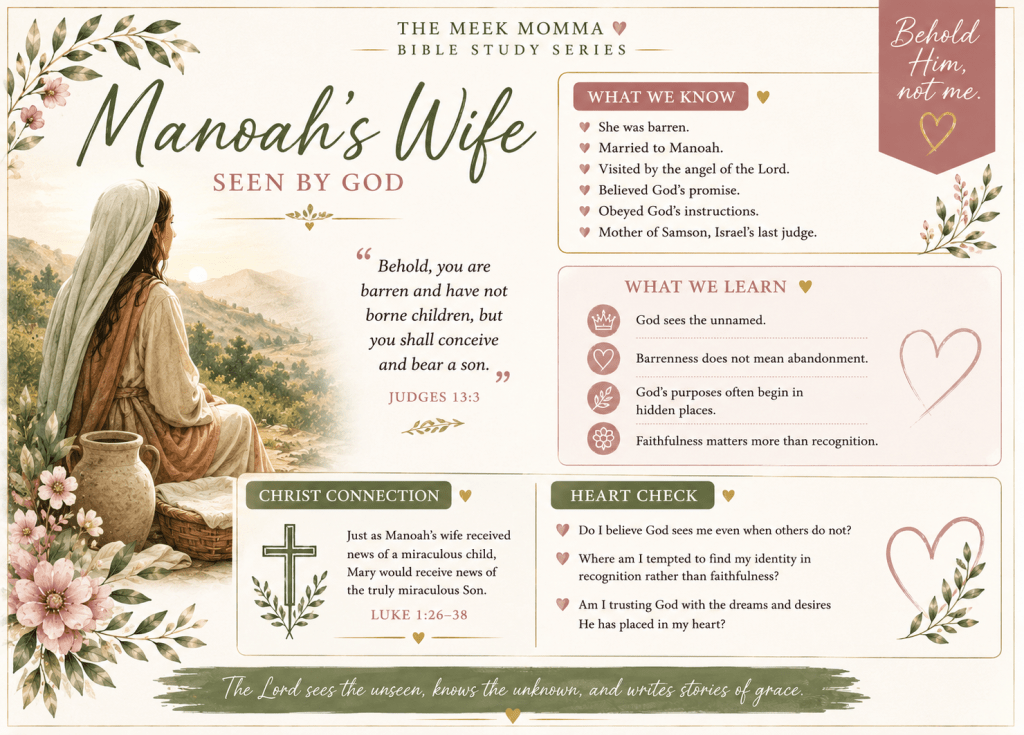
Judges 13 introduces us to one of the most important mothers in Israel’s history, yet we are never told her name.
We know her husband’s name. We know her son’s name. We know the nation she lived among and the oppression she endured. Yet the woman through whom God would begin Israel’s deliverance remains unnamed.
At first glance, that may seem insignificant. But for many women, especially those who have walked through seasons of loneliness, infertility, disappointment, or feeling unseen, there is something deeply comforting here.
We may not know her name.
But God did.
And that is enough.
As someone who has wrestled with infertility myself, this passage immediately drew me in. For twelve years my husband and I prayed for a child. Then, in God’s kindness, He gave us Jackson. Yet even now, as Jackson grows older, there are still moments when I feel the ache of unmet expectations and unanswered prayers.
Perhaps that is why this woman feels so familiar.
She was barren.
She knew disappointment.
She understood waiting.
And yet she was not forgotten.
Israel’s Need and God’s Mercy
Judges 13 opens with a familiar refrain:
“And the people of Israel again did what was evil in the sight of the Lord.”
We have seen these words throughout the book of Judges.
Israel sins.
God disciplines.
Israel suffers.
God raises up a deliverer.
The cycle repeats.
This time, God gives Israel into the hands of the Philistines for forty years.
Israel’s greatest problem, however, was not the Philistines.
It was their sin.
And the same is true for us.
The greatest danger we face is never ultimately outside of us. It is the rebellion that resides within our own hearts.
Yet even as Israel continues its downward spiral, God is already preparing a rescue.
Not because Israel deserves it.
Not because they have repented.
But because God is merciful.
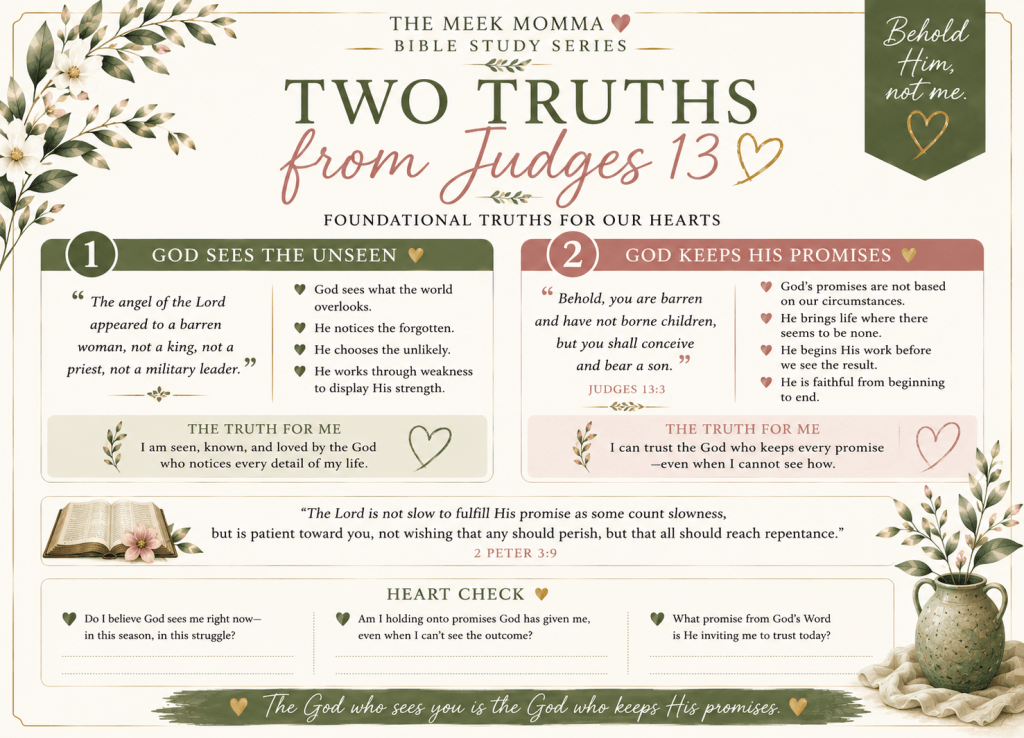
The God Who Sees the Unseen
The angel of the Lord appears not to a king.
Not to a priest.
Not to a military leader.
He appears to a barren woman.
And the first words she hears are words of hope:
“Behold, you are barren and have not borne children, but you shall conceive and bear a son.” (Judges 13:3)
The world often overlooks people who seem insignificant.
God does not.
Scripture repeatedly reminds us that God sees those whom others forget.
Hagar in the wilderness.
Ruth in the fields.
Hannah in her grief.
Elizabeth in her barrenness.
And here, Manoah’s wife.
The God of Scripture is not drawn to the impressive. He delights in displaying His power through weakness.
Her barrenness was not evidence of God’s absence.
It became the stage upon which His grace would be displayed.
A Child Set Apart Before Birth
The angel gives unusual instructions.
Manoah’s wife is not to drink wine.
She is not to eat anything unclean.
Her son’s hair must never be cut.
Why?
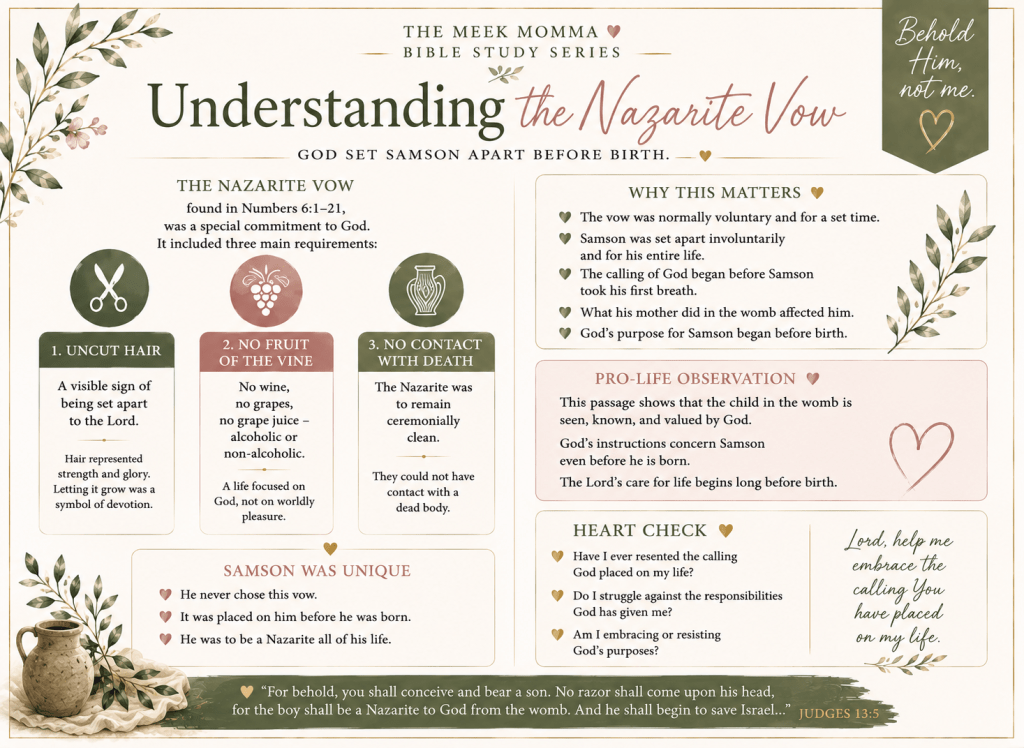
Because the child would be a Nazarite from birth.
The Nazarite vow described in Numbers 6 was ordinarily voluntary and temporary.
A person would willingly set themselves apart for a specific season of devotion to God.
The vow included three primary restrictions:
- No cutting of the hair.
- No produce from the vine.
- No contact with dead bodies.
These were outward signs of an inward dedication to the Lord.
But Samson’s situation was unique.
He never chose this vow.
God chose it for him.
Before he was born.
Before he could speak.
Before he could understand.
Before he could make any decisions for himself.
God had already set him apart.
Notice how far back God’s claim on Samson extends.
The vow begins while he is still in his mother’s womb.
What she consumes affects him.
What she does impacts him.
God’s purpose for Samson begins before birth.
That reality should cause us to pause.
In a culture that often treats unborn life as insignificant, Scripture consistently presents the child in the womb as a real human being known by God.
Samson is not viewed as a potential person.
He is already a person with a divine calling.
God’s instructions concern him even before he takes his first breath.
The Lord’s care for life begins long before birth.
When God Writes a Story We Didn’t Choose
As I studied Samson’s lifelong Nazarite calling, I found myself wondering something.
Have you ever known someone whose life seemed planned out before they were born?
Perhaps their family had certain expectations.
Certain traditions.
Certain goals.
Certain dreams.
Sometimes those expectations can become burdens.
They can produce resistance.
Even rebellion.
And I cannot help but wonder if that contributed to some of Samson’s struggles.
As we will soon see, Samson repeatedly pushes against the very calling God placed upon his life.
He breaks every aspect of the Nazarite vow.
He pursues what God forbids.
He treats holy things casually.
He resists the identity God gave him.
And if we are honest, we often do the same.
How frequently do we push against God’s design for our lives?
How often do we resent the circumstances He has chosen for us?
How often do we look at His plans and secretly wish for different ones?
The problem is not merely that we dislike His plans.
The problem is that we often believe our plans are better.
That has been a painful lesson for me.
There have been moments in my infertility journey when my heart has quietly insisted that I know what would be best.
A larger family.
More children.
A different path.
A more “normal” experience of motherhood.
None of those desires are inherently sinful.
Children are blessings from the Lord.
Yet even good desires can become dangerous when they become demands.
When I insist that God must give me what I want in order for His plan to be good, I am placing myself in the position of judge.
I am declaring that my wisdom is superior to His.
And that is not trust.
It is idolatry.
The God Who Gives Life
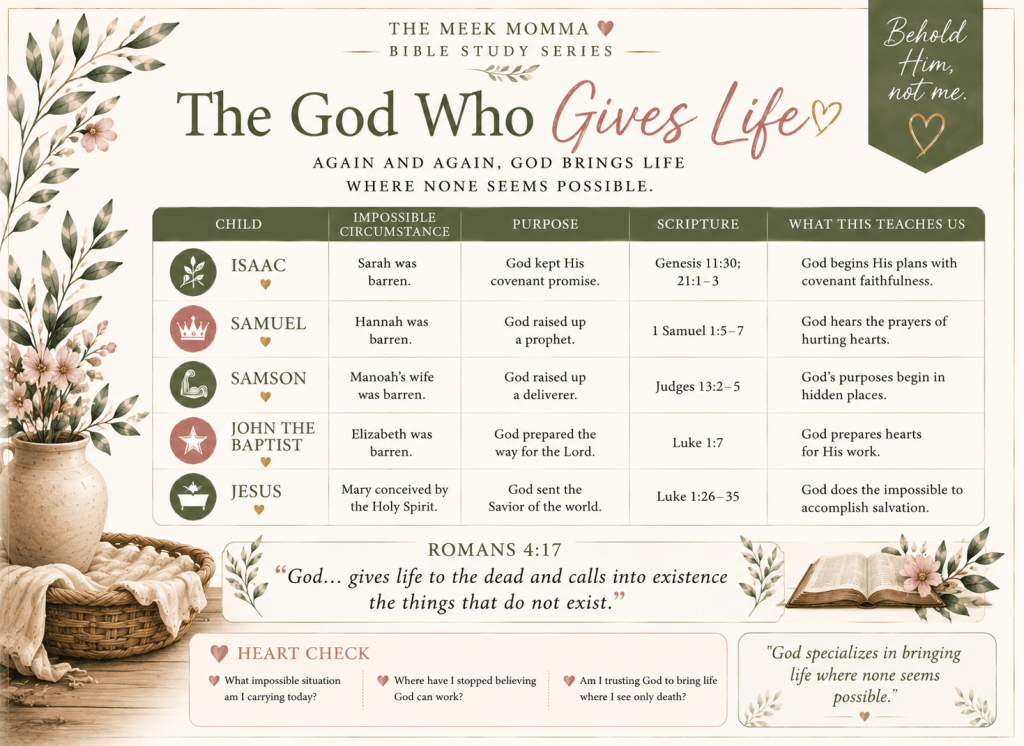
One of the most beautiful themes in Scripture is God’s habit of bringing life from impossible situations.
Samson is not the first miraculous child.
Long before him, there was Isaac.
Sarah was barren.
Yet God gave life.
Then Samuel.
Hannah was barren.
Yet God gave life.
Then John the Baptist.
Elizabeth was barren.
Yet God gave life.
And finally Jesus.
Not conceived through a barren womb but through a virgin.
An even greater miracle.
Each birth announces the same truth:
Salvation belongs to the Lord.
God is demonstrating that His purposes do not depend upon human ability.
He is showing us that redemption is His work from beginning to end.
As Romans 4:17 declares, He is the God:
“who gives life to the dead and calls into existence the things that do not exist.”
Every miraculous birth points us to that reality.
Every impossible pregnancy whispers the same message:
God alone saves.
Samson Points Beyond Himself
Yet there is something striking in the angel’s announcement.
The angel does not say Samson will completely save Israel.
Instead he says:
“He shall begin to save Israel from the hand of the Philistines.” (Judges 13:5)
Begin.
Not finish.
Samson’s salvation would be incomplete.
Like every judge before him, he would ultimately fail.
His victories would be real.
But partial.
His strength would be impressive.
But insufficient.
His life would point beyond itself.
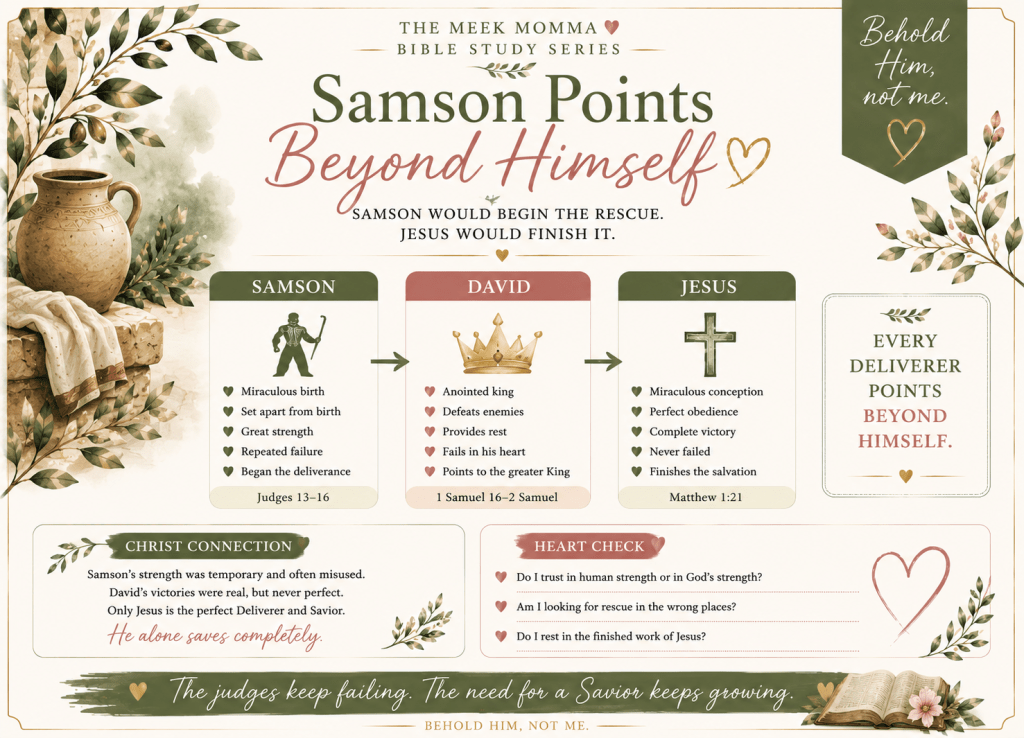
In many ways Samson prepares us for David.
David would accomplish what Samson could not.
He would establish peace and defeat Israel’s enemies.
Yet David would also fail.
His greatest enemies were not outside him but within his own heart.
And so David points beyond himself as well.
Both Samson and David leave us longing for a greater Deliverer.
One who would not merely begin the rescue.
One who would finish it.
The Better Samson
Jesus is everything Samson was supposed to be.
Samson was set apart from birth.
Jesus was set apart before the foundation of the world.
Samson possessed great strength.
Jesus possesses all authority in heaven and on earth.
Samson repeatedly failed.
Jesus never sinned.
Samson began a deliverance he could not complete.
Jesus finished the work completely.
As the angel told Joseph:
“He will save his people from their sins.” (Matthew 1:21)
That is the salvation every judge pointed toward.
That is the salvation every king pointed toward.
That is the salvation every miraculous birth pointed toward.
The story was never ultimately about Samson.
It was always about Christ.
Behold Him, Not Me
The longer I study Judges, the more convinced I become that the book is designed to leave us dissatisfied with human heroes.
Every judge disappoints us.
Every deliverer fails.
Every leader falls short.
The need for a Savior keeps growing.
And that is precisely the point.
Judges is teaching us to stop looking horizontally for salvation and start looking upward.
Not to Samson.
Not to David.
Not to ourselves.
To Jesus.
The One who does not merely begin the rescue.
The One who finishes it.
The One who gives life where there is only death.
The One who sees the forgotten.
The One who keeps every promise.
The One who takes away the sins of the world.
Behold Him, not me.


Leave a Reply