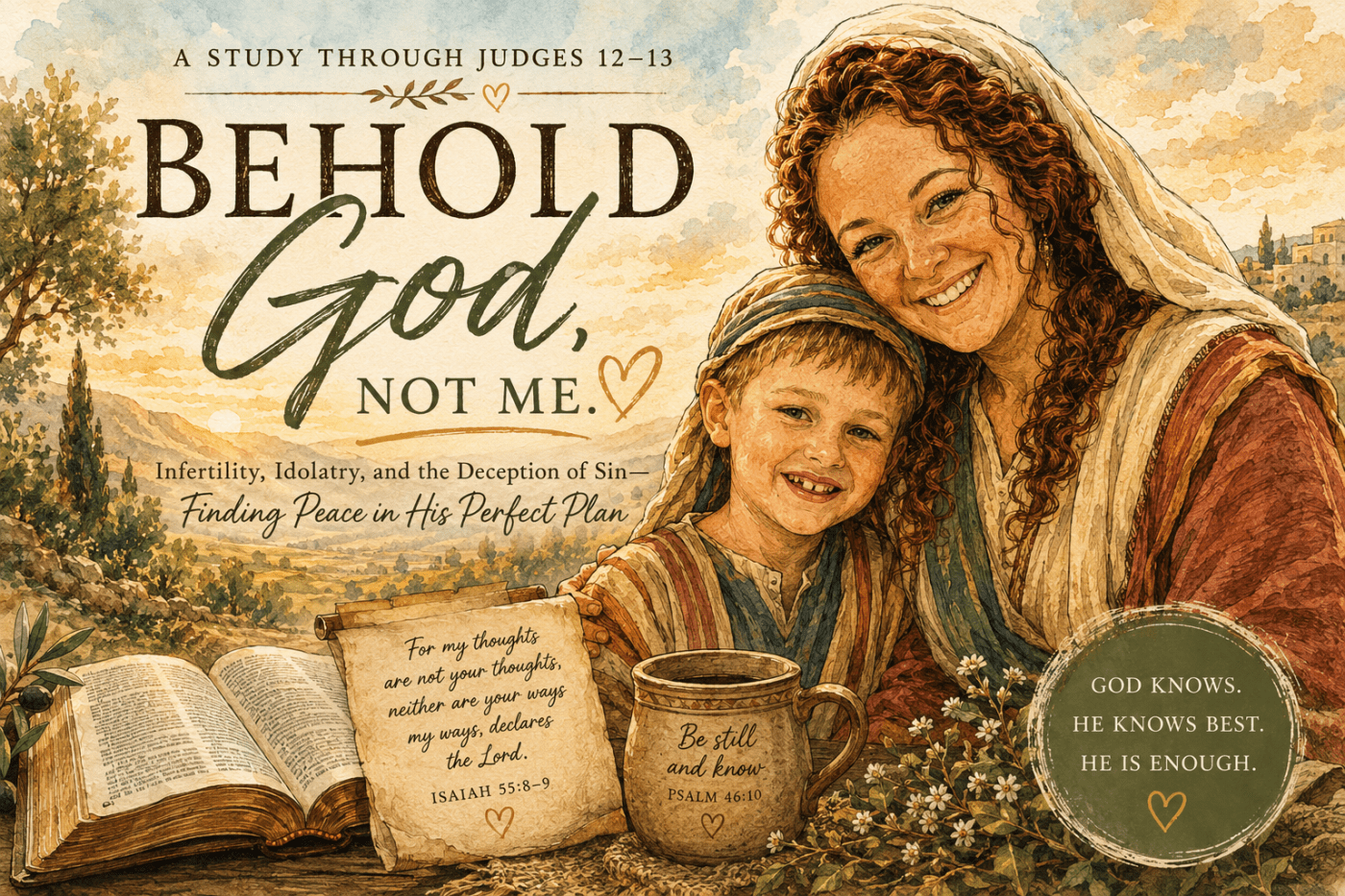
Judges 12-13, Infertility, Idolatry, and the Deception of Sin
One of the things I love most about studying God’s Word verse by verse is that it often confronts me in places I didn’t expect.
Recently, I found myself praying and talking with a friend about a struggle that has resurfaced many times throughout my life: infertility.
For twelve years, my husband and I prayed for a child. Then, in His kindness and perfect timing, God gave us Jackson. What a gift he has been. Yet as Jackson approaches eight years old, our family has not grown in the way I once assumed it would.
Like many women, I was told that once you have one child, having more often becomes easier. That has not been our story.
And if I’m honest, there are days when grief sneaks in.
I see beautiful growing families around me. I celebrate them sincerely because every child is a gift from God. Working in foster care has only deepened that conviction. There is not a single child I believe was born outside the knowledge and purpose of our good Father.
Yet sometimes I still find myself asking, “Lord, why?”
Why do some families grow effortlessly while others wait?
Why are some prayers answered quickly while others seem to linger unanswered?
As always, when I earnestly seek the Lord about the condition of my heart, He faithfully meets me in His Word.

Some Are Increased, Others Are Diminished
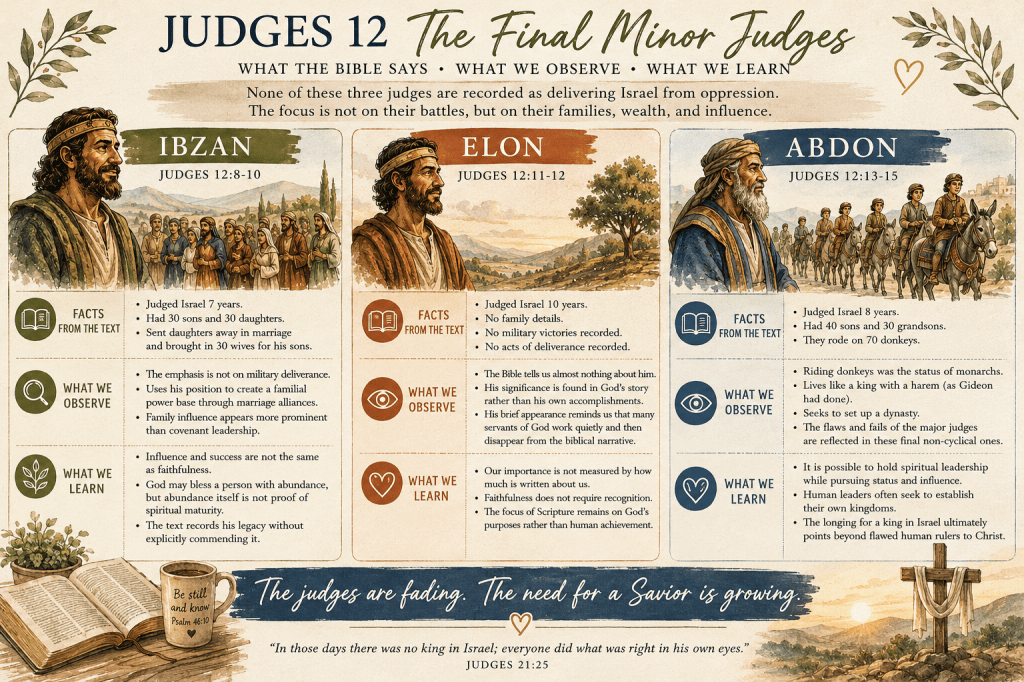
As I was studying the minor judges in Judges 12, I noticed an interesting contrast.
Ibzan had thirty sons and thirty daughters (Judges 12:9).
Earlier in Judges, Jair also had thirty sons.
Yet Jephthah had only one child—a daughter—and through his foolish vow and tragic actions, she never married and left no descendants.
Seventeenth-century commentator Matthew Henry observed:
“Some are increased, others are diminished; both are the Lord’s doing.”
Those words are not easy to accept.
Our hearts naturally want explanations.
We want formulas.
We want reasons.
We want to know why God gives one person abundance while another experiences loss.
Yet Scripture repeatedly reminds us that God’s wisdom exceeds our own.
Isaiah tells us:
“For my thoughts are not your thoughts, neither are your ways my ways, declares the Lord. For as the heavens are higher than the earth, so are my ways higher than your ways and my thoughts than your thoughts.” (Isaiah 55:8-9)
That was exactly the reminder my heart needed.
God knows what He is doing.
God knows me.
God knows what will bring Him glory.
God knows what will make me more like Christ.
And that must be enough.
The Forgotten Judges and the God Who Is Remembered
As I continued reading, I noticed something else.
The Bible gives us only a few details about Ibzan, Elon and Abdon. We learn how long they judged Israel. We learn a few facts about their families. Then their stories end.
At first glance, it almost feels unsatisfying.
We want more details.
We want their stories fully told.
But perhaps that discomfort reveals something about us.
Isn’t that what we want for ourselves?
We want to leave a legacy.
We want to be remembered.
We want our stories to matter.
Yet Scripture consistently directs our attention elsewhere.
The Bible is not ultimately about human greatness.
It is about God’s greatness.
The focus of Scripture is not the lives of judges, kings, prophets, or even ordinary believers.
The focus is Christ.
Every page points to Him.
Even Abdon’s wealth and the mention of his sons riding on donkeys subtly remind us of a greater King who would one day ride into Jerusalem on a donkey, fulfilling prophecy and declaring His kingship.
The judges fade into the background.
Christ remains.
And that leads me to ask an uncomfortable question:
Does my life say, “Behold me,” or “Behold God”?
The Beginning of the Final Cycle
As we enter Judges 13, we begin the final cycle of the book.
The chapter opens with familiar words:
“And the people of Israel again did what was evil in the sight of the Lord.”
We have seen this refrain over and over throughout Judges.
The people sin.
God disciplines them.
They cry out.
God delivers them.
Then the cycle repeats.
Yet there is something particularly significant about this final occurrence.
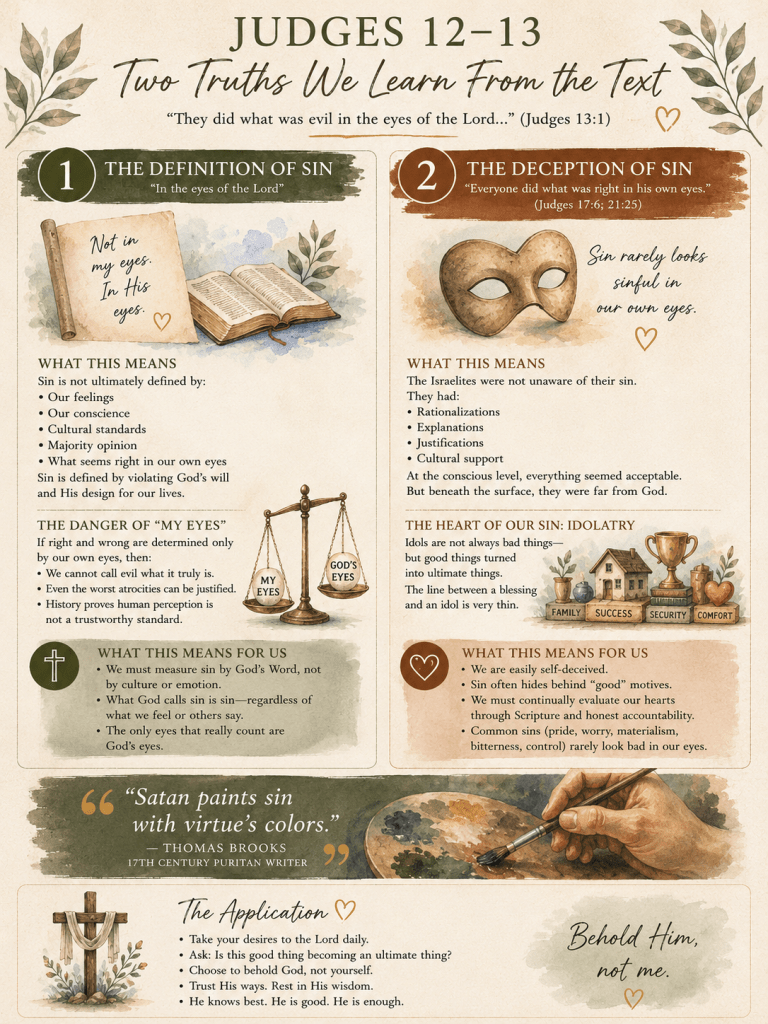
The phrase “evil in the sight of the Lord” highlights a truth our culture desperately needs to hear.
Notice what the text does not say.
It does not say Israel did what was evil in their own eyes.
In fact, later in Judges we encounter another repeated phrase:
“Everyone did what was right in his own eyes.”
The two statements are connected.
The Israelites did not wake up every morning thinking, “Today I will rebel against God.”
They believed their choices were reasonable.
Understandable.
Justified.
Acceptable.
In their own eyes, much of their behavior probably seemed perfectly fine.
Yet God saw things differently.
And therein lies the danger.
What Is Sin?
This passage teaches us something foundational about sin.
Sin is not ultimately defined by my feelings.
Sin is not determined by cultural approval.
Sin is not established by majority opinion.
Sin is not measured by whether my conscience happens to bother me.
Sin is defined by God.
Something is sinful because it violates God’s will and God’s design.
This truth directly contradicts modern thinking.
Our culture continually tells us:
“Follow your heart.”
“Live your truth.”
“You define what is right for you.”
But Scripture says something very different.
If morality is determined only by personal perception, then no one can meaningfully condemn evil.
History itself demonstrates the flaw in that thinking.
People can sincerely believe terrible things.
Groups of people can collectively justify horrific actions.
Human perception is not a trustworthy standard.
Only God is.
The eyes that ultimately matter are not my eyes.
They are God’s.
The Deception of Sin
The second truth we learn is how deceptive sin really is.
The Israelites had convinced themselves they were fine.
They had explanations.
Rationalizations.
Justifications.
At the conscious level, everything seemed acceptable.
But beneath the surface, they had drifted far from God.
That should concern all of us because we are no different.
The most dangerous sins are often not the obvious ones.
The most dangerous sins are the ones we have learned to justify.
Pride.
Bitterness.
Materialism.
Worry.
Control.
Self-reliance.
These sins rarely look sinful in our own eyes.
And this is where the Lord began pressing on my own heart.
When Good Desires Become Ultimate Desires
As I thought about my longing for more children, I realized something uncomfortable.
The desire itself is not sinful.
Children are a blessing.
Family is a gift.
Wanting those things is good.
But good things become idols when they become ultimate things.
The line between loving something and worshiping something is often thinner than we realize.
And I began to wonder:
Had I crossed that line?
Had my desire for more children subtly become a demand?
Was I saying, “God, I know what would be best for my life”?
Was I acting as though God’s gifts were somehow insufficient?
Was I placing myself in the judge’s seat?
Because when I insist that God must give me what I want in order for His plan to be good, I am no longer trusting Him.
I am attempting to replace Him.
That is the essence of idolatry.
An idol is not always a bad thing.
More often, it is a good thing that has become an ultimate thing.
Tim Keller famously described idols as good things turned into god things.
Family can become an idol.
Ministry can become an idol.
Work can become an idol.
Even motherhood can become an idol.
Anything we place above trustful submission to God becomes a rival to Him.
As the Puritan Thomas Brooks wisely wrote:
“Satan paints sin with virtue’s colors.”
The idol never announces itself as an idol.
It disguises itself as wisdom.
Responsibility.
Love.
Good stewardship.
Common sense.
And before we realize it, our hearts have drifted.
Behold God
That is why we must constantly evaluate ourselves through Scripture.
Not through culture.
Not through emotions.
Not through popular opinion.
Through God’s Word.
The Word reveals what our hearts often hide.
And when it does, our response should not be despair.
It should be worship.
Because the goal of our lives is not ultimately to get everything we want.
The goal is not to have our preferred story.
The goal is not even to be remembered.
The goal is to behold God.
The minor judges came and went.
Their stories occupy only a few verses.
Yet God’s purposes prevailed.
Their significance was not found in the size of their role.
It was found in the God who authored the story.
The same is true for us.
Whether God increases or diminishes.
Whether He gives or withholds.
Whether our stories look ordinary or extraordinary.
He remains worthy.
And so today, I find myself returning once again to Isaiah 55.
His ways are higher than my ways.
His thoughts are higher than my thoughts.
He knows what is best.
He knows my heart.
He is trustworthy.
And when I preach that truth to myself, it changes everything.
Behold Him, not me.


Leave a comment