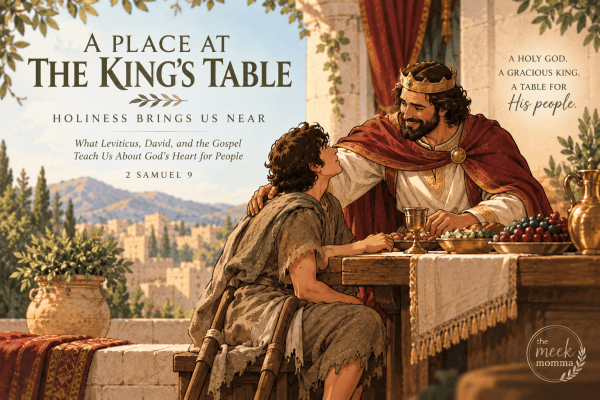
A Place at the Kingโ€™s Table

What Leviticus 21โ€“22, David, and the Gospel Teach Us About Holiness, Grace, and Belonging


A Note Before We Begin

As I have been studying through Leviticus 21โ€“22, I have found myself slowing down over some passages that can be difficult for modern readers to hear.

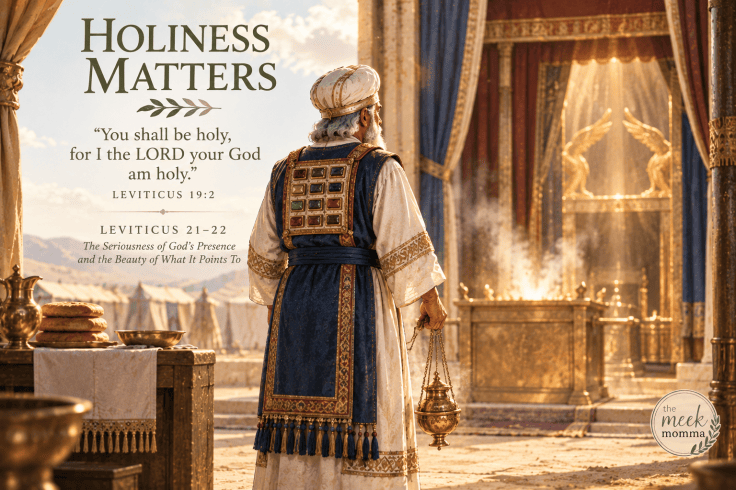
The Lord gives Moses instructions concerning the descendants of Aaron who would serve as priests. Among those instructions, we read that a priest with certain physical blemishes or disabilities was not to approach the altar to offer the Lordโ€™s food offerings or go through the veil.

At first glance, these passages can be jarring.

And because of that, I think we need to slow down and let the text say what it actually says rather than allowing our first reaction to determine what we believe it means.

Leviticus 21 is not teaching that a person with a disability is less valuable, less loved, or somehow unacceptable to God.

The restriction concerns the priestly function of approaching the altar and performing particular sacred duties.

In fact, there is a detail in this passage that is easy to miss.

The priest who had a physical blemish was still permitted to eat the bread of his God, both the most holy and the holy things (Leviticus 21:22).

He was restricted from performing a particular priestly function.

He was not cast away from Godโ€™s provision – This to me reveals the heart of our God.

The priesthood and sacrificial system communicated through visible, tangible realities. The sacrifices were to be without blemish. The priests who approached the altar were given corresponding physical qualifications. These requirements belonged to the symbolic language of Israelโ€™s worship and helped communicate the holiness, completeness, and sacredness of the work being performed.

The priesthood was pointing beyond itself.

Hebrews tells us that Jesus is our perfect High Priest:

โ€œHoly, innocent, unstained, separated from sinners, and exalted above the heavens.โ€
โ€” Hebrews 7:26

What Israelโ€™s priesthood could only imperfectly portray, Christ fulfills completely.

And yet, as I sat with these passages, I kept thinking about someone else.

Mephibosheth.

And that is where this study took me next.


A Man Who Was Far Off

Mephibosheth was the son of Jonathan and the grandson of Saul.

When he was five years old, news came that Saul and Jonathan had died in battle. His nurse picked him up and fled, but in the process he fell and became disabled in both feet (2 Samuel 4:4).

Years later, David became king.

And David did something unexpected.

He asked:

โ€œIs there still anyone left of the house of Saul, that I may show him kindness for Jonathanโ€™s sake?โ€
โ€” 2 Samuel 9:1

Eventually David learns about Mephibosheth.

And Mephibosheth is brought before the king.

Imagine what that must have felt like.

He was the grandson of Saul, the former king. His father, Jonathan, was dead. His grandfather was dead. He was living in Lo-debar, far from the center of the kingdom.

And now he was being summoned into the presence of David.

He falls on his face.

David tells him not to be afraid.

Then David gives him something he could never have secured for himself:

his inheritance.

David restores to Mephibosheth all the land that had belonged to Saul.

But David doesnโ€™t stop there.

He says:

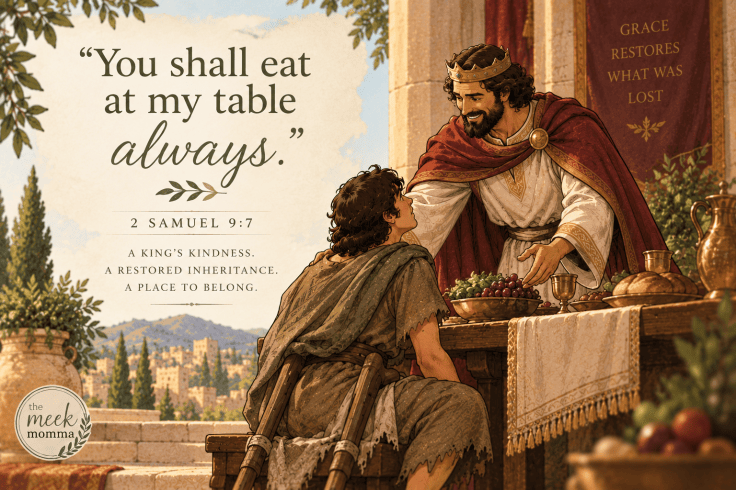
โ€œYou shall eat at my table always.โ€
โ€” 2 Samuel 9:7

And the text repeats the picture:

โ€œSo Mephibosheth ate at Davidโ€™s table, like one of the kingโ€™s sons.โ€
โ€” 2 Samuel 9:11

That is the part that stopped me.

Because Mephibosheth did not walk into the kingโ€™s presence because he had made himself worthy.

He didnโ€™t restore his own inheritance.

He didnโ€™t earn his invitation.

He didnโ€™t change the condition of his feet before he was welcomed.

The king extended kindness to him.


Holiness Matters

At this point, it would be easy to make the story of Mephibosheth into a simple illustration about acceptance. However, Leviticus is teaching us something we desperately need to remember:

Holiness matters.

God is holy.

His presence is holy.

His worship is holy.

His sacrifices are holy.

His priesthood is holy.

And approaching Him is not something to be treated casually.

Leviticus 21โ€“22 reminds Israel that the things associated with Godโ€™s presence were not ordinary things.

The priests were not ordinary representatives.

The sacrifices were not ordinary meals.

The altar was not an ordinary place.

God was teaching His people through physical realities that He is holy.

And that holiness ultimately points us toward Christ.

The priests of Israel were not the final answer.

The sacrifices were not the final answer.

The earthly tabernacle was not the final answer.

They were shadows and signs pointing forward to the One who would perfectly fulfill what they could only portray.

Jesus is the spotless sacrifice.

Jesus is the perfect High Priest.

Jesus is holy, undefiled, and without sin.

And because of Him, something extraordinary happens.


From Far Off to Near

Paul writes to the Ephesians:

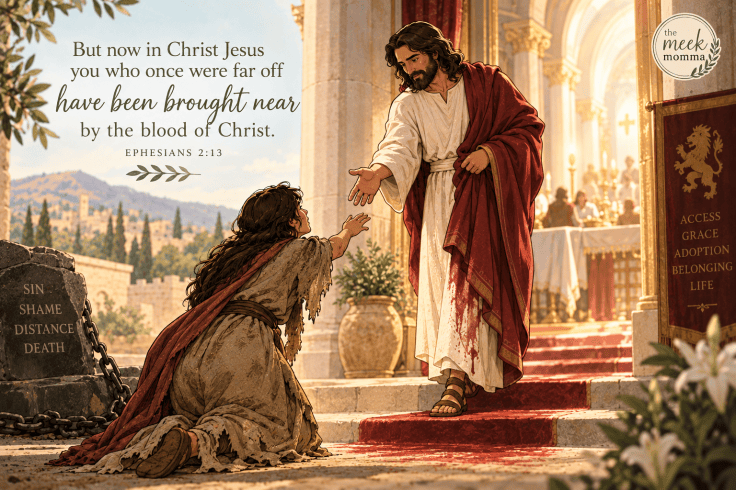
โ€œBut now in Christ Jesus you who once were far off have been brought near by the blood of Christ.โ€
โ€” Ephesians 2:13

There it is.

Far off.

Brought near.

That language ignites a fire within me as I reflect on the profound movement we’ve witnessed throughout Scripture!

Genesis introduces the problem.

Exodus establishes Godโ€™s presence among His people.

Leviticus teaches Israel how to live in the presence of a holy God.

And then, throughout the rest of Scripture, we begin to see Godโ€™s redemptive plan unfold until we arrive at Christ.

The God who dwells among His people makes a way for sinners to draw near.

Not because we have made ourselves clean.

Not because we have made ourselves worthy.

Not because we have repaired everything that is broken.

But because Christ has made a way.

Paul says that those who were once far off have been brought near by the blood of Christ.

That is not sentimental language.

It is sacrificial language.

It takes us right back to the world of Leviticus.

Blood mattered because life mattered.

Sacrifice mattered because sin mattered.

Holiness mattered because God Himself is holy.

And all of those things ultimately point us toward Jesus.


A King Who Welcomes the Unworthy

This is where I think 2 Samuel 9 becomes such a beautiful companion to what we are seeing in Leviticus.

I donโ€™t mean that Mephibosheth is a direct prophecy of Jesus.

Scripture doesnโ€™t tell us to read the story that way.

And I donโ€™t want to force a connection simply because it makes for a beautiful illustration.

But Scripture does allow us to trace themes.

And one of those themes is gracious welcome.

Mephibosheth comes before the king knowing he has nothing to offer.

At one point he even describes himself as a โ€œdead dogโ€ (2 Samuel 9:8).

Yet David restores what was lost and gives him a permanent place at his table.

There is something profoundly beautiful about that picture.

The kingโ€™s kindness creates belonging.

And that makes me think again about the difficult passage in Leviticus.

The priest with a physical blemish was not worthless.

He was not beyond Godโ€™s provision.

He was still permitted to eat the holy things.

His restriction concerned his priestly function.

And Mephiboshethโ€™s disability did not prevent him from being welcomed to the kingโ€™s table.

These truths belong together.

Holiness does not mean that people with disabilities are less valuable.

And grace does not mean that holiness doesnโ€™t matter.

Both are true.

God is holy.

And God is gracious.


The Table

There is something about a table that communicates belonging.

To eat at someoneโ€™s table is to be welcomed.

To have a place at the table is to belong.

And David doesnโ€™t merely tell Mephibosheth that he may visit.

He says:

โ€œYou shall eat at my table always.โ€

And the narrator emphasizes it again:

โ€œLike one of the kingโ€™s sons.โ€

Mephiboshethโ€™s identity at the table was no longer defined by what he had lost.

He was defined by the kindness that had been extended to him.

And this is where my thoughts eventually move from David to Christ.

Because the gospel tells us that we, too, were once far off.

We were separated from God.

We could not make ourselves worthy of His presence.

We could not repair the breach ourselves.

But God did what we could not do.

Christ brought us near.


A Better High Priest

Leviticus teaches us to take holiness seriously.

Hebrews teaches us why.

The priests of Israel were imperfect.

Their sacrifices had to be repeated.

Their service was temporary.

But Jesus is different.

He is the perfect High Priest.

He does not need to offer sacrifice for His own sin.

He does not need to repeat His sacrifice.

He does not enter an earthly sanctuary that will eventually pass away.

He enters the true presence of God on our behalf.

And His sacrifice is sufficient.

The spotless Lamb became the sacrifice.

The perfect High Priest offered Himself.

And through His blood, those who were far off are brought near.

That changes everything.


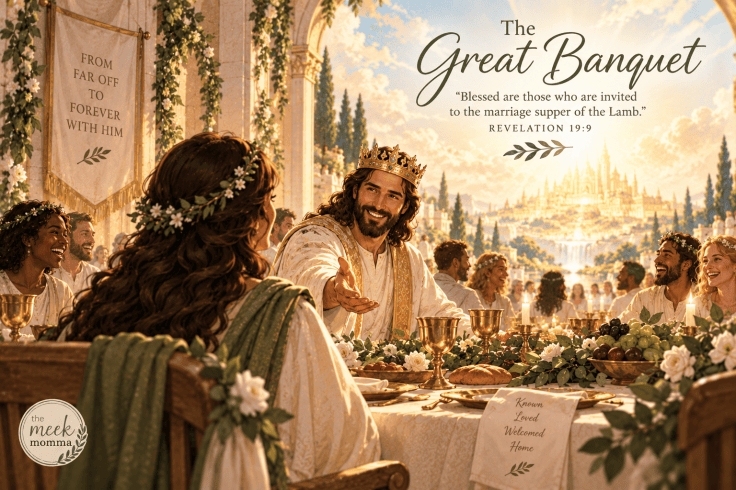
From the Kingโ€™s Table to the Great Banquet

The Bible begins with humanity separated from God because of sin.

But Scripture doesnโ€™t end there.

It ends with Godโ€™s people dwelling with Him.

And the language of Scripture eventually brings us to another table.

A greater banquet.

Revelation 19:9 says:

โ€œBlessed are those who are invited to the marriage supper of the Lamb.โ€

The invitation is not something we earned.

It is grace.

The table is not something we built.

The King prepared it.

And the One who makes our invitation possible is the Lamb who was slain.

This is why I donโ€™t want to rush past the difficult passages in Leviticus.

They teach us something precious.

Godโ€™s holiness is not a small thing.

His presence is not casual.

Sin is not insignificant.

Sacrifice is not meaningless.

The Scriptures are the story of a holy God making a way to bring His people near.


Come Near

Maybe that is the question I am left with after studying these passages:

Do I really understand what it means that I have been brought near?

We can become so familiar with the language of Christianity that we forget how astonishing it is.

I was far off.

You were far off.

And Christ brought us near.

Not through our goodness.

Not through our religious performance.

Not through our ability to make ourselves whole.

By His blood.

That is grace.

And perhaps this is part of what makes the story of Mephibosheth so beautiful.

He didnโ€™t have to become worthy of the table before he could sit at it.

The kingโ€™s kindness gave him a place.

And while Davidโ€™s table was only a small picture within the larger story of Scripture, it gives us a glimpse of something wonderful:

There is a King who welcomes the undeserving.

There is a King who restores what was lost.

There is a King who brings the far-off near.

And there is a King who has prepared a table that will never end.

So let us not diminish holiness.

Let us not minimize sin.

Let us not make the cross small.

Instead, let the holiness of God make the grace of God even more astonishing.

Because the greater our understanding of Godโ€™s holiness, the greater our wonder should be that He has made a way for us to come near.

And one day, by the grace of Christ, we will see the fulfillment of it all.

Not merely a place at an earthly kingโ€™s table.

But a place at the marriage supper of the Lamb.

Come hungry.

The King has made a place.

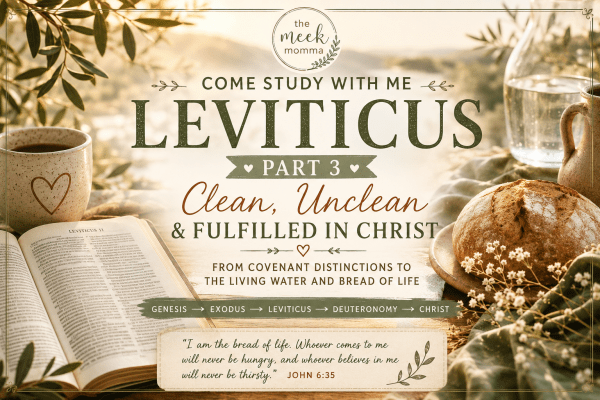
COME STUDY WITH ME

Notes from Leviticus โ€” Part 3

Clean, Unclean & Fulfilled in Christ

As we study Leviticus 11, one thing becomes clear: the distinction between clean and unclean did not begin with Moses.

In Genesis 7:2, Noah already knows the distinction between clean and unclean animals. In Genesis 8:20, he offers clean animals and birds to the LORD.

Then, in Exodus, God forms Israel as His covenant people and establishes His dwelling place among them. In Leviticus, He gives increasingly specific instructions concerning sacrifice, purity, priesthood, holiness, and food.

Deuteronomy later reiterates many of these dietary distinctions.

The pattern is unfolding:

Genesis โ†’ Exodus โ†’ Leviticus โ†’ Deuteronomy

God progressively reveals what it means for His covenant people to live in relationship with a holy God.

But what does โ€œcleanโ€ actually mean?

This is important:

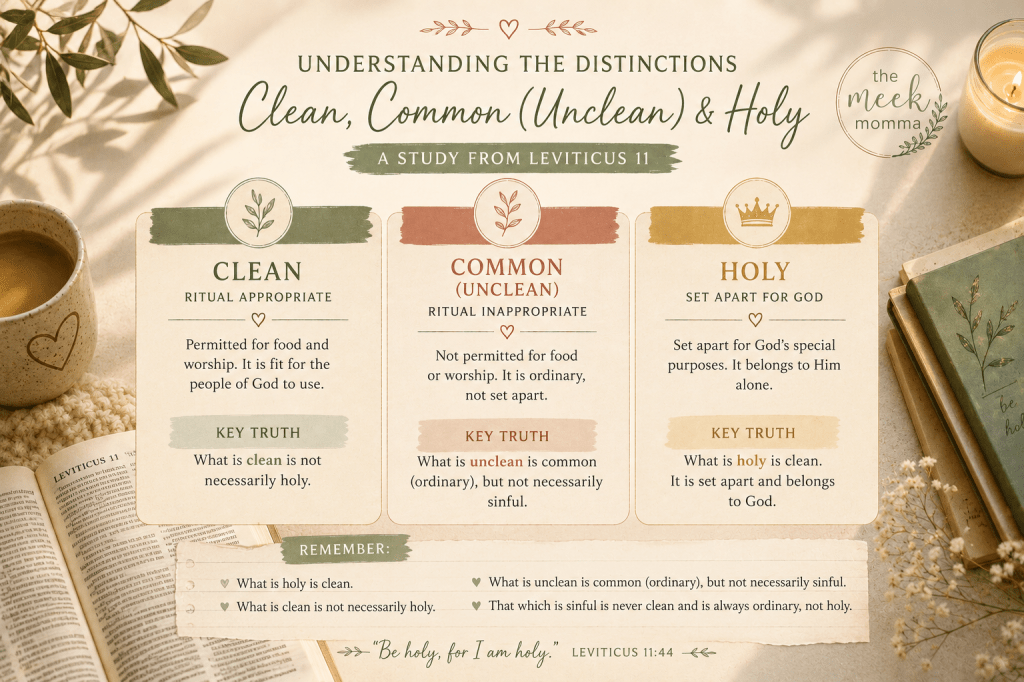
Unclean does not automatically mean sinful.

Something could be ritually unclean without being morally sinful.

Likewise, something could be clean without being holy.

These categories help us understand Leviticus more carefully:

Holy โ†’ clean
Clean โ†’ not necessarily holy
Unclean โ†’ not necessarily sinful
Sinful โ†’ never holy or clean

The purity laws were teaching Israel to recognize distinctions and boundaries as they lived in the presence of a holy God.

Then Jesus changes the conversation.

Jesus teaches that defilement is not ultimately about what enters a person from the outside, but what comes from the heart (Mark 7:14โ€“23).

In Acts 10, Peter receives a vision involving animals previously considered unclean. God tells him:

โ€œWhat God has made clean, do not call common.โ€

Peter comes to understand that the vision reaches beyond food. God was showing him that Gentiles were not to be considered spiritually unclean or excluded from Godโ€™s people.

Through Christ, the ceremonial boundaries that once distinguished Israel from the nations are fulfilled and transformed.

And this is where the story becomes beautiful.

Jesus doesnโ€™t simply make food clean.

Jesus makes people clean.

He doesnโ€™t merely provide another ritual washing.

He gives living water.

โ€œIf anyone thirsts, let him come to me and drink.โ€
โ€” John 7:37

He doesnโ€™t simply give bread to sustain physical life.

He is the Bread of Life.

โ€œI am the bread of life.โ€
โ€” John 6:35

The Old Testament repeatedly teaches us about cleansing, sacrifice, priesthood, blood, holiness, food, and access to Godโ€™s presence.

The New Testament shows us their greater fulfillment in Christ:

The sacrifice โ†’ Christโ€™s once-for-all atonement

The priesthood โ†’ Christ our great High Priest

Cleansing โ†’ Christ makes His people clean

Access to God โ†’ Christ brings us near

The bread that sustains โ†’ Christ, the Bread of Life

The water that cleanses and gives life โ†’ Christ, the Living Water

And the important thing is that we donโ€™t have to force these connections. The New Testament itself develops them.

Hebrews tells us that the sacrificial system was pointing toward something greater:

โ€œThe law has but a shadow of the good things to come.โ€
โ€” Hebrews 10:1

The Bigger Story

Leviticus is not a disconnected collection of strange rules.

It is part of a story that begins much earlier.

Genesis: God establishes His creation and we see humanityโ€™s separation from Him.

Exodus: God rescues His people and comes to dwell among them.

Leviticus: God teaches His people how to live in the presence of a holy God.

Deuteronomy: God reiterates the covenant and calls His people to faithful obedience.

The New Testament: Christ fulfills the purposes toward which these things were pointing.

And the question underneath Leviticus remains the same:

How can a holy God dwell with sinful people?

The answer that unfolds throughout Scripture is not ultimately a ritual, a sacrifice, a food, or a purification ceremony.

God Himself makes the way.

And in the New Covenant, that way is Jesus Christ.

โ€œFor by a single offering he has perfected for all time those who are being sanctified.โ€
โ€” Hebrews 10:14

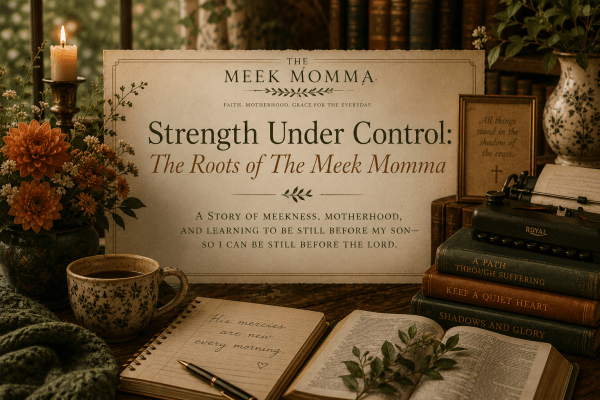
The Roots of the Meek Momma

One of my favorite Elisabeth Elliot quotes has always been this:

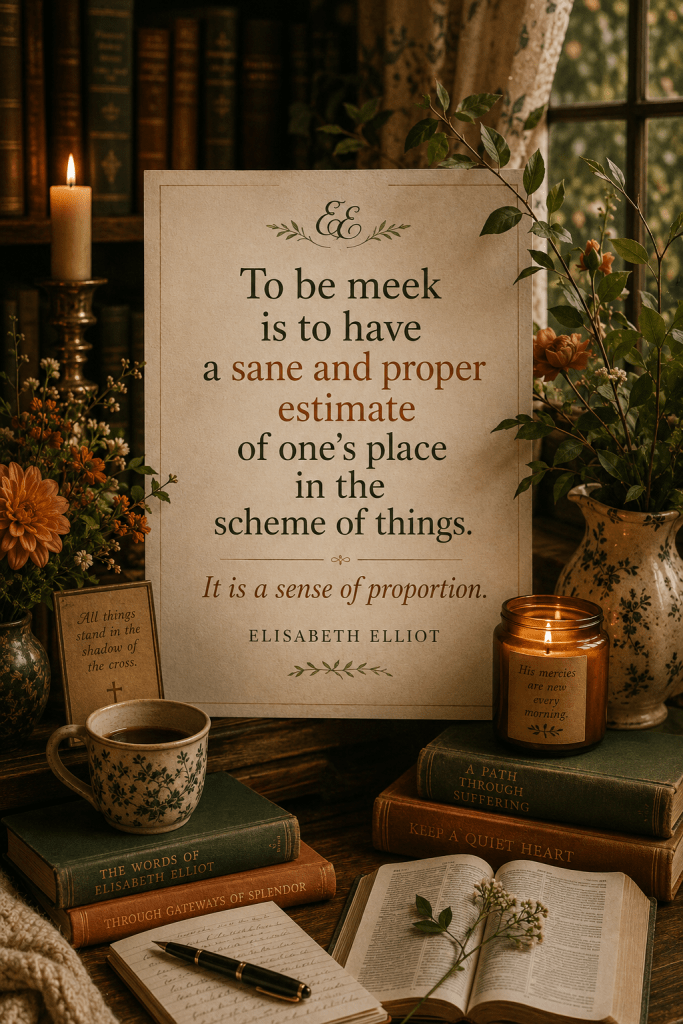
โ€œTo be meek is to have a sane and proper estimate of oneโ€™s place in the scheme of things. It is a sense of proportion.โ€

Elisabeth Elliot has been something of a spiritual mother to me. I have read her words in many different seasons, and depending on where I was in life, they have felt like correction, a lecture, encouragement, or sometimes simply a soft place to land. There were times I read her words and felt as though I were being lovingly disciplined by an older woman who had walked through suffering and knew something I desperately needed to learn.

One of the things she helped me understand was that meekness is not weakness. It is strength under control. It is having a right understanding of who I am in relation to God: I am the created, and He is the Creator. I am not sovereign, I am not in control of everything, and I donโ€™t have to be.

That realization changed the way I looked at my life, particularly motherhood.

When my son was very young, during the isolation of COVID and the months surrounding his autism diagnosis, his needs and behaviors were becoming increasingly difficult to understand. He was nonverbal at the time, and sleep became almost nonexistent. There were months when I was getting less than ten hours of sleep in an entire week.

Looking back, it is remarkable to me that I was still functioning. I was caring for my son, tending to our home, continuing to work, and trying to learn everything I could about autism while running on almost nothing.

But I know now that it wasnโ€™t because I was strong enough. God was sustaining me.

I remember one particular night, around three in the morning, after two days without sleep. My son woke me by slapping me in the face. He wasnโ€™t being aggressive or disobedient. He was nonverbal and simply trying to wake Mommy because Mommy wasnโ€™t waking up.

For the first few seconds after waking, I had an overwhelming urge to hit him back.

I was angry. I was exhausted. I was completely at the end of myself.

And as painful as it is to admit that, I am grateful for what God showed me in that moment. I saw my flesh in a way I donโ€™t think I ever had before. I saw how quickly my exhaustion could expose the sinfulness of my heart. I saw how desperately I needed a Savior.

Being at the end of myself became an invitation to stop pretending that I could be sufficient for myself.

I began learning to pursue the Lord even when I didnโ€™t feel like pursuing Him. Sometimes all I had to offer was five minutes of Scripture or ten minutes of prayer. Then five minutes became ten, ten became twenty, and eventually those small pieces of time became hours.

Some of my sweetest times with the Lord happened in the middle of the night while my son paced back and forth or watched the same short documentaries over and over again. I would sit with my Bible and pray, asking God to change me and make me the mother my son needed.

And then there were the bathtubs.

For a long time, water was one of the few things that helped my son regulate and feel safe in his body. So I spent a lot of time sitting beside the bathtub. Sometimes for hours. Sometimes more than once a day. Because of the safety concerns, I couldnโ€™t simply leave him there. I had to stay.

I remember lying beside that bathtub and thinking about all the things I was missing out on. Motherhood was supposed to look so different. I had imagined something quieter and more predictable.

But somewhere in those long hours of forced stillness, I began to realize that maybe motherhood hadnโ€™t gone wrong. Maybe this was simply what motherhood needed to look like in that particular season.

And I remember what felt like the quietest conviction from the Lord:

If you cannot be still before your son, how will you ever learn to be still before Me?

Those moments of stillness, along with the long nights of being completely dependent upon Godโ€™s grace, eventually became the beginning of The Meek Momma.

I didnโ€™t start this blog because I had figured motherhood out. I started it because I hadnโ€™t.

I needed somewhere to put the honest emotions, the questions, the Scripture I was wrestling through, and the things God was teaching me. I hoped that perhaps another woman could read those words and find encouragement before she reached the same place of exhaustion and desperation.

Because the Lord gives us opportunities every day to turn toward Him. His mercies are new every morning.

And I think that is part of what meekness has come to mean to me.

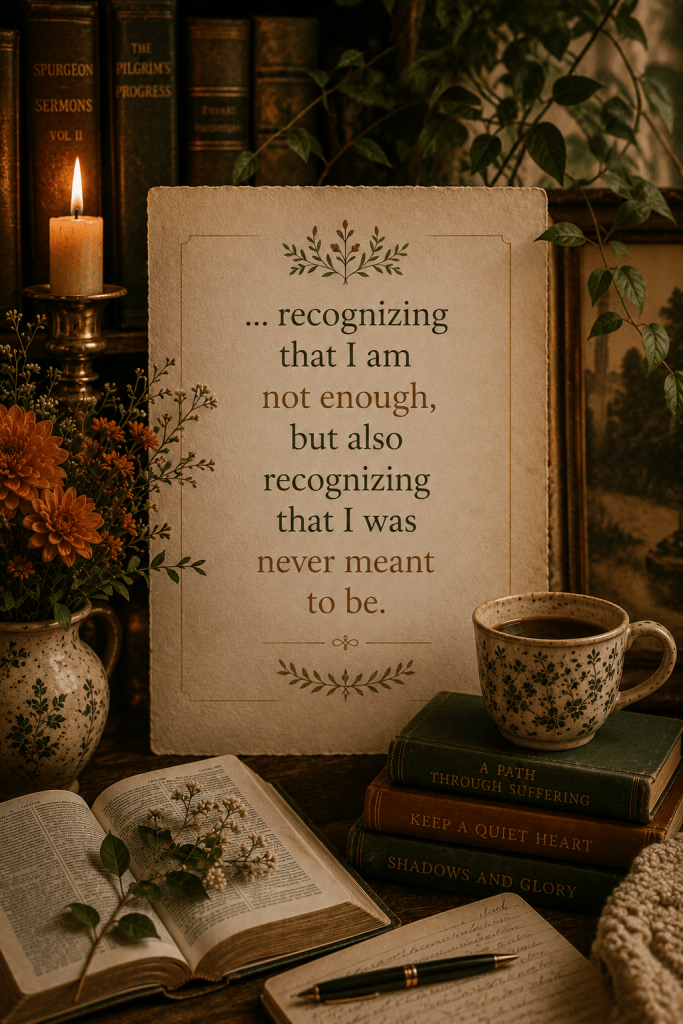
It is recognizing that I am not enough, but also recognizing that I was never meant to be.

It is learning to live within the boundaries of my created place rather than constantly fighting to take Godโ€™s place. It has changed the way I think about my marriage, my motherhood, my work, my leadership, my finances, my service to others, and even the way I respond when I believe I know what should happen next.

It has also changed the way I understand submission.

I believe submission to a husband, rightly understood through Scripture, is a beautiful thing. It does not require a woman to become voiceless, passive, or insignificant. It is not an erasure of strength. Rather, it is one of the places where strength can be brought under control and entrusted to God.

There is something beautiful about a woman who doesnโ€™t have to dominate every room, win every argument, control every outcome, or prove that she is the strongest person present.

There is strength in knowing when to speak and when to be quiet. There is strength in yielding. There is strength in serving. There is strength in trusting Godโ€™s order when our flesh would rather insist on our own.

That is why I love this definition of meekness so much.

A sane and proper estimate of my place in the scheme of things.

Not thinking too highly of myself, but not thinking too little of myself either. Simply understanding that I am Godโ€™s creation, He is my Creator, and my life makes the most sense when I live within that reality.

I am still learning this.

I am learning it in my home, in my marriage, in my work, in the courtroom, in leadership, and in the way I serve families and volunteers. I still wrestle with my desire to control. I still have moments when my flesh gets the better of me. But now I know where to take those things.

Back to Him.

Elisabeth Elliot taught me that suffering is never for nothing. She helped me understand that all things stand in the shadow of the cross, and that when I keep my eyes there, I can begin to count even the hardest things as joyโ€”not because suffering is enjoyable, but because God is faithful to use even what I would never have chosen.

This is why I chose the name The Meek Momma all those years ago.

Not because I had mastered meekness.

Because I needed to learn it.

And, by Godโ€™s grace, I am still learning.

Come Study With Me 2: Notes from Leviticus

Notes on the Sacrificial System

Sacrifice of some kind was a nearly universal practice among ancient peoples. Israelโ€™s sacrificial system shared certain similarities with the practices of surrounding nations, but it was also distinctly different in several important ways.

1. Israelโ€™s Absolute Monotheism

Israel worshiped one true God, Yahweh. The sacrificial system was not created by Israel as a means of manipulating multiple competing gods. God Himself gave Israel specific instructions for worship and sacrifice as part of His covenant relationship with them.

2. Sacrifice Was Connected to Holiness, Ethics, and Obedience

Israelโ€™s worship was rooted in the character of God Himself. Because God is absolutely holy, His people were called to holiness.

The sacrificial system was therefore connected to sin, repentance, atonement, forgiveness, and obedience to Godโ€™s covenant commands. Sacrifice was never intended to replace faithful obedience.

โ€œYou shall be holy, for I the LORD your God am holy.โ€
โ€” Leviticus 19:2

The prophets repeatedly reinforce this truth: God does not delight in ritual performed apart from righteousness and obedience (1 Samuel 15:22; Isaiah 1:11โ€“17; Hosea 6:6; Micah 6:6โ€“8).

3. Israel Was Forbidden to Incorporate Magic and Occult Practices

Israelโ€™s worship was not to be blended with the religious practices of the surrounding nations. God explicitly prohibited magic, sorcery, divination, necromancy, and related practices (Leviticus 19:26, 31; 20:6; Deuteronomy 18:9โ€“14).

Biblical sacrifice was never magic. It was not a technique for manipulating God or forcing Him to provide a desired outcome.

4. Israelโ€™s Sacrificial System Had a High Moral Character

The biblical sacrificial system was fundamentally different from fertility religions and other surrounding practices. Israel was prohibited from incorporating ritual prostitution, sexual immorality, occult practices, and human sacrifice into its worship (Leviticus 18:21; Deuteronomy 18:9โ€“14).

Israelโ€™s worship was to reflect the holiness of the God they worshiped.


Sacrifice Before Sinai

Sacrifice did not begin with the Mosaic covenant.

Long before Leviticus, Scripture records people offering sacrifices to God:

  • Cain and Abel โ€” Genesis 4:3โ€“5
  • Noah โ€” Genesis 8:20โ€“22
  • Abraham โ€” Genesis 12:7โ€“8 and following
  • Job โ€” Job 1:5

The biblical record clearly demonstrates that sacrifice was practiced among Godโ€™s people long before the detailed sacrificial laws given through Moses.

The Mosaic covenant therefore revealed and regulated Israelโ€™s sacrificial worship within their covenant relationship with God.


Cain and Abel: The Importance of the Worshiper

Genesis 4:3โ€“5 gives us one of Scriptureโ€™s earliest accounts of sacrifice.

Cain brought an offering from the fruit of the ground, while Abel brought the firstborn of his flock and their fat portions.

God regarded Abel and his offering, but did not regard Cain and his offering.

The text does not explicitly state that Cain offered his โ€œsecond best.โ€ What it does emphasize is that Abel brought the firstborn and the fat portionsโ€”the valuable portions of his flock.

The following conversation with Cain makes clear that the issue was not merely the physical offering. God addresses Cainโ€™s conduct and heart:

โ€œIf you do well, will you not be accepted?โ€
โ€” Genesis 4:7

The story therefore establishes an important biblical principle:

God cares about both the offering and the heart of the worshiper.


Why Cain and Abel Matter

The story appears remarkably early in Scripture, before Sinai, the tabernacle, the priesthood, or the Levitical system.

Already, Scripture is asking:

What does it mean to approach God rightly?

Cain and Abel introduce a theme that will continue throughout Scripture:

Worship cannot be separated from the heart and conduct of the worshiper.

This becomes essential for understanding the sacrifices of Leviticus. The sacrifices were not empty rituals performed mechanically. They belonged within a relationship of covenant faithfulness, holiness, repentance, and obedience.


Noah: Sacrifice and Covenant Grace

After the flood, Noah built an altar and offered burnt offerings to the LORD (Genesis 8:20โ€“22).

The LORD received Noahโ€™s offering as a pleasing aroma and then declared His commitment to preserve the regular rhythms of creation:

โ€œWhile the earth remains, seedtime and harvest, cold and heat, summer and winter, day and night, shall not cease.โ€
โ€” Genesis 8:22

The passage should not be understood as though Noahโ€™s sacrifice manipulated God or changed Him from anger to mercy.

Rather, the sacrifice occurs within the larger story of judgment, grace, and covenant promise. God graciously commits Himself to sustaining His creation despite humanityโ€™s continuing sinfulness.

This gives us an early biblical pattern:

Judgment โ†’ Sacrifice โ†’ Covenant Promise โ†’ Sustaining Grace


A Foundation for Studying Leviticus

As we enter Leviticus, we should first ask what each sacrifice meant within Israelโ€™s own covenant relationship with God.

For each sacrifice, consider:

  1. What was being offered?
  2. Who brought the offering?
  3. What was the worshiper required to do?
  4. What did the priest do?
  5. What happened to the blood and offering?
  6. What portion belonged to God?
  7. What portion, if any, belonged to the worshiper or priest?
  8. What problem or need did the sacrifice address?
  9. How did it relate to holiness, sin, forgiveness, fellowship, or thanksgiving?
  10. How does the rest of Scripture develop this theme?
  11. Where does the New Testament explicitly connect these themes to Jesus Christ?

This allows us to trace the sacrificial system toward Christ without forcing meanings onto the text that Scripture itself does not establish.


Key Thought

Sacrifice was never merely about putting something on an altar.

From the earliest pages of Scripture, sacrifice is connected with approaching God, responding to sin, worshiping rightly, honoring Godโ€™s holiness, and living in covenant relationship with Him.

Israelโ€™s sacrificial system was not unique simply because Israel sacrificed. It was unique because Yahwehโ€”the one true and holy Godโ€”revealed how His covenant people were to worship and approach Him.

As we study Leviticus, we will see the altar continually teaching Israel that:

sin is serious, God is holy, forgiveness is costly, and fellowship with God is a gracious gift.

COME STUDY WITH ME

Notes from Leviticus

Post 1 โ€” Meet the Book

The book of Leviticus begins precisely where Exodus leaves off.

The tabernacle has been completed, and the glory of the LORD has filled it. Godโ€™s presence is so overwhelming that Moses is unable to enter the tent of meeting (Exodus 40:34โ€“35).

That detail is important.

Leviticus begins with a question:

How can a holy God dwell among an unholy people?

Leviticus breaks from much of the narrative structure of Genesis and Exodus and moves primarily into instructions concerning sacrifices, priesthood, purity, holiness, worship, and covenant life.

But these laws are not random regulations.

Mosesโ€™ inability to enter the tabernacle establishes the theological problem that drives the book:

God is holy, and His people are not.

God desires to dwell among His people, yet His holiness cannot simply overlook sin and impurity. Leviticus therefore explains how Israel is to approach God, worship Him, deal with sin and ritual impurity, and live as a people set apart for His presence.

The sacrificial system provided God-appointed means of atonement, purification, forgiveness, and restored fellowship within the Mosaic covenant.


Three Major Areas of Leviticus

The laws of Leviticus can broadly be understood through three overlapping areas:

1. Ritual

These instructions govern Israelโ€™s worshipโ€”particularly sacrifices, offerings, festivals, holy days, and other prescribed rituals.

2. Priesthood

These laws concern the ordination, qualifications, responsibilities, and conduct of the priests, who served in Israelโ€™s worship and ministry at the sanctuary.

3. Holiness

These instructions teach Israel what it meant to live as a people set apart to God. They address worship, morality, relationships, sexuality, food, ritual purity, justice, and everyday life.

And this is important:

Ritual impurity is not necessarily the same thing as moral sin.

Something could make an Israelite ritually unclean without that person having committed a moral offense. The purity laws distinguish between categories of clean and unclean, while the holiness laws also address moral obedience and covenant faithfulness.

Together, these laws teach Israel that life in the presence of a holy God requires distinction, reverence, and holiness.


What Do These Laws Have in Common?

Though the laws of Leviticus address many different subjects, several themes continually emerge.

They call Israel to be holy.

โ€œYou shall be holy, for I the LORD your God am holy.โ€
โ€” Leviticus 19:2

They set Israel apart from the surrounding nations.

Israel was not simply another ancient nation with another religious system. They belonged to Yahweh and were called to reflect His character.

They continually remind Israel of their covenant relationship with God.

Their worship, daily lives, bodies, homes, food, relationships, priests, festivals, and sacrifices all existed within the reality that they belonged to God.

And they prepare us to understand the need for a greater and final atonement.

The New Testament explicitly develops the sacrificial and priestly themes of Leviticus and shows their fulfillment in Jesus Christ (Hebrews 9โ€“10).

We should be careful, however, not to force Christ into every individual detail of Leviticus. Instead, we watch for the connections that Scripture itself develops and allows the biblical storyline to lead us to Christ.


The Day of Atonement

At the center of Leviticus stands Leviticus 16โ€”the Day of Atonement, or Yom Kippur.

This was the great annual ceremony in which atonement was made for the sins and impurities of Israel and the sanctuary.

Two goats were selected.

One was offered as a sin offering.

The other became the scapegoat. The high priest confessed the sins of Israel over the goat, symbolically placing their iniquities upon it, and the goat was sent away into the wilderness.

These two goats vividly communicate two dimensions of atonement:

sin requires dealing with, and sin is removed from Godโ€™s people.

The New Testament helps us see the greater fulfillment of these realities in Christ, whose sacrifice is not repeated annually but is once for all (Hebrews 9:11โ€“14; 10:10โ€“14).


Why Leviticus Matters

Leviticus may require a little more work to understand and apply than some of the more narrative books of Scripture.

But it gives us a profound picture of Godโ€™s character and His purposes.

It teaches us that:

God is holy.

Sin and impurity matter.

God desires to dwell with His people.

Atonement is necessary for sinners to approach a holy God.

God Himself provides the way for His people to draw near.

And as the biblical story continues, these themes lead us toward the ultimate fulfillment of Godโ€™s provision:

Jesus Christ, our perfect and once-for-all sacrifice.


A Simple Outline of Leviticus

Chapters 1โ€“7 โ€” The Sacrificial Offerings

Instructions concerning Israelโ€™s various offerings, including the burnt, grain, peace, sin, and guilt offerings.

Chapters 8โ€“10 โ€” The Priesthood

The ordination of Aaron and his sons, their responsibilities, and the judgment that falls on Nadab and Abihu for unauthorized worship.

Chapters 11โ€“15 โ€” Clean and Unclean

Instructions concerning clean and unclean animals, bodily conditions, skin diseases, bodily discharges, and other matters of ritual purity.

Chapter 16 โ€” The Day of Atonement

Instructions for Israelโ€™s annual Day of Atonement and the cleansing of the sanctuary and people.

Chapter 17 โ€” The Holiness of Blood and Sacrifice

Instructions concerning where sacrifices may be offered and the sacred significance of blood.

Chapters 18โ€“20 โ€” Holiness in Everyday Life

Commands concerning sexual morality, family relationships, idolatry, justice, and separation from the practices of the surrounding nations.

Chapters 21โ€“22 โ€” Priestly Holiness

Additional requirements concerning the holiness and conduct of the priests and regulations concerning acceptable offerings.

Chapter 23 โ€” Feasts and Holy Days

Israelโ€™s appointed times, including Passover, Unleavened Bread, Firstfruits, Weeks, Trumpets, the Day of Atonement, and Booths.

Chapter 24 โ€” Holy Things and Covenant Community

Instructions concerning the lampstand, the bread of the Presence, and the consequences of blaspheming Godโ€™s name.

Chapter 25 โ€” Sabbath Year and Jubilee

Instructions concerning the Sabbath year, the Year of Jubilee, land, property, debt, and care for fellow Israelites.

Chapter 26 โ€” Covenant Blessings and Curses

A covenant call to obedience accompanied by promises of blessing and warnings concerning covenant disobedience.

Chapter 27 โ€” Vows and Dedicated Things

Regulations concerning vows, dedications, valuations, and things devoted to the LORD.


The Big Picture

Leviticus is not simply a book of strange rules about sacrifices, food, priests, and purity.

It is a book answering a profound question:

How can a holy God dwell among a sinful people?

And as we study it carefully, we begin to see the answer unfolding:

God makes a way for His people to dwell in His presence.

The temporary and repeated provisions of the Mosaic covenant ultimately point us toward the greater reality revealed in Christโ€”the One whose sacrifice is sufficient once for all.

โ€œFor by a single offering he has perfected for all time those who are being sanctified.โ€
โ€” Hebrews 10:14

What Do You Pray for the People You Love?

Learning to Pray for Spiritual Growth from Philippians 1:9โ€“11

Perhaps one of the clearest measures of what we truly desire for the people we love is what we repeatedly ask God to do in their lives.

โ€œAnd it is my prayer that your love may abound more and more, with knowledge and all discernment, so that you may approve what is excellent, and so be pure and blameless for the day of Christ, filled with the fruit of righteousness that comes through Jesus Christ, to the glory and praise of God.โ€

โ€” Philippians 1:9โ€“11

What do you pray for the people you love?

If someone listened carefully to your prayers for your husband, your children, your friends, your church, or the believers God has entrusted to your care, what would they discover that you most deeply desire for them?

We pray for safety, healing, provision, restored relationships, open doors, protection for our children, strength for marriages, and relief from suffering.

These are good things to bring before our Father.

But Paulโ€™s prayer in Philippians 1:9โ€“11 confronts us with a deeper question:

Do our prayers reveal that our greatest desire for the people we love is their spiritual maturity and conformity to Jesus Christ?

Paul writes Philippians from imprisonment. He loves these believers deeply. He has invested himself in their lives, labored for their spiritual good, and partnered with them in the advancement of the gospel.

Immediately before recording his prayer, Paul writes:

โ€œFor God is my witness, how I yearn for you all with the affection of Christ Jesus.โ€

โ€” Philippians 1:8

Then Paul allows us to hear what a heart filled with the affection of Christ asks God to do in the lives of others.

He does not begin by praying that the Philippians would escape suffering or experience easier circumstances.

Paul prays for their spiritual growth.

He asks God to increase their love, deepen their knowledge, sharpen their discernment, teach them to recognize what is excellent, make them sincere and blameless, fill their lives with the fruit of righteousness through Jesus Christ, and keep them faithful until the day of Christ.

And all of it moves toward one ultimate purpose:

the glory and praise of God.

This prison prayer gives us more than a glimpse into Paulโ€™s pastoral heart.

It teaches us how to pray for the people we love.

1. A Love That Never Stops Growing

Paul begins:

โ€œAnd it is my prayer that your love may abound more and moreโ€ฆโ€

The Greek word translated abound is perisseuล (ฯ€ฮตฯฮนฯƒฯƒฮตฯฯ‰).

It carries the idea of increasing, overflowing, exceeding, or becoming abundant.

Paul is not writing to Christians who have no love. The Philippians have already demonstrated their affection for Paul and their partnership in the gospel.

Yet Paul prays for more.

There is no point in the Christian life when we graduate from the command to love. Spiritual maturity does not mean that we eventually become loving enough.

The more deeply we know Christ, the greater our capacity should become to love the people He has placed around us.

Paul does not explicitly state the object of the Philippiansโ€™ love in verse 9. The Greek text simply says:

แผก แผ€ฮณฮฌฯ€ฮท แฝ‘ฮผแฟถฮฝ โ€” โ€œyour love.โ€

Within Paulโ€™s letters, love for fellow believers frequently occupies a prominent place, especially in the opening sections of his letters. Paul commends the saints for their love in Ephesians 1:15, Colossians 1:4, 1 Thessalonians 1:3, and 2 Thessalonians 1:3.

Given Paulโ€™s repeated emphasis upon the love believers should have for one another, and the relational concerns that later emerge in Philippians, love for fellow Christians is certainly included and may be especially prominent here.

But Paulโ€™s prayer reaches even deeper.

He desires a growing Christian loveโ€”love rooted in God, shaped by truth, and expressed wisely toward others.

When Jesus identifies the greatest commandments, He first commands us to love God with our entire being and then to love our neighbor as ourselves.

Love for God and love for others belong together.

We need love that abounds still more and more.

But Paul does not pray merely for more love.

He prays for a particular kind of love.

2. A Love Governed by Truth

Paul continues:

โ€œโ€ฆwith knowledge and all discernment.โ€

The word translated knowledge is epignลsis (แผฯ€ฮฏฮณฮฝฯ‰ฯƒฮนฯ‚).

It carries the idea of genuine, deep, or full knowledge.

The Reformer John Calvin explained Paulโ€™s meaning:

โ€œPaul means that it is full and complete, not a knowledge of all things.โ€

Paul is not praying that the Philippians would simply accumulate more information or become intellectually impressive.

He desires a deepening knowledge that shapes how they live and love.

The word translated discernment is aisthฤ“sis (ฮฑแผดฯƒฮธฮทฯƒฮนฯ‚).

It refers to moral perception, insight, or the capacity to recognize what is appropriate in a particular situation.

Paul is praying for love with eyes.

Love that sees.

Love that understands.

Love that perceives.

Love that knows how to respond wisely to real people in real situations.

Biblical love is not blind sentimentality.

It is not merely being nice.

It is not avoiding difficult conversations, affirming every decision someone makes, or doing whatever makes us feel loving.

Paul is not praying that the Philippians would become smarter, but wiser in their care for one another.

Genuine love requires spiritual wisdom.

We need discernment to know when to speak and when to remain silent. When to confront and when to comfort. When to intervene and when to wait. When to give generously and when helping in the wrong way might enable destructive patterns.

Without knowledge and discernment, sincere attempts to love can become misguided.

We may offer tenderness without truth.

Or truth without tenderness.

We may give someone what they want when faithfulness requires giving them what they need.

We may avoid necessary conversations because we have confused kindness with silence.

Paul prays for something better.

Love governed by truth and guided by discernment.

Biblical love requires more than good intentions.

We need wisdom from God.

3. A Love That Chooses What Is Excellent

Paul explains the purpose of knowledge and discernment:

โ€œโ€ฆso that you may approve what is excellentโ€ฆโ€

The word translated approve is dokimazล (ฮดฮฟฮบฮนฮผฮฌฮถฯ‰).

It means to test, examine, scrutinize, and determine whether something meets the necessary standard.

Paul prays that the Philippians would develop the spiritual ability to examine the choices before them and recognize what is truly excellent.

Steven Lawson observes that some of the most difficult choices Christians face are not between what is obviously good and evil, but between what is good, better, and best.

That is where discernment becomes necessary.

We have limited time.

Limited energy.

Limited resources.

We cannot meet every need, accept every invitation, pursue every opportunity, intervene in every situation, or say yes to every good thing.

Mature Christian love asks:

What is most excellent here?

What will genuinely serve this personโ€™s spiritual good?

What does faithfulness require in this particular situation?

What will matter most in light of eternity?

What must I say no to so that I can say yes to what God has actually entrusted to me?

Paul does not want the Philippians to stumble through relationships guided only by emotion, pressure, guilt, or the expectations of others.

He prays that their growing love, governed by knowledge and discernment, will enable them to recognize and pursue what is excellent.

We should pray the same for our churches, our spouses, our friends, those we disciple, and our children.

Lord, teach them to recognize what matters most.

4. A Love That Produces Integrity

Paul continues:

โ€œโ€ฆand so be pure and blameless for the day of Christโ€ฆโ€

The word translated pure or sincere is eilikrinฤ“s (ฮตแผฐฮปฮนฮบฯฮนฮฝฮฎฯ‚).

It communicates genuineness, sincerity, purity of motive, and integrity.

Paul is praying for believers whose lives can withstand examination.

Christians without divided loyalties.

Without religious performance.

Without carefully constructed appearances that conceal contradictory lives.

There must not be an inconsistency between what we confess to believe and how we live.

Our theology and conduct belong together.

Our public Christianity and private character belong together.

Our doctrine and love belong together.

Every area of life should increasingly become part of one integrated whole under the lordship of Jesus Christ.

That is integrity.

Paul also prays that the Philippians would be blameless.

The Greek word is aproskopos (แผ€ฯ€ฯฯŒฯƒฮบฮฟฯ€ฮฟฯ‚).

It carries the idea of being without offense or not causing stumbling.

Paul wants their lives to be marked by such integrity that their conduct does not become an unnecessary obstacle in the spiritual lives of others.

It matters to God how we live.

Forgiveness of sin does not give us freedom to continue carelessly in sin.

The grace that pardons us is the same grace that purifies us.

Our hypocrisy can wound.

Our careless words can discourage.

Our uncontrolled anger can harm.

Our dishonesty can destroy trust.

Our selfishness can place obstacles in the spiritual lives of those around us.

Christian love therefore requires personal holiness.

Paul prays that this integrity would characterize the Philippians:

โ€œโ€ฆfor the day of Christ.โ€

His prayer stretches all the way to eternity.

There is always more patience to learn, more kindness to practice, more forgiveness to extend, more selfishness to put to death, more wisdom to gain, and more Christlikeness to pursue.

The whole Christian life is lived in preparation for that great day.

When Christ returns, may He find us loving one another.

5. A Love That Bears Fruit Through Christ

Paul continues:

โ€œโ€ฆfilled with the fruit of righteousness that comes through Jesus Christโ€ฆโ€

The Christian life produces fruit.

But notice carefully where the fruit comes from.

Through Jesus Christ.

Paul is not praying for self-generated moral improvement.

He is not asking the Philippians to become better people through greater willpower.

The righteousness visible in their lives is produced through their relationship with Jesus Christ.

This connects beautifully with the opening words of Philippians and with the foundation we established in the first blog of this series.

Paul has already addressed these believers as:

โ€œsaints in Christ Jesus.โ€

They belong to Christ.

They are in Christ.

They receive grace and peace from Christ.

And now Paul prays that the life of Christ would increasingly bear visible fruit through them.

The spiritual fruit of righteousness begins to grow when God makes a sinner alive in Christ.

We do not love others in order to make ourselves Christians.

We love because God has made us alive in Christ.

We do not produce spiritual fruit in order to earn acceptance from God.

Spiritual fruit grows because we have been united to Jesus Christ.

The first fruit of the Spirit listed in Galatians 5:22 is love.

Rebirth is the root.

Love is the fruit.

The Christian life is not the decoration of a dead tree.

It is the fruitfulness of a living one.

And the source of that life is Jesus Christ.

This should deeply shape how we pray.

When we pray for spiritual growth in the people we love, we are not merely asking them to try harder.

We are asking God to produce through Christ what human effort cannot manufacture.

Lord, bear the fruit of Christ in them.

6. A Love That Ends in the Glory of God

Paul reaches the destination of his prayer:

โ€œโ€ฆto the glory and praise of God.โ€

Paul begins with love.

But he ends with glory.

The glory of God.

Choosing what is excellent.

Sincerity and blamelessness.

Perseverance until the day of Christ.

The fruit of righteousness through Jesus Christ.

And ultimately:

The glory and praise of God.

Christian love is not ultimately about making us appear compassionate.

Spiritual maturity is not about producing impressive Christians.

The fruit of righteousness is not intended to build our reputation.

Everything terminates in the glory of God.

Paul writes:

โ€œSo, whether you eat or drink, or whatever you do, do all to the glory of God.โ€

โ€” 1 Corinthians 10:31

The Puritan Thomas Brooks wrote:

โ€œThe aim of the obedient soul, in prayer, and praises, and talking, and walking, in giving, and receiving, in living, and doing, is divine glory.โ€

Godโ€™s glory must become the master passion of the Christian life.

The way we pray.

The way we speak.

The way we love.

The way we forgive.

The way we serve.

The way we parent.

The way we suffer.

The way we work.

All of life should increasingly be directed toward one great end:

the glory and praise of God.

What Do Your Prayers Reveal About What You Want Most?

Paulโ€™s prayer forces us to examine our own.

What do we most deeply desire for the people we love?

Do I merely want my children to be safe, successful, healthy, well-behaved, and happy?

Do I want my husband to change primarily because his change would make my life easier?

Do I pray more frequently for the physical health of the people I love than for their holiness?

Do I pray for my church to grow numerically without praying with equal intensity that we would grow in love, discernment, integrity, and righteousness?

If someone listened to our prayers, would they know that our greatest desire for the people we love is that Christ would be formed in them?

Paul teaches us to pray beyond circumstances.

That does not mean we stop praying for healing, safety, provision, protection, reconciliation, or relief from suffering.

Our Father invites us to bring every burden to Him.

But our prayers should reach further.

Lord, whatever You do with their circumstances, make them more like Christ.

Increase their love.

Deepen their knowledge.

Sharpen their discernment.

Teach them to recognize what is excellent.

Make their lives sincere and blameless.

Fill them with the fruit of righteousness through Jesus Christ.

Keep them faithful until the day of Christ.

And through their lives, receive glory and praise.

Perhaps one of the greatest ways we can love another person is to pray for what God desires to produce in them.

Behold Christ

Paulโ€™s prayer does not leave us staring at ourselves.

It leads us to Jesus Christ.

The love Paul desires is formed in those who know Christ.

The discernment Paul requests is wisdom God must give.

The righteousness Paul desires comes through Jesus Christ.

The perseverance Paul anticipates continues until the day of Christ.

And the glory produced through transformed lives ultimately belongs to God.

Christ is not standing at the edge of this prayer waiting for us to become better people.

He is at the center of it.

He is the source of the righteousness Paul desires.

He is the One whose life increasingly becomes visible in His people.

He is the One toward whose return the Christian life is moving.

We cannot manufacture this kind of love.

We must receive from Christ what we need in order to give ourselves faithfully to others.

So when we pray for the people we love, we are asking God for something only He can do:

Make them like Jesus.

And through their lives, glorify Your name.

Examine Your Heart

What do my prayers reveal that I most deeply desire for the people I love?

Do I pray more frequently for changed circumstances than for transformed character?

Is my love governed by biblical truth and spiritual discernment, or primarily by emotion, fear, guilt, pressure, or the desire for approval?

Is there consistency between what I confess to believe and how I live?

Am I trying to produce spiritual fruit through human effort rather than depending upon Jesus Christ?

Is the glory of God truly the highest aim of my prayers and my life?

Respond

Choose one person God has placed upon your heart.

Your spouse.

Your child.

A friend.

A church member.

Someone you disciple.

Someone who is suffering.

Someone with whom your relationship is difficult.

For the next week, pray Philippians 1:9โ€“11 specifically for that person.

Ask God to increase their love, deepen their knowledge, sharpen their discernment, teach them to recognize what is excellent,

Pray

Father, teach me to pray for the people I love according to Your priorities and not merely my preferences.

Let our love abound more and more with knowledge and all discernment. Give us wisdom to recognize the real needs of the people You have placed in our lives and teach us to love them faithfully.

Help us recognize what is excellent and give us courage to choose what is best rather than simply what is easiest, most comfortable, or most approved by others.

Make our lives sincere and blameless. Bring every hidden inconsistency under the lordship of Jesus Christ, and keep our lives from becoming stumbling blocks to others.

Fill us with the fruit of righteousness that comes through Jesus Christ. Produce in us what we cannot manufacture ourselves. Keep us faithful until the day of Christ.

And above every other desire, teach us to live for Your glory.

Make us more like Jesus.

And through our lives, glorify Your name.

Amen.

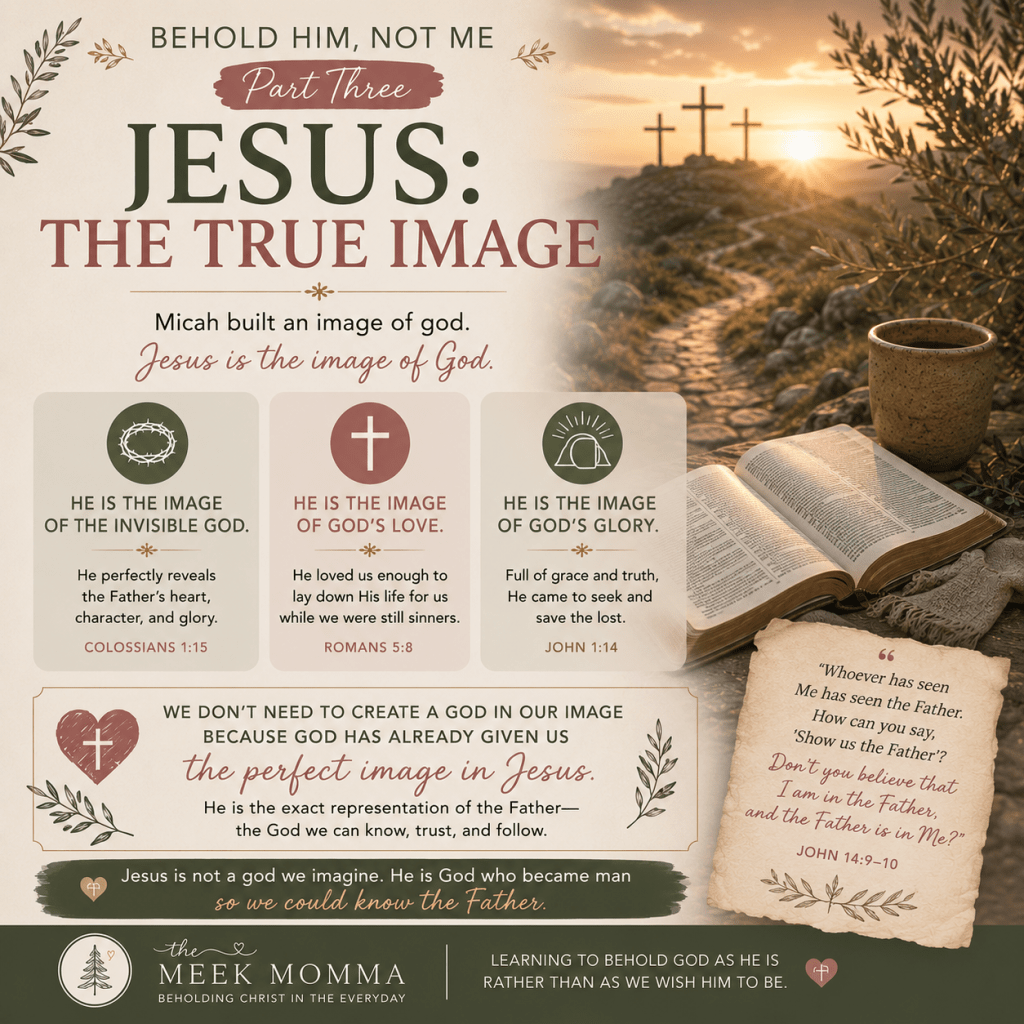
Behold Him, Not Me: Part Three

When We Remake God

Judges 17:1โ€“6

โ€œThe most dangerous idols are often the ones we create in Godโ€™s name.โ€


A Note to Readers

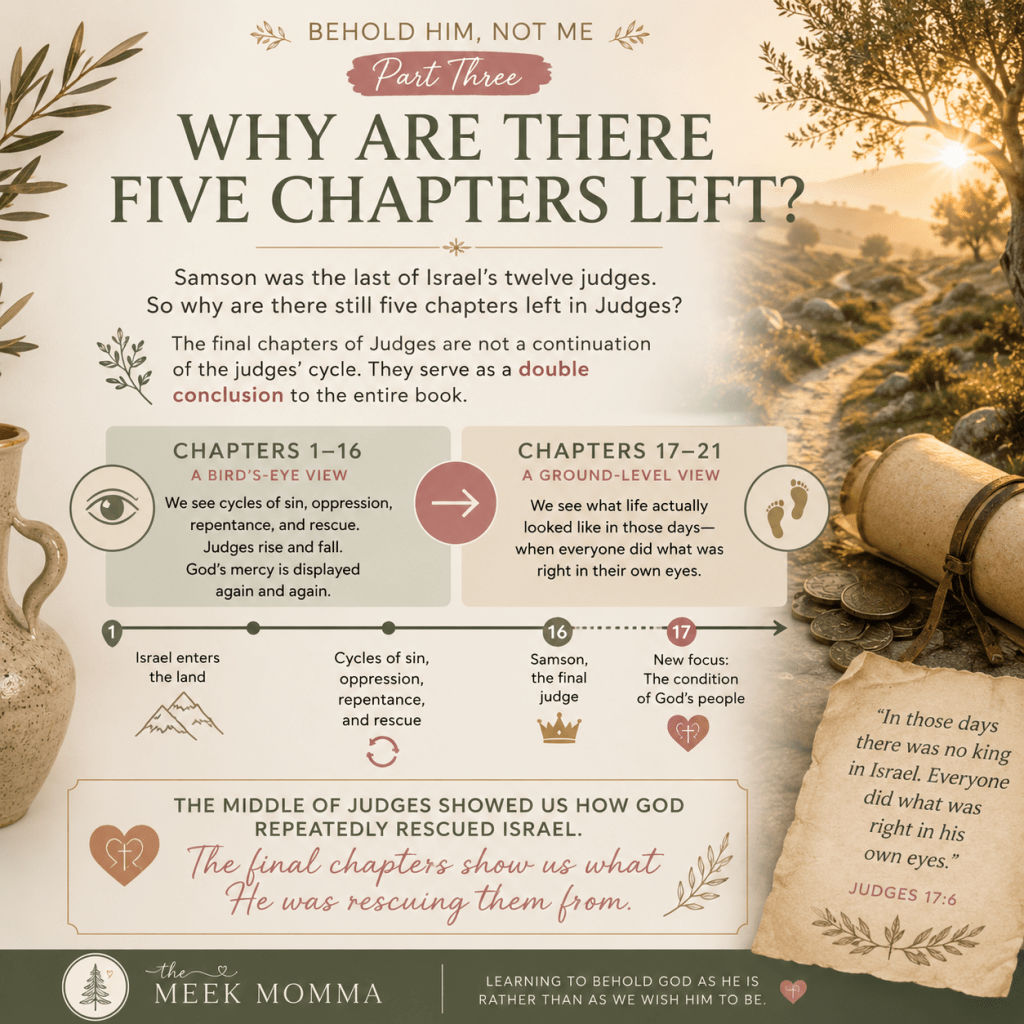
As we continue our journey through Judges, some readers may be wondering why there are still five chapters left in the book. After all, Samson was the last of Israelโ€™s twelve judges.

The answer is that the final chapters of Judges are not a continuation of the judgesโ€™ cycle. Instead, they serve as a double conclusion to the entire book.

Earlier chapters gave us a birdโ€™s-eye view of Israelโ€™s history. We watched cycles of sin, oppression, repentance, and rescue unfold across generations. We saw judges rise and fall. We witnessed Godโ€™s mercy displayed again and again toward a people who continually wandered from Him.

Now the author zooms in.

The final chapters provide a ground-level view of what life actually looked like during those dark days.

These stories are not primarily about foreign enemies.

They are about the spiritual condition of Godโ€™s people themselves.

The middle of Judges showed us how God repeatedly rescued Israel.

The final chapters show us what He was rescuing them from.

And what we find is sobering.

Again and again we will hear the refrain:

โ€œIn those days there was no king in Israel. Everyone did what was right in his own eyes.โ€ (Judges 17:6)

That verse is not merely describing Israel.

It is describing the human heart apart from Godโ€™s rule.

Judges 17 is our first case study.

And what makes this story so unsettling is that it is not a story about atheism.

It is a story about religion.

Lots of religion.

The problem is that it is religion shaped by human preference rather than Godโ€™s revelation.

It is worship that looks right but isnโ€™t.

It is devotion that sounds sincere but is fundamentally distorted.

And if we are honest, it is a temptation that remains just as dangerous today.


A Hollow Man

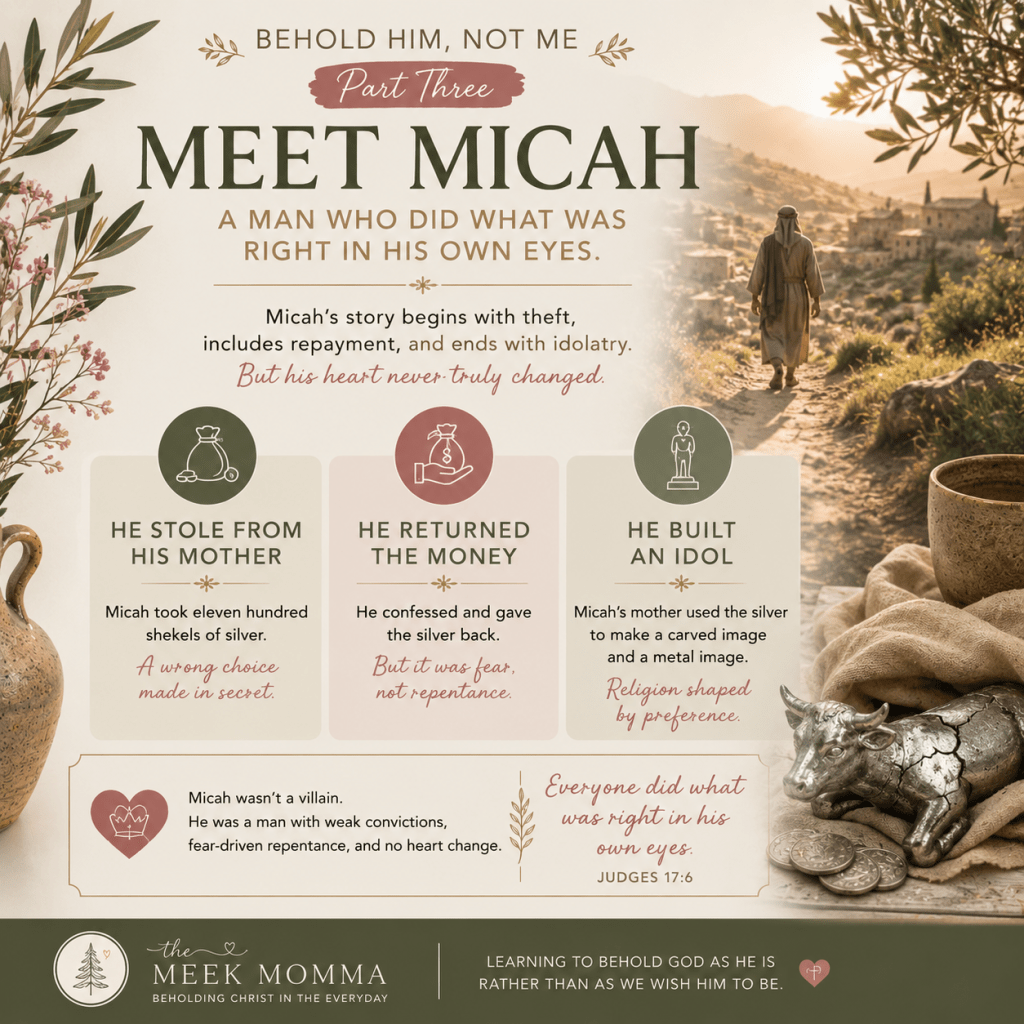
The story begins with a man named Micah from the hill country of Ephraim.

Micah had stolen eleven hundred shekels of silver from his mother. Later, after hearing her pronounce a curse upon the thief, he confesses and returns the money.

At first glance, Micah is difficult to categorize.

He does not appear thoroughly wicked.

After all, he returns the money.

Yet neither does he appear righteous.

A righteous man would never have stolen it in the first place.

The text gives us the impression of a weak man with weak convictionsโ€”a man moved more by fear than by conscience.

A man without much moral substance.

Perhaps that is what makes him so relatable.

Most people do not see themselves in Pharaoh.

Or Jezebel.

Or Judas.

But many of us can recognize compromise.

We recognize drift.

We recognize moments when fear of consequences moved us more than love for righteousness.

Micah is not a monster.

He is simply a man doing what seems right in his own eyes.

And that is exactly the problem.


Grace Without Repentance

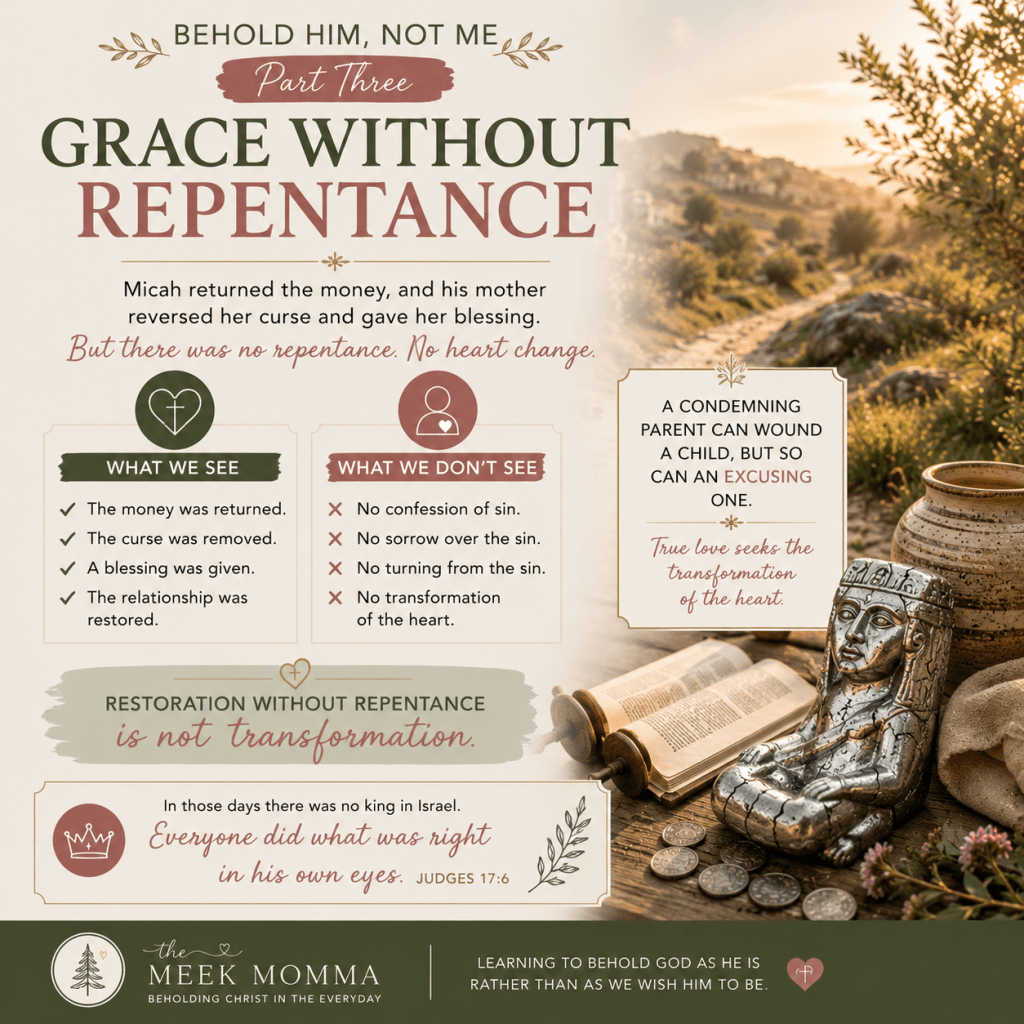
Micahโ€™s mother responds by reversing her curse and pronouncing a blessing over him.

There is something admirable in her willingness to forgive.

Yet there is also something deeply concerning.

She quickly restores the relationship without ever addressing the deeper issue.

There is blessing.

But no repentance.

Restoration.

But no transformation.

No examination of Micahโ€™s heart.

No discussion of why he stole the money.

No acknowledgment of his need for grace.

No call to humility.

As parents, this is an important warning.

A condemning parent can wound a child.

But an excusing parent can wound a child as well.

True love does not merely remove consequences.

It seeks the transformation of the heart.

Micahโ€™s mother appears eager to move past the offense, but in doing so she misses the opportunity to shepherd her son toward genuine repentance.

And as the story unfolds, we will see that Micah remains exactly the same man he was before.

Forgiveness is beautiful.

But biblical restoration always aims at something deeper than simply making conflict disappear.

It aims at reconciliation with God.


The God We Want vs. The God Who Is

The story takes an unexpected turn when Micahโ€™s mother declares:

โ€œI dedicate this silver to the Lord from my hand for my son, to make a carved image and a metal image.โ€ (Judges 17:3)

If that sounds contradictory, it should.

She claims to dedicate the silver to the Lord.

Then she uses it to violate one of His clearest commands.

God had explicitly forbidden the making of images for worship:

โ€œYou shall not make for yourself a carved imageโ€ฆโ€ (Exodus 20:4)

This was not a minor detail in Israelโ€™s faith.

It was the Second Commandment.

So why was God so concerned about images?

The issue was never artistic ability.

The issue was theological accuracy.

Any image of God automatically reveals one aspect of His character while concealing others.

Consider Aaronโ€™s golden calf in the wilderness.

The calf may have symbolized strength and power.

But it could not communicate Godโ€™s holiness.

His justice.

His mercy.

His wisdom.

His love.

Every image inevitably distorts what it attempts to represent.

God refuses to be reduced to something fashioned by human hands because He cannot be contained by human imagination.

Yet the deeper problem is not the image itself.

The deeper problem is the heart behind the image.

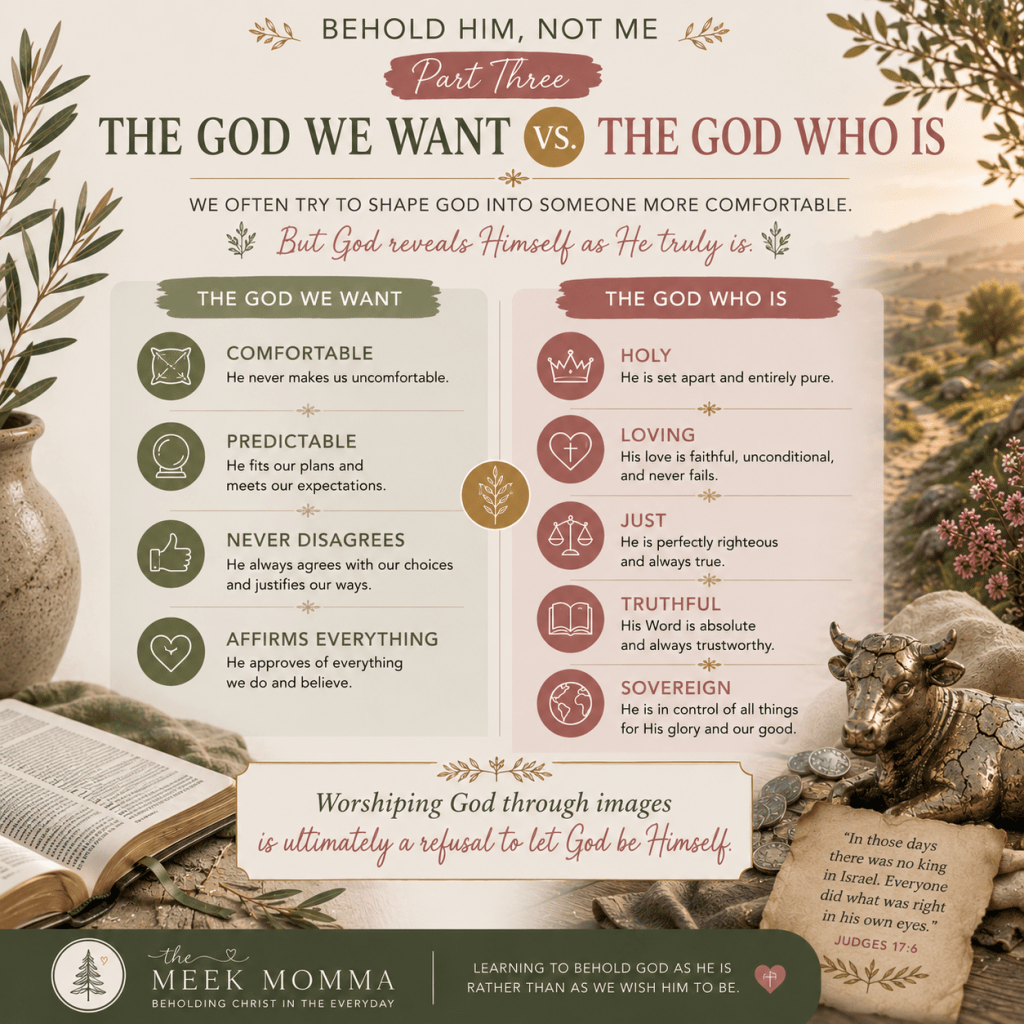
Worshiping God through images reveals a desire to reshape Him into someone we find more comfortable.

It is an attempt to edit God.

To soften the attributes we dislike.

To emphasize the attributes we prefer.

To create a version of God that fits our expectations.

Tim Keller observed that the fundamental problem behind idolatry is a refusal to let God be Himself.

In modern terms, it is a refusal to submit to God as He has revealed Himself.

And if weโ€™re honest, we do this all the time.

Most of us do not carve idols out of silver.

But we often create versions of God in our minds.

How often have we heard someone say:

โ€œI donโ€™t believe in a God who would do that.โ€

Or:

โ€œI like to think of God asโ€ฆโ€

At first those statements sound thoughtful.

But they reveal something dangerous.

They place us in the position of deciding who God should be.

Instead of allowing Scripture to reveal God to us, we attempt to recreate Him according to our preferences.

Like Micahโ€™s family, we begin shaping God instead of allowing God to shape us.


The Comfortable God

There are many ways we attempt to remake God.

Sometimes we do it intellectually.

We encounter something in Scripture that offends our modern sensibilities, so we quietly dismiss it.

We decide that God could not possibly mean what He says.

After all, our culture has progressed beyond such things.

Yet what we are really saying is that our culture has become the authority rather than God.

Other times we do it psychologically.

We simply avoid the parts of Godโ€™s character that make us uncomfortable.

Perhaps we love Godโ€™s grace but ignore His holiness.

Perhaps we celebrate His love but avoid His authority.

Perhaps we cling to His promises while neglecting His commands.

Still other times we do it practically.

We know what Scripture teaches.

Yet we follow our feelings instead.

We follow our desires instead.

We follow our culture instead.

And then we reassure ourselves by saying:

โ€œI prayed about it.โ€

โ€œI feel peace about it.โ€

But peace is not the measure of truth.

Godโ€™s Word is.

This is exactly what Micahโ€™s family is doing.

They are not abandoning religion.

They are customizing it.

They follow the commands they like.

They ignore the commands they dislike.

They keep enough of Godโ€™s truth to feel spiritual while discarding enough of it to remain comfortable.

The most dangerous idols are often the ones we create in Godโ€™s name.


Why This Matters

A counterfeit god can never save us.

More than that, a counterfeit god can never truly know us.

Real relationships require wrestling.

A real person can disagree with you.

Correct you.

Challenge you.

Say no to you.

The same is true in our relationship with God.

When Scripture confronts us, we have an opportunity to wrestle honestly with Him.

To submit where we disagree.

To grow where we are resistant.

To deepen our understanding of His character.

But if we simply ignore every truth we dislike, we are not relating to God at all.

We are relating to a projection of ourselves.

We may have created a more comfortable god.

But we have also created a nonexistent one.

And that may be the most sobering lesson in Judges 17.

Micahโ€™s greatest problem was not that he rejected God.

It was that he remade Him.


Jesus: The True Image

Micahโ€™s mother believed she could fashion something with silver that would help her worship God.

Yet every image created by human hands inevitably distorts the One it seeks to represent.

But in Jesus Christ, God has given us the perfect image of Himself.

Paul writes:

โ€œHe is the image of the invisible God.โ€ (Colossians 1:15)

Unlike Micahโ€™s idol, Jesus does not distort Godโ€™s character.

He reveals it perfectly.

If we want to know what God is like, we do not look at statues.

We look at Christ.

In Jesus we see Godโ€™s holiness.

His mercy.

His justice.

His compassion.

His truth.

His love.

Micah attempted to create an image of God.

God gave us the real thing.

We never need to imagine what God is like.

God has shown us.


Behold Him, Not Me

Micahโ€™s problem was not that he stopped worshiping.

His problem was that he wanted a version of God that fit comfortably inside his own preferences.

Every idol ultimately asks the same question:

Will I worship God as He is?

Or will I create a god I prefer?

The answer is not better religion.

The answer is Christ.

The true image of God.

As we continue through the closing chapters of Judges, may we learn to lay aside our preferences, our assumptions, and our attempts to remake God according to our own image.

May we instead allow God to reveal Himself through His Word and through His Son.

And may we learn, once again, to behold Himโ€”not ourselves.


Heart Check Questions

โ€ข What parts of Godโ€™s Word do I most wish were different?

โ€ข Have I been wrestling honestly with those truths or avoiding them?

โ€ข Are there attributes of God I emphasize while ignoring others?

โ€ข Where am I tempted to shape God according to culture rather than Scripture?

โ€ข Am I worshiping God as He isโ€”or as I would prefer Him to be?


Prayer

Father,

Forgive me for the ways I try to reshape You according to my preferences. Forgive me for the times I have emphasized the parts of Your character that comfort me while ignoring the parts that challenge me.

Thank You for revealing Yourself through Your Word and through Your Son. Thank You that I do not have to imagine what You are like because You have shown me in Jesus Christ.

Help me to worship You as You are, not as I wish You to be.

Give me humility where I resist Your truth.

Give me faith where I struggle to understand.

Give me courage to submit even when Your Word confronts my desires.

Teach me to behold Christ more clearly, trust Him more deeply, and follow Him more faithfully.

May I stop creating gods in my own image and instead be transformed into Yours.

In Jesusโ€™ name,

Amen.
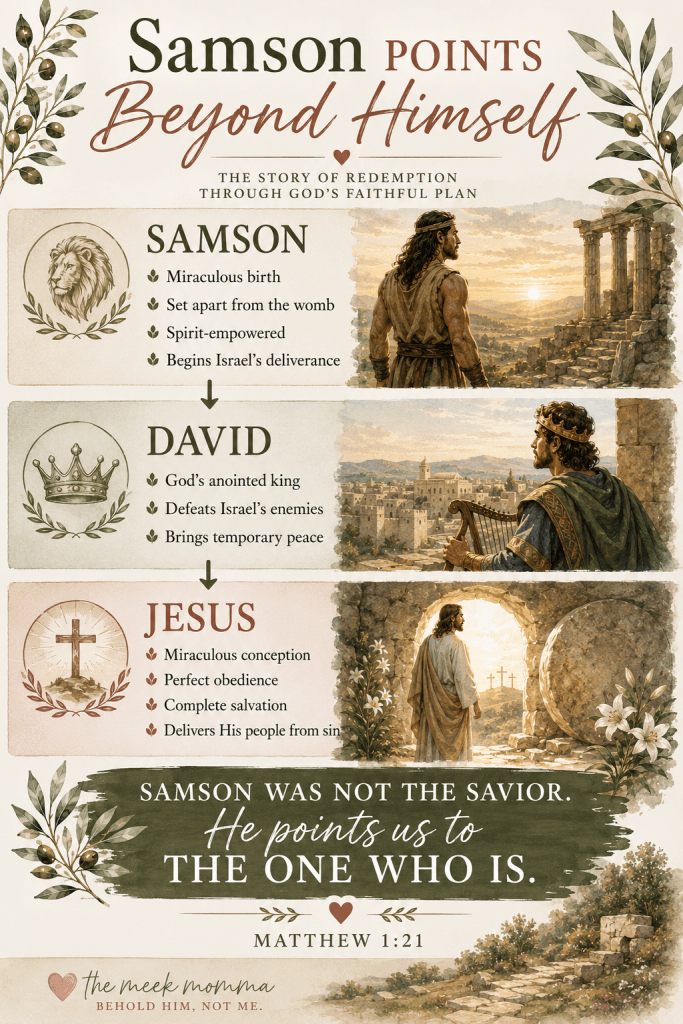

The most dangerous idols are often the ones we create in Godโ€™s name.

Behold Him, not me.

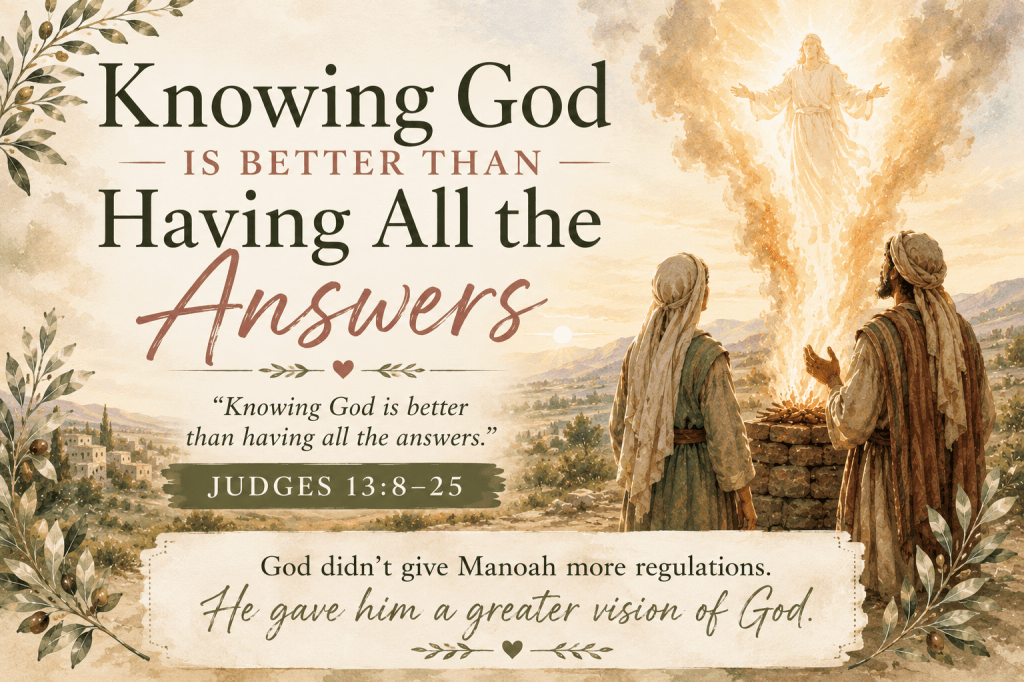
Knowing God Is Better Than Having All the Answers

Before We Dive In

You may notice some overlap between this study and the previous two Judges posts Iโ€™ve shared. Thatโ€™s intentional. In those studies, we looked at the broader movement of Judges 12โ€“13 and how the story points us forward to Christ. This time, I found myself lingering over a much smaller section of the textโ€”Judges 13:8โ€“25โ€”and discovering a lesson I wasnโ€™t ready to move past.

Sometimes Scripture is like that. We read a passage once and see the big picture. Then we come back and find the Lord gently pressing a particular truth deeper into our hearts. For me, that truth was this: knowing God is better than having all the answers.

So if some of these verses feel familiar, I hope youโ€™ll slow down with me and look again. Godโ€™s Word always has more to show us.

And perhaps thatโ€™s one of the greatest gifts of studying Scripture slowly. We donโ€™t simply gather more informationโ€”we come to know the Author more deeply. As always, my prayer is that through this study we would learn to behold Him, not ourselves, trusting that His character is enough even when we donโ€™t have all the answers.

Judges 13:8โ€“25

As I studied Judges 13 this week, I found myself identifying with Samsonโ€™s father, Manoah.

After hearing that his barren wife would bear a son, Manoah prayed:

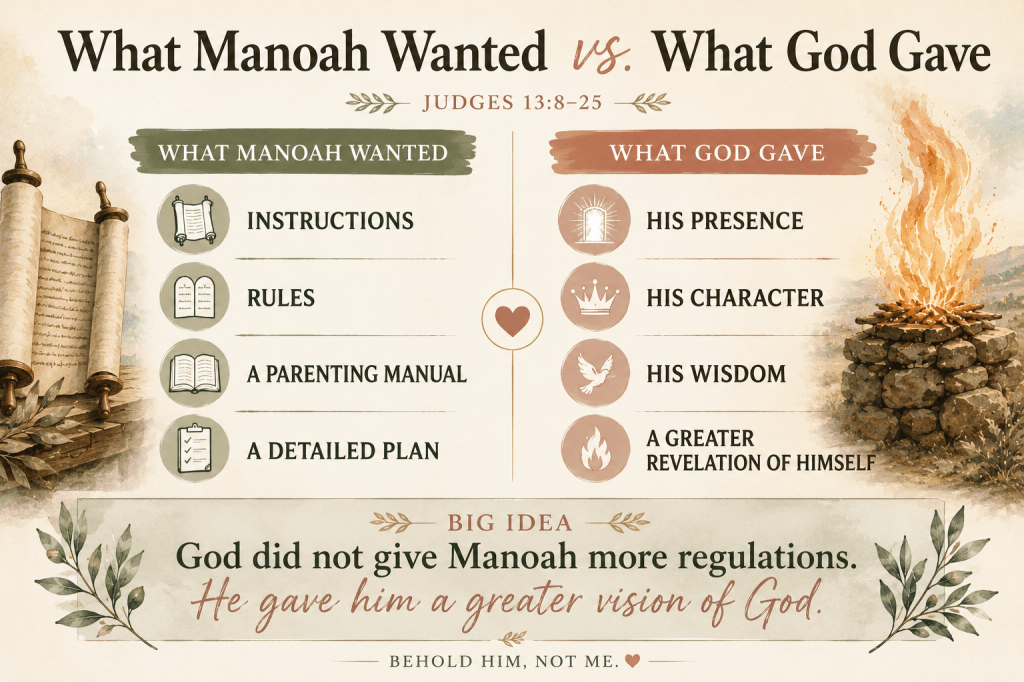
โ€œPlease, Lord, let the man of God you sent to us come again to teach us how to bring up the boy who is to be born.โ€ (Judges 13:8)

His request is deeply relatable. He wants clarity, direction, and a plan for the future God has placed in his hands.

Iโ€™ve prayed the same way countless times.

As the mother of a son with autism, I have often asked God for guidance. Should I pursue this therapy or that one? Should I homeschool or choose public school? What does faithfulness look like in this situation?

If God would simply make the path clear, I would gladly follow it.

But Judges 13 reveals a better gift. The central lesson of Manoahโ€™s story is this:

Knowing God is better than having all the answers.

Manoah asks for guidance, yet God gives him something deeperโ€”a greater revelation of Himself. And that is often how God works in our lives as well.

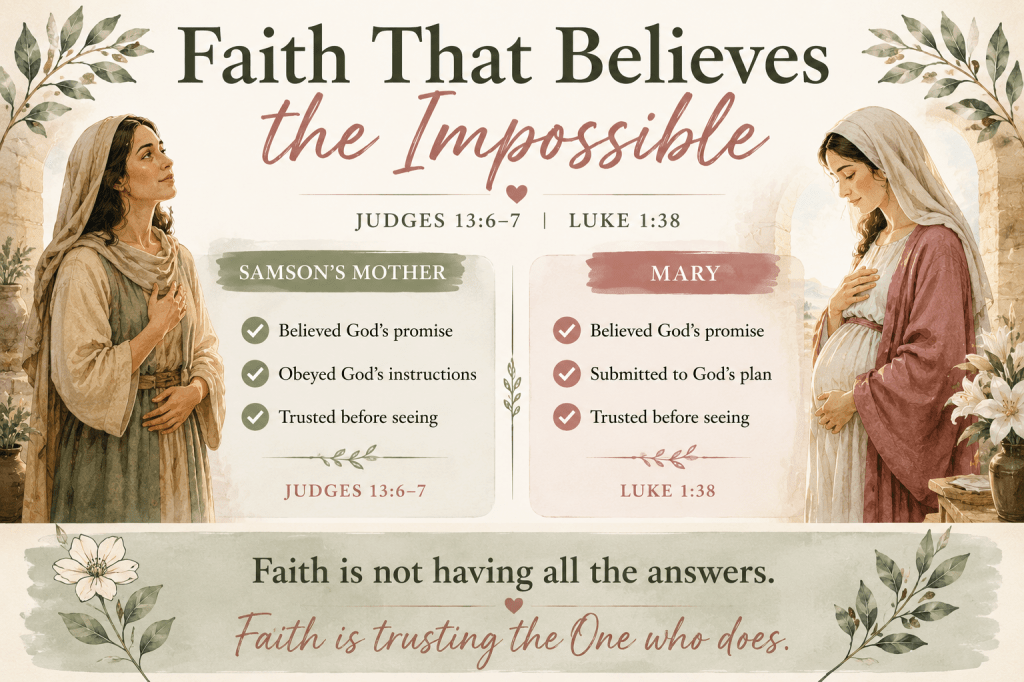
Faith That Believes the Impossible

Before we look at Manoah, we must first notice the remarkable faith of Samsonโ€™s mother.

When the angel of the Lord appeared and announced that she would conceive and bear a son, she simply believed.

There is no recorded laughter as there was with Sarah when she heard she would bear Isaac in her old age (Genesis 18:9โ€“15).

There is no disbelief like Zechariah displayed when he learned John the Baptist would be born (Luke 1:13โ€“20).

Instead, Samsonโ€™s mother receives Godโ€™s word with faith:

โ€œA man of God came to me. He looked like an angel of God, very awesome.โ€ (Judges 13:6)

She believed the promise before she saw the fulfillment.

In this way, she reminds us of another woman who would receive impossible news more than a thousand years later.

When Gabriel announced the coming birth of Jesus, Mary responded:

โ€œMay it be to me as you have said.โ€ (Luke 1:38)

Both women trusted Godโ€™s promises.

Both women submitted themselves to Godโ€™s purposes.

Both women accepted personal cost in order to participate in Godโ€™s plan.

Samsonโ€™s mother embraced the Nazarite restrictions required during her pregnancy. Mary embraced the shame and misunderstanding that would accompany an unwed pregnancy.

Both women demonstrate that faith is not merely believing God can do the impossibleโ€”it is willingly placing ourselves at His disposal.

Manoahโ€™s Request

Unlike his wife, Manoah has questions.

And honestly, I appreciate that.

His response feels very human.

Notice that he doesnโ€™t ask whether Godโ€™s promise is true.

He assumes the child will come.

His request is not for proof but for guidance.

He wants to know:

โ€œWhat is to be the rule for the boyโ€™s life and work?โ€ (Judges 13:12)

How do we raise him?

What should we do?

What rules should we follow?

Again, I find myself nodding along.

As parents, we want certainty.

We want formulas.

We want detailed instructions.

We want guarantees.

Yet when the angel returns, something surprising happens.

He doesnโ€™t provide much new information at all.

The child will be a Nazarite.

Manoahโ€™s wife must continue obeying what she has already been told.

Thatโ€™s essentially it.

No parenting manual.

No detailed roadmap.

No step-by-step guide.

Why?

The Help Manoah Wanted Versus the Help He Needed

At first it seems like God ignored Manoahโ€™s request.

But He didnโ€™t.

God answered the prayer.

Just not in the way Manoah expected.

Manoah wanted information.

God gave revelation.

Manoah wanted rules.

God revealed His character.

Manoah wanted to know what to do.

God showed him who He was.

When Manoah asks the angelโ€™s name, the angel responds:

โ€œWhy do you ask my name? It is beyond understanding.โ€ (Judges 13:18)

Then the angel ascends into heaven in the flame of the sacrifice.

Suddenly Manoah realizes this was no ordinary visitor.

This was a divine encounter.

The angel of the Lord had come not merely to deliver information but to reveal Godโ€™s greatness.

That was the help Manoah truly needed.

And perhaps it is the help we need as well.

The Lesson I Keep Learning

This part of the story stopped me in my tracks.

Because I often approach God exactly the way Manoah did.

I want clarity.

I want confidence for the next step.

I want God to show me how to move forward.

As the mother of a child with autism, I have cried out to God with questions similar to Manoahโ€™s.

But Godโ€™s silence has not really been silence.

Like Manoah, I often discover that God is answering a deeper question than the one I am asking.

He is teaching me His character.

His goodness.

His faithfulness.

His wisdom.

His sovereignty.

Because the truth is this:

Knowing God is better than having all the answers.

No set of instructions can prepare us for every decision we will face.

Only a deep understanding of who God is can guide us through the countless twists and turns of life.

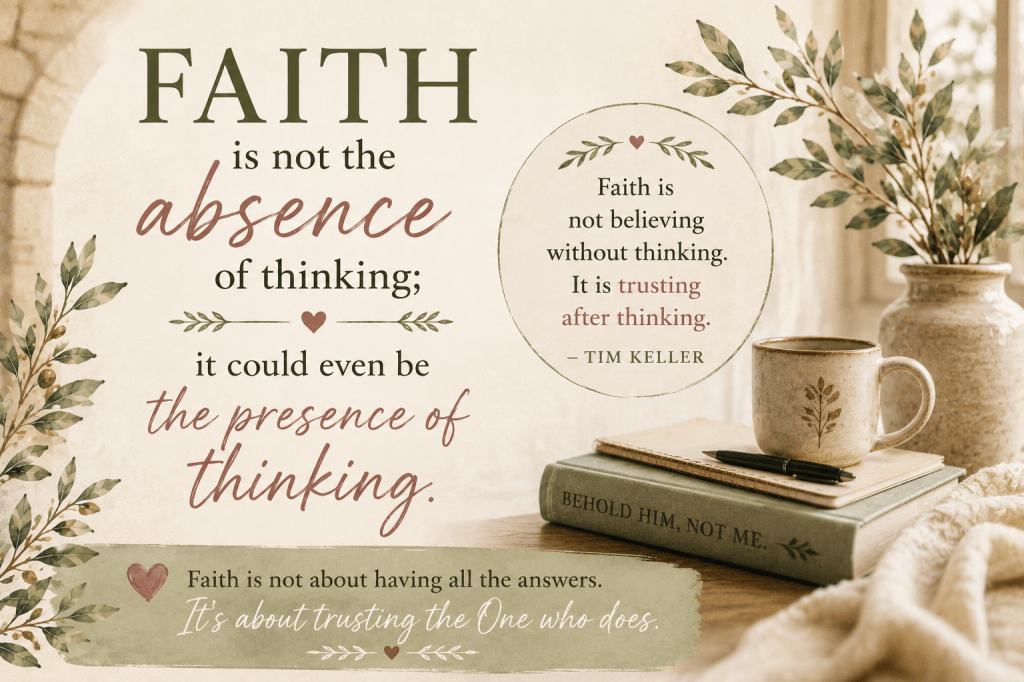
Faith Is Not the Absence of Thinking

After Manoah panics and assumes they are about to die because they have seen God, it is his wife who calmly reasons through the situation:

โ€œIf the Lord had meant to kill us, he would not have accepted a burnt offering and grain offering from our hands.โ€ (Judges 13:23)

Her response beautifully illustrates what Tim Keller wrote:

โ€œFaith is not the absence of thinking. It is thinking and acting on the basis of the Word and promises of God.โ€

She reflects on what God has already revealed.

She reasons from His character.

She trusts His promises.

That is biblical faith.

Not blind optimism.

Not wishful thinking.

But confidence rooted in who God is.

We Need God More Than More Rules

Tim Keller points out that mature relationships require fewer external rules and more internal wisdom.

Young children need constant instructions:

Donโ€™t touch that.

Donโ€™t go there.

Donโ€™t do this.

But as children mature, parents desire them to internalize wisdom and values so they can make good decisions even when specific instructions are absent.

The same is true spiritually.

Many Christians imagine Old Testament believers had a better system because they received more regulations.

Yet under the New Covenant, we have something far greater.

We have the Holy Spirit.

Paul writes:

โ€œBe transformed by the renewing of your mind.โ€ (Romans 12:2)

And:

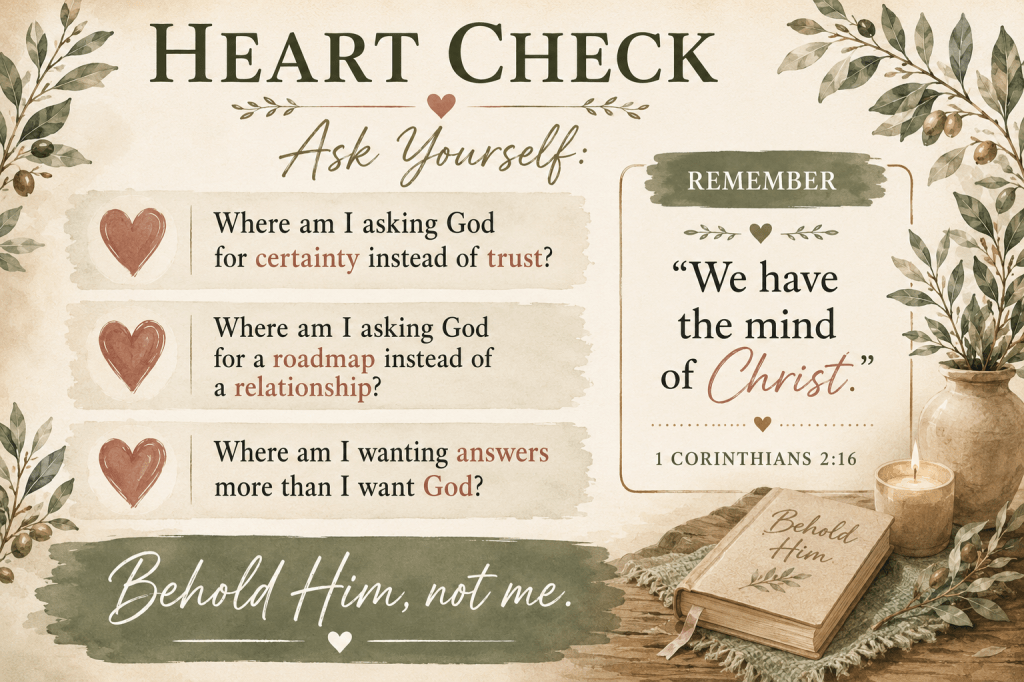
โ€œWe have the mind of Christ.โ€ (1 Corinthians 2:16)

Rather than endless prescriptions, God gives us Himself.

Rather than merely telling us what to do, He transforms who we are.

What Manoah needed most was not more regulations.

It was a greater vision of God.

And the same is true for us.

Samsonโ€™s Birth and Our Need for a Greater Savior

Finally, just as God promised, Samson is born.

The promise was never in doubt because it rested on Godโ€™s word.

The child grows.

God blesses him.

The Spirit begins to stir within him.

Everything appears poised for success.

If anyone ever had spiritual advantages, it was Samson.

Miraculous birth.

Divine calling.

Godโ€™s blessing.

The Spiritโ€™s power.

Yet as we continue through Judges, we will discover that Samson is not the Savior Israel needs.

He will disappoint us.

His flaws will become painfully evident.

And that disappointment is intentional.

Because Samson was never meant to be the final Deliverer.

He points beyond himself.

To David.

And beyond David.

To Jesus Christ.

The One who would perfectly obey.

The One who would perfectly trust.

The One who would perfectly save.

Heart Check

As I closed my Bible, one question lingered in my heart:

In what areas of my life would I rather have answers than God Himself?

Where am I asking for certainty instead of trust?

Where am I asking for a roadmap instead of a relationship?

Like Manoah, we often think we need more information.

But God knows what we truly need.

We need Him.

His character.

His wisdom.

His presence.

His promises.

Because in the end:

Knowing God is better than having all the answers.

Behold Him, not me.

He Told Her All His Heart

โ€œThen he told her all his heartโ€ฆโ€
โ€” Judges 16:17

Iโ€™ve read the story of Samson and Delilah many times.

Like many people, I often focused on the obvious lessonsโ€”the danger of temptation, Samsonโ€™s pride, Delilahโ€™s betrayal, or the cutting of his hair. But this morning, one small phrase stopped me in my tracks:

โ€œThen he told her all his heart.โ€

Suddenly, Samson felt less like a larger-than-life judge and more like a deeply lonely man.

Behind all the strength, bravado, and reckless choices was someone desperately craving intimacy.

Samson wanted to be known.

He wanted to be loved.

He wanted someone to hold his heart.

The tragedy is not that Samson desired intimacy. God created us for relationship. The tragedy is that Samson sought from Delilah what he could only receive from God.

Isnโ€™t that often our story too?

How often do we go to people first for validation, security, comfort, approval, or identity? We carry empty places in our hearts and expect spouses, friends, children, ministry, success, or relationships to fill what only God was ever meant to satisfy.

Psalm 118:8 reminds us:

โ€œIt is better to take refuge in the Lord than to trust in man.โ€

The problem isnโ€™t loving people.

The problem is asking people to be what only God can be.

When we come to others looking for them to fill our deepest needs, we eventually place a weight on them they were never designed to carry. But when we first come to the Lord, allowing Him to satisfy our hearts with His steadfast love, we are free to love others not out of need but out of service.

That is exactly what Samson never learned.

Many of us were taught that Samsonโ€™s strength was somehow hidden in his hair. Almost as if his hair possessed some magical power. But Scripture tells a different story.

After Delilah had his head shaved, Samson awoke expecting to defeat the Philistines once again.

โ€œBut he did not know that the Lord had left him.โ€ (Judges 16:20)

The hair was never the source of his strength.

The Lord was.

Psalm 28:7 says:

โ€œThe Lord is my strength and my shield.โ€

Samsonโ€™s strength did not leave when his hair was cut.

His strength left when the presence of the Lord departed.

As I reflected on this passage, my mind kept returning to Psalm 118. Again and again the psalmist repeats truths we need to hear:

โ€œThe Lord is on my side.โ€

โ€œThe Lord is my helper.โ€

โ€œThe Lord is my strength.โ€

โ€œHis steadfast love endures forever.โ€

The Christian life is not about becoming stronger versions of ourselves.

It is about learning to depend on the One who is already strong.

Unlike Samson, we do not need to rip city gates from their hinges and carry them up a mountain. We do not need to prove ourselves through our own strength.

Instead, we are invited to enter the gates of the Lord with thanksgiving, humility, and trust.

The steadfast love of the Lord endures forever.

And because it does, we can bring Him our whole hearts.

As I closed my Bible this morning, I realized that Samsonโ€™s story isnโ€™t only a warning for meโ€”itโ€™s a mirror.

Like Samson, I know what it is to crave being seen. I know what it is to long to be known, understood, chosen, and loved. There are days when I look to people for what I should first seek from God. Days when the approval of others feels more tangible than His presence. Days when I wish someone would notice the burdens I carry without me having to speak them aloud.
And if Iโ€™m being honest, sometimes the presence of the Lord doesnโ€™t feel like enough.

Not because He isnโ€™t enough, but because my heart is still learning to believe that He is.

That is part of living in a broken world. We were created for perfect fellowship with God, yet we live east of Eden, still feeling the ache of longing, loneliness, and unmet desires.

This morning I found myself praying:

โ€œLord, return to me the joy of my salvation. Remind me that You are my refuge and my strength. Teach me to wait patiently for You. When I am tempted to run to others for what can only be found in You, turn my heart back toward Your steadfast love. Hear my cry and turn to me. Let me find in You what I keep searching for everywhere else.โ€
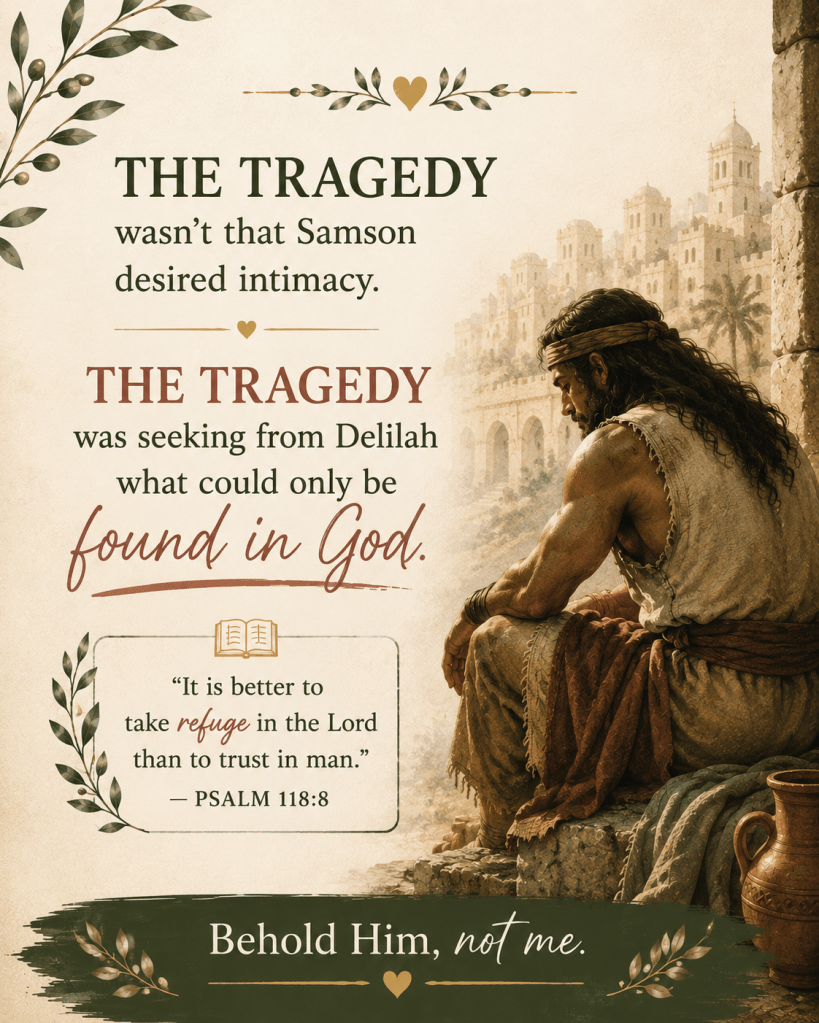
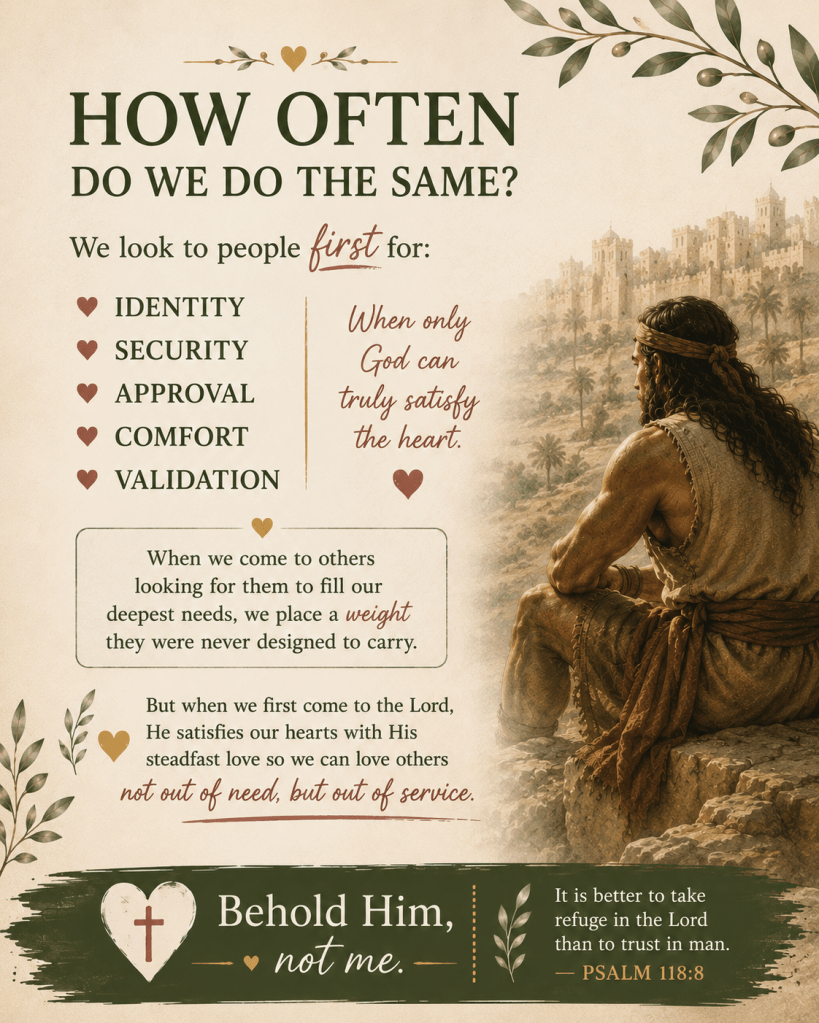
The good news is that unlike Delilah, the Lord never betrays the heart that is entrusted to Him.

His steadfast love truly does endure forever.

Behold God, Not Me

Judges 12-13, Infertility, Idolatry, and the Deception of Sin

One of the things I love most about studying Godโ€™s Word verse by verse is that it often confronts me in places I didnโ€™t expect.

Recently, I found myself praying and talking with a friend about a struggle that has resurfaced many times throughout my life: infertility.

For twelve years, my husband and I prayed for a child. Then, in His kindness and perfect timing, God gave us Jackson. What a gift he has been. Yet as Jackson approaches eight years old, our family has not grown in the way I once assumed it would.

Like many women, I was told that once you have one child, having more often becomes easier. That has not been our story.

And if Iโ€™m honest, there are days when grief sneaks in.

I see beautiful growing families around me. I celebrate them sincerely because every child is a gift from God. Working in foster care has only deepened that conviction. There is not a single child I believe was born outside the knowledge and purpose of our good Father.

Yet sometimes I still find myself asking, โ€œLord, why?โ€

Why do some families grow effortlessly while others wait?

Why are some prayers answered quickly while others seem to linger unanswered?

As always, when I earnestly seek the Lord about the condition of my heart, He faithfully meets me in His Word.

Some Are Increased, Others Are Diminished

As I was studying the minor judges in Judges 12, I noticed an interesting contrast.

Ibzan had thirty sons and thirty daughters (Judges 12:9).

Earlier in Judges, Jair also had thirty sons.

Yet Jephthah had only one childโ€”a daughterโ€”and through his foolish vow and tragic actions, she never married and left no descendants.

Seventeenth-century commentator Matthew Henry observed:

โ€œSome are increased, others are diminished; both are the Lordโ€™s doing.โ€

Those words are not easy to accept.

Our hearts naturally want explanations.

We want formulas.

We want reasons.

We want to know why God gives one person abundance while another experiences loss.

Yet Scripture repeatedly reminds us that Godโ€™s wisdom exceeds our own.

Isaiah tells us:

โ€œFor my thoughts are not your thoughts, neither are your ways my ways, declares the Lord. For as the heavens are higher than the earth, so are my ways higher than your ways and my thoughts than your thoughts.โ€ (Isaiah 55:8-9)

That was exactly the reminder my heart needed.

God knows what He is doing.

God knows me.

God knows what will bring Him glory.

God knows what will make me more like Christ.

And that must be enough.

The Forgotten Judges and the God Who Is Remembered

As I continued reading, I noticed something else.

The Bible gives us only a few details about Ibzan, Elon and Abdon. We learn how long they judged Israel. We learn a few facts about their families. Then their stories end.

At first glance, it almost feels unsatisfying.

We want more details.

We want their stories fully told.

But perhaps that discomfort reveals something about us.

Isnโ€™t that what we want for ourselves?

We want to leave a legacy.

We want to be remembered.

We want our stories to matter.

Yet Scripture consistently directs our attention elsewhere.

The Bible is not ultimately about human greatness.

It is about Godโ€™s greatness.

The focus of Scripture is not the lives of judges, kings, prophets, or even ordinary believers.

The focus is Christ.

Every page points to Him.

Even Abdonโ€™s wealth and the mention of his sons riding on donkeys subtly remind us of a greater King who would one day ride into Jerusalem on a donkey, fulfilling prophecy and declaring His kingship.

The judges fade into the background.

Christ remains.

And that leads me to ask an uncomfortable question:

Does my life say, โ€œBehold me,โ€ or โ€œBehold Godโ€?

Character profiles of the 3 Minor Judges discussed

The Beginning of the Final Cycle

As we enter Judges 13, we begin the final cycle of the book.

The chapter opens with familiar words:

โ€œAnd the people of Israel again did what was evil in the sight of the Lord.โ€

We have seen this refrain over and over throughout Judges.

The people sin.

God disciplines them.

They cry out.

God delivers them.

Then the cycle repeats.

Yet there is something particularly significant about this final occurrence.

The phrase โ€œevil in the sight of the Lordโ€ highlights a truth our culture desperately needs to hear.

Notice what the text does not say.

It does not say Israel did what was evil in their own eyes.

In fact, later in Judges we encounter another repeated phrase:

โ€œEveryone did what was right in his own eyes.โ€

The two statements are connected.

The Israelites did not wake up every morning thinking, โ€œToday I will rebel against God.โ€

They believed their choices were reasonable.

Understandable.

Justified.

Acceptable.

In their own eyes, much of their behavior probably seemed perfectly fine.

Yet God saw things differently.

And therein lies the danger.

What Is Sin?

This passage teaches us something foundational about sin.

Sin is not ultimately defined by my feelings.

Sin is not determined by cultural approval.

Sin is not established by majority opinion.

Sin is not measured by whether my conscience happens to bother me.

Sin is defined by God.

Something is sinful because it violates Godโ€™s will and Godโ€™s design.

This truth directly contradicts modern thinking.

Our culture continually tells us:

โ€œFollow your heart.โ€

โ€œLive your truth.โ€

โ€œYou define what is right for you.โ€

But Scripture says something very different.

If morality is determined only by personal perception, then no one can meaningfully condemn evil.

History itself demonstrates the flaw in that thinking.

People can sincerely believe terrible things.

Groups of people can collectively justify horrific actions.

Human perception is not a trustworthy standard.

Only God is.

The eyes that ultimately matter are not my eyes.

They are Godโ€™s.

The Deception of Sin

The second truth we learn is how deceptive sin really is.

The Israelites had convinced themselves they were fine.

They had explanations.

Rationalizations.

Justifications.

At the conscious level, everything seemed acceptable.

But beneath the surface, they had drifted far from God.

That should concern all of us because we are no different.

The most dangerous sins are often not the obvious ones.

The most dangerous sins are the ones we have learned to justify.

Pride.

Bitterness.

Materialism.

Worry.

Control.

Self-reliance.

These sins rarely look sinful in our own eyes.

And this is where the Lord began pressing on my own heart.

When Good Desires Become Ultimate Desires

As I thought about my longing for more children, I realized something uncomfortable.

The desire itself is not sinful.

Children are a blessing.

Family is a gift.

Wanting those things is good.

But good things become idols when they become ultimate things.

The line between loving something and worshiping something is often thinner than we realize.

And I began to wonder:

Had I crossed that line?

Had my desire for more children subtly become a demand?

Was I saying, โ€œGod, I know what would be best for my lifeโ€?

Was I acting as though Godโ€™s gifts were somehow insufficient?

Was I placing myself in the judgeโ€™s seat?

Because when I insist that God must give me what I want in order for His plan to be good, I am no longer trusting Him.

I am attempting to replace Him.

That is the essence of idolatry.

An idol is not always a bad thing.

More often, it is a good thing that has become an ultimate thing.

Tim Keller famously described idols as good things turned into god things.

Family can become an idol.

Ministry can become an idol.

Work can become an idol.

Even motherhood can become an idol.

Anything we place above trustful submission to God becomes a rival to Him.

As the Puritan Thomas Brooks wisely wrote:

โ€œSatan paints sin with virtueโ€™s colors.โ€

The idol never announces itself as an idol.

It disguises itself as wisdom.

Responsibility.

Love.

Good stewardship.

Common sense.

And before we realize it, our hearts have drifted.

Bible Study Notes

Behold God

That is why we must constantly evaluate ourselves through Scripture.

Not through culture.

Not through emotions.

Not through popular opinion.

Through Godโ€™s Word.

The Word reveals what our hearts often hide.

And when it does, our response should not be despair.

It should be worship.

Because the goal of our lives is not ultimately to get everything we want.

The goal is not to have our preferred story.

The goal is not even to be remembered.

The goal is to behold God.

The minor judges came and went.

Their stories occupy only a few verses.

Yet Godโ€™s purposes prevailed.

Their significance was not found in the size of their role.

It was found in the God who authored the story.

The same is true for us.

Whether God increases or diminishes.

Whether He gives or withholds.

Whether our stories look ordinary or extraordinary.

He remains worthy.

And so today, I find myself returning once again to Isaiah 55.

His ways are higher than my ways.

His thoughts are higher than my thoughts.

He knows what is best.

He knows my heart.

He is trustworthy.

And when I preach that truth to myself, it changes everything.

Behold Him, not me.

Blog at WordPress.com.

Up ↑