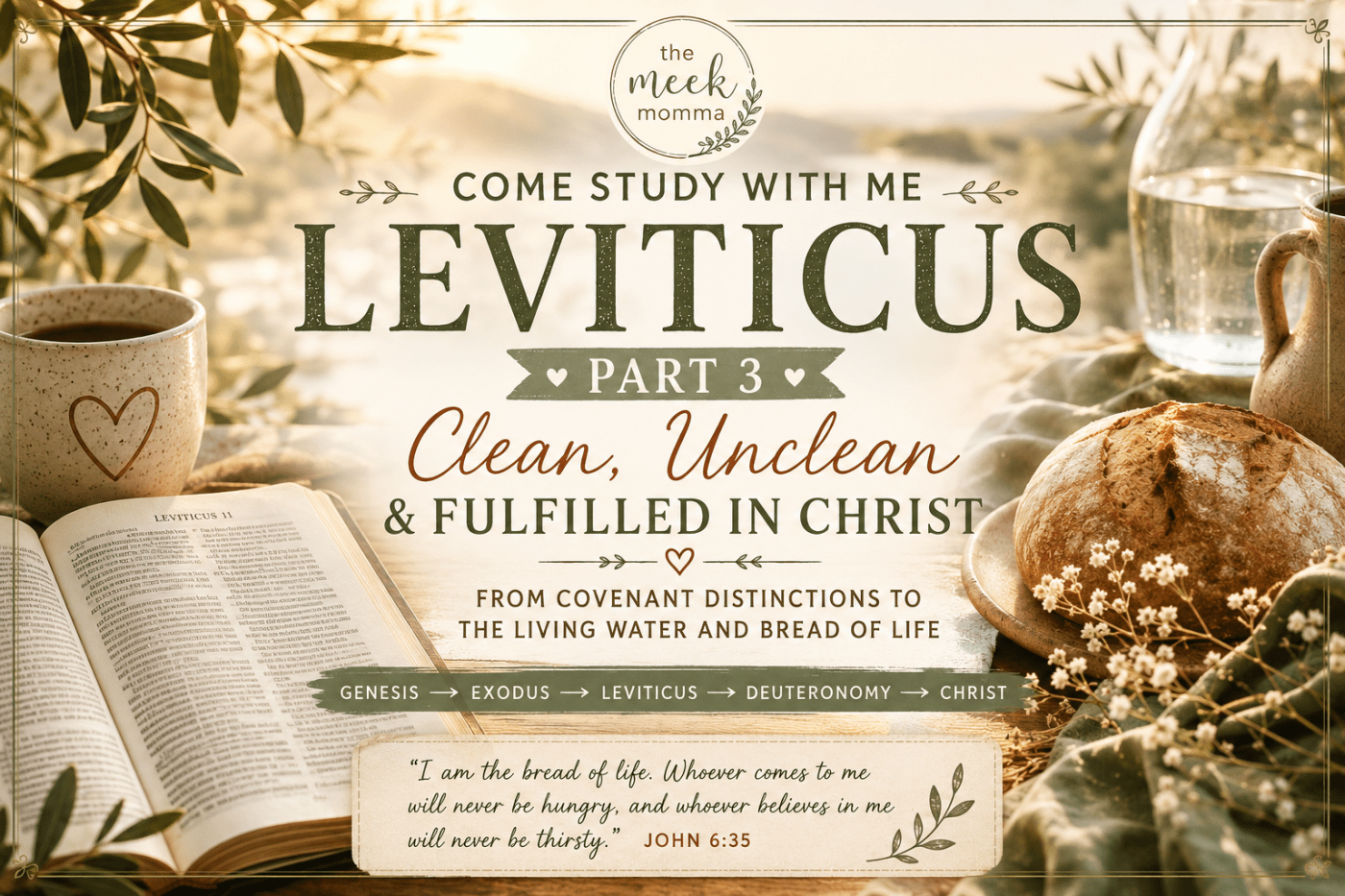
Notes from Leviticus — Part 3
Clean, Unclean & Fulfilled in Christ
As we study Leviticus 11, one thing becomes clear: the distinction between clean and unclean did not begin with Moses.
In Genesis 7:2, Noah already knows the distinction between clean and unclean animals. In Genesis 8:20, he offers clean animals and birds to the LORD.
Then, in Exodus, God forms Israel as His covenant people and establishes His dwelling place among them. In Leviticus, He gives increasingly specific instructions concerning sacrifice, purity, priesthood, holiness, and food.
Deuteronomy later reiterates many of these dietary distinctions.
The pattern is unfolding:
Genesis → Exodus → Leviticus → Deuteronomy
God progressively reveals what it means for His covenant people to live in relationship with a holy God.
But what does “clean” actually mean?
This is important:
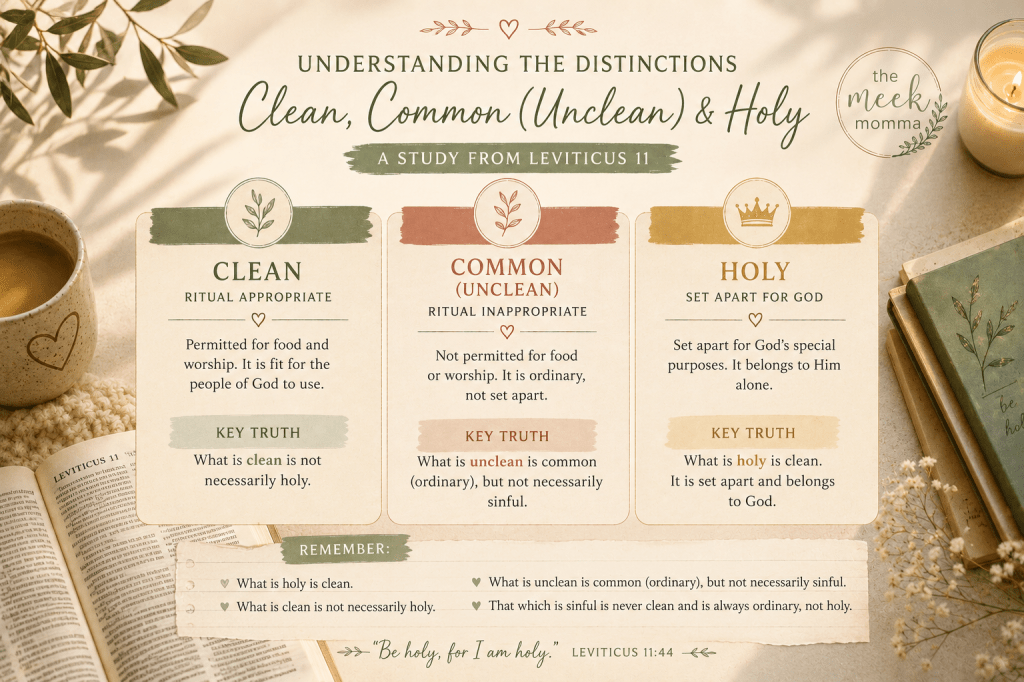
Unclean does not automatically mean sinful.
Something could be ritually unclean without being morally sinful.
Likewise, something could be clean without being holy.
These categories help us understand Leviticus more carefully:
Holy → clean
Clean → not necessarily holy
Unclean → not necessarily sinful
Sinful → never holy or clean
The purity laws were teaching Israel to recognize distinctions and boundaries as they lived in the presence of a holy God.
Then Jesus changes the conversation.
Jesus teaches that defilement is not ultimately about what enters a person from the outside, but what comes from the heart (Mark 7:14–23).
In Acts 10, Peter receives a vision involving animals previously considered unclean. God tells him:
“What God has made clean, do not call common.”
Peter comes to understand that the vision reaches beyond food. God was showing him that Gentiles were not to be considered spiritually unclean or excluded from God’s people.
Through Christ, the ceremonial boundaries that once distinguished Israel from the nations are fulfilled and transformed.
And this is where the story becomes beautiful.
Jesus doesn’t simply make food clean.
Jesus makes people clean.
He doesn’t merely provide another ritual washing.
He gives living water.
“If anyone thirsts, let him come to me and drink.”
— John 7:37
He doesn’t simply give bread to sustain physical life.
He is the Bread of Life.
“I am the bread of life.”
— John 6:35
The Old Testament repeatedly teaches us about cleansing, sacrifice, priesthood, blood, holiness, food, and access to God’s presence.
The New Testament shows us their greater fulfillment in Christ:
The sacrifice → Christ’s once-for-all atonement
The priesthood → Christ our great High Priest
Cleansing → Christ makes His people clean
Access to God → Christ brings us near
The bread that sustains → Christ, the Bread of Life
The water that cleanses and gives life → Christ, the Living Water
And the important thing is that we don’t have to force these connections. The New Testament itself develops them.
Hebrews tells us that the sacrificial system was pointing toward something greater:
“The law has but a shadow of the good things to come.”
— Hebrews 10:1
The Bigger Story
Leviticus is not a disconnected collection of strange rules.
It is part of a story that begins much earlier.
Genesis: God establishes His creation and we see humanity’s separation from Him.
Exodus: God rescues His people and comes to dwell among them.
Leviticus: God teaches His people how to live in the presence of a holy God.
Deuteronomy: God reiterates the covenant and calls His people to faithful obedience.
The New Testament: Christ fulfills the purposes toward which these things were pointing.
And the question underneath Leviticus remains the same:
How can a holy God dwell with sinful people?
The answer that unfolds throughout Scripture is not ultimately a ritual, a sacrifice, a food, or a purification ceremony.
God Himself makes the way.
And in the New Covenant, that way is Jesus Christ.
“For by a single offering he has perfected for all time those who are being sanctified.”
— Hebrews 10:14


Leave a comment