When We Remake God
Judges 17:1–6
“The most dangerous idols are often the ones we create in God’s name.”
A Note to Readers
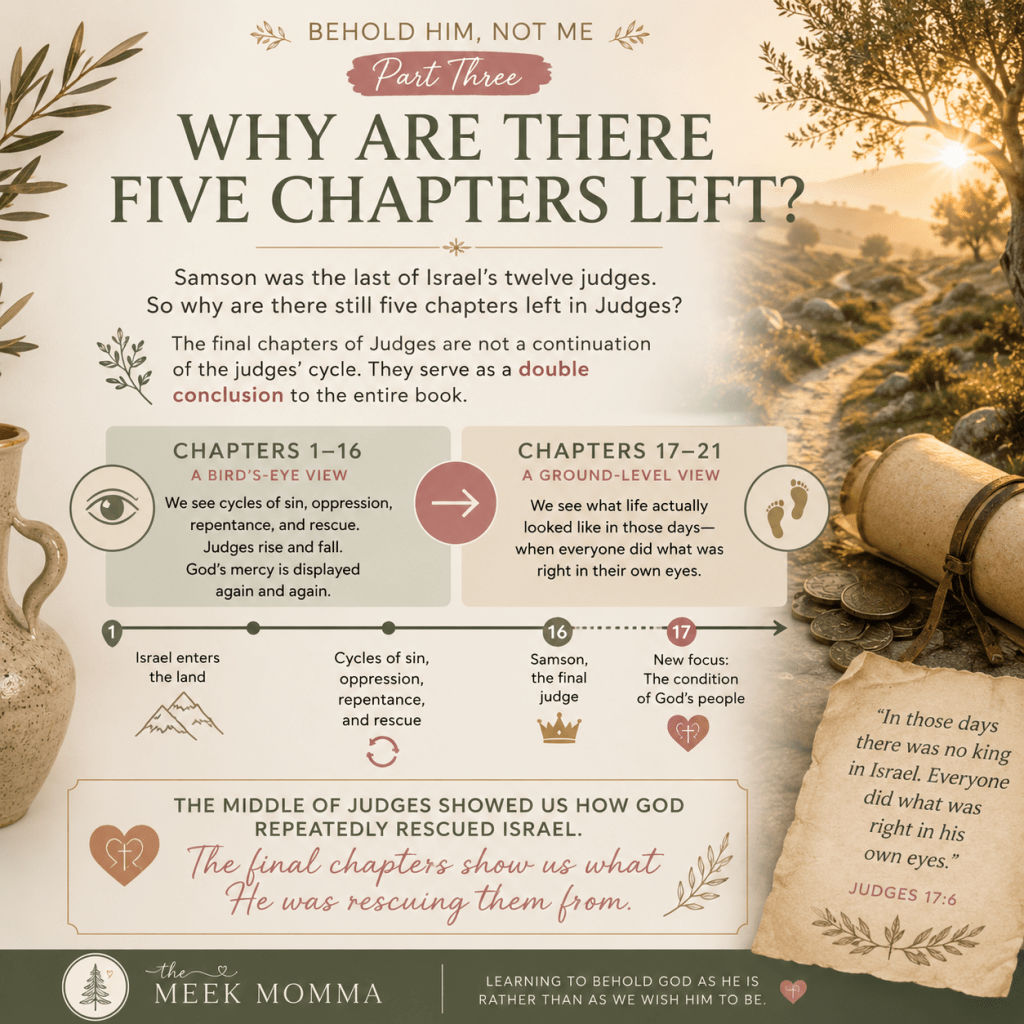
As we continue our journey through Judges, some readers may be wondering why there are still five chapters left in the book. After all, Samson was the last of Israel’s twelve judges.
The answer is that the final chapters of Judges are not a continuation of the judges’ cycle. Instead, they serve as a double conclusion to the entire book.
Earlier chapters gave us a bird’s-eye view of Israel’s history. We watched cycles of sin, oppression, repentance, and rescue unfold across generations. We saw judges rise and fall. We witnessed God’s mercy displayed again and again toward a people who continually wandered from Him.
Now the author zooms in.
The final chapters provide a ground-level view of what life actually looked like during those dark days.
These stories are not primarily about foreign enemies.
They are about the spiritual condition of God’s people themselves.
The middle of Judges showed us how God repeatedly rescued Israel.
The final chapters show us what He was rescuing them from.
And what we find is sobering.
Again and again we will hear the refrain:
“In those days there was no king in Israel. Everyone did what was right in his own eyes.” (Judges 17:6)
That verse is not merely describing Israel.
It is describing the human heart apart from God’s rule.
Judges 17 is our first case study.
And what makes this story so unsettling is that it is not a story about atheism.
It is a story about religion.
Lots of religion.
The problem is that it is religion shaped by human preference rather than God’s revelation.
It is worship that looks right but isn’t.
It is devotion that sounds sincere but is fundamentally distorted.
And if we are honest, it is a temptation that remains just as dangerous today.
A Hollow Man
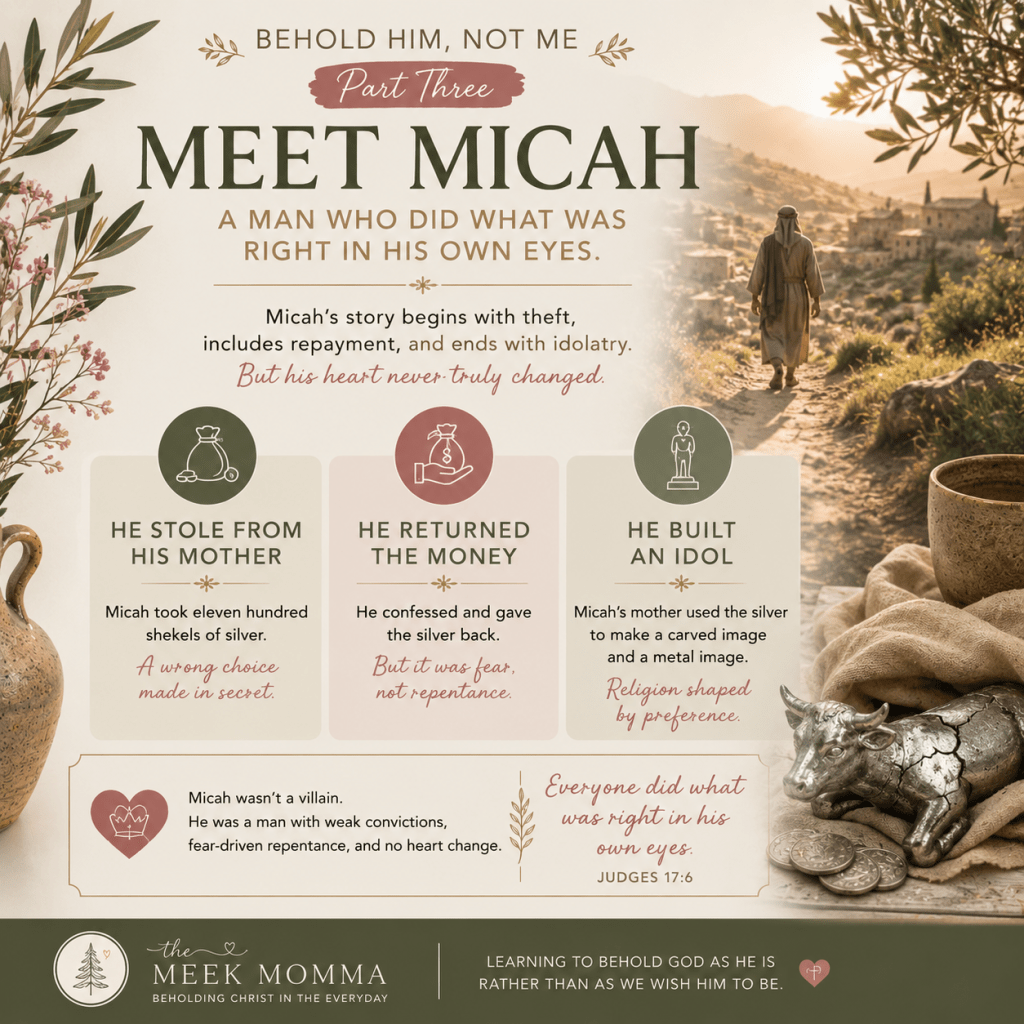
The story begins with a man named Micah from the hill country of Ephraim.
Micah had stolen eleven hundred shekels of silver from his mother. Later, after hearing her pronounce a curse upon the thief, he confesses and returns the money.
At first glance, Micah is difficult to categorize.
He does not appear thoroughly wicked.
After all, he returns the money.
Yet neither does he appear righteous.
A righteous man would never have stolen it in the first place.
The text gives us the impression of a weak man with weak convictions—a man moved more by fear than by conscience.
A man without much moral substance.
Perhaps that is what makes him so relatable.
Most people do not see themselves in Pharaoh.
Or Jezebel.
Or Judas.
But many of us can recognize compromise.
We recognize drift.
We recognize moments when fear of consequences moved us more than love for righteousness.
Micah is not a monster.
He is simply a man doing what seems right in his own eyes.
And that is exactly the problem.
Grace Without Repentance
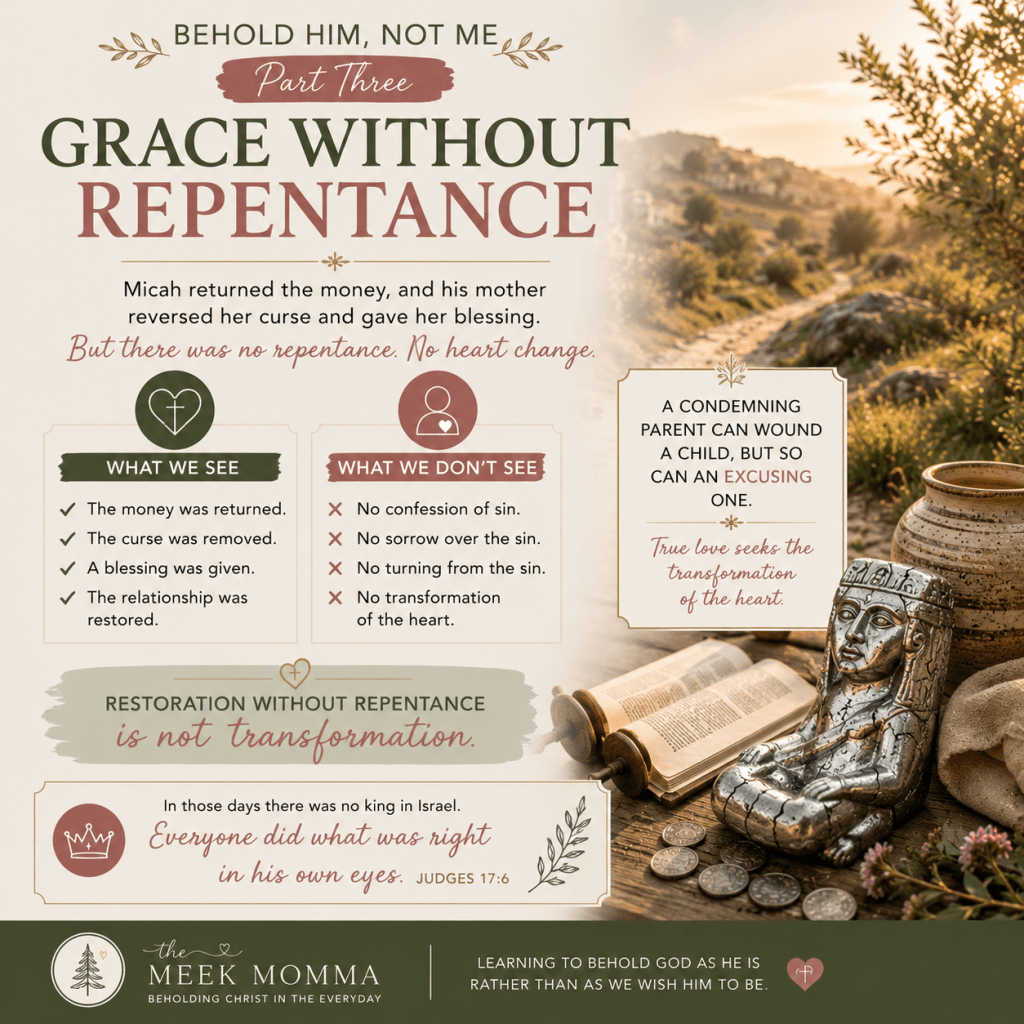
Micah’s mother responds by reversing her curse and pronouncing a blessing over him.
There is something admirable in her willingness to forgive.
Yet there is also something deeply concerning.
She quickly restores the relationship without ever addressing the deeper issue.
There is blessing.
But no repentance.
Restoration.
But no transformation.
No examination of Micah’s heart.
No discussion of why he stole the money.
No acknowledgment of his need for grace.
No call to humility.
As parents, this is an important warning.
A condemning parent can wound a child.
But an excusing parent can wound a child as well.
True love does not merely remove consequences.
It seeks the transformation of the heart.
Micah’s mother appears eager to move past the offense, but in doing so she misses the opportunity to shepherd her son toward genuine repentance.
And as the story unfolds, we will see that Micah remains exactly the same man he was before.
Forgiveness is beautiful.
But biblical restoration always aims at something deeper than simply making conflict disappear.
It aims at reconciliation with God.
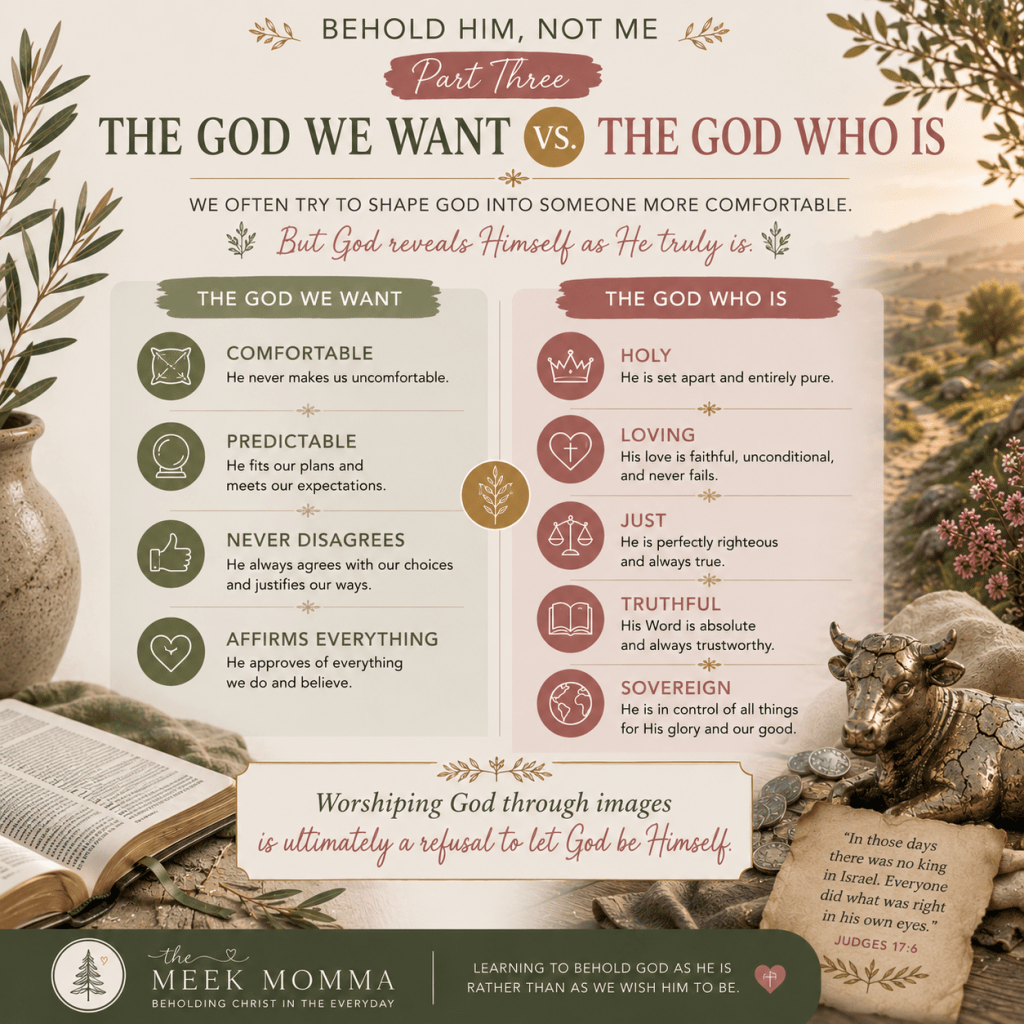
The God We Want vs. The God Who Is
The story takes an unexpected turn when Micah’s mother declares:
“I dedicate this silver to the Lord from my hand for my son, to make a carved image and a metal image.” (Judges 17:3)
If that sounds contradictory, it should.
She claims to dedicate the silver to the Lord.
Then she uses it to violate one of His clearest commands.
God had explicitly forbidden the making of images for worship:
“You shall not make for yourself a carved image…” (Exodus 20:4)
This was not a minor detail in Israel’s faith.
It was the Second Commandment.
So why was God so concerned about images?
The issue was never artistic ability.
The issue was theological accuracy.
Any image of God automatically reveals one aspect of His character while concealing others.
Consider Aaron’s golden calf in the wilderness.
The calf may have symbolized strength and power.
But it could not communicate God’s holiness.
His justice.
His mercy.
His wisdom.
His love.
Every image inevitably distorts what it attempts to represent.
God refuses to be reduced to something fashioned by human hands because He cannot be contained by human imagination.
Yet the deeper problem is not the image itself.
The deeper problem is the heart behind the image.
Worshiping God through images reveals a desire to reshape Him into someone we find more comfortable.
It is an attempt to edit God.
To soften the attributes we dislike.
To emphasize the attributes we prefer.
To create a version of God that fits our expectations.
Tim Keller observed that the fundamental problem behind idolatry is a refusal to let God be Himself.
In modern terms, it is a refusal to submit to God as He has revealed Himself.
And if we’re honest, we do this all the time.
Most of us do not carve idols out of silver.
But we often create versions of God in our minds.
How often have we heard someone say:
“I don’t believe in a God who would do that.”
Or:
“I like to think of God as…”
At first those statements sound thoughtful.
But they reveal something dangerous.
They place us in the position of deciding who God should be.
Instead of allowing Scripture to reveal God to us, we attempt to recreate Him according to our preferences.
Like Micah’s family, we begin shaping God instead of allowing God to shape us.
The Comfortable God
There are many ways we attempt to remake God.
Sometimes we do it intellectually.
We encounter something in Scripture that offends our modern sensibilities, so we quietly dismiss it.
We decide that God could not possibly mean what He says.
After all, our culture has progressed beyond such things.
Yet what we are really saying is that our culture has become the authority rather than God.
Other times we do it psychologically.
We simply avoid the parts of God’s character that make us uncomfortable.
Perhaps we love God’s grace but ignore His holiness.
Perhaps we celebrate His love but avoid His authority.
Perhaps we cling to His promises while neglecting His commands.
Still other times we do it practically.
We know what Scripture teaches.
Yet we follow our feelings instead.
We follow our desires instead.
We follow our culture instead.
And then we reassure ourselves by saying:
“I prayed about it.”
“I feel peace about it.”
But peace is not the measure of truth.
God’s Word is.
This is exactly what Micah’s family is doing.
They are not abandoning religion.
They are customizing it.
They follow the commands they like.
They ignore the commands they dislike.
They keep enough of God’s truth to feel spiritual while discarding enough of it to remain comfortable.
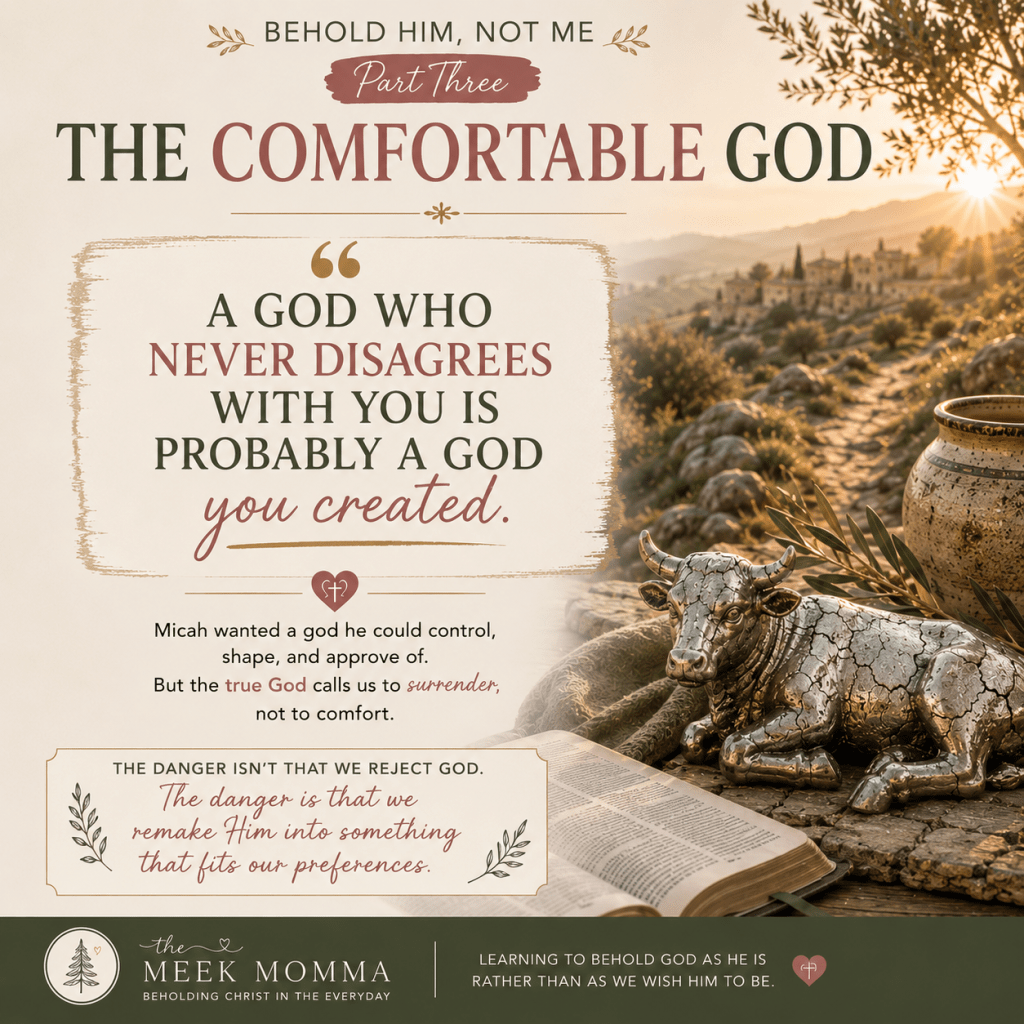
The most dangerous idols are often the ones we create in God’s name.
Why This Matters
A counterfeit god can never save us.
More than that, a counterfeit god can never truly know us.
Real relationships require wrestling.
A real person can disagree with you.
Correct you.
Challenge you.
Say no to you.
The same is true in our relationship with God.
When Scripture confronts us, we have an opportunity to wrestle honestly with Him.
To submit where we disagree.
To grow where we are resistant.
To deepen our understanding of His character.
But if we simply ignore every truth we dislike, we are not relating to God at all.
We are relating to a projection of ourselves.
We may have created a more comfortable god.
But we have also created a nonexistent one.
And that may be the most sobering lesson in Judges 17.
Micah’s greatest problem was not that he rejected God.
It was that he remade Him.
Jesus: The True Image
Micah’s mother believed she could fashion something with silver that would help her worship God.
Yet every image created by human hands inevitably distorts the One it seeks to represent.
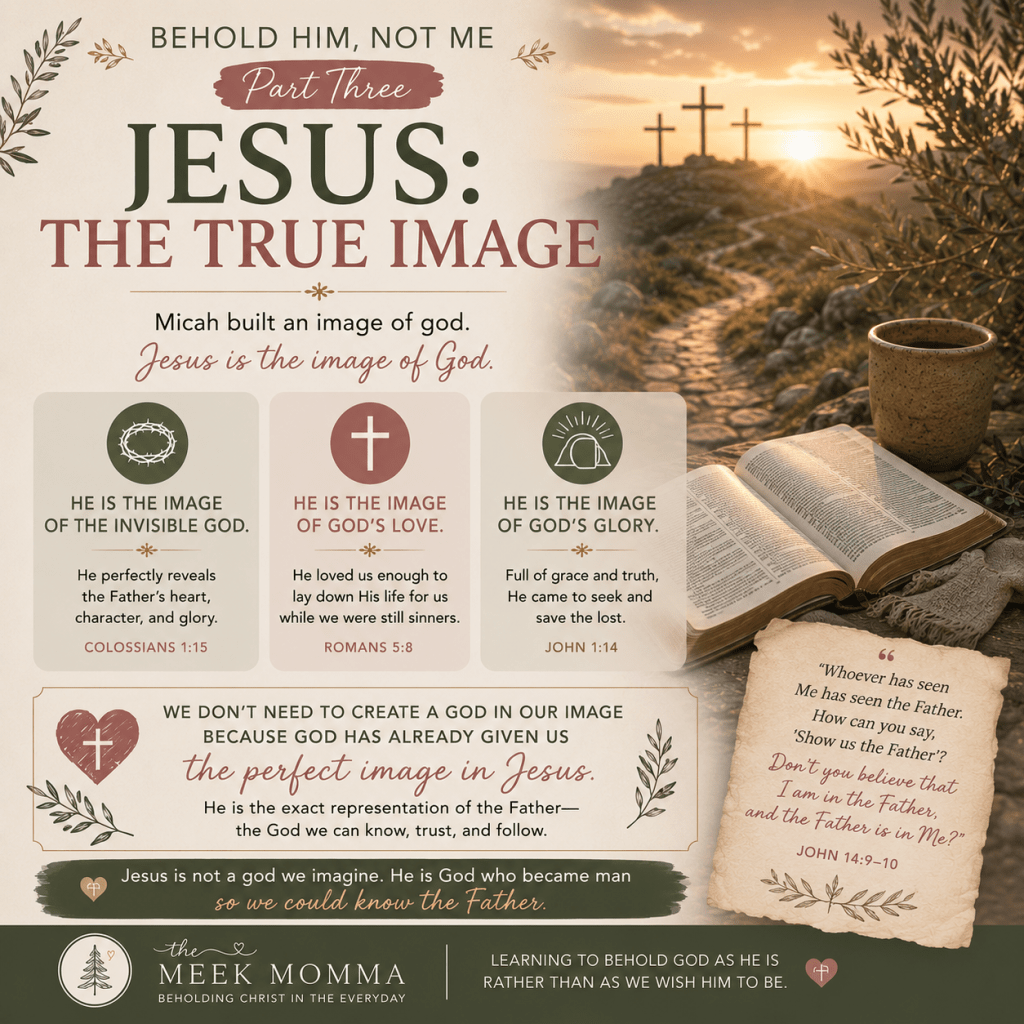
But in Jesus Christ, God has given us the perfect image of Himself.
Paul writes:
“He is the image of the invisible God.” (Colossians 1:15)
Unlike Micah’s idol, Jesus does not distort God’s character.
He reveals it perfectly.
If we want to know what God is like, we do not look at statues.
We look at Christ.
In Jesus we see God’s holiness.
His mercy.
His justice.
His compassion.
His truth.
His love.
Micah attempted to create an image of God.
God gave us the real thing.
We never need to imagine what God is like.
God has shown us.
Behold Him, Not Me
Micah’s problem was not that he stopped worshiping.
His problem was that he wanted a version of God that fit comfortably inside his own preferences.
Every idol ultimately asks the same question:
Will I worship God as He is?
Or will I create a god I prefer?
The answer is not better religion.
The answer is Christ.
The true image of God.
As we continue through the closing chapters of Judges, may we learn to lay aside our preferences, our assumptions, and our attempts to remake God according to our own image.
May we instead allow God to reveal Himself through His Word and through His Son.
And may we learn, once again, to behold Him—not ourselves.
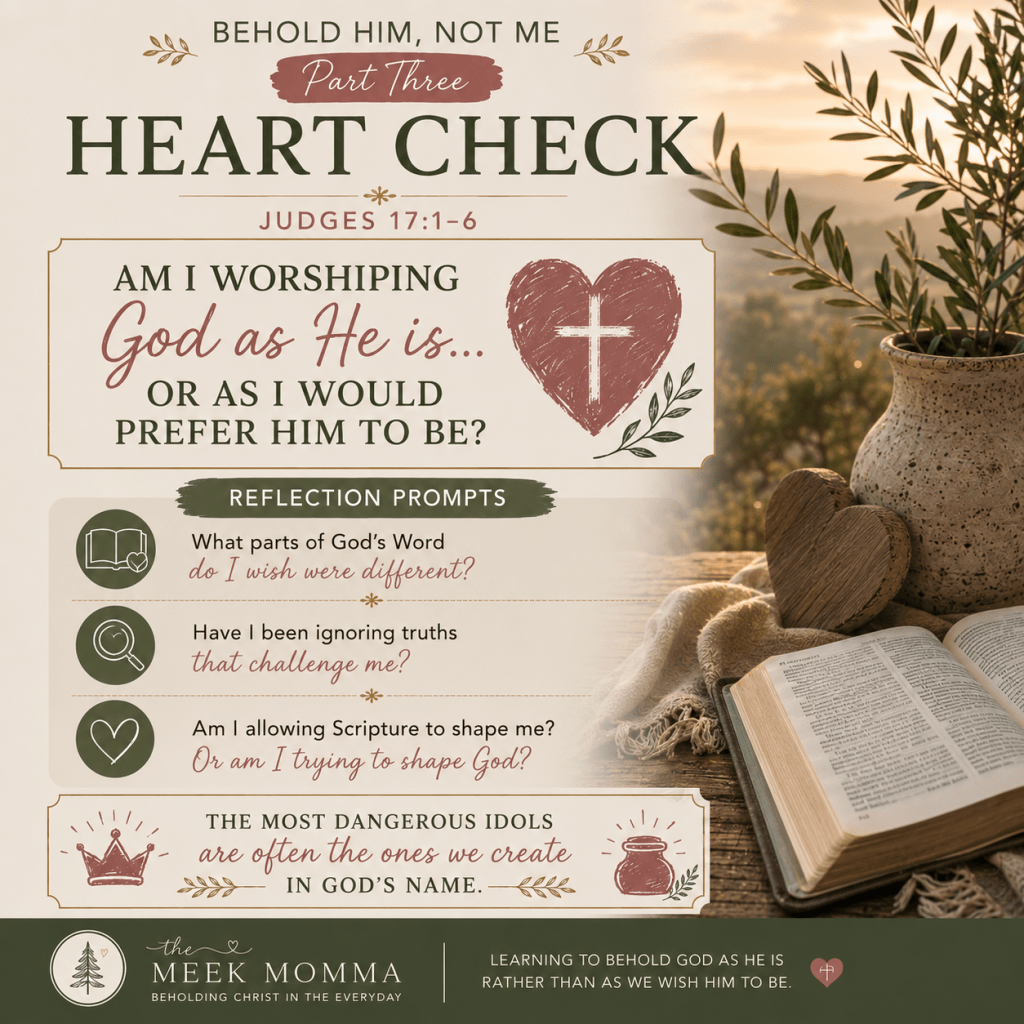
Heart Check Questions
• What parts of God’s Word do I most wish were different?
• Have I been wrestling honestly with those truths or avoiding them?
• Are there attributes of God I emphasize while ignoring others?
• Where am I tempted to shape God according to culture rather than Scripture?
• Am I worshiping God as He is—or as I would prefer Him to be?
Prayer
Father,
Forgive me for the ways I try to reshape You according to my preferences. Forgive me for the times I have emphasized the parts of Your character that comfort me while ignoring the parts that challenge me.
Thank You for revealing Yourself through Your Word and through Your Son. Thank You that I do not have to imagine what You are like because You have shown me in Jesus Christ.
Help me to worship You as You are, not as I wish You to be.
Give me humility where I resist Your truth.
Give me faith where I struggle to understand.
Give me courage to submit even when Your Word confronts my desires.
Teach me to behold Christ more clearly, trust Him more deeply, and follow Him more faithfully.
May I stop creating gods in my own image and instead be transformed into Yours.
In Jesus’ name,
Amen.
The most dangerous idols are often the ones we create in God’s name.
Behold Him, not me.


Leave a Reply