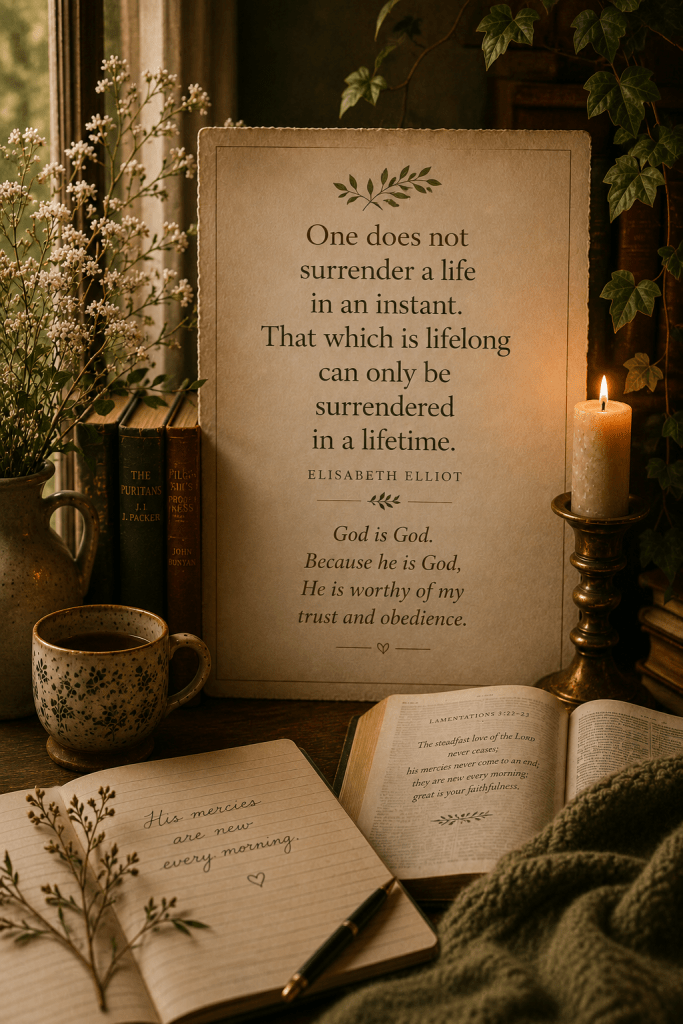
A Reflection on Wisdom, Repentance, and Living Before Christ
I’ve been reading Contend by Philip Anthony Mitchell, and several passages have brought me back to something the Lord has been impressing upon my heart through my own study of Scripture, writing, and teaching over these last several months.
At our Mom Fight Club retreat, we spent time in Proverbs 14:1, considering the woman who builds her house through wisdom and the woman who tears it down through folly. We talked about how wisdom is not simply knowing what is right, but living in reverence and obedience to the Lord. How the things we do quietly, consistently, and sometimes without anyone noticing are shaping our homes and our lives.
I’ve also been thinking about Paul’s warning in 2 Timothy 3 concerning those who are “always learning and never able to arrive at a knowledge of the truth” (verse 7).
What a sobering description of something we can recognize in our own generation.
We have access to more sermons, podcasts, Bible studies, teachers, books, and Christian content than we could possibly consume in a lifetime. Yet access to biblical information is not the same thing as spiritual maturity. We can know what everyone is saying about God while spending very little time actually listening to what God has said in His Word.
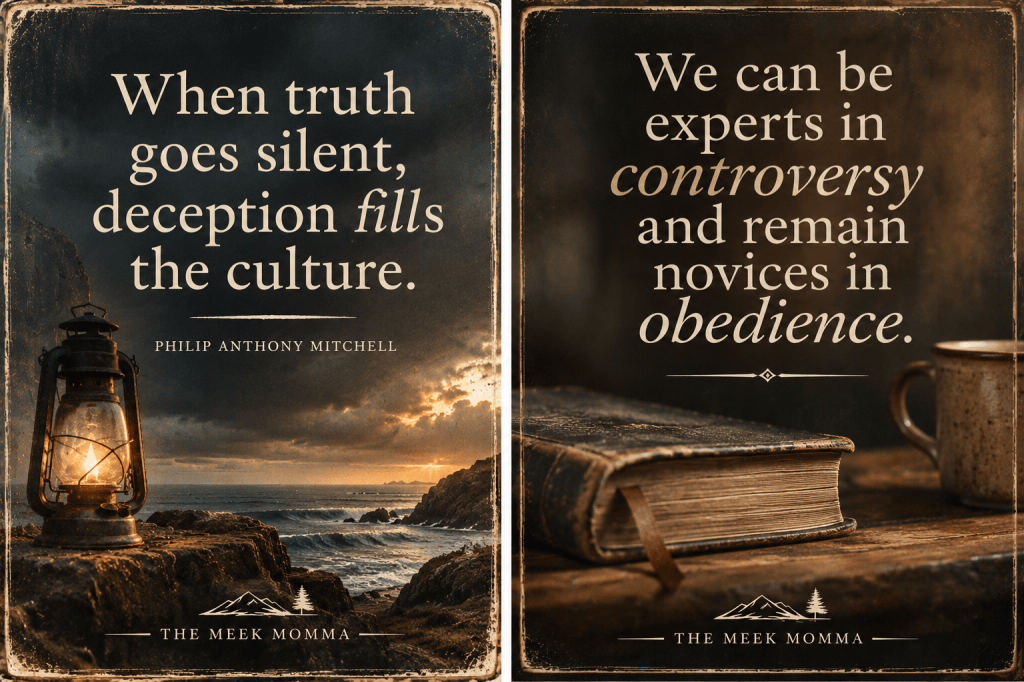
We can become experts in controversy and remain novices in obedience.
And perhaps most concerning, we can become so preoccupied with the sins of the world, the failures of church leaders, and the deception we see around us that we neglect to examine the condition of our own hearts.
In Jude 3, believers are urged to contend for the faith once delivered to the saints. That is a necessary charge. Truth matters. Doctrine matters. We are not free to reshape Christianity around our preferences, feelings, or the changing convictions of the culture.
But contending for the faith must never become a substitute for actually living the faith.
Jude doesn’t merely warn against false teachers. He goes on to instruct believers to build themselves up in the faith, pray in the Holy Spirit, keep themselves in the love of God, and wait for the mercy of Jesus Christ (Jude 20–21).
Notice how much of that instruction requires our own faithful participation.
And this brings me back to Proverbs 14:1.
What are we building?
What are we allowing to shape our thinking, our affections, our conversations, and our homes? What are we teaching our children about what matters, not merely through the things we tell them, but through the things they watch us pursue?
Are we becoming more patient? More humble? More generous? More acquainted with Scripture? More willing to confess our sins and turn from them?
Or are we simply becoming more informed, more opinionated, more distracted, and more comfortable with the things God has called us to put away?
I ask these questions of myself as much as anyone else.
Because repentance is not merely the doorway through which we entered the Christian life. It ought to remain an ongoing posture of the Christian heart.
Not because Christ’s sacrifice was insufficient, but because His grace is continually teaching us to renounce ungodliness and live godly lives (Titus 2:11–12).
We should be growing in our willingness to be corrected by Scripture. We should be quicker to recognize our own sin, quicker to confess it, and increasingly unwilling to make peace with the things that grieve the Lord.
And we should never confuse repentance with despair. The Christian does not turn from sin toward hopelessness. We turn toward Christ, whose mercy is sufficient and whose grace continues to transform us.
Lately, I’ve been thinking more about the judgment seat of Christ.
Paul writes in 2 Corinthians 5:9–10 that his aim is to please the Lord, because we must all appear before the judgment seat of Christ and give account for what we have done in the body.
One day, we will stand before Him.
And I wonder how much of what consumes us today will seem terribly insignificant in that moment.
The arguments we felt compelled to win. The opinions we needed everyone to hear. The endless hours spent consuming information that did little to make us more faithful. The comforts we protected, the distractions we justified, and the opportunities to love and serve that we allowed to pass us by.
How differently might we live today if we remembered that our lives are being lived before the Lord?
Not every faithful act will be impressive to the world. Much of it may look like ordinary obedience. Loving our families. Speaking truth graciously. Repenting when we are wrong. Praying when no one sees. Refusing to compromise. Opening our Bibles when something else would be easier. Serving faithfully in the places God has assigned to us.
These things matter.
And none of this is about earning our standing before God. Our salvation rests entirely upon the finished work of Jesus Christ. But the grace that saves us is also the grace that changes us.
I don’t want to spend my life collecting Christian knowledge while resisting the very transformation that knowledge ought to produce.
I don’t want to be so busy identifying the foolishness around me that I fail to recognize the foolishness I am allowing into my own home.
And I certainly don’t want to stand before Christ having devoted more attention to the temporary things of this world than to the eternal things He entrusted to me.
Psalm 1 describes the blessed person as one who delights in the instruction of the Lord and meditates on it day and night. That person is compared to a tree planted by streams of water, bearing fruit in its season.
There is something encouraging about that picture.
The tree does not produce fruit by chasing every passing thing. It bears fruit because it is rooted, nourished, and sustained.
Perhaps that is where we need to return.
Not to another personality, another controversy, or another endless stream of content, but to the Word of God. To prayer. To repentance. To the ordinary, often unseen work of faithfully following Jesus.
Are we allowing biblical truth to govern the way we actually live?
Because one day we will see our lives in the light of eternity, and I pray that what matters to Christ will have mattered to us.
May we be women who build wisely, repent readily, contend faithfully, and rest wholly in the grace of our Savior.
We do not need to wait until eternity to begin caring about the things that will matter in eternity.
“So whether we are at home or away, we make it our aim to please him.” — 2 Corinthians 5:9
This morning, I woke up with a heavy heart as I considered the results of last night’s election. I’ve spent much of the morning praying, thinking about the condition of our nation, and returning to the Scriptures.
My disappointment isn’t simply about political parties or who won and who lost. My concern is much deeper than that. As Christians, we are called to examine what we value, what we approve of, and what we place our hope in. We ought to be asking whether our convictions are being shaped by the Word of God or by the desires of our flesh, our pursuit of comfort, our love of money, and the things this world promises us.
And that examination must begin with ourselves.
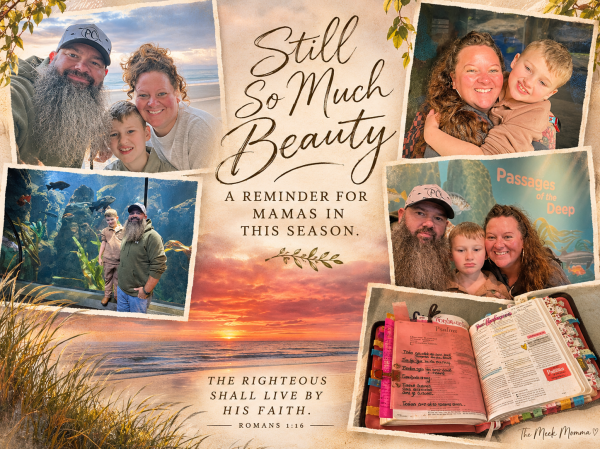
Paul writes in Romans 1:16–17:
“For I am not ashamed of the gospel, for it is the power of God for salvation to everyone who believes, to the Jew first and also to the Greek. For in it the righteousness of God is revealed from faith for faith, as it is written, ‘The righteous shall live by faith.’”
Paul continues in Romans 1:18–32 by describing humanity’s rejection of God. Although God has made Himself known through creation, sinful humanity has exchanged the truth about God for a lie, worshiping and serving the creature rather than the Creator.
What a sobering description of the human heart.
We are so prone to elevate created things into places of ultimate importance. Power, prosperity, security, comfort, approval, and even our political convictions can become idols when we allow them to occupy the place that belongs to God alone.
But Romans doesn’t leave us merely examining the sins of the world around us. Paul goes on to establish that all have sinned and fall short of the glory of God (Romans 3:23). None of us stands righteous before God on our own merit. Yet Romans 3:24 reminds us that sinners can be justified by His grace as a gift, through the redemption that is in Christ Jesus.
That is the gospel. And that is where our hope must remain.
Something else has been on my heart this morning as I think about the women I’ve been teaching and the passages of Scripture we’ve been studying together.
When Paul writes, “The righteous shall live by faith,” he is quoting Habakkuk 2:4.
Habakkuk was a prophet who looked around at the wickedness, injustice, and violence of his own day and cried out to the Lord. He struggled to understand what God was doing and why He seemed to allow evil to continue.
Doesn’t that sound familiar?
But what I find so beautiful about Habakkuk is that he doesn’t abandon the Lord in his confusion. Instead, he positions himself to watch and wait.
“I will take my stand at my watchpost and station myself on the tower, and look out to see what he will say to me.” — Habakkuk 2:1
In the ancient world, watchmen stood upon city walls, looking for approaching danger or messengers. Habakkuk uses this imagery to describe his posture before God. He doesn’t have all the answers, but he is determined to wait upon the Lord.
And God’s answer includes this remarkable declaration:
“But the righteous shall live by his faith.” — Habakkuk 2:4
Faith does not mean having every answer. It does not require circumstances to change before we trust God. It means trusting His character, His promises, and His purposes even when the outcome is not yet visible.
By the end of Habakkuk’s book, his circumstances have not suddenly become easy. Yet he declares that even if the fig tree should not blossom, the fields yield no food, and the flocks disappear, he will rejoice in the Lord and take joy in the God of his salvation (Habakkuk 3:17–19).
What a beautiful picture of faith in the in-between.
This is what I want to remember this morning.
My joy cannot depend upon election results, political leadership, financial security, or the direction of our culture. If it does, my peace will always be as unstable as my circumstances.
But Christ is not unstable. His throne is not threatened. His promises have not changed, and His return is certain.
So yes, I am grieved. I am praying for repentance, for revival, and for hearts to turn back to the living God. I am praying that the Church would be faithful to His Word, unwilling to exchange truth for comfort or compromise for acceptance.
But I am also reminded that our calling has not changed.
We are still called to proclaim the gospel, love our neighbors, pursue righteousness, speak truth, repent of our own sins, and live by faith.
Our hope was never supposed to rest in the outcome of an election. It rests in the risen and returning Christ.
So my prayer today echoes the words of King Jehoshaphat in 2 Chronicles 20:12:
“We do not know what to do, but our eyes are on you.”
Lord, may our eyes remain fixed upon You. Bring us to repentance. Revive Your Church. Teach us to be faithful in the waiting, steadfast in truth, and joyful in Your salvation.
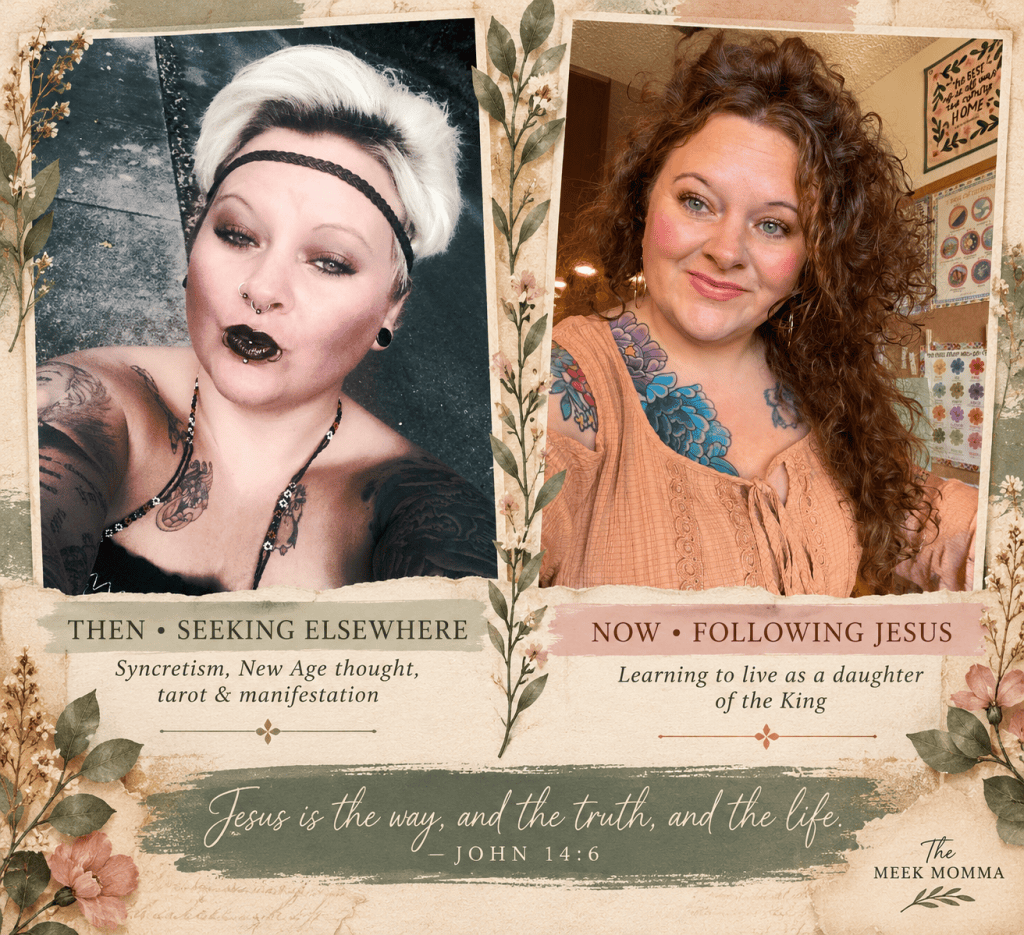
This is sort of a follow up to my previous post regarding my journey out of practicing syncretism and with it being October this word study felt timely.
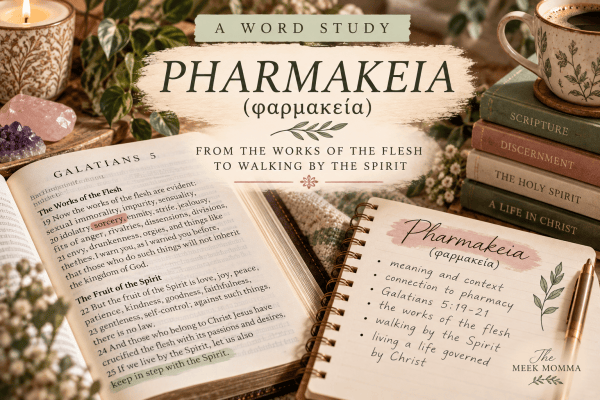
There is an interesting Greek word in the New Testament that is worth slowing down over as we study Scripture’s warnings about sorcery and occult practices. The word pharmakeia (φαρμακεία) appears in Galatians 5:20 and is commonly translated as “sorcery” or “witchcraft.” It also appears in Revelation 9:21 and 18:23.
The word is related to pharmakon, which could refer to a drug, medicine, poison, or potion. In ancient contexts, substances and potions could be associated with magical or occult practices, which helps explain the connection between this family of words and sorcery. The Greek word is also related historically to our English word pharmacy. However, this does not mean that pharmakeia simply means taking drugs, that all medicines were associated with sorcery, or that the modern practice of pharmacy is inherently occult. We need to let the context of Scripture determine how the word is being used.
What makes Galatians 5 particularly important is that Paul doesn’t mention pharmakeia in isolation. He includes it in a larger list of what he calls the “works of the flesh” (Galatians 5:19–21). This list includes sexual immorality, idolatry, sorcery, jealousy, fits of anger, rivalries, dissensions, and other sinful practices. Paul is describing a way of life that is opposed to the life God calls His people to live.
But notice where Paul takes the discussion next.
In Galatians 5:16, he writes:
“But I say, walk by the Spirit, and you will not gratify the desires of the flesh.”
After describing the works of the flesh, Paul contrasts them with the fruit of the Spirit: love, joy, peace, patience, kindness, goodness, faithfulness, gentleness, and self-control (Galatians 5:22–23).
This connection is important because the Christian response to occult practices is not merely to identify what we must avoid. It is to turn toward God and learn to walk by His Spirit. Repentance involves turning away from what is contrary to Him, but the Christian life is not sustained by avoidance alone. We are called to grow in Christlikeness as the Spirit works in us.
When I look back on my own story, I can see why this distinction matters. I once looked to crystals and stones for energy and manifestation, used tarot cards to seek answers, and pursued spiritual guidance outside of what God has revealed in His Word. At the time, I believed I could combine those practices with my belief in Jesus. I didn’t understand that following Christ required me to reconsider not only what I believed but also where I was looking for wisdom, guidance, and spiritual power.
As I began sitting under the preaching and teaching of Scripture, I started to see these things differently. My response wasn’t supposed to be an ongoing fascination with the practices I was leaving behind. It was to turn toward Christ, trust His Word, and allow His truth to reshape how I lived.
That is the distinction I want us to understand. We do not become spiritually mature simply by learning to recognize everything we should avoid. We grow as we know God through His Word, depend on His Spirit, and increasingly bring our thoughts, desires, decisions, and actions under the lordship of Jesus Christ.
Paul brings this section of Galatians to a fitting conclusion:
“If we live by the Spirit, let us also keep in step with the Spirit.” — Galatians 5:25
The goal isn’t to become fascinated with darkness or to spend our lives looking for it around every corner. The goal is to know Christ and walk faithfully with Him. As we grow in our understanding of God’s Word, we learn to discern what is contrary to Him and to cultivate what honors Him.
For me, repentance began to take a tangible form when I gathered up the objects I had once considered spiritually meaningful and threw them away. But removing those objects was not the whole of the Christian life. It was one expression of a deeper change: I was learning that Jesus was not meant to be one spiritual authority among many in my life. He is Lord, and I am called to follow Him.
The question is not only, “What must I turn away from?” It is also, “How can I walk more faithfully with Christ?”
There are passages of Scripture that we read and appreciate, and then there are passages that seem to reach across the pages of the Bible and meet us right where we are.
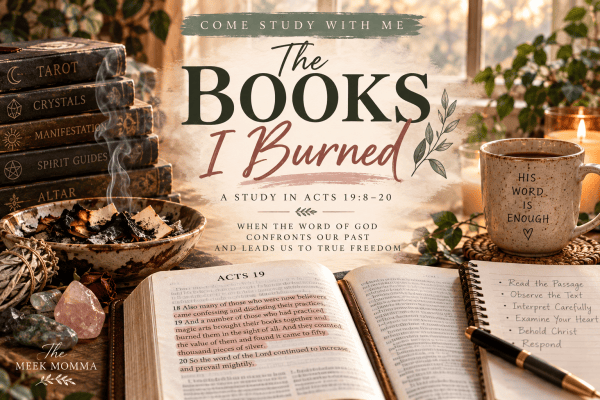
Acts 19:18–20 is one of those passages for me.
I have read the account of the people in Ephesus who practiced magic and then brought their scrolls together and burned them, but the older I get in my faith, the more I understand why Luke included this detail. These people didn’t simply hear Paul preach, agree with what he said, and then continue living exactly as they had before. The Word of God confronted something in their lives, and their response was to repent and remove the things that belonged to their old way of life.
Luke writes:
“Also many of those who were now believers came confessing and disclosing their practices. And a number of those who had practiced magic arts brought their books together and burned them in the sight of all. And they counted the value of them and found it came to fifty thousand pieces of silver. So the word of the Lord continued to increase and prevail mightily.” — Acts 19:18–20
For a long time, I thought I understood what it meant to believe in Jesus.
I believed in God. I believed Jesus was real. I would have told you that I was a Christian. But looking back, I can see that my understanding of Christianity was mixed with many other things. I was practicing what I now understand as syncretism: taking pieces of Christianity and combining them with other spiritual practices that I believed could give me knowledge, protection, power, guidance, or access to something beyond what I could see.
I didn’t understand at the time that these things were incompatible with following Christ.
I grew up knowing that the spiritual realm was real. There were things I experienced and witnessed in my childhood that I could not explain, and because of those experiences, I never really struggled with the idea that there was more to this world than what we can see. The problem was that I didn’t have a biblical framework for understanding any of it.
I knew there was a spiritual world, but I didn’t understand that Scripture teaches us to distinguish between what comes from God and what does not.
So I began looking in places I should never have looked.
There were crystals, stones, and gems that I believed carried energy or could help with manifestation. I had tarot cards that I used to look for answers about the future or ask questions and seek guidance from spirits. At one point I had an altar where I kept things that I associated with spiritual power, including parts of dead animals. During a particularly dark period of my life when I was struggling with self-harm, I even used my own blood on that altar while asking for particular things to happen to people who had hurt me.
I don’t share those details because I want to make the darkness sound interesting. I actually want to do the opposite.
I want to be careful about how we talk about these things because our culture has become very comfortable with spiritual practices that Scripture tells us to take seriously. What is sometimes presented as harmless, aesthetic, empowering, or even entertaining can become spiritually significant without us recognizing what we are participating in.
My story isn’t meant to make anyone curious about those things.
It is meant to show what happened when I finally began looking at them through the lens of Scripture.
When I Came Back to Church
When I came back to church as an adult, something began to change in me that I didn’t fully understand at first.
I started sitting under the preaching and teaching of God’s Word in a way I never really had before. I wasn’t simply hearing encouraging messages. I was beginning to encounter Scripture as God’s Word, with the authority to tell me what was true, what was false, what was holy, what was sinful, and what needed to change in my life.
The more I listened, the more I began to see things differently.
I had spent years believing that I could have Jesus and still hold onto these other spiritual practices. I thought I could believe in God while also looking to crystals for energy, tarot for answers, manifestation for outcomes, and spiritual experiences for guidance.
But Scripture doesn’t present Jesus as one spiritual option among many.
Jesus is Lord.
One of the passages that helped me understand this was Deuteronomy 18, where God specifically warned His people against practices such as divination, sorcery, interpreting omens, witchcraft, mediums, and consulting the dead. God wasn’t giving Israel a list of strange things they should be afraid of. He was teaching them where they were to look for guidance and where they were not.
The issue wasn’t whether there was a spiritual realm.
The issue was who God had told His people to trust.
Isaiah says something similar:
“And when they say to you, ‘Inquire of the mediums and the necromancers who chirp and mutter,’ should not a people inquire of their God?” — Isaiah 8:19
That question is incredibly important.
Should not a people inquire of their God?
I began realizing that I had been looking for answers in places where God had never told me to look.
The Night I Cleaned Out My Closets
Eventually, the conviction became impossible for me to ignore.
I remember one night going through my closets and gathering these things up. It was the middle of the night, and I began pulling out the things I had accumulated over the years.
I threw them away.
Some of these things had cost me real money. They weren’t insignificant possessions that I had no attachment to. They were things I had intentionally purchased and kept because I believed they had some kind of spiritual significance.
But by that point, the question in my mind was no longer, “Do these things really work?”
The question was, “Do these things belong in a life surrendered to Jesus?”
And I knew the answer.
My husband was in complete shock.
We had argued about some of these things over the years. Eventually, he had essentially taken the position of agreeing to disagree with me. He knew how strongly I felt about them, and I knew how strongly he felt differently.
So when he saw me gathering everything up and getting rid of it, he couldn’t believe what he was seeing.
I remember telling him that I felt convicted by the Lord and that I needed to listen to the Spirit.
I didn’t have a perfectly developed theology of everything that was happening in that moment. I didn’t have all the answers. But I had begun to understand something that I hadn’t understood before:
If I belonged to Christ, I could not continue treating every spiritual practice as though it was compatible with Him.
So I got rid of it.
And I have never looked back.
The People in Ephesus
This is why Acts 19 means so much to me.
When Paul came to Ephesus, he reasoned with people from the Scriptures and taught them about the kingdom of God. The chapter tells us that his ministry continued for an extended period of time, and that God was doing extraordinary things through him.
There was also a dramatic confrontation involving some men who attempted to use the name of Jesus without actually belonging to Him. Their encounter exposed something important: the name of Jesus isn’t a spiritual formula that we manipulate to get power. Jesus is Lord, and His authority cannot be separated from relationship with Him.
And then we come to verses 18–20.
Many who had believed came confessing what they had been doing. Those who had practiced magic brought their scrolls together and burned them publicly.
I love that Luke tells us what those scrolls were worth.
Fifty thousand pieces of silver.
Whatever the exact modern equivalent, Luke wants us to understand that this was not a meaningless sacrifice. These were valuable possessions.
They didn’t say, “Well, these cost a lot, so I’ll keep them even though I don’t use them.”
They didn’t put them in a box in the attic.
They didn’t keep them around as a reminder of their past.
They burned them.
And I think there is something we need to understand about biblical repentance here.
Repentance is more than feeling bad about something.
It is more than admitting that something was wrong.
Repentance means turning.
Sometimes that turning requires us to make very practical changes in our lives.
For those believers in Ephesus, repentance meant getting rid of the things associated with their former practices. For me, it meant going through my closets in the middle of the night and throwing away the things I had once considered spiritually meaningful.
The objects weren’t the source of my salvation or the proof that I had truly repented. Christ was my salvation.
But getting rid of those things was one tangible expression of what God was doing in my heart.
I Didn’t Become Afraid of the Spiritual Realm
One of the things I want to make clear about my story is that I didn’t come away from this thinking that the spiritual realm wasn’t real.
Quite the opposite.
I already knew it was real.
What changed was the lens through which I understood it.
Before Christ became central in my life, I had treated the spiritual realm almost like a marketplace. There were good things and bad things, different kinds of spiritual power, different ways to gain knowledge, different sources of guidance, and different practices I could use depending on what I wanted.
But Scripture gave me a completely different framework.
There is one God.
He is Creator.
I am His creature.
Jesus Christ is Lord.
And I don’t need to search the spiritual world for power, knowledge, protection, identity, or guidance because God has already told me where to go.
His Word.
His presence.
His wisdom.
His people.
And ultimately, Christ Himself.
I don’t want my testimony to make people fascinated with the things I used to practice. I don’t want to describe my past in a way that makes darkness sound mysterious or powerful or exciting.
I want women to learn to look at the world through the lens of Scripture.
Because the spiritual danger isn’t only found in obvious things.
Sometimes it is hidden beneath something beautiful.
Sometimes it is packaged as self-care.
Sometimes it is called manifestation.
Sometimes it is entertainment.
Sometimes it is presented as harmless curiosity.
And sometimes we don’t recognize what we are participating in because we have never opened our Bibles and learned what God actually says about it.
What About the Things We Let Enter Our Homes?
This is where I think Acts 19 begins to challenge all of us.
We can read about the people of Ephesus and think, “Well, I don’t practice magic, so this doesn’t really apply to me.”
But Scripture asks us to examine our hearts much more deeply than that.
What sources do I look to for guidance?
What do I believe will give me power or control?
Where do I go when I am afraid?
What am I trusting to protect me?
What do I believe will tell me what is going to happen?
What practices have I allowed into my life because they seemed harmless?
What entertainment has slowly taught me to become comfortable with things God calls us to reject?
What have I kept because it has sentimental value even though I know it doesn’t belong in my life with Christ?
These are questions meant to make us discerning.
Paul tells the believers in Corinth that they cannot have fellowship with the Lord while participating in what belongs to idolatry. Scripture consistently calls God’s people to distinguish between what belongs to Him and what does not.
That doesn’t mean Christians should live terrified of everything around them.
It means we should live with our eyes open.
We don’t need to become fascinated with darkness in order to recognize it.
We need to know the light.
When the Word Confronts Us
One of the things I love about Acts 19 is that the people weren’t simply given a list of rules.
They encountered the Word of God.
And when the Word confronted them, they responded.
That is what happened to me.
I didn’t wake up one morning and decide that I needed to completely change my spiritual worldview because I had become particularly disciplined or wise.
God used His Word.
He allowed me to sit under preaching and teaching, and slowly I began to see what I hadn’t seen before.
That is why I have become so passionate about studying Scripture.
The Bible doesn’t simply give us information about God.
It teaches us how to see everything else.
It gives us a framework for understanding ourselves, the world around us, suffering, temptation, sin, relationships, culture, our bodies, our families, and even the unseen spiritual realities that Scripture tells us exist.
The more we know God’s Word, the less dependent we become on our own feelings and experiences to determine what is true.
And that matters because my experiences were real to me, but my experiences could not be my authority.
Scripture had to be.
Behold Christ
This is where I want us to end, because the point of Acts 19 isn’t really the books.
It is Jesus.
The people of Ephesus weren’t saved because they burned their scrolls. They burned their scrolls because they had come to believe in Christ and their allegiance to Him changed what they were willing to keep.
Christianity isn’t primarily about cleaning up our lives so that we can become acceptable to God.
It is about being reconciled to God through Jesus Christ and then allowing His lordship to change everything.
There were many things I needed to leave behind when I came to Christ.
But what I gained was infinitely greater.
I didn’t lose access to spiritual power.
I found the One who has all authority.
I didn’t lose the ability to seek answers.
I found the One who is Truth.
I didn’t lose protection.
I found the One who is my refuge.
I didn’t lose my connection to the spiritual world.
I found the God who created both the seen and the unseen and who has authority over them all.
And that is why Acts 19:20 is such a beautiful ending to this story:
“So the word of the Lord continued to increase and prevail mightily.”
The books were burned.
But the Word remained.
And the Word prevailed.
Maybe your story looks nothing like mine.
Maybe you have never owned tarot cards or crystals. Maybe you have never participated in anything you would have called occult or spiritual.
But I would still encourage you to sit with Acts 19 for a while.
Ask the Lord to search your heart.
Are there things you have been trying to hold alongside Christ?
Are there places you are looking for guidance that God has not given you permission to look?
Are there practices you have accepted because our culture has made them seem harmless?
Are there things in your home, your entertainment, your habits, or your thinking that the Holy Spirit has been bringing to your attention?
And if He does bring something to mind, don’t respond with shame.
Respond with repentance.
You don’t have to be fascinated with what you are leaving behind.
You don’t have to understand every detail of it.
You don’t have to become an expert on darkness.
You simply need to know Christ and trust His Word.
There was a night when I went through my closets and threw away things that I once believed were spiritually meaningful.
I didn’t know then that years later I would look back on that night and see Acts 19 in it.
But now I do.
And I am grateful that the Lord loved me enough to let His Word confront me.
Because the greatest thing that happened wasn’t that I threw away some books, cards, stones, or objects.
The greatest thing that happened was that I began to understand that Jesus was not meant to be one part of my spirituality.
He was calling me to Himself.
Come Study With Me
Read: Acts 19:8–20 Study: Deuteronomy 18:9–14; Isaiah 8:19–20; 1 Corinthians 10:20–21 Ask: What does this passage teach me about repentance? What does it reveal about where I seek guidance and authority? Examine: Is there anything I am attempting to hold alongside Christ? Behold: Jesus is Lord over both the seen and unseen. Respond: Repent where God convicts, remove what needs to be removed, and trust Christ completely.
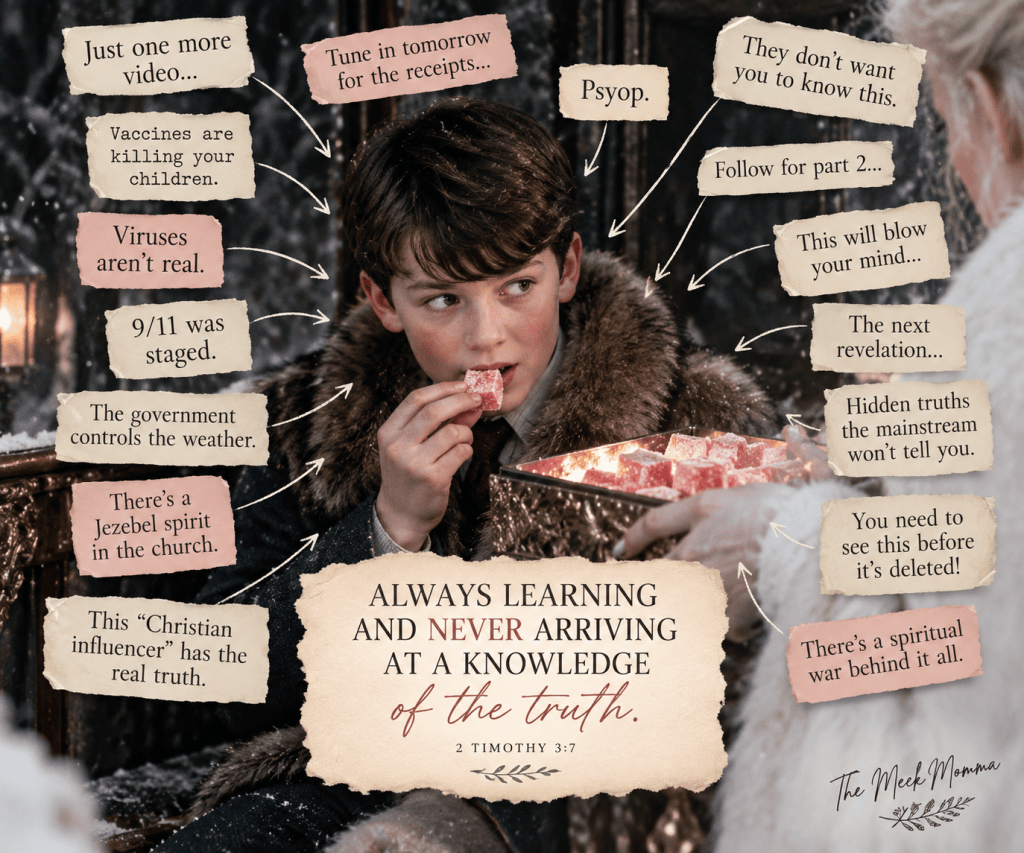
We are living in an age where women can spend hours scrolling, listening, watching, speculating, gossiping, following personalities, chasing conspiracy theories, consuming controversy, and endlessly learning about everything—while becoming increasingly unfamiliar with the Word of God.
We can have access to more information than any generation before us and yet be increasingly starved of truth.
Paul warns Timothy:
“For among them are those who creep into households and capture weak women, burdened with sins and led astray by various passions, always learning and never able to arrive at a knowledge of the truth.” — 2 Timothy 3:6–7
Notice that Paul doesn’t merely warn about false information.
He warns about captivation.
There are voices that want access to your attention. There are voices that want access to your home. There are voices that want access to your children. There are voices that want access to your emotions. And there are voices that will gladly keep you angry, afraid, suspicious, entertained, and distracted because a distracted Christian is easier to influence.
And Christian women, we need to be careful.
Not everything that calls itself “discernment” is discernment.
Not every secret explanation is truth.
Not every viral video deserves our attention.
Not every accusation deserves our agreement.
Not every Christian influencer deserves our trust.
Not every “dream,” “revelation,” or personal experience carries biblical authority.
And not every hour we spend consuming information is an hour well spent.
Jude gives us another sobering picture. He warns about people who reject authority, follow their own ungodly desires, boast about what they do not understand, and infiltrate the people of God. They are compared to hidden reefs—dangerous beneath the surface.
That is what makes this so serious.
Some dangers do not look dangerous at first.
They look like entertainment.
They look like “just keeping up.”
They look like being informed.
They look like exposing evil.
They look like having discernment.
They look like Christian content.
But if something continually produces fear, suspicion, outrage, gossip, arrogance, obsession, division, or contempt—and continually pulls you away from Scripture, prayer, your responsibilities, and loving Christ and His people—we should have enough discernment to step away.
Christian women, we need to be in the Word.
Not merely hearing what someone says the Bible says.
Not merely listening to sermons while scrolling through everything else.
Not merely collecting Bible studies.
We need to know the Word ourselves.
We need sound doctrine.
We need prayer.
We need self-control.
We need holy lives.
We need to learn how to recognize a counterfeit because we know what is true.
And husbands, fathers, pastors, and spiritual leaders—pay attention.
Pay attention to what is entering your home.
Pay attention to what voices are discipling your family.
Pay attention to what is filling the ears and hearts of those entrusted to your care.
This isn’t about controlling women.
It is about shepherding a household.
We should all be asking:
What is discipling me?
What am I consuming every day?
What occupies my thoughts?
What am I constantly talking about?
What am I teaching my children to care about?
Am I becoming more like Christ—or simply more informed about the things of this world?
Paul says that in the last days there will be people who are lovers of self, lovers of money, proud, arrogant, abusive, disobedient, ungrateful, unholy, heartless, slanderous, without self-control, brutal, treacherous, reckless, swollen with conceit, and lovers of pleasure rather than lovers of God.
And then he tells Timothy what to do.
Stay faithful.
Jude tells us:
“But you, beloved, building yourselves up in your most holy faith and praying in the Holy Spirit, keep yourselves in the love of God, waiting for the mercy of our Lord Jesus Christ that leads to eternal life.” — Jude 20–21
There is our answer.
Grow strong in sound doctrine. Preserve in prayer. Keep yourselves in the love of God. Wait for the coming of Christ.
We do not need to know every conspiracy.
We do not need to follow every controversy.
We do not need to have an opinion about everything.
We need to know Christ.
We need to know His Word.
We need to guard our homes.
We need to guard our hearts.
We need to live holy lives.
And we need to remember that our King is coming.
So, sister—
Put the phone down.Open the Word.Pray.Test what you hear.Guard your heart.Love your family.Walk in holiness.And keep your eyes on Christ.
Because the goal isn’t to be the woman who knows everything happening in the world.
The goal is to be the woman who knows the One who made it.
“To the only God, our Savior, through Jesus Christ our Lord, be glory, majesty, dominion, and authority, before all time and now and forever. Amen.” — Jude 25
In 1929, the Soviet Union introduced what became known as the “continuous working week” (nepreryvka). The goal was to keep factories operating continuously and maximize industrial productivity. Instead of everyone sharing the same weekly day of rest, workers were divided into groups and assigned different days off. Four days of work were followed by one day of rest, but because everyone’s schedule was staggered, the factory could keep operating every day.
The system created an unexpected—and deeply human—problem.
Families and friends often no longer had the same day off.
A husband might have Tuesday off while his wife had Friday. Parents and children could have different schedules. Communities lost a common rhythm of rest and gathering. The arrangement also made participation in religious worship more difficult, particularly because the traditional Sunday rest had been eliminated.
The experiment ultimately failed. In 1931, the Soviet government replaced the five-day system with a six-day work cycle, and in 1940 the traditional seven-day week was restored.
Why does this matter when reading Scripture?
Because Sabbath was never merely about stopping work.
God established a rhythm of work, rest, worship, community, and remembrance.
The Sabbath created a shared rhythm for God’s people.
It reminded Israel:
We are not machines.Our worth is not measured by our productivity.God is our provider.Rest is a gift.Worship matters.Community matters.
The Soviet experiment tried to organize human beings around continuous production.
God built a rhythm into His covenant people that reminded them they belonged first to Him.
“Remember the Sabbath day, to keep it holy.” — Exodus 20:8
And perhaps that gives us another reason to slow down when we read Leviticus.
God was not merely giving Israel a list of strange regulations.
He was teaching them how to live as His people in His presence.
Even their calendar was meant to remind them who they belonged to.
This little historical story paired with my Sabbath readings really gave me a lot to chew on in a way I did not expect… it caused me to ask myself, How does my calendar reflect the things that are important to me? Does my calendar look like the world’s calendar, does my family rhythm reflect that we are a people set apart? Or are we busy to just be busy?
🌿 — A Note to Remember
God did not create us for endless production.He created us for Himself.
Yesterday, Jackson had a neuropsychological evaluation.
His autism diagnosis was not new. He has been diagnosed with autism since he was two, and that has been a consistent part of our understanding of him.
What was new was a diagnosis of intellectual disability.
I had wondered about this possibility because, as Jackson has grown, I have noticed areas of executive functioning, learning, problem-solving, and adaptive functioning that seem different from what I would expect for his chronological age. Still, hearing a new diagnosis attached to your child is a different experience than simply wondering about something.
My heart is heavy.
Not because I believe this diagnosis makes Jackson less capable or less valuable. It doesn’t.
But because as his mother, I immediately start thinking about his future.
Will people understand him?
Will he have lasting friendships?
Will he find places where he belongs?
Will he receive the accommodations and support he needs—or will people assume he doesn’t need enough help because his challenges aren’t considered “severe”?
I think this is one of the most misunderstood things about developmental disabilities.
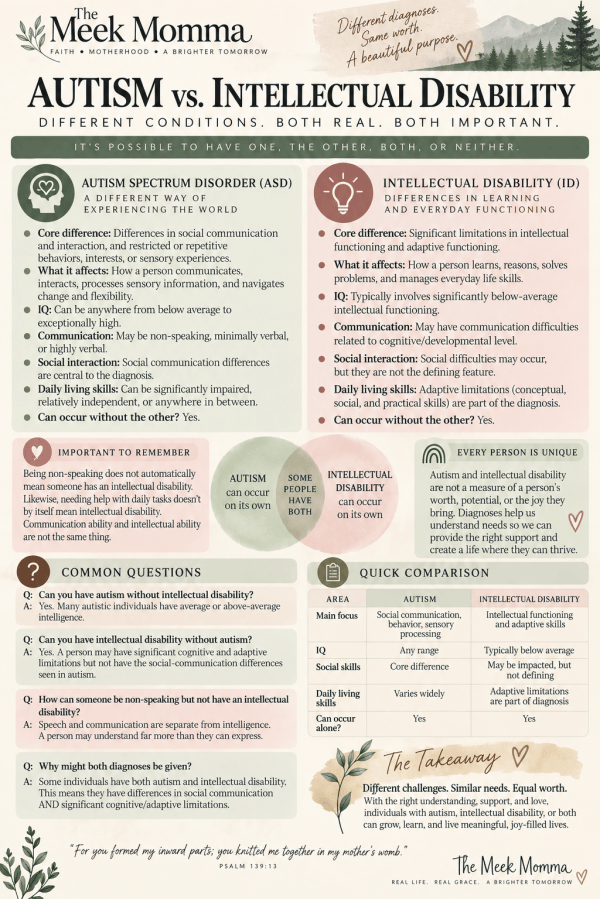
Autism and intellectual disability are not the same thing.
Autism primarily involves differences in social communication and interaction, along with restricted or repetitive behaviors, interests, or sensory experiences.
Intellectual disability involves significant limitations in intellectual functioning and adaptive functioning—things like learning, reasoning, problem-solving, communication, and managing everyday life.
You can have autism without intellectual disability.
You can have intellectual disability without autism.
And you can have both.
And perhaps most importantly:
Communication ability and intellectual ability are not the same thing.
A person can be non-speaking and understand much more than they can communicate. A person can have significant sensory or social challenges and have average or above-average intellectual ability. And a person with intellectual disability may have strengths and abilities that aren’t captured well by a standardized test.
That distinction matters because a diagnosis is supposed to help us understand what support a person needs, not determine their worth or write their future for them.
And this is where my heart has been wrestling.
Jackson is getting older.
He is too big to simply be included with much younger children, but developmentally he may not yet be ready to participate in the same way as many children his age.
We’ve seen glimpses of this already.
The last two Sundays at church, Jackson tried to engage groups of older boys. He approached them because he wanted to play. But they backed away awkwardly or simply told him, “No, I don’t want to play with you,” and walked away.
I’m sure those boys weren’t trying to wound him.
They probably didn’t know what to do.
But I was his mother, standing there watching my child reach for friendship and not quite know how to bridge the gap.
And that hurts.
It makes me think about the spaces Jackson will encounter throughout his life where he may be too old for one group, but not developmentally ready for another.
Where does a child belong when the world has categories for age, but development doesn’t always follow those categories?
Where does he fit when he needs more support than some people realize, but doesn’t fit the picture people have in their minds of someone with a “severe” disability?
Those are questions I’m still learning how to answer.
But there is something I want to remind myself—and perhaps another parent needs to hear it too:
Diagnoses aren’t prophecy.
A diagnosis describes something important about a person’s functioning today.
It can help us understand.
It can help us advocate.
It can help us access accommodations.
It can help us stop blaming a child for something that isn’t simply a matter of trying harder.
But it does not tell me everything about Jackson’s future.
It doesn’t tell me what relationships he will have.
It doesn’t tell me what he will learn.
It doesn’t tell me what strengths will emerge.
It doesn’t tell me who will love him.
And it certainly doesn’t tell me what God intends to do with his life.
The evaluation may give us information about Jackson that we didn’t have before.
It doesn’t give us a prophecy.
And I am grateful that God knows the whole story when I can only see the next page.
He knows every part of Jackson—the things the evaluation measured and the things no evaluation could ever measure.
He knows what Jackson understands when he can’t communicate it.
He knows the desires of his heart.
He knows the friendships he will have.
He knows where Jackson will struggle and where he will flourish.
He knows what support Jackson will need.
And He knows the future.
So today, I’m allowing myself to feel the heaviness.
I’m also grateful.
Grateful that we have more information.
Grateful that we can better understand how Jackson learns and functions.
Grateful that there were no additional diagnoses, including ADHD.
Grateful that his evaluation did not paint the severe picture my fearful heart sometimes imagines.
And grateful that a diagnosis gives us another tool to advocate for our son.
Most of all, I’m reminding myself:
Jackson is not his diagnoses.
He is not a score.
He is not a developmental age.
He is not a list of limitations.
He is my son.
And he is fearfully and wonderfully made.
“For you formed my inward parts; you knitted me together in my mother’s womb.” — Psalm 139:13
So we will keep learning.
We will keep advocating.
We will keep making room for him.
We will keep looking for ways to help him communicate, connect, learn, and belong.
And when I can’t see what comes next, I will remind myself:
Nothing about Jackson is a mystery to God.
“The LORD is my strength and my shield; in him my heart trusts.” — Psalm 28:7
Diagnoses aren’t prophecy.They are information.And information can help us build better support for the child God has already entrusted to us.
What Leviticus 21–22, David, and the Gospel Teach Us About Holiness, Grace, and Belonging
A Note Before We Begin
As I have been studying through Leviticus 21–22, I have found myself slowing down over some passages that can be difficult for modern readers to hear.
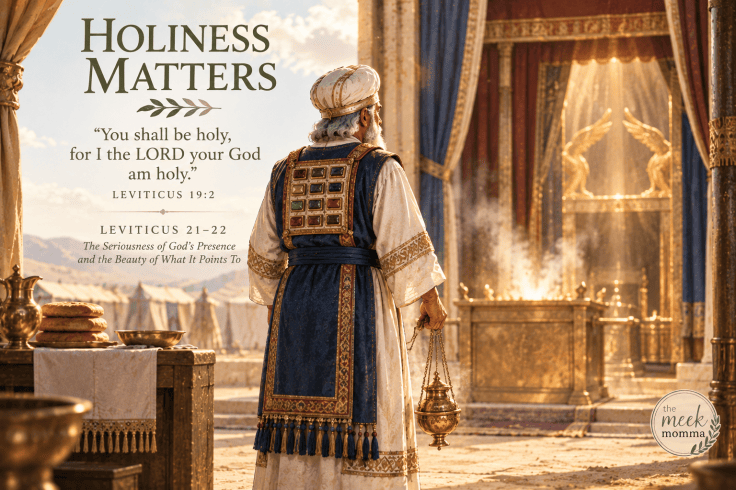
The Lord gives Moses instructions concerning the descendants of Aaron who would serve as priests. Among those instructions, we read that a priest with certain physical blemishes or disabilities was not to approach the altar to offer the Lord’s food offerings or go through the veil.
At first glance, these passages can be jarring.
And because of that, I think we need to slow down and let the text say what it actually says rather than allowing our first reaction to determine what we believe it means.
Leviticus 21 is not teaching that a person with a disability is less valuable, less loved, or somehow unacceptable to God.
The restriction concerns the priestly function of approaching the altar and performing particular sacred duties.
In fact, there is a detail in this passage that is easy to miss.
The priest who had a physical blemish was still permitted to eat the bread of his God, both the most holy and the holy things (Leviticus 21:22).
He was restricted from performing a particular priestly function.
He was not cast away from God’s provision – This to me reveals the heart of our God.
The priesthood and sacrificial system communicated through visible, tangible realities. The sacrifices were to be without blemish. The priests who approached the altar were given corresponding physical qualifications. These requirements belonged to the symbolic language of Israel’s worship and helped communicate the holiness, completeness, and sacredness of the work being performed.
The priesthood was pointing beyond itself.
Hebrews tells us that Jesus is our perfect High Priest:
“Holy, innocent, unstained, separated from sinners, and exalted above the heavens.” — Hebrews 7:26
What Israel’s priesthood could only imperfectly portray, Christ fulfills completely.
And yet, as I sat with these passages, I kept thinking about someone else.
Mephibosheth.
And that is where this study took me next.
A Man Who Was Far Off
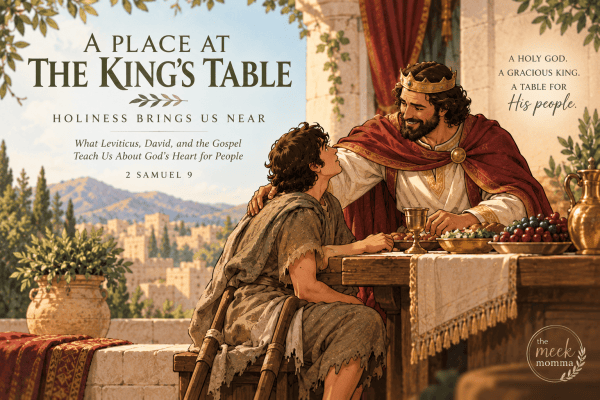
Mephibosheth was the son of Jonathan and the grandson of Saul.
When he was five years old, news came that Saul and Jonathan had died in battle. His nurse picked him up and fled, but in the process he fell and became disabled in both feet (2 Samuel 4:4).
Years later, David became king.
And David did something unexpected.
He asked:
“Is there still anyone left of the house of Saul, that I may show him kindness for Jonathan’s sake?” — 2 Samuel 9:1
Eventually David learns about Mephibosheth.
And Mephibosheth is brought before the king.
Imagine what that must have felt like.
He was the grandson of Saul, the former king. His father, Jonathan, was dead. His grandfather was dead. He was living in Lo-debar, far from the center of the kingdom.
And now he was being summoned into the presence of David.
He falls on his face.
David tells him not to be afraid.
Then David gives him something he could never have secured for himself:
his inheritance.
David restores to Mephibosheth all the land that had belonged to Saul.
But David doesn’t stop there.
He says:
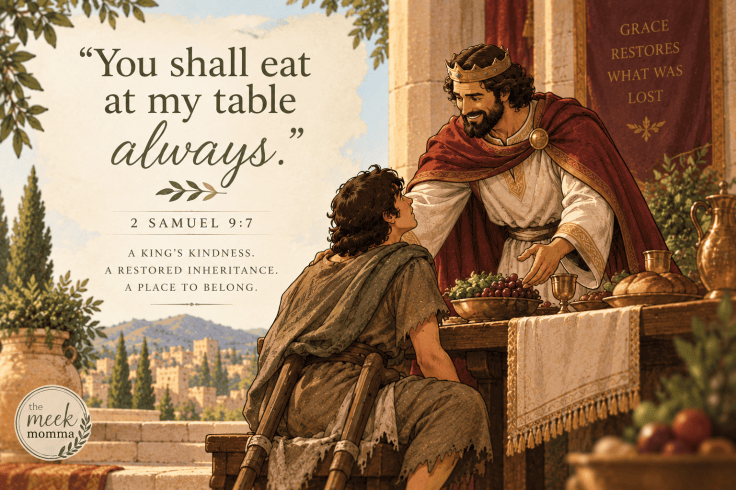
“You shall eat at my table always.” — 2 Samuel 9:7
And the text repeats the picture:
“So Mephibosheth ate at David’s table, like one of the king’s sons.” — 2 Samuel 9:11
That is the part that stopped me.
Because Mephibosheth did not walk into the king’s presence because he had made himself worthy.
He didn’t restore his own inheritance.
He didn’t earn his invitation.
He didn’t change the condition of his feet before he was welcomed.
The king extended kindness to him.
Holiness Matters
At this point, it would be easy to make the story of Mephibosheth into a simple illustration about acceptance. However, Leviticus is teaching us something we desperately need to remember:
Holiness matters.
God is holy.
His presence is holy.
His worship is holy.
His sacrifices are holy.
His priesthood is holy.
And approaching Him is not something to be treated casually.
Leviticus 21–22 reminds Israel that the things associated with God’s presence were not ordinary things.
The priests were not ordinary representatives.
The sacrifices were not ordinary meals.
The altar was not an ordinary place.
God was teaching His people through physical realities that He is holy.
And that holiness ultimately points us toward Christ.
The priests of Israel were not the final answer.
The sacrifices were not the final answer.
The earthly tabernacle was not the final answer.
They were shadows and signs pointing forward to the One who would perfectly fulfill what they could only portray.
Jesus is the spotless sacrifice.
Jesus is the perfect High Priest.
Jesus is holy, undefiled, and without sin.
And because of Him, something extraordinary happens.
From Far Off to Near
Paul writes to the Ephesians:
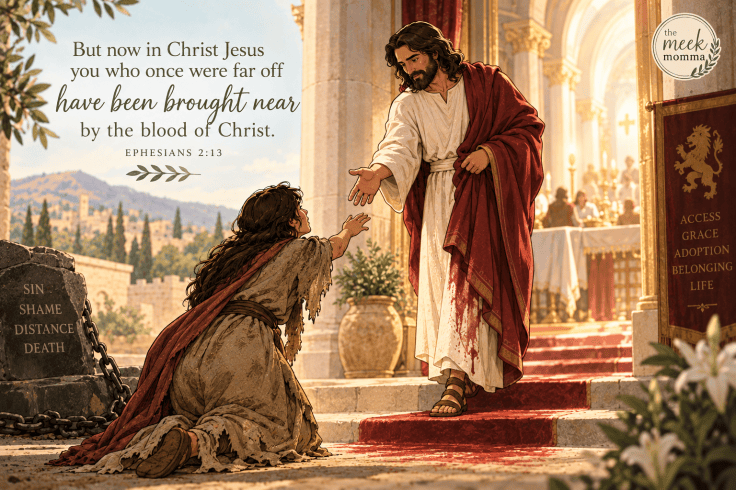
“But now in Christ Jesus you who once were far off have been brought near by the blood of Christ.” — Ephesians 2:13
There it is.
Far off.
Brought near.
That language ignites a fire within me as I reflect on the profound movement we’ve witnessed throughout Scripture!
Genesis introduces the problem.
Exodus establishes God’s presence among His people.
Leviticus teaches Israel how to live in the presence of a holy God.
And then, throughout the rest of Scripture, we begin to see God’s redemptive plan unfold until we arrive at Christ.
The God who dwells among His people makes a way for sinners to draw near.
Not because we have made ourselves clean.
Not because we have made ourselves worthy.
Not because we have repaired everything that is broken.
But because Christ has made a way.
Paul says that those who were once far off have been brought near by the blood of Christ.
That is not sentimental language.
It is sacrificial language.
It takes us right back to the world of Leviticus.
Blood mattered because life mattered.
Sacrifice mattered because sin mattered.
Holiness mattered because God Himself is holy.
And all of those things ultimately point us toward Jesus.
A King Who Welcomes the Unworthy
This is where I think 2 Samuel 9 becomes such a beautiful companion to what we are seeing in Leviticus.
I don’t mean that Mephibosheth is a direct prophecy of Jesus.
Scripture doesn’t tell us to read the story that way.
And I don’t want to force a connection simply because it makes for a beautiful illustration.
But Scripture does allow us to trace themes.
And one of those themes is gracious welcome.
Mephibosheth comes before the king knowing he has nothing to offer.
At one point he even describes himself as a “dead dog” (2 Samuel 9:8).
Yet David restores what was lost and gives him a permanent place at his table.
There is something profoundly beautiful about that picture.
The king’s kindness creates belonging.
And that makes me think again about the difficult passage in Leviticus.
The priest with a physical blemish was not worthless.
He was not beyond God’s provision.
He was still permitted to eat the holy things.
His restriction concerned his priestly function.
And Mephibosheth’s disability did not prevent him from being welcomed to the king’s table.
These truths belong together.
Holiness does not mean that people with disabilities are less valuable.
And grace does not mean that holiness doesn’t matter.
Both are true.
God is holy.
And God is gracious.
The Table
There is something about a table that communicates belonging.
To eat at someone’s table is to be welcomed.
To have a place at the table is to belong.
And David doesn’t merely tell Mephibosheth that he may visit.
He says:
“You shall eat at my table always.”
And the narrator emphasizes it again:
“Like one of the king’s sons.”
Mephibosheth’s identity at the table was no longer defined by what he had lost.
He was defined by the kindness that had been extended to him.
And this is where my thoughts eventually move from David to Christ.
Because the gospel tells us that we, too, were once far off.
We were separated from God.
We could not make ourselves worthy of His presence.
We could not repair the breach ourselves.
But God did what we could not do.
Christ brought us near.
A Better High Priest
Leviticus teaches us to take holiness seriously.
Hebrews teaches us why.
The priests of Israel were imperfect.
Their sacrifices had to be repeated.
Their service was temporary.
But Jesus is different.
He is the perfect High Priest.
He does not need to offer sacrifice for His own sin.
He does not need to repeat His sacrifice.
He does not enter an earthly sanctuary that will eventually pass away.
He enters the true presence of God on our behalf.
And His sacrifice is sufficient.
The spotless Lamb became the sacrifice.
The perfect High Priest offered Himself.
And through His blood, those who were far off are brought near.
That changes everything.
From the King’s Table to the Great Banquet
The Bible begins with humanity separated from God because of sin.
But Scripture doesn’t end there.
It ends with God’s people dwelling with Him.
And the language of Scripture eventually brings us to another table.
A greater banquet.
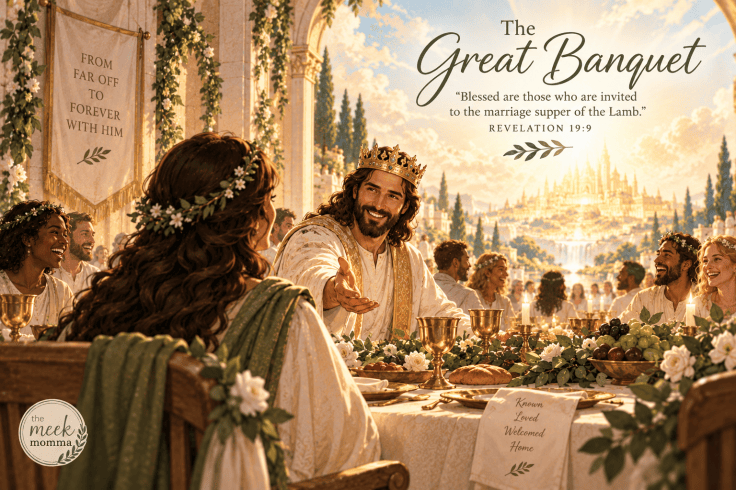
Revelation 19:9 says:
“Blessed are those who are invited to the marriage supper of the Lamb.”
The invitation is not something we earned.
It is grace.
The table is not something we built.
The King prepared it.
And the One who makes our invitation possible is the Lamb who was slain.
This is why I don’t want to rush past the difficult passages in Leviticus.
They teach us something precious.
God’s holiness is not a small thing.
His presence is not casual.
Sin is not insignificant.
Sacrifice is not meaningless.
The Scriptures are the story of a holy God making a way to bring His people near.
Come Near
Maybe that is the question I am left with after studying these passages:
Do I really understand what it means that I have been brought near?
We can become so familiar with the language of Christianity that we forget how astonishing it is.
I was far off.
You were far off.
And Christ brought us near.
Not through our goodness.
Not through our religious performance.
Not through our ability to make ourselves whole.
By His blood.
That is grace.
And perhaps this is part of what makes the story of Mephibosheth so beautiful.
He didn’t have to become worthy of the table before he could sit at it.
The king’s kindness gave him a place.
And while David’s table was only a small picture within the larger story of Scripture, it gives us a glimpse of something wonderful:
There is a King who welcomes the undeserving.
There is a King who restores what was lost.
There is a King who brings the far-off near.
And there is a King who has prepared a table that will never end.
So let us not diminish holiness.
Let us not minimize sin.
Let us not make the cross small.
Instead, let the holiness of God make the grace of God even more astonishing.
Because the greater our understanding of God’s holiness, the greater our wonder should be that He has made a way for us to come near.
And one day, by the grace of Christ, we will see the fulfillment of it all.
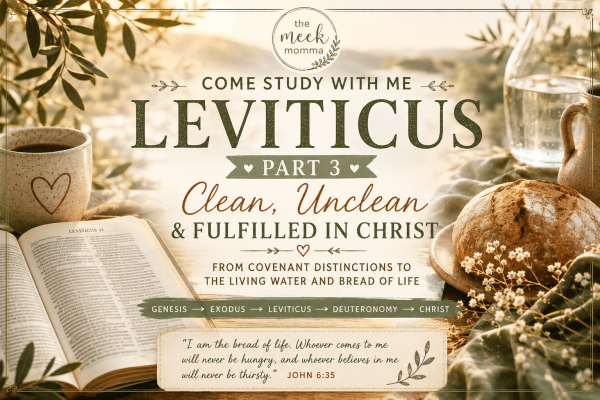
As we study Leviticus 11, one thing becomes clear: the distinction between clean and unclean did not begin with Moses.
In Genesis 7:2, Noah already knows the distinction between clean and unclean animals. In Genesis 8:20, he offers clean animals and birds to the LORD.
Then, in Exodus, God forms Israel as His covenant people and establishes His dwelling place among them. In Leviticus, He gives increasingly specific instructions concerning sacrifice, purity, priesthood, holiness, and food.
Deuteronomy later reiterates many of these dietary distinctions.
The pattern is unfolding:
Genesis → Exodus → Leviticus → Deuteronomy
God progressively reveals what it means for His covenant people to live in relationship with a holy God.
But what does “clean” actually mean?
This is important:
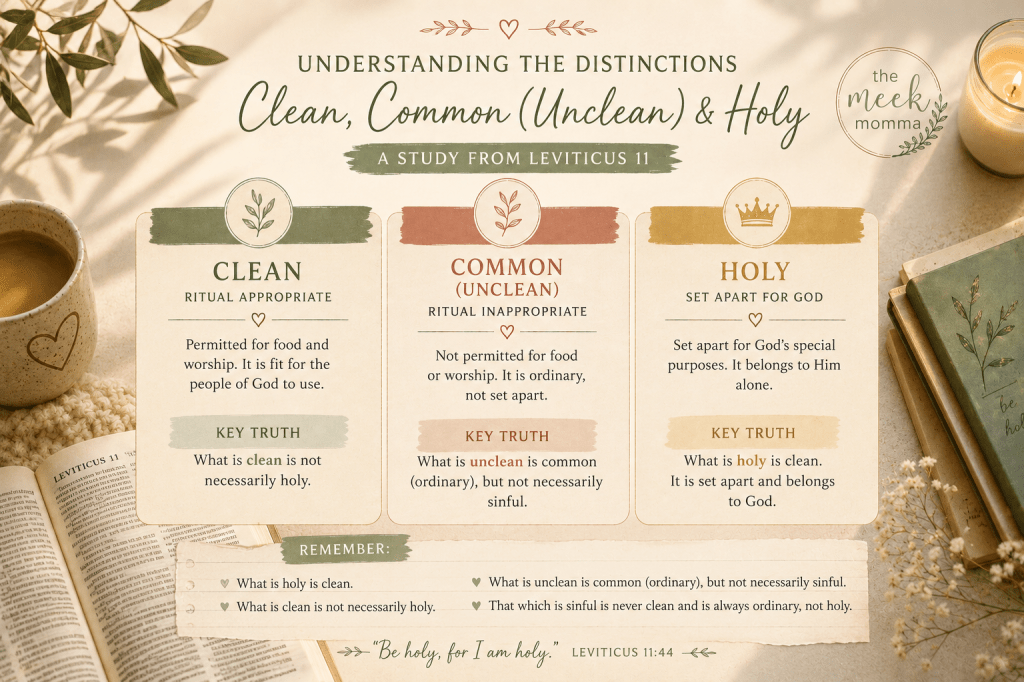
Unclean does not automatically mean sinful.
Something could be ritually unclean without being morally sinful.
Likewise, something could be clean without being holy.
These categories help us understand Leviticus more carefully:
Holy → clean Clean → not necessarily holy Unclean → not necessarily sinful Sinful → never holy or clean
The purity laws were teaching Israel to recognize distinctions and boundaries as they lived in the presence of a holy God.
Then Jesus changes the conversation.
Jesus teaches that defilement is not ultimately about what enters a person from the outside, but what comes from the heart (Mark 7:14–23).
In Acts 10, Peter receives a vision involving animals previously considered unclean. God tells him:
“What God has made clean, do not call common.”
Peter comes to understand that the vision reaches beyond food. God was showing him that Gentiles were not to be considered spiritually unclean or excluded from God’s people.
Through Christ, the ceremonial boundaries that once distinguished Israel from the nations are fulfilled and transformed.
And this is where the story becomes beautiful.
Jesus doesn’t simply make food clean.
Jesus makes people clean.
He doesn’t merely provide another ritual washing.
He gives living water.
“If anyone thirsts, let him come to me and drink.” — John 7:37
He doesn’t simply give bread to sustain physical life.
He is the Bread of Life.
“I am the bread of life.” — John 6:35
The Old Testament repeatedly teaches us about cleansing, sacrifice, priesthood, blood, holiness, food, and access to God’s presence.
The New Testament shows us their greater fulfillment in Christ:
The sacrifice → Christ’s once-for-all atonement
The priesthood → Christ our great High Priest
Cleansing → Christ makes His people clean
Access to God → Christ brings us near
The bread that sustains → Christ, the Bread of Life
The water that cleanses and gives life → Christ, the Living Water
And the important thing is that we don’t have to force these connections. The New Testament itself develops them.
Hebrews tells us that the sacrificial system was pointing toward something greater:
“The law has but a shadow of the good things to come.” — Hebrews 10:1
The Bigger Story
Leviticus is not a disconnected collection of strange rules.
It is part of a story that begins much earlier.
Genesis: God establishes His creation and we see humanity’s separation from Him.
Exodus: God rescues His people and comes to dwell among them.
Leviticus: God teaches His people how to live in the presence of a holy God.
Deuteronomy: God reiterates the covenant and calls His people to faithful obedience.
The New Testament: Christ fulfills the purposes toward which these things were pointing.
And the question underneath Leviticus remains the same:
How can a holy God dwell with sinful people?
The answer that unfolds throughout Scripture is not ultimately a ritual, a sacrifice, a food, or a purification ceremony.
God Himself makes the way.
And in the New Covenant, that way is Jesus Christ.
“For by a single offering he has perfected for all time those who are being sanctified.” — Hebrews 10:14
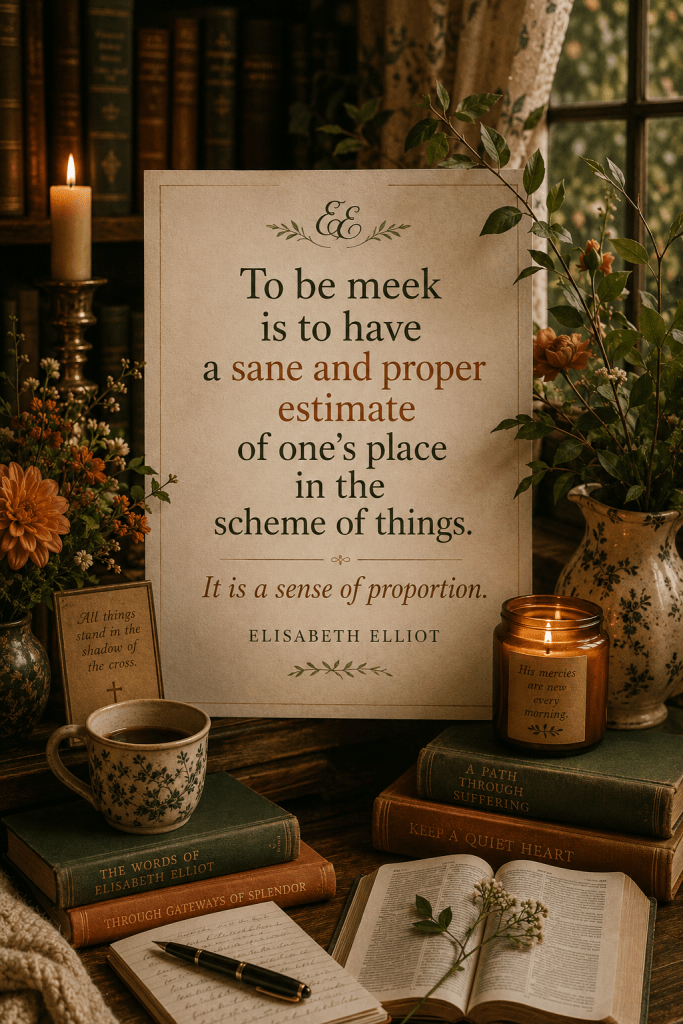
One of my favorite Elisabeth Elliot quotes has always been this:
“To be meek is to have a sane and proper estimate of one’s place in the scheme of things. It is a sense of proportion.”
Elisabeth Elliot has been something of a spiritual mother to me. I have read her words in many different seasons, and depending on where I was in life, they have felt like correction, a lecture, encouragement, or sometimes simply a soft place to land. There were times I read her words and felt as though I were being lovingly disciplined by an older woman who had walked through suffering and knew something I desperately needed to learn.
One of the things she helped me understand was that meekness is not weakness. It is strength under control. It is having a right understanding of who I am in relation to God: I am the created, and He is the Creator. I am not sovereign, I am not in control of everything, and I don’t have to be.
That realization changed the way I looked at my life, particularly motherhood.
When my son was very young, during the isolation of COVID and the months surrounding his autism diagnosis, his needs and behaviors were becoming increasingly difficult to understand. He was nonverbal at the time, and sleep became almost nonexistent. There were months when I was getting less than ten hours of sleep in an entire week.
Looking back, it is remarkable to me that I was still functioning. I was caring for my son, tending to our home, continuing to work, and trying to learn everything I could about autism while running on almost nothing.
But I know now that it wasn’t because I was strong enough. God was sustaining me.
I remember one particular night, around three in the morning, after two days without sleep. My son woke me by slapping me in the face. He wasn’t being aggressive or disobedient. He was nonverbal and simply trying to wake Mommy because Mommy wasn’t waking up.
For the first few seconds after waking, I had an overwhelming urge to hit him back.
I was angry. I was exhausted. I was completely at the end of myself.
And as painful as it is to admit that, I am grateful for what God showed me in that moment. I saw my flesh in a way I don’t think I ever had before. I saw how quickly my exhaustion could expose the sinfulness of my heart. I saw how desperately I needed a Savior.
Being at the end of myself became an invitation to stop pretending that I could be sufficient for myself.
I began learning to pursue the Lord even when I didn’t feel like pursuing Him. Sometimes all I had to offer was five minutes of Scripture or ten minutes of prayer. Then five minutes became ten, ten became twenty, and eventually those small pieces of time became hours.
Some of my sweetest times with the Lord happened in the middle of the night while my son paced back and forth or watched the same short documentaries over and over again. I would sit with my Bible and pray, asking God to change me and make me the mother my son needed.
And then there were the bathtubs.
For a long time, water was one of the few things that helped my son regulate and feel safe in his body. So I spent a lot of time sitting beside the bathtub. Sometimes for hours. Sometimes more than once a day. Because of the safety concerns, I couldn’t simply leave him there. I had to stay.
I remember lying beside that bathtub and thinking about all the things I was missing out on. Motherhood was supposed to look so different. I had imagined something quieter and more predictable.
But somewhere in those long hours of forced stillness, I began to realize that maybe motherhood hadn’t gone wrong. Maybe this was simply what motherhood needed to look like in that particular season.
And I remember what felt like the quietest conviction from the Lord:
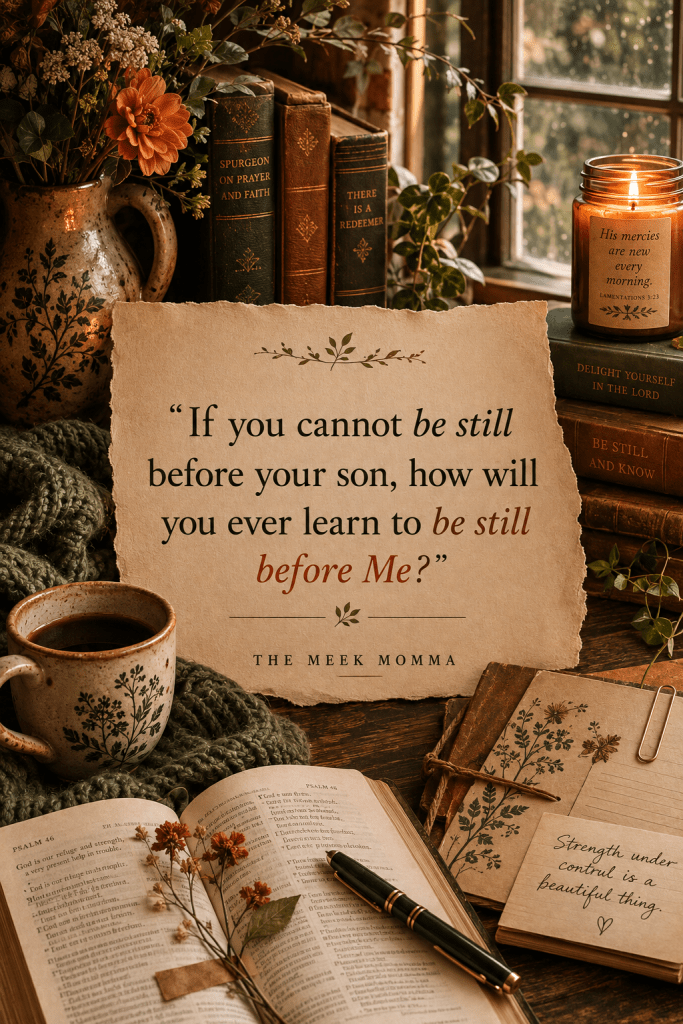
If you cannot be still before your son, how will you ever learn to be still before Me?
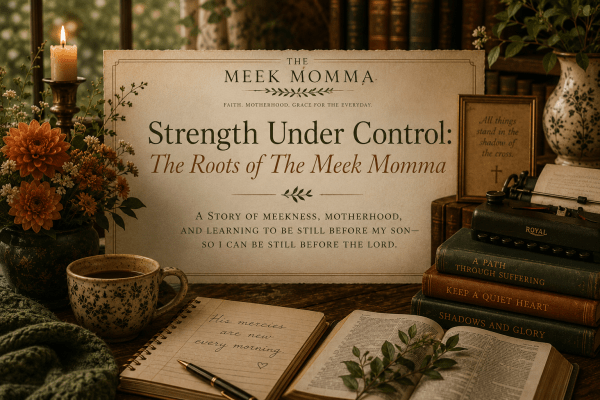
Those moments of stillness, along with the long nights of being completely dependent upon God’s grace, eventually became the beginning of The Meek Momma.
I didn’t start this blog because I had figured motherhood out. I started it because I hadn’t.
I needed somewhere to put the honest emotions, the questions, the Scripture I was wrestling through, and the things God was teaching me. I hoped that perhaps another woman could read those words and find encouragement before she reached the same place of exhaustion and desperation.
Because the Lord gives us opportunities every day to turn toward Him. His mercies are new every morning.
And I think that is part of what meekness has come to mean to me.
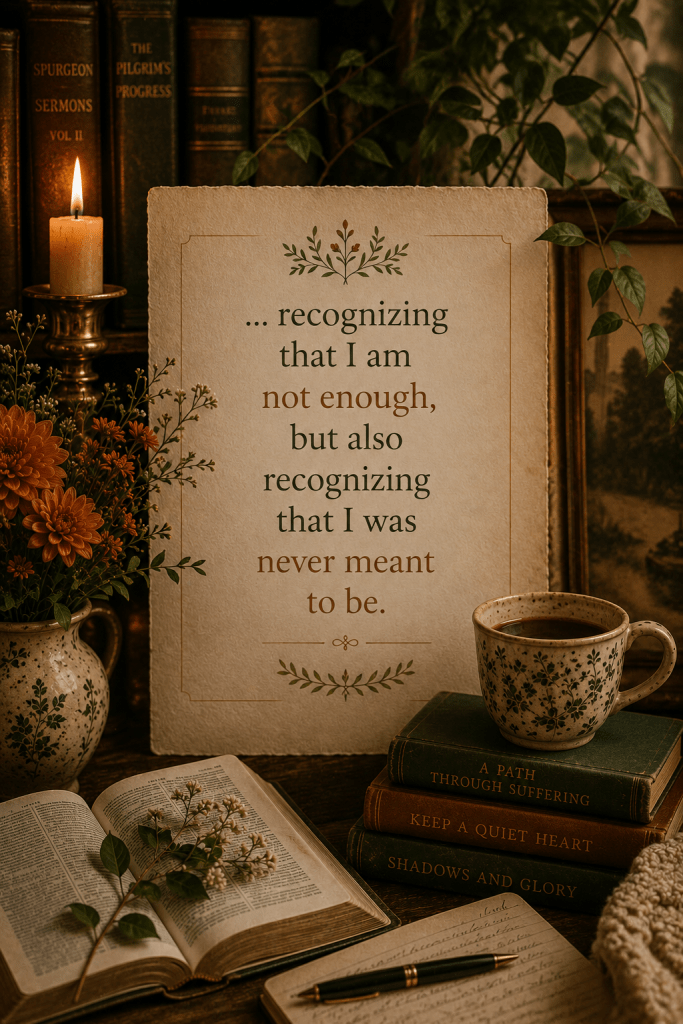
It is recognizing that I am not enough, but also recognizing that I was never meant to be.
It is learning to live within the boundaries of my created place rather than constantly fighting to take God’s place. It has changed the way I think about my marriage, my motherhood, my work, my leadership, my finances, my service to others, and even the way I respond when I believe I know what should happen next.
It has also changed the way I understand submission.
I believe submission to a husband, rightly understood through Scripture, is a beautiful thing. It does not require a woman to become voiceless, passive, or insignificant. It is not an erasure of strength. Rather, it is one of the places where strength can be brought under control and entrusted to God.
There is something beautiful about a woman who doesn’t have to dominate every room, win every argument, control every outcome, or prove that she is the strongest person present.
There is strength in knowing when to speak and when to be quiet. There is strength in yielding. There is strength in serving. There is strength in trusting God’s order when our flesh would rather insist on our own.
That is why I love this definition of meekness so much.
A sane and proper estimate of my place in the scheme of things.
Not thinking too highly of myself, but not thinking too little of myself either. Simply understanding that I am God’s creation, He is my Creator, and my life makes the most sense when I live within that reality.
I am still learning this.
I am learning it in my home, in my marriage, in my work, in the courtroom, in leadership, and in the way I serve families and volunteers. I still wrestle with my desire to control. I still have moments when my flesh gets the better of me. But now I know where to take those things.
Back to Him.
Elisabeth Elliot taught me that suffering is never for nothing. She helped me understand that all things stand in the shadow of the cross, and that when I keep my eyes there, I can begin to count even the hardest things as joy—not because suffering is enjoyable, but because God is faithful to use even what I would never have chosen.
This is why I chose the name The Meek Momma all those years ago.