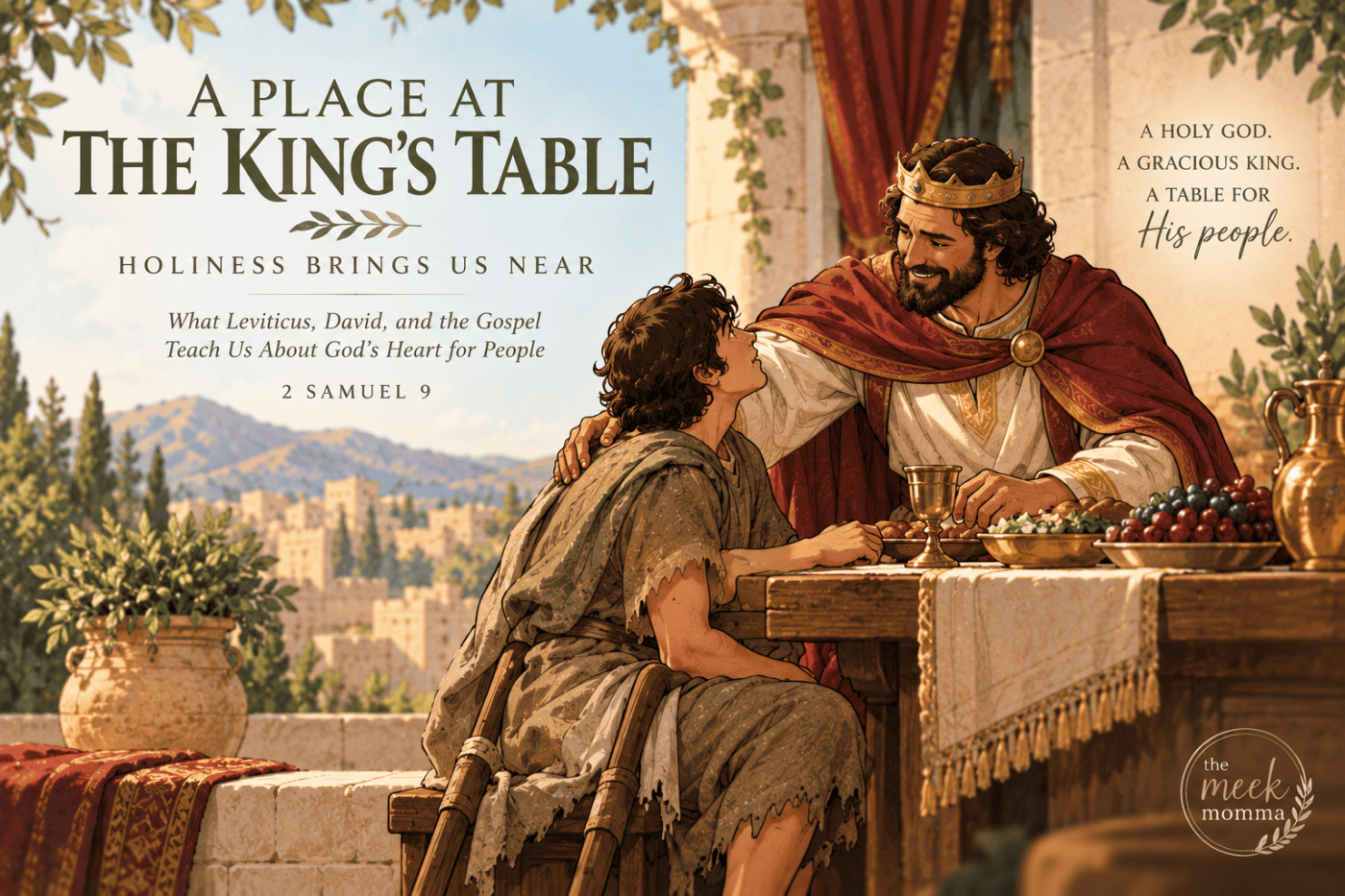
What Leviticus 21–22, David, and the Gospel Teach Us About Holiness, Grace, and Belonging
A Note Before We Begin
As I have been studying through Leviticus 21–22, I have found myself slowing down over some passages that can be difficult for modern readers to hear.
The Lord gives Moses instructions concerning the descendants of Aaron who would serve as priests. Among those instructions, we read that a priest with certain physical blemishes or disabilities was not to approach the altar to offer the Lord’s food offerings or go through the veil.
At first glance, these passages can be jarring.
And because of that, I think we need to slow down and let the text say what it actually says rather than allowing our first reaction to determine what we believe it means.
Leviticus 21 is not teaching that a person with a disability is less valuable, less loved, or somehow unacceptable to God.
The restriction concerns the priestly function of approaching the altar and performing particular sacred duties.
In fact, there is a detail in this passage that is easy to miss.
The priest who had a physical blemish was still permitted to eat the bread of his God, both the most holy and the holy things (Leviticus 21:22).
He was restricted from performing a particular priestly function.
He was not cast away from God’s provision – This to me reveals the heart of our God.
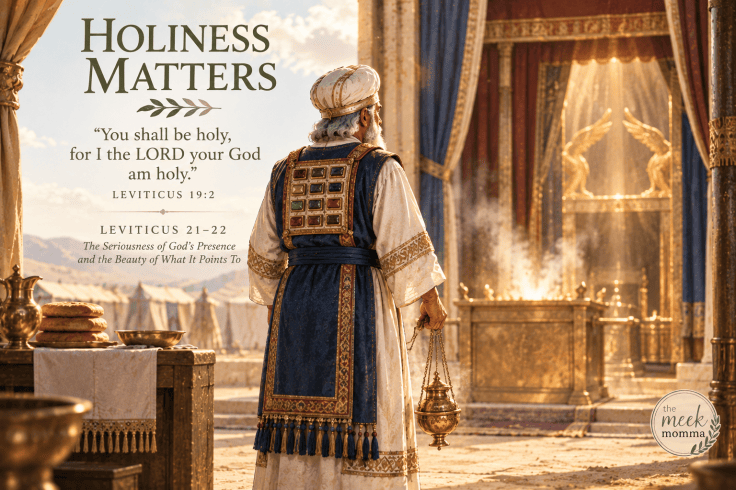
The priesthood and sacrificial system communicated through visible, tangible realities. The sacrifices were to be without blemish. The priests who approached the altar were given corresponding physical qualifications. These requirements belonged to the symbolic language of Israel’s worship and helped communicate the holiness, completeness, and sacredness of the work being performed.
The priesthood was pointing beyond itself.
Hebrews tells us that Jesus is our perfect High Priest:
“Holy, innocent, unstained, separated from sinners, and exalted above the heavens.”
— Hebrews 7:26
What Israel’s priesthood could only imperfectly portray, Christ fulfills completely.
And yet, as I sat with these passages, I kept thinking about someone else.
Mephibosheth.
And that is where this study took me next.
A Man Who Was Far Off
Mephibosheth was the son of Jonathan and the grandson of Saul.
When he was five years old, news came that Saul and Jonathan had died in battle. His nurse picked him up and fled, but in the process he fell and became disabled in both feet (2 Samuel 4:4).
Years later, David became king.
And David did something unexpected.
He asked:
“Is there still anyone left of the house of Saul, that I may show him kindness for Jonathan’s sake?”
— 2 Samuel 9:1
Eventually David learns about Mephibosheth.
And Mephibosheth is brought before the king.
Imagine what that must have felt like.
He was the grandson of Saul, the former king. His father, Jonathan, was dead. His grandfather was dead. He was living in Lo-debar, far from the center of the kingdom.
And now he was being summoned into the presence of David.
He falls on his face.
David tells him not to be afraid.
Then David gives him something he could never have secured for himself:
his inheritance.
David restores to Mephibosheth all the land that had belonged to Saul.
But David doesn’t stop there.
He says:
“You shall eat at my table always.”
— 2 Samuel 9:7
And the text repeats the picture:
“So Mephibosheth ate at David’s table, like one of the king’s sons.”
— 2 Samuel 9:11
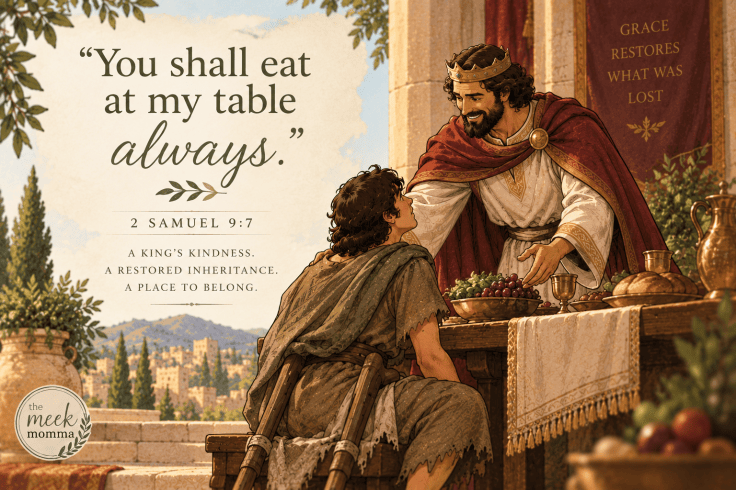
That is the part that stopped me.
Because Mephibosheth did not walk into the king’s presence because he had made himself worthy.
He didn’t restore his own inheritance.
He didn’t earn his invitation.
He didn’t change the condition of his feet before he was welcomed.
The king extended kindness to him.
Holiness Matters
At this point, it would be easy to make the story of Mephibosheth into a simple illustration about acceptance. However, Leviticus is teaching us something we desperately need to remember:
Holiness matters.
God is holy.
His presence is holy.
His worship is holy.
His sacrifices are holy.
His priesthood is holy.
And approaching Him is not something to be treated casually.
Leviticus 21–22 reminds Israel that the things associated with God’s presence were not ordinary things.
The priests were not ordinary representatives.
The sacrifices were not ordinary meals.
The altar was not an ordinary place.
God was teaching His people through physical realities that He is holy.
And that holiness ultimately points us toward Christ.
The priests of Israel were not the final answer.
The sacrifices were not the final answer.
The earthly tabernacle was not the final answer.
They were shadows and signs pointing forward to the One who would perfectly fulfill what they could only portray.
Jesus is the spotless sacrifice.
Jesus is the perfect High Priest.
Jesus is holy, undefiled, and without sin.
And because of Him, something extraordinary happens.
From Far Off to Near
Paul writes to the Ephesians:
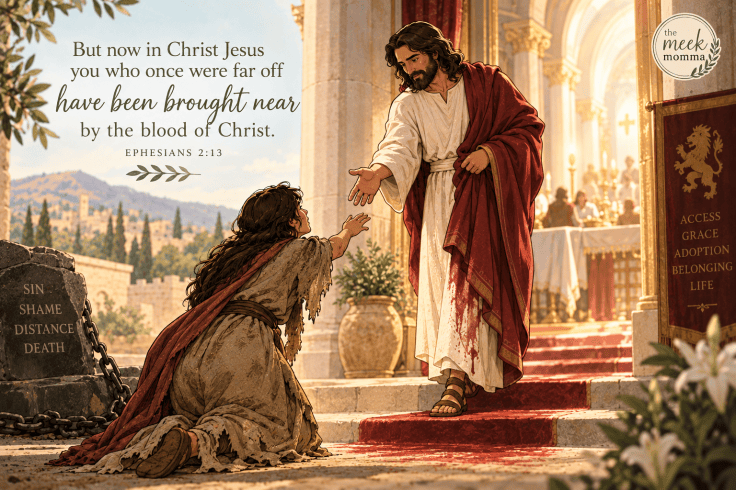
“But now in Christ Jesus you who once were far off have been brought near by the blood of Christ.”
— Ephesians 2:13
There it is.
Far off.
Brought near.
That language ignites a fire within me as I reflect on the profound movement we’ve witnessed throughout Scripture!
Genesis introduces the problem.
Exodus establishes God’s presence among His people.
Leviticus teaches Israel how to live in the presence of a holy God.
And then, throughout the rest of Scripture, we begin to see God’s redemptive plan unfold until we arrive at Christ.
The God who dwells among His people makes a way for sinners to draw near.
Not because we have made ourselves clean.
Not because we have made ourselves worthy.
Not because we have repaired everything that is broken.
But because Christ has made a way.
Paul says that those who were once far off have been brought near by the blood of Christ.
That is not sentimental language.
It is sacrificial language.
It takes us right back to the world of Leviticus.
Blood mattered because life mattered.
Sacrifice mattered because sin mattered.
Holiness mattered because God Himself is holy.
And all of those things ultimately point us toward Jesus.
A King Who Welcomes the Unworthy
This is where I think 2 Samuel 9 becomes such a beautiful companion to what we are seeing in Leviticus.
I don’t mean that Mephibosheth is a direct prophecy of Jesus.
Scripture doesn’t tell us to read the story that way.
And I don’t want to force a connection simply because it makes for a beautiful illustration.
But Scripture does allow us to trace themes.
And one of those themes is gracious welcome.
Mephibosheth comes before the king knowing he has nothing to offer.
At one point he even describes himself as a “dead dog” (2 Samuel 9:8).
Yet David restores what was lost and gives him a permanent place at his table.
There is something profoundly beautiful about that picture.
The king’s kindness creates belonging.
And that makes me think again about the difficult passage in Leviticus.
The priest with a physical blemish was not worthless.
He was not beyond God’s provision.
He was still permitted to eat the holy things.
His restriction concerned his priestly function.
And Mephibosheth’s disability did not prevent him from being welcomed to the king’s table.
These truths belong together.
Holiness does not mean that people with disabilities are less valuable.
And grace does not mean that holiness doesn’t matter.
Both are true.
God is holy.
And God is gracious.
The Table
There is something about a table that communicates belonging.
To eat at someone’s table is to be welcomed.
To have a place at the table is to belong.
And David doesn’t merely tell Mephibosheth that he may visit.
He says:
“You shall eat at my table always.”
And the narrator emphasizes it again:
“Like one of the king’s sons.”
Mephibosheth’s identity at the table was no longer defined by what he had lost.
He was defined by the kindness that had been extended to him.
And this is where my thoughts eventually move from David to Christ.
Because the gospel tells us that we, too, were once far off.
We were separated from God.
We could not make ourselves worthy of His presence.
We could not repair the breach ourselves.
But God did what we could not do.
Christ brought us near.
A Better High Priest
Leviticus teaches us to take holiness seriously.
Hebrews teaches us why.
The priests of Israel were imperfect.
Their sacrifices had to be repeated.
Their service was temporary.
But Jesus is different.
He is the perfect High Priest.
He does not need to offer sacrifice for His own sin.
He does not need to repeat His sacrifice.
He does not enter an earthly sanctuary that will eventually pass away.
He enters the true presence of God on our behalf.
And His sacrifice is sufficient.
The spotless Lamb became the sacrifice.
The perfect High Priest offered Himself.
And through His blood, those who were far off are brought near.
That changes everything.
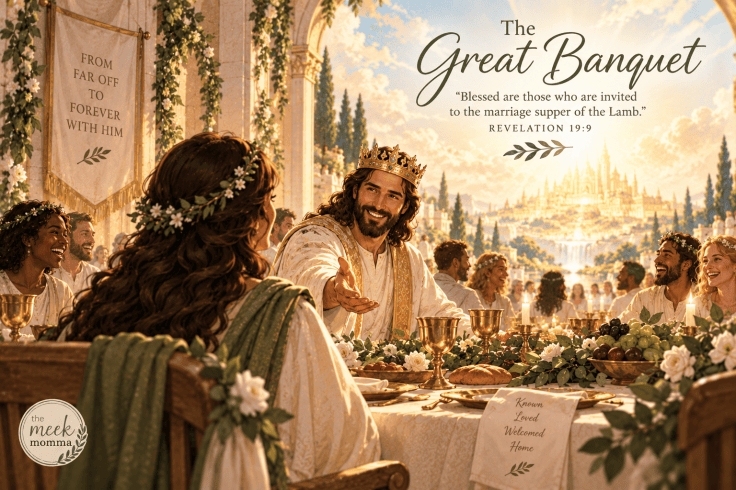
From the King’s Table to the Great Banquet
The Bible begins with humanity separated from God because of sin.
But Scripture doesn’t end there.
It ends with God’s people dwelling with Him.
And the language of Scripture eventually brings us to another table.
A greater banquet.
Revelation 19:9 says:
“Blessed are those who are invited to the marriage supper of the Lamb.”
The invitation is not something we earned.
It is grace.
The table is not something we built.
The King prepared it.
And the One who makes our invitation possible is the Lamb who was slain.
This is why I don’t want to rush past the difficult passages in Leviticus.
They teach us something precious.
God’s holiness is not a small thing.
His presence is not casual.
Sin is not insignificant.
Sacrifice is not meaningless.
The Scriptures are the story of a holy God making a way to bring His people near.
Come Near
Maybe that is the question I am left with after studying these passages:
Do I really understand what it means that I have been brought near?
We can become so familiar with the language of Christianity that we forget how astonishing it is.
I was far off.
You were far off.
And Christ brought us near.
Not through our goodness.
Not through our religious performance.
Not through our ability to make ourselves whole.
By His blood.
That is grace.
And perhaps this is part of what makes the story of Mephibosheth so beautiful.
He didn’t have to become worthy of the table before he could sit at it.
The king’s kindness gave him a place.
And while David’s table was only a small picture within the larger story of Scripture, it gives us a glimpse of something wonderful:
There is a King who welcomes the undeserving.
There is a King who restores what was lost.
There is a King who brings the far-off near.
And there is a King who has prepared a table that will never end.
So let us not diminish holiness.
Let us not minimize sin.
Let us not make the cross small.
Instead, let the holiness of God make the grace of God even more astonishing.
Because the greater our understanding of God’s holiness, the greater our wonder should be that He has made a way for us to come near.
And one day, by the grace of Christ, we will see the fulfillment of it all.
Not merely a place at an earthly king’s table.
But a place at the marriage supper of the Lamb.
Come hungry.
The King has made a place.


I was far off; He drew me near. I sit at his table as one of his own. The unbelievable welcome and belonging. Hallelujah! What a Savior.
LikeLiked by 1 person