Yesterday, Jackson had a neuropsychological evaluation.
His autism diagnosis was not new. He has been diagnosed with autism since he was two, and that has been a consistent part of our understanding of him.
What was new was a diagnosis of intellectual disability.
I had wondered about this possibility because, as Jackson has grown, I have noticed areas of executive functioning, learning, problem-solving, and adaptive functioning that seem different from what I would expect for his chronological age. Still, hearing a new diagnosis attached to your child is a different experience than simply wondering about something.
My heart is heavy.
Not because I believe this diagnosis makes Jackson less capable or less valuable. It doesn’t.
But because as his mother, I immediately start thinking about his future.
Will people understand him?
Will he have lasting friendships?
Will he find places where he belongs?
Will he receive the accommodations and support he needs—or will people assume he doesn’t need enough help because his challenges aren’t considered “severe”?
I think this is one of the most misunderstood things about developmental disabilities.
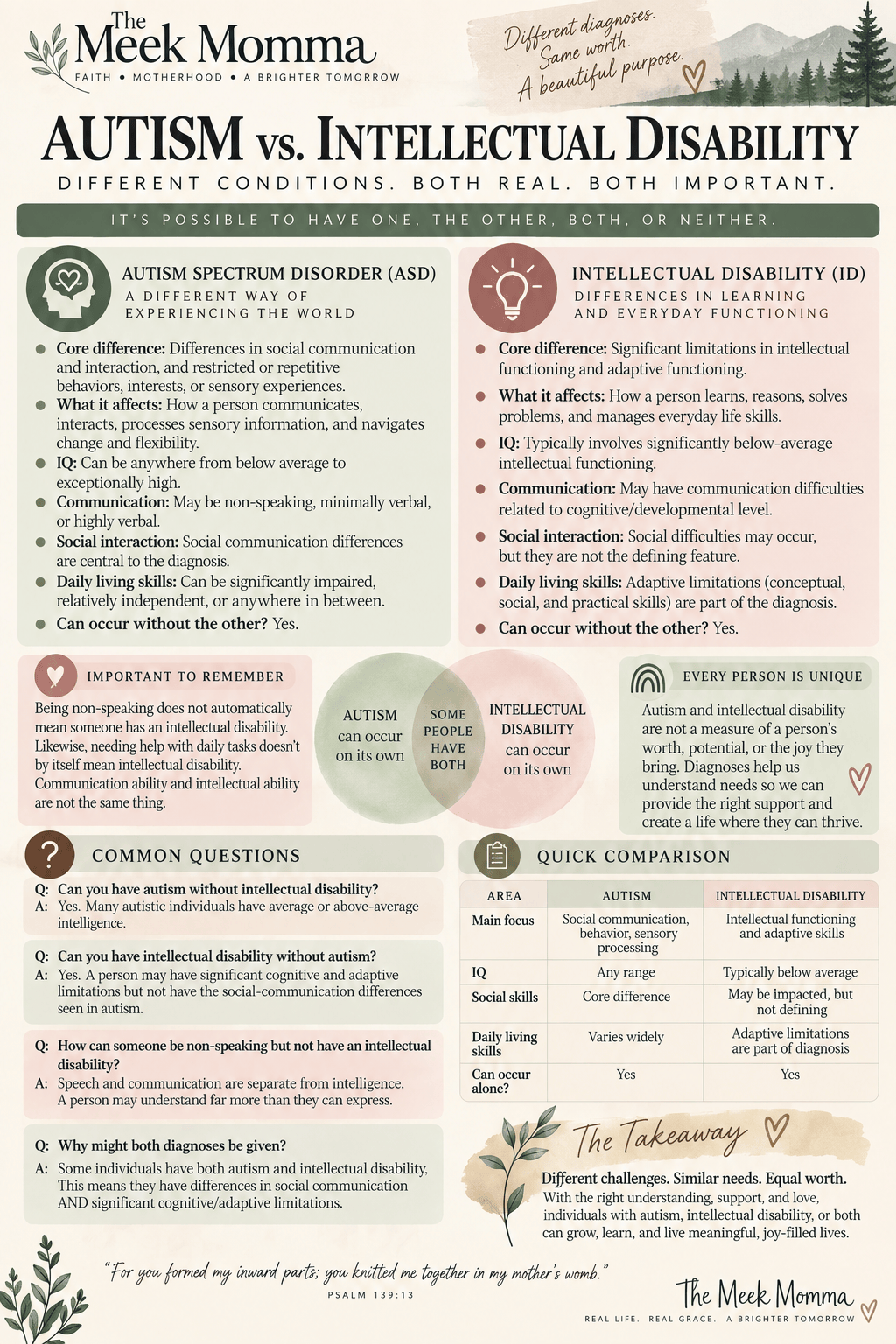
Autism and intellectual disability are not the same thing.
Autism primarily involves differences in social communication and interaction, along with restricted or repetitive behaviors, interests, or sensory experiences.
Intellectual disability involves significant limitations in intellectual functioning and adaptive functioning—things like learning, reasoning, problem-solving, communication, and managing everyday life.
You can have autism without intellectual disability.
You can have intellectual disability without autism.
And you can have both.
And perhaps most importantly:
Communication ability and intellectual ability are not the same thing.
A person can be non-speaking and understand much more than they can communicate. A person can have significant sensory or social challenges and have average or above-average intellectual ability. And a person with intellectual disability may have strengths and abilities that aren’t captured well by a standardized test.
That distinction matters because a diagnosis is supposed to help us understand what support a person needs, not determine their worth or write their future for them.
And this is where my heart has been wrestling.
Jackson is getting older.
He is too big to simply be included with much younger children, but developmentally he may not yet be ready to participate in the same way as many children his age.
We’ve seen glimpses of this already.
The last two Sundays at church, Jackson tried to engage groups of older boys. He approached them because he wanted to play. But they backed away awkwardly or simply told him, “No, I don’t want to play with you,” and walked away.
I’m sure those boys weren’t trying to wound him.
They probably didn’t know what to do.
But I was his mother, standing there watching my child reach for friendship and not quite know how to bridge the gap.
And that hurts.
It makes me think about the spaces Jackson will encounter throughout his life where he may be too old for one group, but not developmentally ready for another.
Where does a child belong when the world has categories for age, but development doesn’t always follow those categories?
Where does he fit when he needs more support than some people realize, but doesn’t fit the picture people have in their minds of someone with a “severe” disability?
Those are questions I’m still learning how to answer.
But there is something I want to remind myself—and perhaps another parent needs to hear it too:
Diagnoses aren’t prophecy.
A diagnosis describes something important about a person’s functioning today.
It can help us understand.
It can help us advocate.
It can help us access accommodations.
It can help us stop blaming a child for something that isn’t simply a matter of trying harder.
But it does not tell me everything about Jackson’s future.
It doesn’t tell me what relationships he will have.
It doesn’t tell me what he will learn.
It doesn’t tell me what strengths will emerge.
It doesn’t tell me who will love him.
And it certainly doesn’t tell me what God intends to do with his life.
The evaluation may give us information about Jackson that we didn’t have before.
It doesn’t give us a prophecy.
And I am grateful that God knows the whole story when I can only see the next page.
He knows every part of Jackson—the things the evaluation measured and the things no evaluation could ever measure.
He knows what Jackson understands when he can’t communicate it.
He knows the desires of his heart.
He knows the friendships he will have.
He knows where Jackson will struggle and where he will flourish.
He knows what support Jackson will need.
And He knows the future.
So today, I’m allowing myself to feel the heaviness.
I’m also grateful.
Grateful that we have more information.
Grateful that we can better understand how Jackson learns and functions.
Grateful that there were no additional diagnoses, including ADHD.
Grateful that his evaluation did not paint the severe picture my fearful heart sometimes imagines.
And grateful that a diagnosis gives us another tool to advocate for our son.
Most of all, I’m reminding myself:
Jackson is not his diagnoses.
He is not a score.
He is not a developmental age.
He is not a list of limitations.
He is my son.
And he is fearfully and wonderfully made.
“For you formed my inward parts; you knitted me together in my mother’s womb.”
— Psalm 139:13
So we will keep learning.
We will keep advocating.
We will keep making room for him.
We will keep looking for ways to help him communicate, connect, learn, and belong.
And when I can’t see what comes next, I will remind myself:
Nothing about Jackson is a mystery to God.
“The LORD is my strength and my shield; in him my heart trusts.”
— Psalm 28:7
Diagnoses aren’t prophecy. They are information. And information can help us build better support for the child God has already entrusted to us.
— The Meek Momma


Leave a Reply