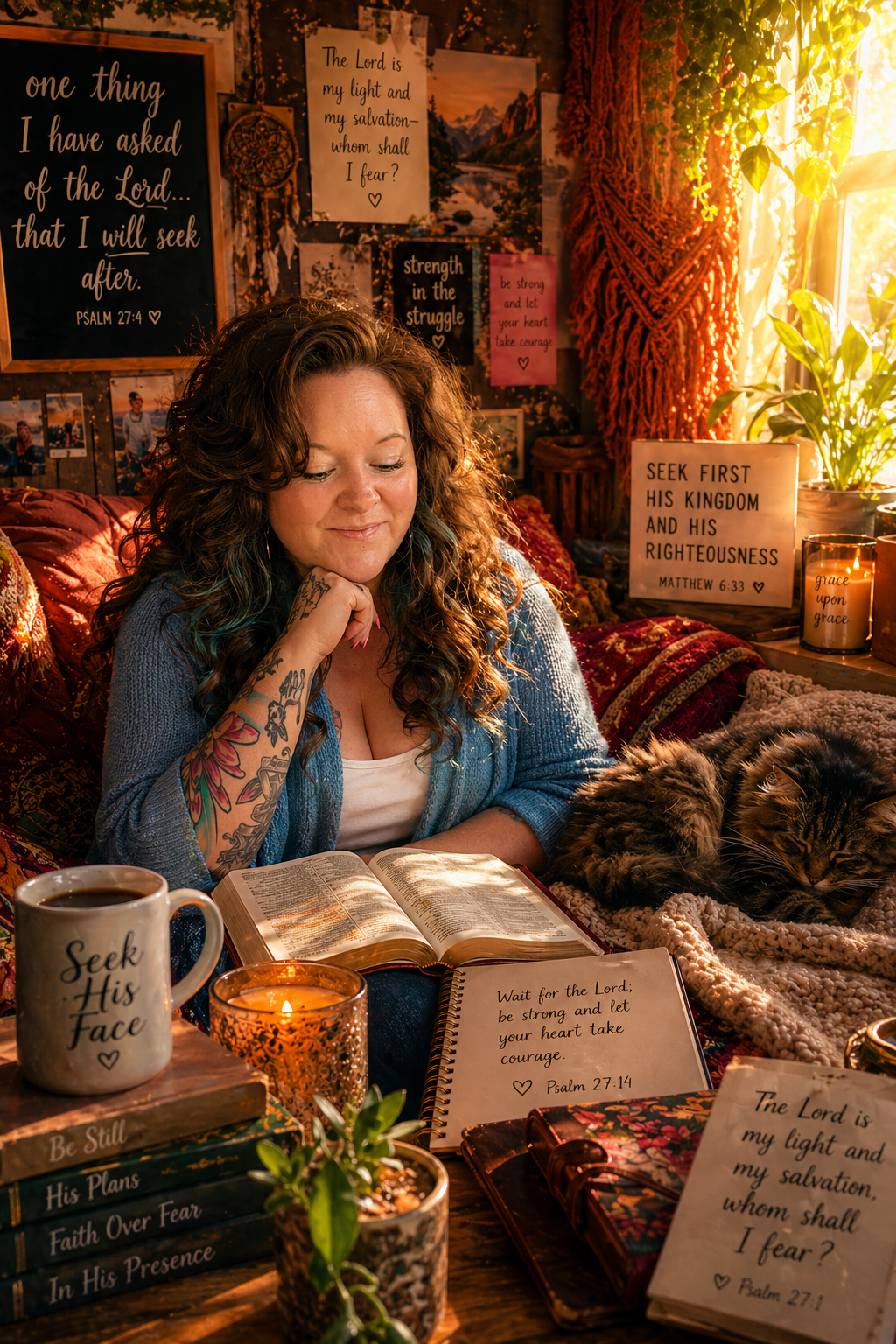
There is a tension every Christian must learn to live in—the space where strength and struggle coexist. It’s not a clean, polished place. It’s messy. It’s exhausting. And often, it feels like there is very little comfort in the circumstances themselves.
Psalm 27 speaks directly into that tension.
It is a psalm of contrast—lament and confidence, persecution and praise, warfare and worship. David doesn’t present a neat, resolved faith. Instead, he invites us into an honest, layered conversation with God. In fact, throughout the psalm, David engages in three distinct conversations: he speaks about God with confidence, he cries out to God in desperation, and he ultimately speaks to himself with chosen faith.
The psalm begins with bold declaration:
“The Lord is my light and my salvation—whom shall I fear? The Lord is the stronghold of my life—of whom shall I be afraid?”
This is David’s foundation. Before he addresses his circumstances, he anchors himself in who God is. His identity is rooted in God as his light, his salvation, and his stronghold. And that identity—claimed before the storm—becomes the source of his courage within it.
Verses 1–6 reveal a conversation of confidence. Even with enemies surrounding him, David declares that his heart will not fear. Why? Because his “one thing” is clear: to dwell in the presence of the Lord, to seek Him, to gaze upon His beauty. This pursuit becomes the stabilizing force in the chaos. Seeking God first, before trying to fix everything else, is what leads to a faithful life—and ultimately, where true comfort is found.
But the tone shifts.
In verses 7–12, David cries out. This is no longer confident proclamation; this is raw, vulnerable pleading:
“Hear me, Lord, when I cry aloud… do not hide your face from me… do not forsake me.”
Here, we see desperation. Honest, unfiltered need. David brings his fears, his pain, and even his sense of abandonment before God. He doesn’t pretend to be okay. He prays Scripture back to God, recalls His character, and asks Him to act.
And then, in verses 13–14, something powerful happens. David speaks to himself:
“I believe that I shall look upon the goodness of the Lord in the land of the living… Wait for the Lord; be strong, and let your heart take courage; wait for the Lord.”
This is chosen faith.
Not because everything has changed—but because he chooses to trust that God will show up. The word “wait” here isn’t passive. It means a hopeful, eager, patient expectation. It is active trust in the “in-between.”
This is the tension: desperation and confidence, struggle and strength, all at once.
And if I’m honest, this week, I didn’t handle that tension very well.
Normally, I thrive in a busy schedule. But this week felt different. I was tired in a deeper way—the kind that comes from pouring out more than I’ve been filling back up. My quiet times haven’t been quiet. My workload is the heaviest it’s been in years, with over 70 children and families I’m trying to serve within a deeply broken foster care system. Grant writing, grocery shopping, meal prepping…. The list is long.
On top of that, my mom has had ongoing medical appointments. Thursdays is a day when my office is supposed to be closed and what’s supposed to be a day of rest has turned into a full day of caregiving, emotional support, and work responsibilities. It’s been a lot to carry.
The day looked liked this:
Early morning—meal prepping, feeding fish, frogs, cats, and dogs.
Loving on my sweet boy after another rough night.
Praying with him. Opening the Word together… while trying to find a few quiet moments in it for myself.
Then it’s go time—
Getting ready, rushing out the door, navigating appointments, questions, waiting rooms…
If you know, you know.
Back home for a quick lunch.
Let the animals out.
Sit with Jackson, help with school, breathe for a second.
Then log into court—
Case after case, report after report, heavy stories, real lives.
Two, sometimes three hearings back-to-back.
And just like that, the clock resets—
45 minutes (if I’m lucky)…
Dinner. Sunshine. Evening routine.
Animals again. Wind down. Repeat.
And somehow, it all came to a head over something small—a grumpy cat with a bad attitude and a misplaced mess. In a moment, everything bubbling beneath the surface spilled out. I reacted in frustration, raising my voice, taking it out on the animals around me.
It wasn’t my best moment.
But it was a revealing one.
In that moment, I realized how much I needed help. Not just practically—but spiritually. I started looking into support services for my mom (and I’m still waiting on those doors to open), and her heart to soften, but more than anything, I knew I needed to return to the presence of the Lord.
Earlier that same day, I had felt prompted to step away from my study in Titus and read Psalm 27. At the time, it felt like a beautiful passage—but I didn’t sit with it deeply.
After my breakdown, I came back to it.
And this time, I saw it differently.
I saw the tension. I saw the honesty. I saw the way David held both struggle and faith at the same time. And I felt humbled. Because what I’m walking through, as heavy as it feels, pales in comparison to what David endured—and yet, he still chose to trust.
Scripture is full of this “in-between” waiting:
- Abraham and Sarah waiting for a promised child
- Joseph waiting in prison for God’s plan to unfold
- Hannah waiting in anguish before her prayer was answered
- David himself, anointed king but not yet crowned
These stories remind us that waiting is not wasted. God works in the tension.
And even more comforting—God understands the tension.
We are not walking through this alone. We have a Savior who stepped into humanity, who experienced struggle, temptation, exhaustion, and sorrow. He knows what it is to live in the “in-between.” He meets us there with compassion, not condemnation.
So when we fail—when we lose our patience, when we react instead of respond, when we feel overwhelmed—we don’t have to run away from God.
We run toward Him.
We return to His presence.
We remind ourselves of who He is.
And we choose, again, to believe:
That we will see His goodness.
That He is still working.
That He can be trusted in every season.
So today, I’m praying this:
Lord, help me not to walk in condemnation, but in the freedom You provide.
Teach me to seek Your face above everything else.
Strengthen my heart to believe that I will see Your goodness—even here, even now.
Help me to wait with hope, with courage, and with trust.
Because this is where faith is formed—not outside the tension, but right in the middle of it.



Leave a Reply