This morning, I woke up with a heavy heart as I considered the results of last night’s election. I’ve spent much of the morning praying, thinking about the condition of our nation, and returning to the Scriptures.
My disappointment isn’t simply about political parties or who won and who lost. My concern is much deeper than that. As Christians, we are called to examine what we value, what we approve of, and what we place our hope in. We ought to be asking whether our convictions are being shaped by the Word of God or by the desires of our flesh, our pursuit of comfort, our love of money, and the things this world promises us.
And that examination must begin with ourselves.
Paul writes in Romans 1:16–17:
“For I am not ashamed of the gospel, for it is the power of God for salvation to everyone who believes, to the Jew first and also to the Greek. For in it the righteousness of God is revealed from faith for faith, as it is written, ‘The righteous shall live by faith.’”
Paul continues in Romans 1:18–32 by describing humanity’s rejection of God. Although God has made Himself known through creation, sinful humanity has exchanged the truth about God for a lie, worshiping and serving the creature rather than the Creator.
What a sobering description of the human heart.
We are so prone to elevate created things into places of ultimate importance. Power, prosperity, security, comfort, approval, and even our political convictions can become idols when we allow them to occupy the place that belongs to God alone.
But Romans doesn’t leave us merely examining the sins of the world around us. Paul goes on to establish that all have sinned and fall short of the glory of God (Romans 3:23). None of us stands righteous before God on our own merit. Yet Romans 3:24 reminds us that sinners can be justified by His grace as a gift, through the redemption that is in Christ Jesus.
That is the gospel. And that is where our hope must remain.
Something else has been on my heart this morning as I think about the women I’ve been teaching and the passages of Scripture we’ve been studying together.
When Paul writes, “The righteous shall live by faith,” he is quoting Habakkuk 2:4.
Habakkuk was a prophet who looked around at the wickedness, injustice, and violence of his own day and cried out to the Lord. He struggled to understand what God was doing and why He seemed to allow evil to continue.
Doesn’t that sound familiar?
But what I find so beautiful about Habakkuk is that he doesn’t abandon the Lord in his confusion. Instead, he positions himself to watch and wait.
“I will take my stand at my watchpost and station myself on the tower, and look out to see what he will say to me.” — Habakkuk 2:1
In the ancient world, watchmen stood upon city walls, looking for approaching danger or messengers. Habakkuk uses this imagery to describe his posture before God. He doesn’t have all the answers, but he is determined to wait upon the Lord.
And God’s answer includes this remarkable declaration:
“But the righteous shall live by his faith.” — Habakkuk 2:4
Faith does not mean having every answer. It does not require circumstances to change before we trust God. It means trusting His character, His promises, and His purposes even when the outcome is not yet visible.
By the end of Habakkuk’s book, his circumstances have not suddenly become easy. Yet he declares that even if the fig tree should not blossom, the fields yield no food, and the flocks disappear, he will rejoice in the Lord and take joy in the God of his salvation (Habakkuk 3:17–19).
What a beautiful picture of faith in the in-between.
This is what I want to remember this morning.
My joy cannot depend upon election results, political leadership, financial security, or the direction of our culture. If it does, my peace will always be as unstable as my circumstances.
But Christ is not unstable. His throne is not threatened. His promises have not changed, and His return is certain.
So yes, I am grieved. I am praying for repentance, for revival, and for hearts to turn back to the living God. I am praying that the Church would be faithful to His Word, unwilling to exchange truth for comfort or compromise for acceptance.
But I am also reminded that our calling has not changed.
We are still called to proclaim the gospel, love our neighbors, pursue righteousness, speak truth, repent of our own sins, and live by faith.
Our hope was never supposed to rest in the outcome of an election. It rests in the risen and returning Christ.
So my prayer today echoes the words of King Jehoshaphat in 2 Chronicles 20:12:
“We do not know what to do, but our eyes are on you.”
Lord, may our eyes remain fixed upon You. Bring us to repentance. Revive Your Church. Teach us to be faithful in the waiting, steadfast in truth, and joyful in Your salvation.
There are passages of Scripture that we read and appreciate, and then there are passages that seem to reach across the pages of the Bible and meet us right where we are.
Acts 19:18–20 is one of those passages for me.
I have read the account of the people in Ephesus who practiced magic and then brought their scrolls together and burned them, but the older I get in my faith, the more I understand why Luke included this detail. These people didn’t simply hear Paul preach, agree with what he said, and then continue living exactly as they had before. The Word of God confronted something in their lives, and their response was to repent and remove the things that belonged to their old way of life.
Luke writes:
“Also many of those who were now believers came confessing and disclosing their practices. And a number of those who had practiced magic arts brought their books together and burned them in the sight of all. And they counted the value of them and found it came to fifty thousand pieces of silver. So the word of the Lord continued to increase and prevail mightily.” — Acts 19:18–20
For a long time, I thought I understood what it meant to believe in Jesus.
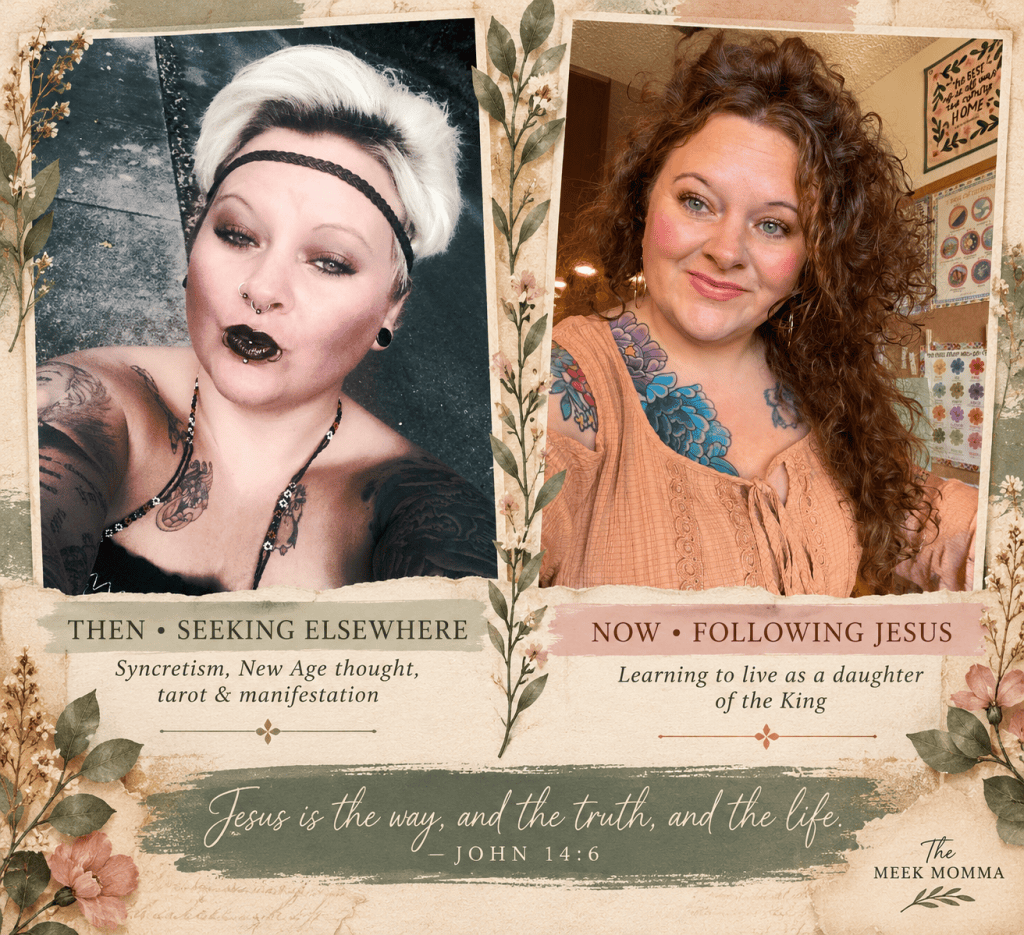
I believed in God. I believed Jesus was real. I would have told you that I was a Christian. But looking back, I can see that my understanding of Christianity was mixed with many other things. I was practicing what I now understand as syncretism: taking pieces of Christianity and combining them with other spiritual practices that I believed could give me knowledge, protection, power, guidance, or access to something beyond what I could see.
I didn’t understand at the time that these things were incompatible with following Christ.
I grew up knowing that the spiritual realm was real. There were things I experienced and witnessed in my childhood that I could not explain, and because of those experiences, I never really struggled with the idea that there was more to this world than what we can see. The problem was that I didn’t have a biblical framework for understanding any of it.
I knew there was a spiritual world, but I didn’t understand that Scripture teaches us to distinguish between what comes from God and what does not.
So I began looking in places I should never have looked.
There were crystals, stones, and gems that I believed carried energy or could help with manifestation. I had tarot cards that I used to look for answers about the future or ask questions and seek guidance from spirits. At one point I had an altar where I kept things that I associated with spiritual power, including parts of dead animals. During a particularly dark period of my life when I was struggling with self-harm, I even used my own blood on that altar while asking for particular things to happen to people who had hurt me.
I don’t share those details because I want to make the darkness sound interesting. I actually want to do the opposite.
I want to be careful about how we talk about these things because our culture has become very comfortable with spiritual practices that Scripture tells us to take seriously. What is sometimes presented as harmless, aesthetic, empowering, or even entertaining can become spiritually significant without us recognizing what we are participating in.
My story isn’t meant to make anyone curious about those things.
It is meant to show what happened when I finally began looking at them through the lens of Scripture.
When I Came Back to Church
When I came back to church as an adult, something began to change in me that I didn’t fully understand at first.
I started sitting under the preaching and teaching of God’s Word in a way I never really had before. I wasn’t simply hearing encouraging messages. I was beginning to encounter Scripture as God’s Word, with the authority to tell me what was true, what was false, what was holy, what was sinful, and what needed to change in my life.
The more I listened, the more I began to see things differently.
I had spent years believing that I could have Jesus and still hold onto these other spiritual practices. I thought I could believe in God while also looking to crystals for energy, tarot for answers, manifestation for outcomes, and spiritual experiences for guidance.
But Scripture doesn’t present Jesus as one spiritual option among many.
Jesus is Lord.
One of the passages that helped me understand this was Deuteronomy 18, where God specifically warned His people against practices such as divination, sorcery, interpreting omens, witchcraft, mediums, and consulting the dead. God wasn’t giving Israel a list of strange things they should be afraid of. He was teaching them where they were to look for guidance and where they were not.
The issue wasn’t whether there was a spiritual realm.
The issue was who God had told His people to trust.
Isaiah says something similar:
“And when they say to you, ‘Inquire of the mediums and the necromancers who chirp and mutter,’ should not a people inquire of their God?” — Isaiah 8:19
That question is incredibly important.
Should not a people inquire of their God?
I began realizing that I had been looking for answers in places where God had never told me to look.
The Night I Cleaned Out My Closets
Eventually, the conviction became impossible for me to ignore.
I remember one night going through my closets and gathering these things up. It was the middle of the night, and I began pulling out the things I had accumulated over the years.
I threw them away.
Some of these things had cost me real money. They weren’t insignificant possessions that I had no attachment to. They were things I had intentionally purchased and kept because I believed they had some kind of spiritual significance.
But by that point, the question in my mind was no longer, “Do these things really work?”
The question was, “Do these things belong in a life surrendered to Jesus?”
And I knew the answer.
My husband was in complete shock.
We had argued about some of these things over the years. Eventually, he had essentially taken the position of agreeing to disagree with me. He knew how strongly I felt about them, and I knew how strongly he felt differently.
So when he saw me gathering everything up and getting rid of it, he couldn’t believe what he was seeing.
I remember telling him that I felt convicted by the Lord and that I needed to listen to the Spirit.
I didn’t have a perfectly developed theology of everything that was happening in that moment. I didn’t have all the answers. But I had begun to understand something that I hadn’t understood before:
If I belonged to Christ, I could not continue treating every spiritual practice as though it was compatible with Him.
So I got rid of it.
And I have never looked back.
The People in Ephesus
This is why Acts 19 means so much to me.
When Paul came to Ephesus, he reasoned with people from the Scriptures and taught them about the kingdom of God. The chapter tells us that his ministry continued for an extended period of time, and that God was doing extraordinary things through him.
There was also a dramatic confrontation involving some men who attempted to use the name of Jesus without actually belonging to Him. Their encounter exposed something important: the name of Jesus isn’t a spiritual formula that we manipulate to get power. Jesus is Lord, and His authority cannot be separated from relationship with Him.
And then we come to verses 18–20.
Many who had believed came confessing what they had been doing. Those who had practiced magic brought their scrolls together and burned them publicly.
I love that Luke tells us what those scrolls were worth.
Fifty thousand pieces of silver.
Whatever the exact modern equivalent, Luke wants us to understand that this was not a meaningless sacrifice. These were valuable possessions.
They didn’t say, “Well, these cost a lot, so I’ll keep them even though I don’t use them.”
They didn’t put them in a box in the attic.
They didn’t keep them around as a reminder of their past.
They burned them.
And I think there is something we need to understand about biblical repentance here.
Repentance is more than feeling bad about something.
It is more than admitting that something was wrong.
Repentance means turning.
Sometimes that turning requires us to make very practical changes in our lives.
For those believers in Ephesus, repentance meant getting rid of the things associated with their former practices. For me, it meant going through my closets in the middle of the night and throwing away the things I had once considered spiritually meaningful.
The objects weren’t the source of my salvation or the proof that I had truly repented. Christ was my salvation.
But getting rid of those things was one tangible expression of what God was doing in my heart.
I Didn’t Become Afraid of the Spiritual Realm
One of the things I want to make clear about my story is that I didn’t come away from this thinking that the spiritual realm wasn’t real.
Quite the opposite.
I already knew it was real.
What changed was the lens through which I understood it.
Before Christ became central in my life, I had treated the spiritual realm almost like a marketplace. There were good things and bad things, different kinds of spiritual power, different ways to gain knowledge, different sources of guidance, and different practices I could use depending on what I wanted.
But Scripture gave me a completely different framework.
There is one God.
He is Creator.
I am His creature.
Jesus Christ is Lord.
And I don’t need to search the spiritual world for power, knowledge, protection, identity, or guidance because God has already told me where to go.
His Word.
His presence.
His wisdom.
His people.
And ultimately, Christ Himself.
I don’t want my testimony to make people fascinated with the things I used to practice. I don’t want to describe my past in a way that makes darkness sound mysterious or powerful or exciting.
I want women to learn to look at the world through the lens of Scripture.
Because the spiritual danger isn’t only found in obvious things.
Sometimes it is hidden beneath something beautiful.
Sometimes it is packaged as self-care.
Sometimes it is called manifestation.
Sometimes it is entertainment.
Sometimes it is presented as harmless curiosity.
And sometimes we don’t recognize what we are participating in because we have never opened our Bibles and learned what God actually says about it.
What About the Things We Let Enter Our Homes?
This is where I think Acts 19 begins to challenge all of us.
We can read about the people of Ephesus and think, “Well, I don’t practice magic, so this doesn’t really apply to me.”
But Scripture asks us to examine our hearts much more deeply than that.
What sources do I look to for guidance?
What do I believe will give me power or control?
Where do I go when I am afraid?
What am I trusting to protect me?
What do I believe will tell me what is going to happen?
What practices have I allowed into my life because they seemed harmless?
What entertainment has slowly taught me to become comfortable with things God calls us to reject?
What have I kept because it has sentimental value even though I know it doesn’t belong in my life with Christ?
These are questions meant to make us discerning.
Paul tells the believers in Corinth that they cannot have fellowship with the Lord while participating in what belongs to idolatry. Scripture consistently calls God’s people to distinguish between what belongs to Him and what does not.
That doesn’t mean Christians should live terrified of everything around them.
It means we should live with our eyes open.
We don’t need to become fascinated with darkness in order to recognize it.
We need to know the light.
When the Word Confronts Us
One of the things I love about Acts 19 is that the people weren’t simply given a list of rules.
They encountered the Word of God.
And when the Word confronted them, they responded.
That is what happened to me.
I didn’t wake up one morning and decide that I needed to completely change my spiritual worldview because I had become particularly disciplined or wise.
God used His Word.
He allowed me to sit under preaching and teaching, and slowly I began to see what I hadn’t seen before.
That is why I have become so passionate about studying Scripture.
The Bible doesn’t simply give us information about God.
It teaches us how to see everything else.
It gives us a framework for understanding ourselves, the world around us, suffering, temptation, sin, relationships, culture, our bodies, our families, and even the unseen spiritual realities that Scripture tells us exist.
The more we know God’s Word, the less dependent we become on our own feelings and experiences to determine what is true.
And that matters because my experiences were real to me, but my experiences could not be my authority.
Scripture had to be.
Behold Christ
This is where I want us to end, because the point of Acts 19 isn’t really the books.
It is Jesus.
The people of Ephesus weren’t saved because they burned their scrolls. They burned their scrolls because they had come to believe in Christ and their allegiance to Him changed what they were willing to keep.
Christianity isn’t primarily about cleaning up our lives so that we can become acceptable to God.
It is about being reconciled to God through Jesus Christ and then allowing His lordship to change everything.
There were many things I needed to leave behind when I came to Christ.
But what I gained was infinitely greater.
I didn’t lose access to spiritual power.
I found the One who has all authority.
I didn’t lose the ability to seek answers.
I found the One who is Truth.
I didn’t lose protection.
I found the One who is my refuge.
I didn’t lose my connection to the spiritual world.
I found the God who created both the seen and the unseen and who has authority over them all.
And that is why Acts 19:20 is such a beautiful ending to this story:
“So the word of the Lord continued to increase and prevail mightily.”
The books were burned.
But the Word remained.
And the Word prevailed.
Maybe your story looks nothing like mine.
Maybe you have never owned tarot cards or crystals. Maybe you have never participated in anything you would have called occult or spiritual.
But I would still encourage you to sit with Acts 19 for a while.
Ask the Lord to search your heart.
Are there things you have been trying to hold alongside Christ?
Are there places you are looking for guidance that God has not given you permission to look?
Are there practices you have accepted because our culture has made them seem harmless?
Are there things in your home, your entertainment, your habits, or your thinking that the Holy Spirit has been bringing to your attention?
And if He does bring something to mind, don’t respond with shame.
Respond with repentance.
You don’t have to be fascinated with what you are leaving behind.
You don’t have to understand every detail of it.
You don’t have to become an expert on darkness.
You simply need to know Christ and trust His Word.
There was a night when I went through my closets and threw away things that I once believed were spiritually meaningful.
I didn’t know then that years later I would look back on that night and see Acts 19 in it.
But now I do.
And I am grateful that the Lord loved me enough to let His Word confront me.
Because the greatest thing that happened wasn’t that I threw away some books, cards, stones, or objects.
The greatest thing that happened was that I began to understand that Jesus was not meant to be one part of my spirituality.
He was calling me to Himself.
Come Study With Me
Read: Acts 19:8–20 Study: Deuteronomy 18:9–14; Isaiah 8:19–20; 1 Corinthians 10:20–21 Ask: What does this passage teach me about repentance? What does it reveal about where I seek guidance and authority? Examine: Is there anything I am attempting to hold alongside Christ? Behold: Jesus is Lord over both the seen and unseen. Respond: Repent where God convicts, remove what needs to be removed, and trust Christ completely.
The book of Leviticus begins precisely where Exodus leaves off.
The tabernacle has been completed, and the glory of the LORD has filled it. God’s presence is so overwhelming that Moses is unable to enter the tent of meeting (Exodus 40:34–35).
That detail is important.
Leviticus begins with a question:
How can a holy God dwell among an unholy people?
Leviticus breaks from much of the narrative structure of Genesis and Exodus and moves primarily into instructions concerning sacrifices, priesthood, purity, holiness, worship, and covenant life.
But these laws are not random regulations.
Moses’ inability to enter the tabernacle establishes the theological problem that drives the book:
God is holy, and His people are not.
God desires to dwell among His people, yet His holiness cannot simply overlook sin and impurity. Leviticus therefore explains how Israel is to approach God, worship Him, deal with sin and ritual impurity, and live as a people set apart for His presence.
The sacrificial system provided God-appointed means of atonement, purification, forgiveness, and restored fellowship within the Mosaic covenant.
Three Major Areas of Leviticus
The laws of Leviticus can broadly be understood through three overlapping areas:
1. Ritual
These instructions govern Israel’s worship—particularly sacrifices, offerings, festivals, holy days, and other prescribed rituals.
2. Priesthood
These laws concern the ordination, qualifications, responsibilities, and conduct of the priests, who served in Israel’s worship and ministry at the sanctuary.
3. Holiness
These instructions teach Israel what it meant to live as a people set apart to God. They address worship, morality, relationships, sexuality, food, ritual purity, justice, and everyday life.
And this is important:
Ritual impurity is not necessarily the same thing as moral sin.
Something could make an Israelite ritually unclean without that person having committed a moral offense. The purity laws distinguish between categories of clean and unclean, while the holiness laws also address moral obedience and covenant faithfulness.
Together, these laws teach Israel that life in the presence of a holy God requires distinction, reverence, and holiness.
What Do These Laws Have in Common?
Though the laws of Leviticus address many different subjects, several themes continually emerge.
They call Israel to be holy.
“You shall be holy, for I the LORD your God am holy.” — Leviticus 19:2
They set Israel apart from the surrounding nations.
Israel was not simply another ancient nation with another religious system. They belonged to Yahweh and were called to reflect His character.
They continually remind Israel of their covenant relationship with God.
Their worship, daily lives, bodies, homes, food, relationships, priests, festivals, and sacrifices all existed within the reality that they belonged to God.
And they prepare us to understand the need for a greater and final atonement.
The New Testament explicitly develops the sacrificial and priestly themes of Leviticus and shows their fulfillment in Jesus Christ (Hebrews 9–10).
We should be careful, however, not to force Christ into every individual detail of Leviticus. Instead, we watch for the connections that Scripture itself develops and allows the biblical storyline to lead us to Christ.
The Day of Atonement
At the center of Leviticus stands Leviticus 16—the Day of Atonement, or Yom Kippur.
This was the great annual ceremony in which atonement was made for the sins and impurities of Israel and the sanctuary.
Two goats were selected.
One was offered as a sin offering.
The other became the scapegoat. The high priest confessed the sins of Israel over the goat, symbolically placing their iniquities upon it, and the goat was sent away into the wilderness.
These two goats vividly communicate two dimensions of atonement:
sin requires dealing with, and sin is removed from God’s people.
The New Testament helps us see the greater fulfillment of these realities in Christ, whose sacrifice is not repeated annually but is once for all (Hebrews 9:11–14; 10:10–14).
Why Leviticus Matters
Leviticus may require a little more work to understand and apply than some of the more narrative books of Scripture.
But it gives us a profound picture of God’s character and His purposes.
It teaches us that:
God is holy.
Sin and impurity matter.
God desires to dwell with His people.
Atonement is necessary for sinners to approach a holy God.
God Himself provides the way for His people to draw near.
And as the biblical story continues, these themes lead us toward the ultimate fulfillment of God’s provision:
Jesus Christ, our perfect and once-for-all sacrifice.
A Simple Outline of Leviticus
Chapters 1–7 — The Sacrificial Offerings
Instructions concerning Israel’s various offerings, including the burnt, grain, peace, sin, and guilt offerings.
Chapters 8–10 — The Priesthood
The ordination of Aaron and his sons, their responsibilities, and the judgment that falls on Nadab and Abihu for unauthorized worship.
Chapters 11–15 — Clean and Unclean
Instructions concerning clean and unclean animals, bodily conditions, skin diseases, bodily discharges, and other matters of ritual purity.
Chapter 16 — The Day of Atonement
Instructions for Israel’s annual Day of Atonement and the cleansing of the sanctuary and people.
Chapter 17 — The Holiness of Blood and Sacrifice
Instructions concerning where sacrifices may be offered and the sacred significance of blood.
Chapters 18–20 — Holiness in Everyday Life
Commands concerning sexual morality, family relationships, idolatry, justice, and separation from the practices of the surrounding nations.
Chapters 21–22 — Priestly Holiness
Additional requirements concerning the holiness and conduct of the priests and regulations concerning acceptable offerings.
Chapter 23 — Feasts and Holy Days
Israel’s appointed times, including Passover, Unleavened Bread, Firstfruits, Weeks, Trumpets, the Day of Atonement, and Booths.
Chapter 24 — Holy Things and Covenant Community
Instructions concerning the lampstand, the bread of the Presence, and the consequences of blaspheming God’s name.
Chapter 25 — Sabbath Year and Jubilee
Instructions concerning the Sabbath year, the Year of Jubilee, land, property, debt, and care for fellow Israelites.
Chapter 26 — Covenant Blessings and Curses
A covenant call to obedience accompanied by promises of blessing and warnings concerning covenant disobedience.
Chapter 27 — Vows and Dedicated Things
Regulations concerning vows, dedications, valuations, and things devoted to the LORD.
The Big Picture
Leviticus is not simply a book of strange rules about sacrifices, food, priests, and purity.
It is a book answering a profound question:
How can a holy God dwell among a sinful people?
And as we study it carefully, we begin to see the answer unfolding:
God makes a way for His people to dwell in His presence.
The temporary and repeated provisions of the Mosaic covenant ultimately point us toward the greater reality revealed in Christ—the One whose sacrifice is sufficient once for all.
“For by a single offering he has perfected for all time those who are being sanctified.” — Hebrews 10:14
Content note: This study discusses sexual violence, physical abuse, and trauma in the context of Judges 19 and includes a personal testimony of surviving abuse.
There are chapters of Scripture that comfort us.
There are chapters that encourage us.
There are chapters that strengthen our hope, remind us of God’s faithfulness, and give us words to pray when our own words fail.
Judges 19 is not one of those chapters.
Judges 19 is meant to horrify us.
There is no deliverer.
There is no victory.
There is no miraculous rescue.
There is no repentance.
There is only a Levite, his concubine, an old man, a violent mob, a night of unspeakable abuse, the death of an unnamed woman, and a nation about to tear itself apart.
Judges 19 is one of the darkest chapters in all of Scripture.
And we should not rush through the darkness.
We should not soften the violence.
We should not turn the suffering of this woman into a convenient illustration.
We should not search so quickly for an encouraging application that we fail to sit beneath the weight of what the text is showing us.
Because Judges 19 is here for a reason.
The book of Judges has been showing us what happens when the people of God reject the rule of God.
Again and again, Israel has done what is right in their own eyes.
They have compromised.
They have worshiped idols.
They have reshaped God according to their preferences.
They have pursued comfort.
They have sought blessing without obedience.
They have built religions they could control.
And now, at the end of the book, we are shown where that road leads.
Israel has become indistinguishable from the nations around them.
Worse still, Israel has become like Sodom.
Before We Read
Before going any further, we need to acknowledge what this chapter contains.
Judges 19 describes sexual violence, abuse, dehumanization, and death.
The Bible records these events.
It does not approve of them.
Scripture is painfully honest about the evil human beings are capable of committing. The Bible does not hide the consequences of sin. It does not sanitize human depravity. It does not pretend that rebellion against God remains private, harmless, or contained.
Sin spreads.
Sin corrupts.
Sin dehumanizes.
And when people persistently reject the authority of God, other human beings bear the consequences.
The unnamed woman at the center of Judges 19 is not merely a literary device.
She is a human being made in the image of God.
She is sinned against.
She is abandoned.
She is violated.
She dies.
And the men surrounding her repeatedly treat her as though her life exists for their convenience.
We should allow the horror of that reality to trouble us.
The text intends for us to be troubled.
In Those Days There Was No King
Judges 19 begins with words we have heard before:
“In those days, when there was no king in Israel…”
This statement has become the theological backdrop of the final chapters of Judges.
Israel’s problem is not merely political.
Their deepest problem is spiritual.
There is no human king, but more importantly, Israel is living as though there is no divine King.
God has spoken.
God has given His law.
God has established His covenant.
God has told His people how to worship, how to pursue justice, how to treat the vulnerable, how to order their families, and how to live together as His holy people.
Yet everyone continues doing what is right in his own eyes.
Judges 19 shows us what happens when subjective morality reaches its logical conclusion.
When everyone becomes his own authority, the strong eventually decide what happens to the weak.
When personal desire becomes the highest standard, other people become objects to be used.
When God’s authority is rejected, human dignity does not increase.
It collapses.
A Levite Who Should Have Known Better
Once again, a Levite stands near the center of the story.
That should trouble us.
The Levites had been set apart for service connected to the worship of God.
If anyone should have known the Word of God, it was a Levite.
If anyone should have understood covenant faithfulness, justice, holiness, and the value of belonging to God, it was a Levite.
Yet the Levite in Judges 19 is not presented as a faithful spiritual leader.
He is part of the problem.
The chapter begins by introducing his concubine, who leaves him and returns to her father’s house in Bethlehem.
After four months, the Levite travels to persuade her to return.
Her father welcomes him enthusiastically.
For several days, the men eat, drink, and delay the journey.
Eventually, the Levite insists on leaving.
The decision is made late in the day.
As darkness approaches, the servant suggests that they stop in Jebus, the city that would later become Jerusalem.
But the Levite refuses.
Jebus is inhabited by foreigners.
He does not want to spend the night among people who are not Israelites.
Instead, he chooses to continue to Gibeah.
Surely they will be safer among the people of God.
They are not.
When Israel Became Sodom
The travelers arrive in Gibeah, a city belonging to the tribe of Benjamin.
They sit in the town square.
No one welcomes them.
Eventually, an old man returning from his work in the fields sees them and offers hospitality.
Then the story begins to sound disturbingly familiar.
The men of the city surround the house.
They demand that the Levite be brought outside so that they can sexually assault him.
The deliberate connection to Genesis 19 is difficult to miss.
In Genesis, the men of Sodom surround Lot’s house.
In Judges, the men of Gibeah surround the old man’s house.
In Genesis, the mob demands the male visitors.
In Judges, the mob demands the Levite.
The language is similar.
The circumstances are similar.
The depravity is similar.
But there is one devastating difference.
Gibeah is not a Canaanite city.
Gibeah belongs to Israel.
God had called Israel to be holy.
God had separated them from the nations.
God had given them His Word.
God had placed His name among them.
God had called them to display His character to the world.
But now the people who were supposed to be different have become indistinguishable from the people they were commanded not to imitate.
Israel has become Sodom.
This may be one of the most terrifying warnings in the entire book of Judges.
The people of God can live among the things of God, possess the Word of God, use the name of God, and still become increasingly unlike God.
Spiritual privilege does not make anyone immune to spiritual decay.
A people who repeatedly refuse to listen to God can eventually become unrecognizable as His people.
The Failure of Every Man in the Story
There are no heroes in Judges 19.
The men of Gibeah are wicked.
But they are not the only men who fail.
The old man offers the women of the household to the mob.
The Levite sends his concubine outside.
The men abuse her throughout the night.
In the morning, she collapses at the doorway of the house.
And when the Levite opens the door, he says:
“Get up, let us be going.”
There is no recorded grief.
No tenderness.
No attempt to help her.
No acknowledgment of what she has suffered.
When she does not respond, he places her body on his donkey and returns home.
The woman at the center of the story is repeatedly acted upon.
Men decide where she will go.
Men decide what will happen to her.
Men sacrifice her safety to protect themselves.
Men violate her.
Men speak over her.
Men use her death for their own purposes.
She is never given a voice.
And that silence is part of the horror.
The further Israel moves from the rule of God, the more vulnerable people suffer.
Throughout Scripture, the treatment of the vulnerable is repeatedly connected to the spiritual condition of God’s people.
When people love God, they are commanded to love their neighbor.
When people fear God, they are forbidden from using power merely for their own advantage.
When people reject God’s authority, power becomes something to seize, protect, and use.
Judges 19 shows us a society in which nearly everyone is protecting himself.
And the person with the least power pays the highest price.
The Banality of Evil
One of the most disturbing things about the final chapters of Judges is how ordinary everyone seems.
These are not monsters from another world.
They travel.
They eat meals.
They extend hospitality.
They have families.
They speak about God.
They belong to tribes.
They participate in religious life.
And yet beneath the ordinary surface lies profound moral corruption.
Evil does not always announce itself dramatically.
Sometimes it grows quietly.
Compromise after compromise.
Excuse after excuse.
Desire after desire.
People gradually become accustomed to what once would have horrified them.
Sin becomes normal.
Consciences become dull.
People learn to live with contradictions.
They speak the language of faith while living according to their own desires.
The final chapters of Judges show us what happens when rebellion becomes ordinary.
The people do not merely commit isolated acts of sin.
They inhabit an entire moral world in which everyone is doing what is right in his own eyes.
The Woman at the Door
There is an image near the end of the chapter that is difficult to forget.
Morning comes.
The door opens.
And the woman is lying at the threshold with her hands on the doorway.
She had almost reached shelter.
But the door remained closed.
There are times when careful Bible study requires us to resist the urge to turn every detail into a metaphor.
This woman does not need to become a symbol before we are willing to grieve what happened to her.
She was a person made in the image of God.
And she was treated as disposable.
The text does not give us her name.
But God saw her.
The men in this chapter use her.
Ignore her.
Abandon her.
Violate her.
Dismember her.
But the God who inspired Scripture does not allow Israel to forget her.
Her suffering becomes part of the testimony against a nation that has rejected its King.
Her presence in Scripture reminds us that God does not look away from the suffering human beings would prefer to ignore.
The Bible bears witness to victims whom powerful people would rather leave unnamed.
The God Who Saw Me Too
There is a reason I cannot read Judges 19 from a safe distance.
I know what it is like to be sexually abused.
For a long period of my life, I was sexually abused by my father. I was also sexually and physically abused by other men.
I know something of the deep wounds these kinds of sins leave behind.
I know what it is like to carry questions you do not know how to ask.
Does God see me?
Does He care about what happened?
Will there ever be justice?
Am I still worthy of being loved?
For many years, I did not know how to bring those questions to God. I did not know how to process what had happened to me within my theology.
Then I began learning to slow down when I read Scripture.
I stopped rushing past difficult passages.
I stopped assuming that the darkest stories in the Bible were obstacles to faith that needed to be explained away as quickly as possible.
And I began to see something I had missed.
God does not hide what evil does to people.
He does not call evil good.
He does not ask us to pretend that suffering does not matter.
He does not look away from the people others would prefer to forget.
Judges 19 does not allow us to forget this woman.
The text does not give us her name, but God preserved the testimony of what was done to her.
Her suffering is not hidden.
The evil committed against her is not erased.
Generation after generation has been forced to reckon with what happened in Gibeah because God allowed her story to remain in His Word.
And as I learned to see her, I began to understand more deeply that God saw me too.
I thought about Hagar.
She was a woman caught within the sinful decisions and abuses of power of other people.
She fled into the wilderness.
And there, the angel of the LORD found her.
He called her by name.
“Hagar, servant of Sarai, where have you come from and where are you going?”
— Genesis 16:8
Hagar responded by giving God a name:
“You are a God of seeing.”
She said:
“Truly here I have seen Him who looks after me.”
— Genesis 16:13
Later, Hagar would find herself in the wilderness again, believing she was about to watch her son die.
She wept.
God heard.
And the angel of God called to her from heaven.
These passages began changing the way I understood God.
The God of Scripture is not the author of evil.
He is good.
He is just.
He sees.
He hears.
He knows.
And because He is faithful, He will keep every promise He has made.
That means evil will not be ignored forever.
Those who have harmed others will answer to God’s perfect justice.
Some of us may see justice in this life.
Some of us may not.
Human courts may fail.
People may refuse to believe us.
Those who committed evil may never acknowledge what they have done.
But there is no hidden thing that will remain hidden before the judgment of God.
The Judge of all the earth will do what is just.
For me, that truth did not make forgiveness unnecessary.
It made forgiveness possible.
I began to understand that forgiveness does not require me to call evil good.
It does not require me to pretend that justice does not matter.
It does not require me to deny what happened.
I can entrust final judgment to the God who sees perfectly, knows completely, and judges righteously.
And I can bring my wounds to Jesus.
The One who sees Hagar in the wilderness is the same God who came near to us in Christ.
Jesus saw women others ignored.
He welcomed people others rejected.
He touched those others considered unclean.
He drew near to the suffering.
He was betrayed.
He was stripped.
He was mocked.
He was beaten.
He was crucified.
And He willingly bore the judgment for sin so that sinners could be reconciled to God.
The cross taught me that God does not minimize evil.
Sin is so serious that the Son of God gave His life to save sinners from it.
And the resurrection taught me that evil, suffering, and death will not have the final word.
Slowly, the Old Testament and the New Testament began coming together for me.
The God who saw Hagar is the God who saw me.
The God who refused to let Israel forget the unnamed woman of Judges 19 had not forgotten me.
The righteous Judge before whom every evil will one day be exposed is also the Father who received me through His Son.
I began to understand that Jesus loved me deeply.
I began to receive the love of God instead of believing that what had been done to me determined my worth.
I began to seek forgiveness for my own sins.
I began learning to forgive others.
And I began trusting God with the justice I could not accomplish for myself.
These passages did not destroy my faith.
They deepened it.
They taught me that I do not need a Bible that looks away from evil.
I need a God who sees it more clearly than I ever could.
I do not need a God who offers shallow explanations for suffering.
I need the God who enters our suffering, judges with perfect justice, saves sinners through the blood of His Son, and promises that one day He will make all things new.
If you have experienced sexual violence, physical abuse, or other deep wounds, or if you love someone who has, I want you to know why I am willing to remain in difficult passages like Judges 19.
It is because I have found that slowing down in these passages has helped me know God more deeply.
You do not have to pretend that evil is less evil in order to trust Him.
You do not have to silence your grief.
You do not have to be afraid of your questions.
Bring them into the light of Scripture.
Learn the character of the God who sees.
Learn the justice of the God who will judge rightly.
Learn the mercy of the Savior who receives sinners.
Learn the love of the Father who gave His Son so that all who trust in Him might be reconciled to God.
My prayer is not merely that you will make it through the difficult chapters of the Bible with your faith intact.
My prayer is that, as you slow down and see the God who has revealed Himself there, your faith will deepen too.
The God who saw Hagar sees.
The God who preserved the testimony of the unnamed woman remembers.
The God who gave His Son saves.
And the King who is coming will judge the world in righteousness.
Come and see the God who sees.
Where Is God?
One of the unsettling realities of Judges 19 is the apparent silence of God.
There is no divine speech.
No angel appears.
No miracle interrupts the violence.
No deliverer arrives.
Where is God?
The answer is not that God has disappeared.
The entire book has shown us a people repeatedly refusing to listen to Him.
God has spoken.
Israel possesses His covenant.
Israel has His law.
Israel knows His commands.
The tragedy is not that God failed to reveal what righteousness looks like.
The tragedy is that Israel has rejected what God has revealed.
We must also be careful not to confuse God’s silence in the narrative with God’s indifference to suffering.
The chapter itself stands as testimony against Israel.
God has preserved the record of what happened.
The evil in Gibeah is not hidden from Him.
The suffering of the woman is not forgotten.
Judges 19 shows us what life looks like when human beings insist upon doing what is right in their own eyes.
And it leaves us longing for judgment, rescue, and a righteous King.
Outrage Is Not Repentance
The Levite takes the woman’s body and divides it into twelve pieces.
He sends the pieces throughout the territory of Israel.
The act is horrifying.
The response is immediate.
The people of Israel say:
“Such a thing has never happened or been seen from the day that the people of Israel came up out of the land of Egypt until this day; consider it, take counsel, and speak.”
Israel is finally shocked.
After years of idolatry.
After generations of compromise.
After repeated rejection of God’s covenant.
After everyone has done what is right in his own eyes.
Israel has finally found a sin terrible enough to produce national outrage.
But outrage is not the same thing as repentance.
It is possible to be horrified by the sins of others while remaining blind to the sin within ourselves.
It is possible to correctly identify evil and still respond to evil in ways that reveal our own estrangement from God.
That is where Judges 20 will take us.
The nation will gather.
The people will demand justice.
A civil war will begin.
Thousands will die.
And the people who are outraged by Gibeah will continue demonstrating that the deepest problem in Israel cannot be contained within one city.
The problem is everywhere.
The Road to Gibeah Was Longer Than One Night
Israel did not become Sodom overnight.
The violence of Judges 19 is the fruit of seeds planted throughout the entire book.
Israel compromised with the Canaanites.
Israel tolerated idolatry.
Israel abandoned covenant faithfulness.
Israel repeatedly cried out to God when suffering became unbearable, only to return to rebellion when relief arrived.
Israel treated God as a means of obtaining blessing rather than as their King.
By Judges 17, Micah has created his own religion.
By Judges 18, the tribe of Dan has established institutionalized idolatry.
By Judges 19, Israel has become Sodom.
This is the trajectory of sin.
Sin rarely tells us where it intends to take us.
It asks only for the next compromise.
The next excuse.
The next small act of disobedience.
The next moment when we decide that what seems right in our own eyes matters more than what God has said.
Judges 19 forces us to see the destination.
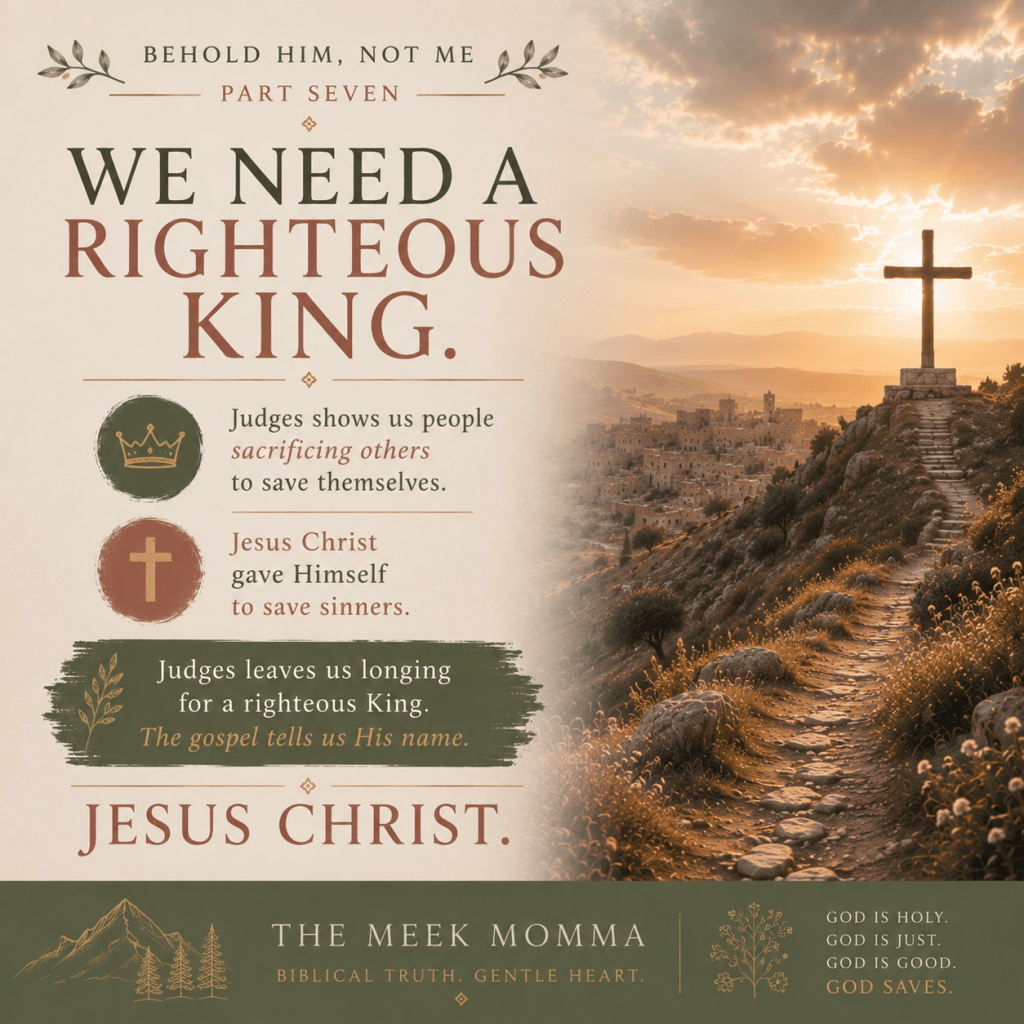
We Need a Righteous King
The book of Judges has shown us judge after judge.
Some were faithful.
Some were deeply flawed.
Some delivered Israel from external enemies while remaining unable to change the hearts of God’s people.
But now there is no judge.
There is no deliverer.
There is no faithful leader standing between the vulnerable and those who would destroy them.
The repeated refrain tells us what Israel lacks:
“In those days there was no king in Israel.”
But Israel does not merely need someone wearing a crown.
Israel needs a righteous King.
A King who will not exploit the weak.
A King who will not sacrifice others to save Himself.
A King who knows the Word of God and obeys it perfectly.
A King who sees the forgotten.
A King who defends the vulnerable.
A King who judges evil without becoming evil.
A King who can deal not only with the enemies surrounding God’s people, but with the sin dwelling within them.
Judges leaves us longing for such a King.
The gospel tells us His name.
The King Who Gave Himself
The men in Judges 19 preserve themselves by giving up someone else.
Jesus does the opposite.
Christ does not sacrifice the vulnerable to save Himself.
He gives Himself to save sinners.
The Good Shepherd does not abandon the sheep when the wolves come.
He lays down His life for the sheep.
Jesus does not use His power to protect Himself from suffering.
He willingly enters suffering.
He is betrayed.
He is mocked.
He is beaten.
He is condemned.
He is crucified.
Not because humanity is innocent.
But because humanity is guilty.
At the cross, we see both the horror of human sin and the holiness of God.
The cross does not minimize evil.
It reveals how serious sin truly is.
The righteous King bears judgment in the place of His people.
Judges 19 shows us human beings sacrificing others to save themselves.
The gospel shows us the Son of God giving Himself to save sinners.
Jesus Christ is the King Israel needed.
And He is the King we need.
The King Who Sees
Judges 19 reminds us that human beings can overlook suffering.
Communities can normalize injustice.
Religious people can become indifferent.
Powerful people can protect themselves.
Victims can remain unnamed.
But God sees.
God hears.
God knows.
And God will judge rightly.
The gospel does not ask us to pretend evil is less terrible than it is.
The gospel tells us that evil will not have the final word.
Jesus Christ was crucified.
Jesus Christ was buried.
Jesus Christ rose from the dead.
Jesus Christ reigns.
And one day the King who sees every injustice will judge the world in righteousness.
Every hidden thing will be brought into the light.
Every wrong will be answered according to perfect justice.
For those who belong to Christ, the promise of His kingdom means that suffering, violence, injustice, and death will not endure forever.
The King is coming.
Behold Him, Not Me
Judges 19 is difficult to read because it shows us what human beings become when we reject the rule of God.
Israel was called to be holy.
Israel was called to be different.
Israel was called to display the character of God among the nations.
Instead, Israel became Sodom.
The warning should humble us.
We should never assume that religious language, biblical knowledge, church attendance, ministry involvement, or spiritual heritage makes us immune to compromise.
We need more than outrage over the sins of the world.
We need more than moral reform.
We need more than better circumstances.
We need new hearts.
We need forgiveness.
We need righteousness we cannot produce for ourselves.
We need a King.
Judges leaves us searching for Him.
The rest of Scripture tells us His name.
Jesus Christ.
The righteous King.
The faithful Shepherd.
The One who sees the forgotten.
The One who judges with perfect justice.
The One who gave Himself to save sinners.
When everyone does what is right in his own eyes, look to the King.
When the world becomes accustomed to evil, look to the King.
When religious people fail, look to the King.
When human justice proves insufficient, look to the King.
When the darkness seems unbearable, look to the King.
Behold Him.
Heart Check
Am I more skilled at identifying the sins of others than examining the compromises within my own heart?
Have I become comfortable with things that Scripture calls evil?
Are there areas of my life where personal preference has become more authoritative than the Word of God?
Do I assume that being surrounded by Christian things is the same as faithfully following Christ?
How do I respond when obedience to Jesus requires me to protect, serve, or speak for people who have less power than I do?
Do I merely feel outrage over evil, or does the reality of sin lead me toward repentance, prayer, obedience, and trust in Christ?
Where am I tempted to protect myself at the expense of others?
Do I truly believe that Jesus is the righteous King I need—not only to judge the evil around me, but to save me from the sin within me?
Prayer
Father,
Judges 19 is difficult to read.
The violence is horrifying. The suffering is real. The depth of human sin is difficult to comprehend.
Yet Your Word refuses to hide what happens when people reject Your rule and do what is right in their own eyes.
Search my heart.
Show me where I have become comfortable with compromise.
Show me where I am quicker to condemn the sins of others than to repent of my own.
Guard me from a faith that knows Your Word but refuses to submit to it.
Teach me to see people as those made in Your image.
Give me courage to protect the vulnerable, speak truth, pursue justice, and refuse to make peace with evil.
For those reading who carry wounds caused by the evil of others, draw near to them.
Help them know that You see.
Help them know that You hear.
Help them know that evil is not hidden from You and that Your justice will not fail.
Lead them to the Savior who receives sinners, binds up the brokenhearted, and will one day make all things new.
And when the darkness of human sin feels overwhelming, turn our eyes toward Christ.
Thank You for giving us the King we could never produce for ourselves.
Thank You that Jesus did not sacrifice others to save Himself, but willingly gave Himself to save sinners.
Thank You that He sees the forgotten, receives the repentant, judges rightly, and reigns forever.
You may notice some overlap between this study and the previous two Judges posts I’ve shared. That’s intentional. In those studies, we looked at the broader movement of Judges 12–13 and how the story points us forward to Christ. This time, I found myself lingering over a much smaller section of the text—Judges 13:8–25—and discovering a lesson I wasn’t ready to move past.
Sometimes Scripture is like that. We read a passage once and see the big picture. Then we come back and find the Lord gently pressing a particular truth deeper into our hearts. For me, that truth was this: knowing God is better than having all the answers.
So if some of these verses feel familiar, I hope you’ll slow down with me and look again. God’s Word always has more to show us.
And perhaps that’s one of the greatest gifts of studying Scripture slowly. We don’t simply gather more information—we come to know the Author more deeply. As always, my prayer is that through this study we would learn to behold Him, not ourselves, trusting that His character is enough even when we don’t have all the answers.
Judges 13:8–25
As I studied Judges 13 this week, I found myself identifying with Samson’s father, Manoah.
After hearing that his barren wife would bear a son, Manoah prayed:
“Please, Lord, let the man of God you sent to us come again to teach us how to bring up the boy who is to be born.” (Judges 13:8)
His request is deeply relatable. He wants clarity, direction, and a plan for the future God has placed in his hands.
I’ve prayed the same way countless times.
As the mother of a son with autism, I have often asked God for guidance. Should I pursue this therapy or that one? Should I homeschool or choose public school? What does faithfulness look like in this situation?
If God would simply make the path clear, I would gladly follow it.
But Judges 13 reveals a better gift. The central lesson of Manoah’s story is this:
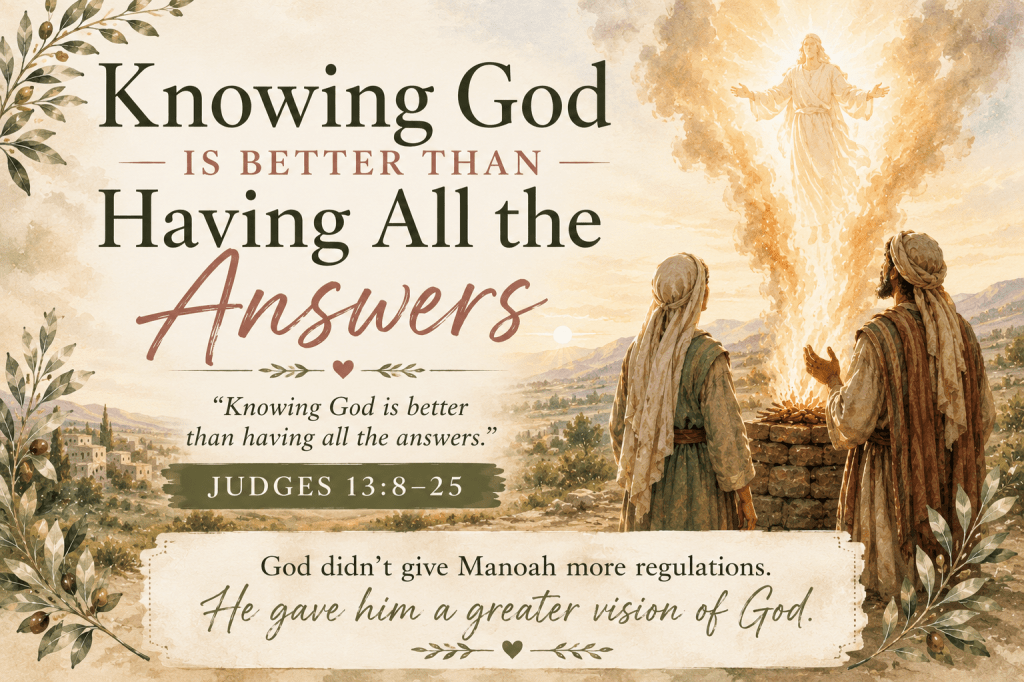
Knowing God is better than having all the answers.
Manoah asks for guidance, yet God gives him something deeper—a greater revelation of Himself. And that is often how God works in our lives as well.
Faith That Believes the Impossible
Before we look at Manoah, we must first notice the remarkable faith of Samson’s mother.
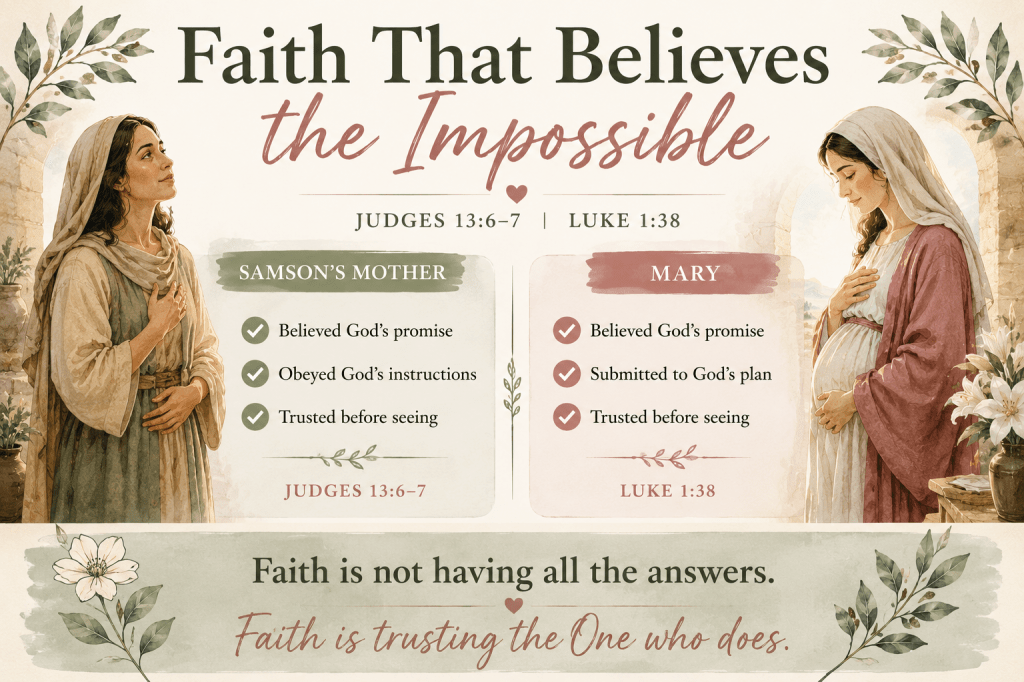
When the angel of the Lord appeared and announced that she would conceive and bear a son, she simply believed.
There is no recorded laughter as there was with Sarah when she heard she would bear Isaac in her old age (Genesis 18:9–15).
There is no disbelief like Zechariah displayed when he learned John the Baptist would be born (Luke 1:13–20).
Instead, Samson’s mother receives God’s word with faith:
“A man of God came to me. He looked like an angel of God, very awesome.” (Judges 13:6)
She believed the promise before she saw the fulfillment.
In this way, she reminds us of another woman who would receive impossible news more than a thousand years later.
When Gabriel announced the coming birth of Jesus, Mary responded:
“May it be to me as you have said.” (Luke 1:38)
Both women trusted God’s promises.
Both women submitted themselves to God’s purposes.
Both women accepted personal cost in order to participate in God’s plan.
Samson’s mother embraced the Nazarite restrictions required during her pregnancy. Mary embraced the shame and misunderstanding that would accompany an unwed pregnancy.
Both women demonstrate that faith is not merely believing God can do the impossible—it is willingly placing ourselves at His disposal.
Manoah’s Request
Unlike his wife, Manoah has questions.
And honestly, I appreciate that.
His response feels very human.
Notice that he doesn’t ask whether God’s promise is true.
He assumes the child will come.
His request is not for proof but for guidance.
He wants to know:
“What is to be the rule for the boy’s life and work?” (Judges 13:12)
How do we raise him?
What should we do?
What rules should we follow?
Again, I find myself nodding along.
As parents, we want certainty.
We want formulas.
We want detailed instructions.
We want guarantees.
Yet when the angel returns, something surprising happens.
He doesn’t provide much new information at all.
The child will be a Nazarite.
Manoah’s wife must continue obeying what she has already been told.
That’s essentially it.
No parenting manual.
No detailed roadmap.
No step-by-step guide.
Why?
The Help Manoah Wanted Versus the Help He Needed
At first it seems like God ignored Manoah’s request.
But He didn’t.
God answered the prayer.
Just not in the way Manoah expected.
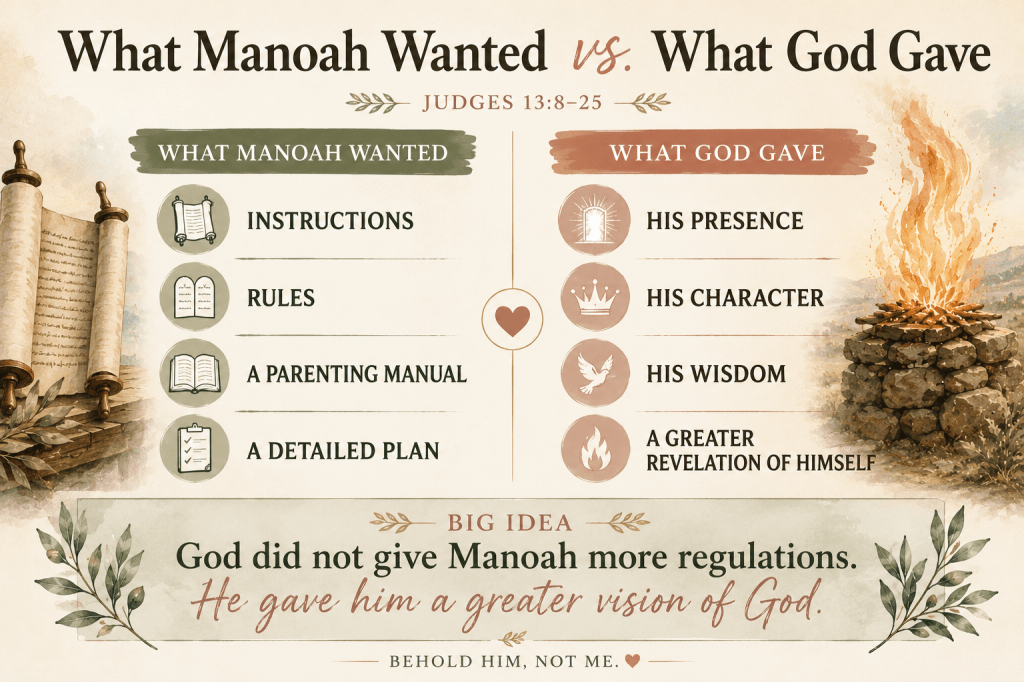
Manoah wanted information.
God gave revelation.
Manoah wanted rules.
God revealed His character.
Manoah wanted to know what to do.
God showed him who He was.
When Manoah asks the angel’s name, the angel responds:
“Why do you ask my name? It is beyond understanding.” (Judges 13:18)
Then the angel ascends into heaven in the flame of the sacrifice.
Suddenly Manoah realizes this was no ordinary visitor.
This was a divine encounter.
The angel of the Lord had come not merely to deliver information but to reveal God’s greatness.
That was the help Manoah truly needed.
And perhaps it is the help we need as well.
The Lesson I Keep Learning
This part of the story stopped me in my tracks.
Because I often approach God exactly the way Manoah did.
I want clarity.
I want confidence for the next step.
I want God to show me how to move forward.
As the mother of a child with autism, I have cried out to God with questions similar to Manoah’s.
But God’s silence has not really been silence.
Like Manoah, I often discover that God is answering a deeper question than the one I am asking.
He is teaching me His character.
His goodness.
His faithfulness.
His wisdom.
His sovereignty.
Because the truth is this:
Knowing God is better than having all the answers.
No set of instructions can prepare us for every decision we will face.
Only a deep understanding of who God is can guide us through the countless twists and turns of life.
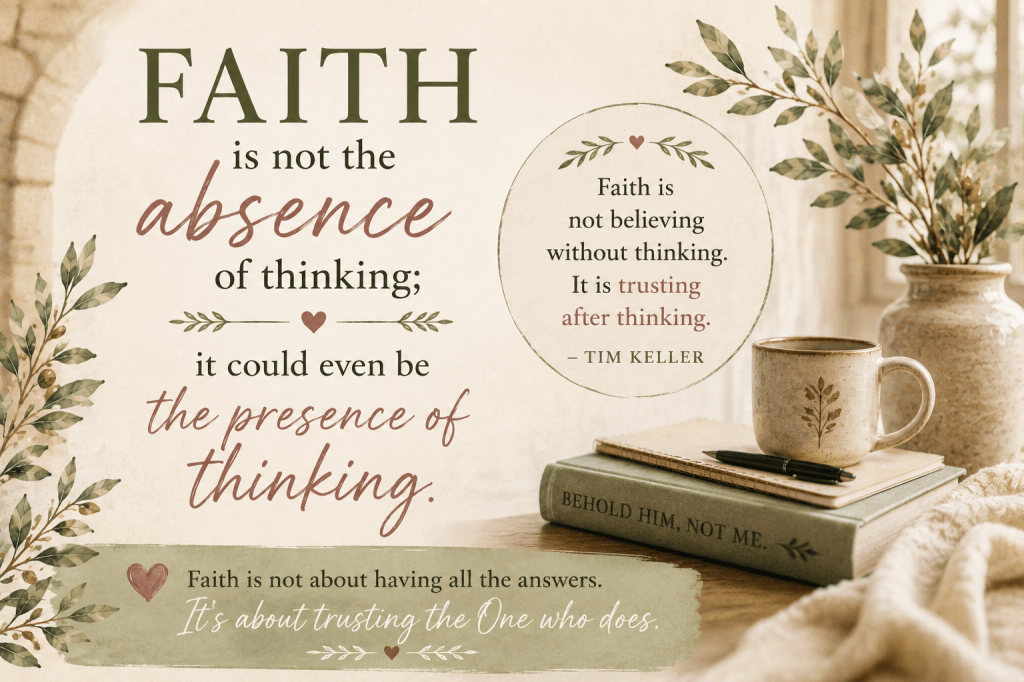
Faith Is Not the Absence of Thinking
After Manoah panics and assumes they are about to die because they have seen God, it is his wife who calmly reasons through the situation:
“If the Lord had meant to kill us, he would not have accepted a burnt offering and grain offering from our hands.” (Judges 13:23)
Her response beautifully illustrates what Tim Keller wrote:
“Faith is not the absence of thinking. It is thinking and acting on the basis of the Word and promises of God.”
She reflects on what God has already revealed.
She reasons from His character.
She trusts His promises.
That is biblical faith.
Not blind optimism.
Not wishful thinking.
But confidence rooted in who God is.
We Need God More Than More Rules
Tim Keller points out that mature relationships require fewer external rules and more internal wisdom.
Young children need constant instructions:
Don’t touch that.
Don’t go there.
Don’t do this.
But as children mature, parents desire them to internalize wisdom and values so they can make good decisions even when specific instructions are absent.
The same is true spiritually.
Many Christians imagine Old Testament believers had a better system because they received more regulations.
Yet under the New Covenant, we have something far greater.
We have the Holy Spirit.
Paul writes:
“Be transformed by the renewing of your mind.” (Romans 12:2)
And:
“We have the mind of Christ.” (1 Corinthians 2:16)
Rather than endless prescriptions, God gives us Himself.
Rather than merely telling us what to do, He transforms who we are.
What Manoah needed most was not more regulations.
It was a greater vision of God.
And the same is true for us.
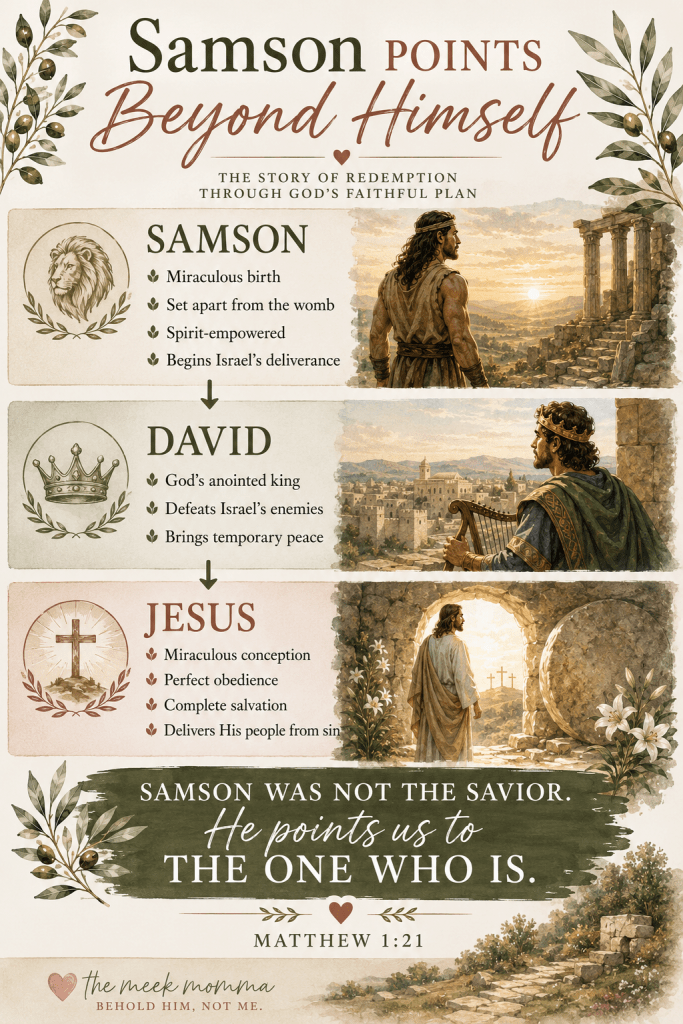
Samson’s Birth and Our Need for a Greater Savior
Finally, just as God promised, Samson is born.
The promise was never in doubt because it rested on God’s word.
The child grows.
God blesses him.
The Spirit begins to stir within him.
Everything appears poised for success.
If anyone ever had spiritual advantages, it was Samson.
Miraculous birth.
Divine calling.
God’s blessing.
The Spirit’s power.
Yet as we continue through Judges, we will discover that Samson is not the Savior Israel needs.
He will disappoint us.
His flaws will become painfully evident.
And that disappointment is intentional.
Because Samson was never meant to be the final Deliverer.
He points beyond himself.
To David.
And beyond David.
To Jesus Christ.
The One who would perfectly obey.
The One who would perfectly trust.
The One who would perfectly save.
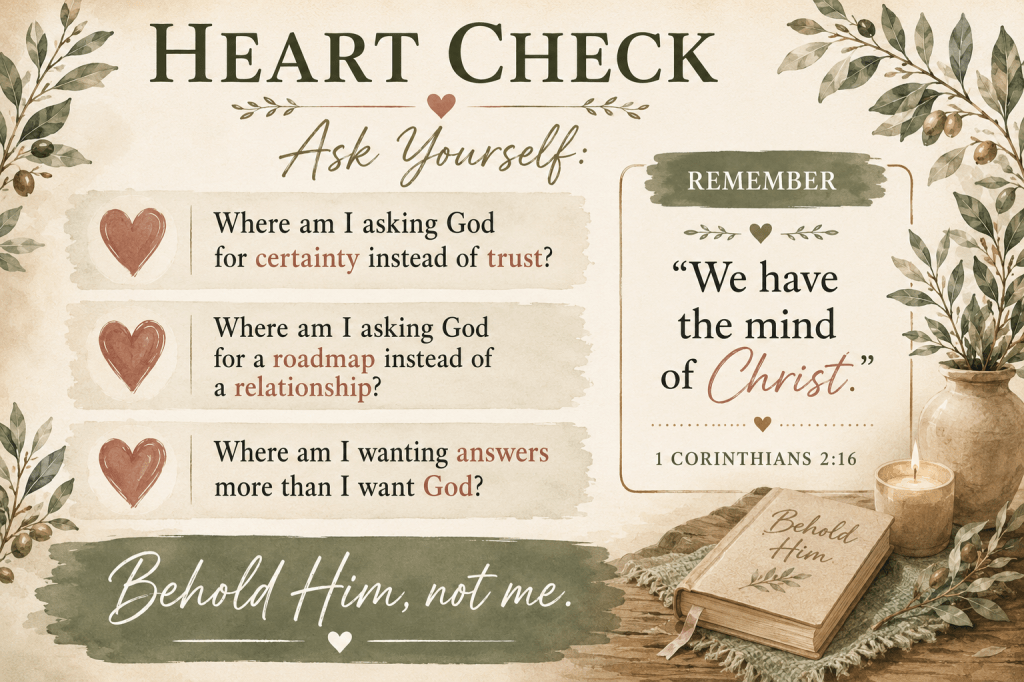
Heart Check
As I closed my Bible, one question lingered in my heart:
In what areas of my life would I rather have answers than God Himself?
Where am I asking for certainty instead of trust?
Where am I asking for a roadmap instead of a relationship?
Like Manoah, we often think we need more information.
But God knows what we truly need.
We need Him.
His character.
His wisdom.
His presence.
His promises.
Because in the end:
Knowing God is better than having all the answers.
I’ve read the story of Samson and Delilah many times.
Like many people, I often focused on the obvious lessons—the danger of temptation, Samson’s pride, Delilah’s betrayal, or the cutting of his hair. But this morning, one small phrase stopped me in my tracks:
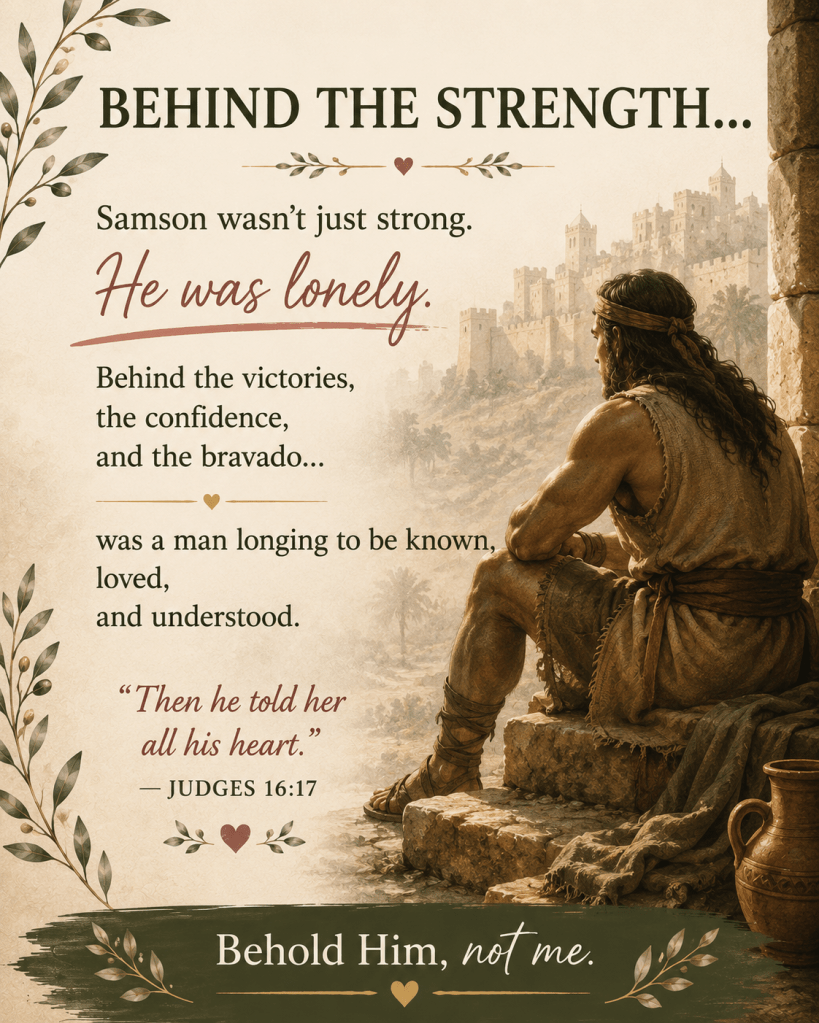
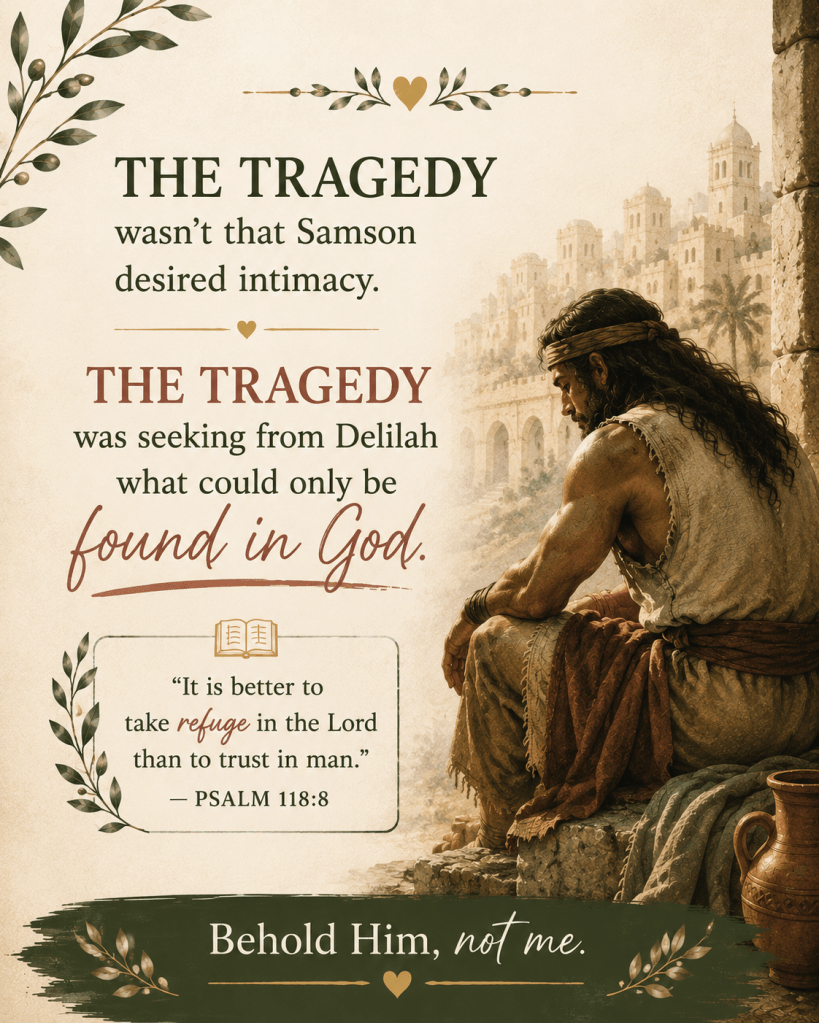
“Then he told her all his heart.”
Suddenly, Samson felt less like a larger-than-life judge and more like a deeply lonely man.
Behind all the strength, bravado, and reckless choices was someone desperately craving intimacy.
Samson wanted to be known.
He wanted to be loved.
He wanted someone to hold his heart.
The tragedy is not that Samson desired intimacy. God created us for relationship. The tragedy is that Samson sought from Delilah what he could only receive from God.
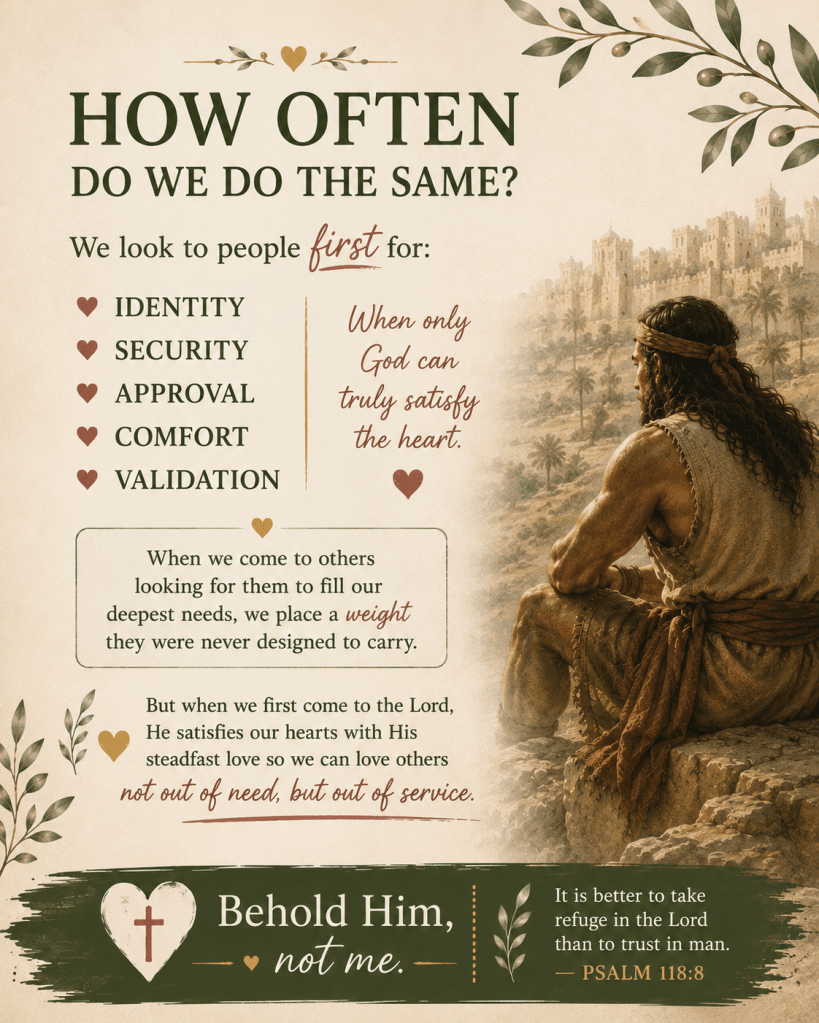
Isn’t that often our story too?
How often do we go to people first for validation, security, comfort, approval, or identity? We carry empty places in our hearts and expect spouses, friends, children, ministry, success, or relationships to fill what only God was ever meant to satisfy.
Psalm 118:8 reminds us:
“It is better to take refuge in the Lord than to trust in man.”
The problem isn’t loving people.
The problem is asking people to be what only God can be.
When we come to others looking for them to fill our deepest needs, we eventually place a weight on them they were never designed to carry. But when we first come to the Lord, allowing Him to satisfy our hearts with His steadfast love, we are free to love others not out of need but out of service.
That is exactly what Samson never learned.
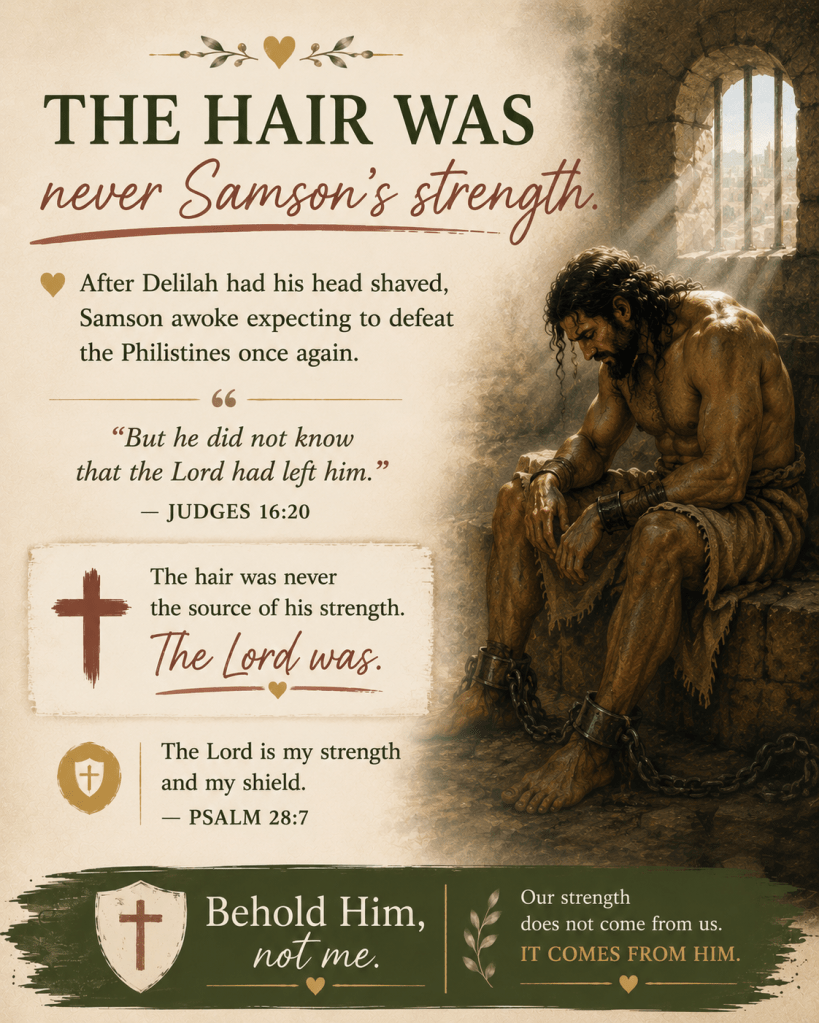
Many of us were taught that Samson’s strength was somehow hidden in his hair. Almost as if his hair possessed some magical power. But Scripture tells a different story.
After Delilah had his head shaved, Samson awoke expecting to defeat the Philistines once again.
“But he did not know that the Lord had left him.” (Judges 16:20)
The hair was never the source of his strength.
The Lord was.
Psalm 28:7 says:
“The Lord is my strength and my shield.”
Samson’s strength did not leave when his hair was cut.
His strength left when the presence of the Lord departed.
As I reflected on this passage, my mind kept returning to Psalm 118. Again and again the psalmist repeats truths we need to hear:
“The Lord is on my side.”
“The Lord is my helper.”
“The Lord is my strength.”
“His steadfast love endures forever.”
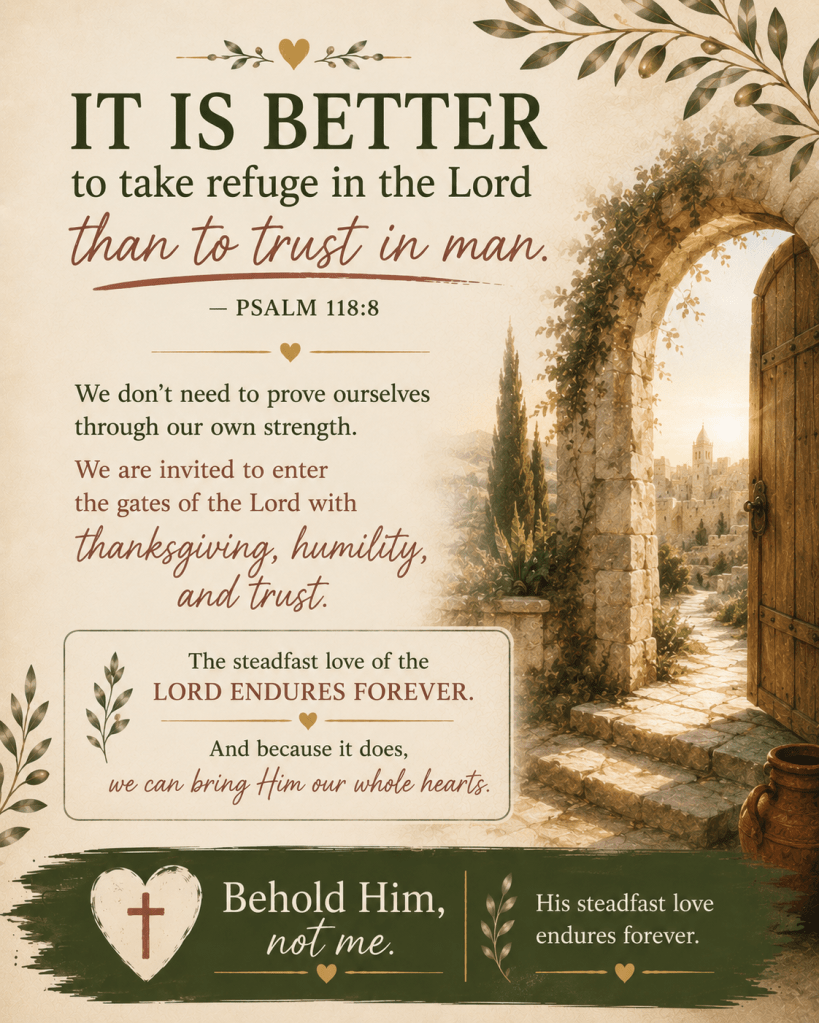
The Christian life is not about becoming stronger versions of ourselves.
It is about learning to depend on the One who is already strong.
Unlike Samson, we do not need to rip city gates from their hinges and carry them up a mountain. We do not need to prove ourselves through our own strength.
Instead, we are invited to enter the gates of the Lord with thanksgiving, humility, and trust.
The steadfast love of the Lord endures forever.
And because it does, we can bring Him our whole hearts.
As I closed my Bible this morning, I realized that Samson’s story isn’t only a warning for me—it’s a mirror.
Like Samson, I know what it is to crave being seen. I know what it is to long to be known, understood, chosen, and loved. There are days when I look to people for what I should first seek from God. Days when the approval of others feels more tangible than His presence. Days when I wish someone would notice the burdens I carry without me having to speak them aloud.
And if I’m being honest, sometimes the presence of the Lord doesn’t feel like enough.
Not because He isn’t enough, but because my heart is still learning to believe that He is.
That is part of living in a broken world. We were created for perfect fellowship with God, yet we live east of Eden, still feeling the ache of longing, loneliness, and unmet desires.
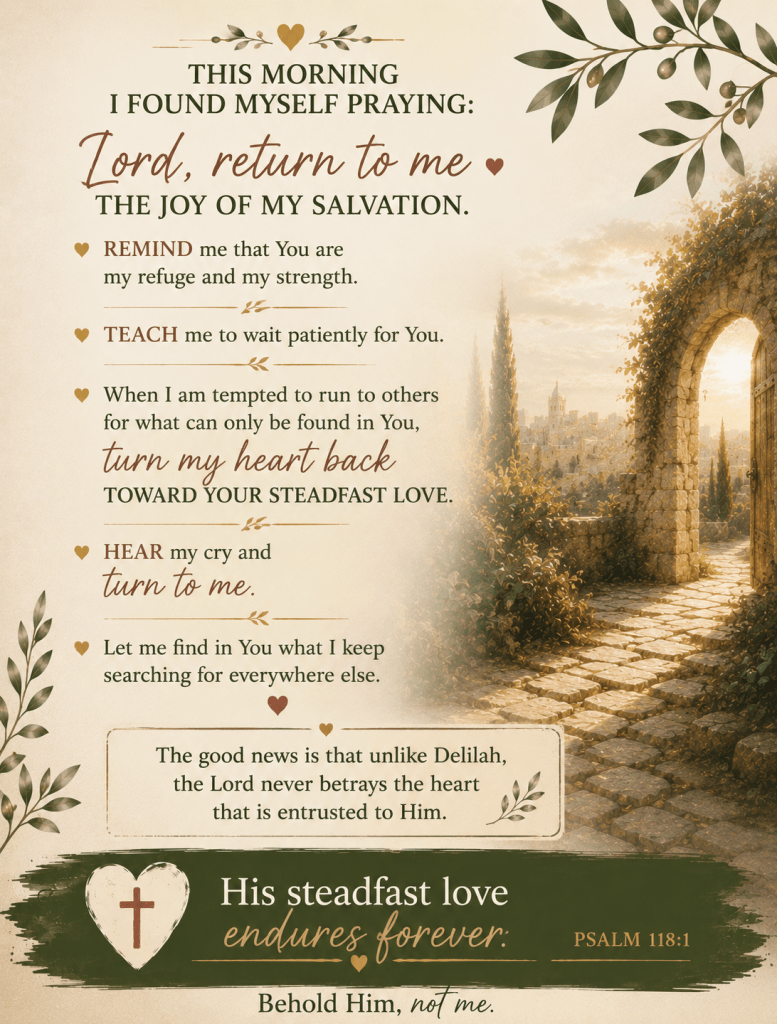
This morning I found myself praying:
“Lord, return to me the joy of my salvation. Remind me that You are my refuge and my strength. Teach me to wait patiently for You. When I am tempted to run to others for what can only be found in You, turn my heart back toward Your steadfast love. Hear my cry and turn to me. Let me find in You what I keep searching for everywhere else.”
The good news is that unlike Delilah, the Lord never betrays the heart that is entrusted to Him.
Judges 12-13, Infertility, Idolatry, and the Deception of Sin
One of the things I love most about studying God’s Word verse by verse is that it often confronts me in places I didn’t expect.
Recently, I found myself praying and talking with a friend about a struggle that has resurfaced many times throughout my life: infertility.
For twelve years, my husband and I prayed for a child. Then, in His kindness and perfect timing, God gave us Jackson. What a gift he has been. Yet as Jackson approaches eight years old, our family has not grown in the way I once assumed it would.
Like many women, I was told that once you have one child, having more often becomes easier. That has not been our story.
And if I’m honest, there are days when grief sneaks in.
I see beautiful growing families around me. I celebrate them sincerely because every child is a gift from God. Working in foster care has only deepened that conviction. There is not a single child I believe was born outside the knowledge and purpose of our good Father.
Yet sometimes I still find myself asking, “Lord, why?”
Why do some families grow effortlessly while others wait?
Why are some prayers answered quickly while others seem to linger unanswered?
As always, when I earnestly seek the Lord about the condition of my heart, He faithfully meets me in His Word.
Some Are Increased, Others Are Diminished
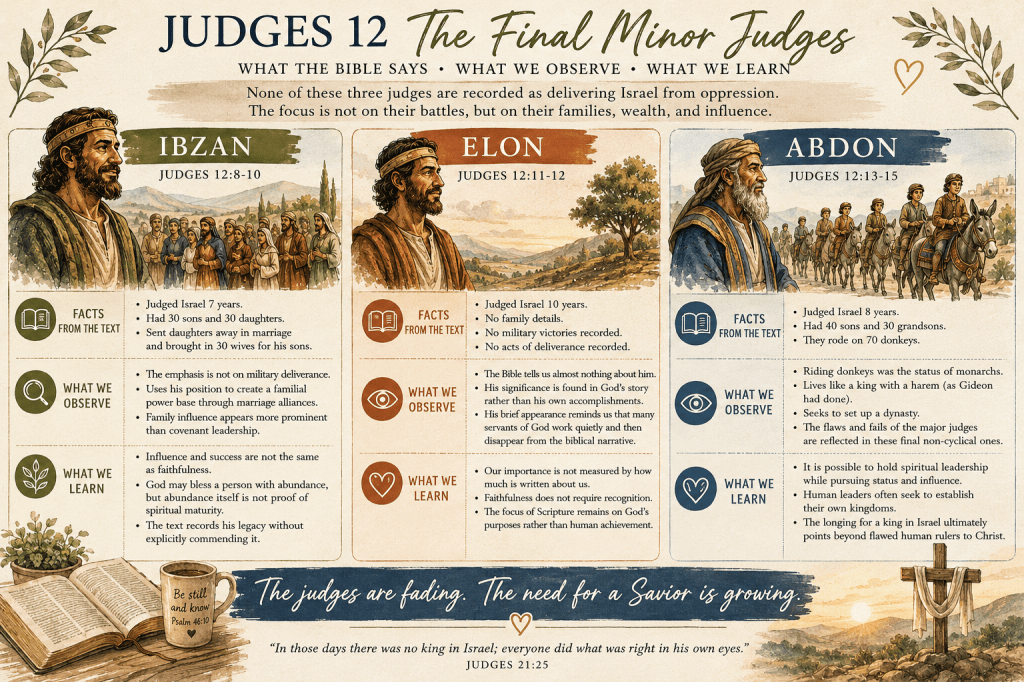
As I was studying the minor judges in Judges 12, I noticed an interesting contrast.
Ibzan had thirty sons and thirty daughters (Judges 12:9).
Earlier in Judges, Jair also had thirty sons.
Yet Jephthah had only one child—a daughter—and through his foolish vow and tragic actions, she never married and left no descendants.
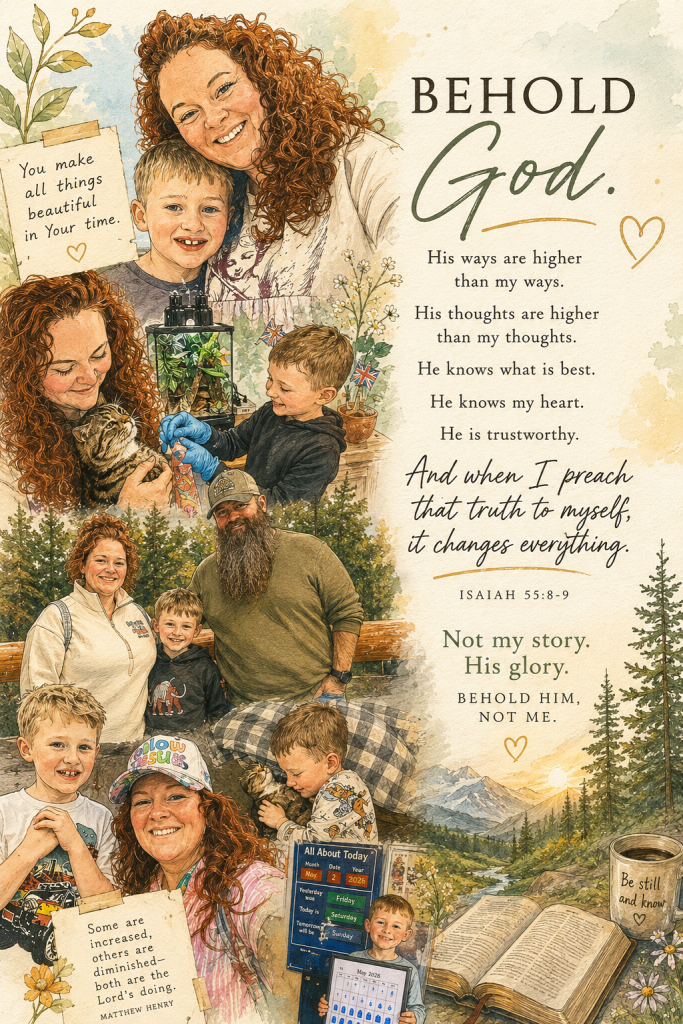
Seventeenth-century commentator Matthew Henry observed:
“Some are increased, others are diminished; both are the Lord’s doing.”
Those words are not easy to accept.
Our hearts naturally want explanations.
We want formulas.
We want reasons.
We want to know why God gives one person abundance while another experiences loss.
Yet Scripture repeatedly reminds us that God’s wisdom exceeds our own.
Isaiah tells us:
“For my thoughts are not your thoughts, neither are your ways my ways, declares the Lord. For as the heavens are higher than the earth, so are my ways higher than your ways and my thoughts than your thoughts.” (Isaiah 55:8-9)
That was exactly the reminder my heart needed.
God knows what He is doing.
God knows me.
God knows what will bring Him glory.
God knows what will make me more like Christ.
And that must be enough.
The Forgotten Judges and the God Who Is Remembered
As I continued reading, I noticed something else.
The Bible gives us only a few details about Ibzan, Elon and Abdon. We learn how long they judged Israel. We learn a few facts about their families. Then their stories end.
At first glance, it almost feels unsatisfying.
We want more details.
We want their stories fully told.
But perhaps that discomfort reveals something about us.
The Bible is not ultimately about human greatness.
It is about God’s greatness.
The focus of Scripture is not the lives of judges, kings, prophets, or even ordinary believers.
The focus is Christ.
Every page points to Him.
Even Abdon’s wealth and the mention of his sons riding on donkeys subtly remind us of a greater King who would one day ride into Jerusalem on a donkey, fulfilling prophecy and declaring His kingship.
The judges fade into the background.
Christ remains.
And that leads me to ask an uncomfortable question:
Does my life say, “Behold me,” or “Behold God”?
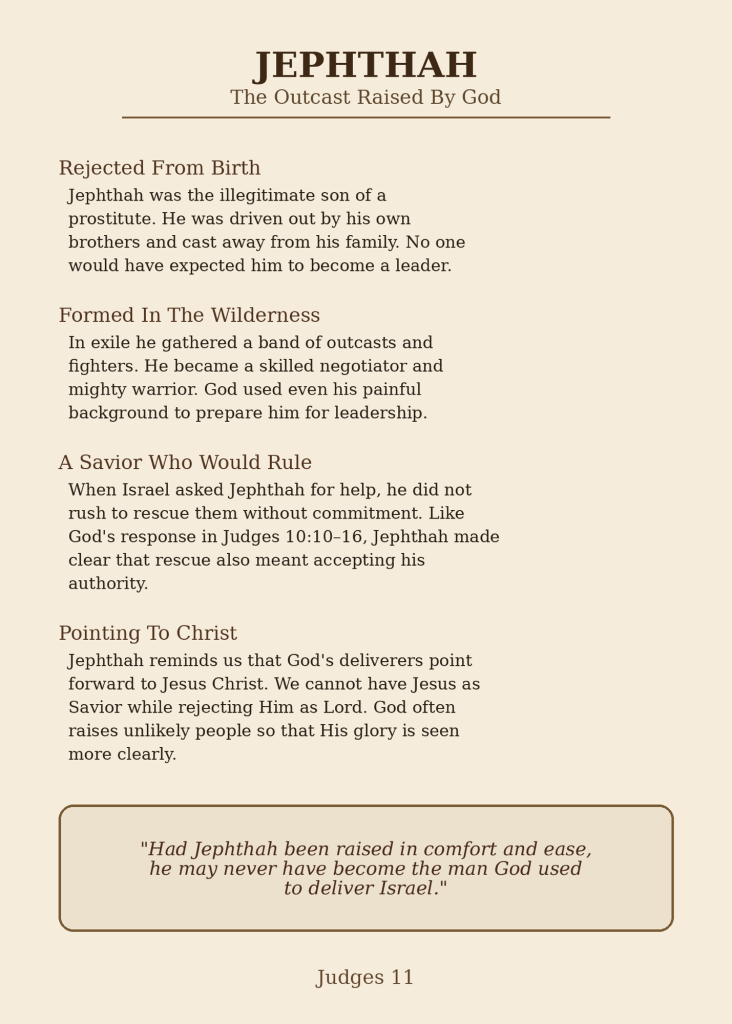
Character profiles of the 3 Minor Judges discussed
The Beginning of the Final Cycle
As we enter Judges 13, we begin the final cycle of the book.
The chapter opens with familiar words:
“And the people of Israel again did what was evil in the sight of the Lord.”
We have seen this refrain over and over throughout Judges.
The people sin.
God disciplines them.
They cry out.
God delivers them.
Then the cycle repeats.
Yet there is something particularly significant about this final occurrence.
The phrase “evil in the sight of the Lord” highlights a truth our culture desperately needs to hear.
Notice what the text does not say.
It does not say Israel did what was evil in their own eyes.
In fact, later in Judges we encounter another repeated phrase:
“Everyone did what was right in his own eyes.”
The two statements are connected.
The Israelites did not wake up every morning thinking, “Today I will rebel against God.”
They believed their choices were reasonable.
Understandable.
Justified.
Acceptable.
In their own eyes, much of their behavior probably seemed perfectly fine.
Yet God saw things differently.
And therein lies the danger.
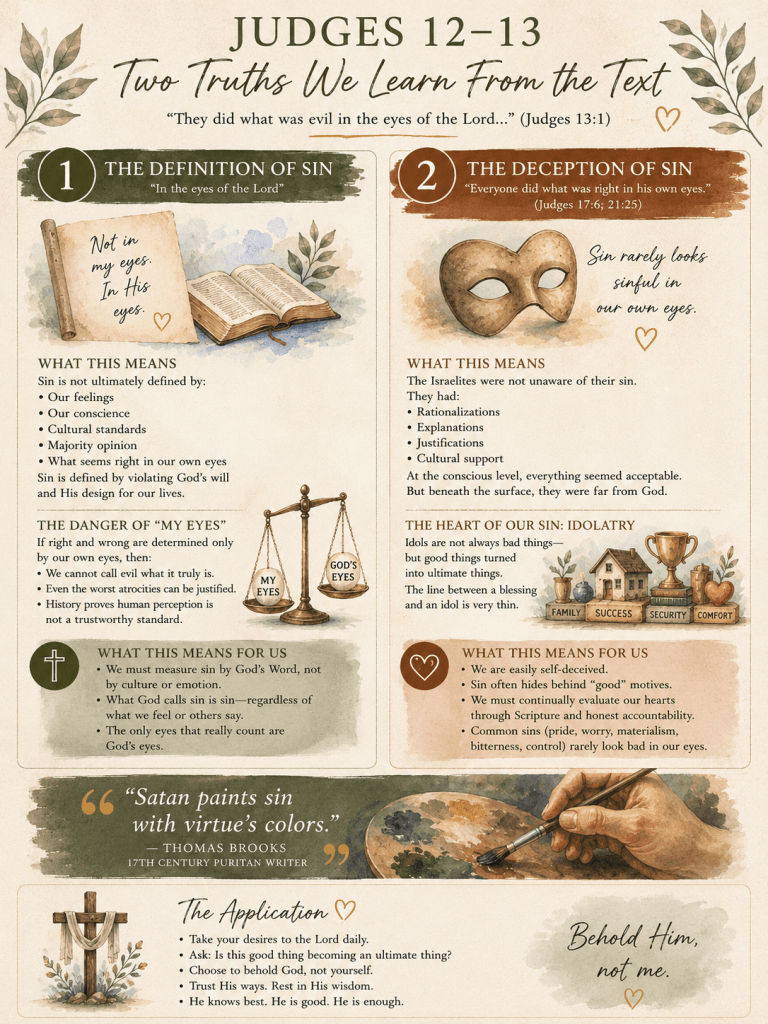
What Is Sin?
This passage teaches us something foundational about sin.
Sin is not ultimately defined by my feelings.
Sin is not determined by cultural approval.
Sin is not established by majority opinion.
Sin is not measured by whether my conscience happens to bother me.
Sin is defined by God.
Something is sinful because it violates God’s will and God’s design.
This truth directly contradicts modern thinking.
Our culture continually tells us:
“Follow your heart.”
“Live your truth.”
“You define what is right for you.”
But Scripture says something very different.
If morality is determined only by personal perception, then no one can meaningfully condemn evil.
History itself demonstrates the flaw in that thinking.
People can sincerely believe terrible things.
Groups of people can collectively justify horrific actions.
Human perception is not a trustworthy standard.
Only God is.
The eyes that ultimately matter are not my eyes.
They are God’s.
The Deception of Sin
The second truth we learn is how deceptive sin really is.
The Israelites had convinced themselves they were fine.
They had explanations.
Rationalizations.
Justifications.
At the conscious level, everything seemed acceptable.
But beneath the surface, they had drifted far from God.
That should concern all of us because we are no different.
The most dangerous sins are often not the obvious ones.
The most dangerous sins are the ones we have learned to justify.
Pride.
Bitterness.
Materialism.
Worry.
Control.
Self-reliance.
These sins rarely look sinful in our own eyes.
And this is where the Lord began pressing on my own heart.
When Good Desires Become Ultimate Desires
As I thought about my longing for more children, I realized something uncomfortable.
The desire itself is not sinful.
Children are a blessing.
Family is a gift.
Wanting those things is good.
But good things become idols when they become ultimate things.
The line between loving something and worshiping something is often thinner than we realize.
And I began to wonder:
Had I crossed that line?
Had my desire for more children subtly become a demand?
Was I saying, “God, I know what would be best for my life”?
Was I acting as though God’s gifts were somehow insufficient?
Was I placing myself in the judge’s seat?
Because when I insist that God must give me what I want in order for His plan to be good, I am no longer trusting Him.
I am attempting to replace Him.
That is the essence of idolatry.
An idol is not always a bad thing.
More often, it is a good thing that has become an ultimate thing.
Tim Keller famously described idols as good things turned into god things.
Family can become an idol.
Ministry can become an idol.
Work can become an idol.
Even motherhood can become an idol.
Anything we place above trustful submission to God becomes a rival to Him.
As the Puritan Thomas Brooks wisely wrote:
“Satan paints sin with virtue’s colors.”
The idol never announces itself as an idol.
It disguises itself as wisdom.
Responsibility.
Love.
Good stewardship.
Common sense.
And before we realize it, our hearts have drifted.
Bible Study Notes
Behold God
That is why we must constantly evaluate ourselves through Scripture.
Not through culture.
Not through emotions.
Not through popular opinion.
Through God’s Word.
The Word reveals what our hearts often hide.
And when it does, our response should not be despair.
It should be worship.
Because the goal of our lives is not ultimately to get everything we want.
The goal is not to have our preferred story.
The goal is not even to be remembered.
The goal is to behold God.
The minor judges came and went.
Their stories occupy only a few verses.
Yet God’s purposes prevailed.
Their significance was not found in the size of their role.
It was found in the God who authored the story.
The same is true for us.
Whether God increases or diminishes.
Whether He gives or withholds.
Whether our stories look ordinary or extraordinary.
He remains worthy.
And so today, I find myself returning once again to Isaiah 55.
His ways are higher than my ways.
His thoughts are higher than my thoughts.
He knows what is best.
He knows my heart.
He is trustworthy.
And when I preach that truth to myself, it changes everything.
There is something both comforting and deeply unsettling about the story of Jephthah in Judges 10–11.
Comforting, because God uses a rejected and broken man. Unsettling, because that same man carries distorted beliefs about God that lead to devastating consequences.
For many women learning to study Scripture faithfully — especially young mothers, homeschool moms, women rebuilding after hardship, or believers new to the faith — Jephthah’s story becomes more than history. It becomes a mirror.
Because one of the hardest truths to learn as Christians is this:
We can know some truth about God while still misunderstanding Him deeply in other places.
And if we are not careful readers of Scripture, we can begin mixing biblical truth with cultural assumptions, personal wounds, fear, and worldly thinking.
That is exactly what happens in the life of Jephthah.
God Raises an Unlikely Savior
Jephthah is introduced in Judges 11 as a mighty warrior. But immediately we are told something painful about him:
He was the son of a prostitute.
His half-brothers drove him away from the family home, rejecting him and cutting him off from inheritance and belonging. He grew up as an outcast, living in the wilderness surrounded by what Scripture calls “worthless fellows” — essentially a band of violent men and raiders.
Humanly speaking, Jephthah is not the kind of man anyone would expect God to use.
And yet God does.
This is one of the repeated themes throughout the book of Judges: God continually rescues His people through deeply flawed deliverers.
Why?
Because the judges were never meant to be ultimate saviors. They were shadows pointing forward to the true Savior still to come — Jesus Christ.
Jephthah’s rejection points us toward Christ, who was also rejected by His own people. Jephthah’s suffering prepared him to lead hurting people. His strength in battle reflected Israel’s need for deliverance.
But unlike Jesus, Jephthah was deeply sinful and spiritually confused.
And Scripture does not hide that from us.
Character Profile
Learning Context Matters
One of the biggest mistakes new believers often make when reading the Bible is assuming that because the Bible describes something, God therefore approves of it.
But biblical narrative does not always equal biblical endorsement.
The book of Judges especially shows us what life looks like when “everyone did what was right in his own eyes” (Judges 21:25).
The stories become darker and darker intentionally.
Judges is not simply recording heroic stories. It is showing the spiritual collapse of Israel when people drift from God’s Word.
That context matters tremendously when reading Jephthah’s tragic vow.
Jephthah’s Strength — and His Blindness
Before battle with the Ammonites, Jephthah actually shows surprising wisdom.
Instead of immediately rushing into war, he first pursues peace. He sends messengers, reasons carefully through Israel’s history, and presents legal, theological, and historical arguments explaining why the Ammonites are in the wrong.
This matters because it shows Jephthah was not merely a reckless brute. He understood leadership, diplomacy, and negotiation.
God had even shaped his painful background into useful strength.
His suffering formed resilience. His exile formed toughness. His wilderness years formed leadership.
Sometimes the hardest parts of our lives become the very places God uses most powerfully.
But giftedness is not the same thing as spiritual maturity.
And this is where careful Bible reading becomes so important.
Because right after displaying wisdom, Jephthah makes one of the most horrific vows in all of Scripture.
Judges 11 study notes
The Terrible Vow
Judges 11:29 says:
“Then the Spirit of the Lord was upon Jephthah…”
That detail matters.
God had already determined to give victory.
The outcome was never dependent on Jephthah bargaining with God.
Yet Jephthah vows that if God gives him victory, he will sacrifice whatever first comes from his house upon returning home.
And tragically, his daughter comes out first.
This is one of the moments where Christians must slow down and read carefully.
Some try to soften the text into something symbolic. Others suggest his daughter was merely devoted to lifelong service.
But the passage itself points toward something far darker and more tragic.
Why would Jephthah even make such a vow?
Because although he knew about God, he still thought about God in many pagan ways.
Study Notes Continued
When We Mix God With The World
The surrounding pagan cultures practiced human sacrifice. Their gods were viewed as beings who had to be manipulated, impressed, or bribed through extravagant offerings.
Jephthah had absorbed some of that thinking.
And if we are honest, we often do the same thing.
Not usually through violence or sacrifice — but through worldly beliefs about success, beauty, money, relationships, motherhood, control, or worth.
We often say we believe grace…
Yet live as though God’s love must constantly be earned.
We assume:
God will love us more if we perform better.
God is pleased only when we are productive.
God’s blessing depends entirely on our perfection.
Rest must be earned.
Weakness disqualifies us.
That is not the gospel.
And that is why studying Scripture carefully matters.
Because if we are not rooted deeply in God’s Word, culture will disciple us instead.
Romans 12:2 warns:
“Do not be conformed to this world, but be transformed by the renewal of your mind.”
Jephthah’s tragedy is not merely that he made a foolish vow.
It is that he fundamentally misunderstood the character of God.
Grace Is Harder To Believe Than Rules
Perhaps the saddest part of the story is this:
Even after realizing the horror of his vow, Jephthah still seems unable to trust God’s mercy enough to repent and stop.
Why?
Because he does not truly understand grace.
He seems trapped by fear — believing God must be appeased rather than trusted.
And honestly, many believers live there too.
Grace feels unsafe to us.
We would often rather manage God through rules than trust Him relationally.
But the gospel tells us something radically different:
God’s favor cannot be bought.
The Father already decided to rescue His people long before Jephthah made his vow. Likewise, Christ came for sinners before we cleaned ourselves up.
Jesus is the better Judge.
Where Jephthah sacrificed his daughter because of his sinful misunderstanding, God the Father willingly gave His own Son out of perfect love and perfect wisdom to save sinners.
One sacrifice brought death through human sin. The other brought life through divine grace.
How Do We Read Scripture Faithfully?
Stories like this teach us several important principles for Bible study:
1. Read passages in context
Never isolate verses from the larger story of Scripture.
2. Distinguish description from approval
The Bible often records sinful actions honestly without endorsing them.
3. Let clearer passages interpret difficult ones
Scripture already clearly condemns human sacrifice elsewhere.
4. Study God’s character across the whole Bible
One distorted view of God can shape an entire life wrongly.
5. Read humbly
Every culture has blind spots. We need Scripture constantly correcting us.
A Final Encouragement For Christian Women
If you are new to studying Scripture, please do not be discouraged by difficult passages like this.
Lean into them.
Some of the deepest growth happens when we slow down, ask questions, study context, and allow Scripture to reshape how we think about God.
The goal of Bible study is not merely gathering information.
It is learning to know the Lord rightly.
And that matters because what we believe about God shapes everything:
how we mother,
how we endure suffering,
how we handle failure,
how we rest,
how we repent,
and how we love others.
Jephthah’s story is tragic.
But even tragedies in Scripture are gracious warnings meant to draw us closer to the true Savior — the One who does not manipulate, crush, or abandon His people, but lovingly redeems them through grace.
Lessons from Gideon for Christian Women Seeking Faithfulness
“We need to remember we are saved by grace when we fail, but we need to remember it much more when we succeed.” — Tim Keller
The last few days in my verse-by-verse study through the book of Book of Judges have pressed this truth deeply into my heart.
When we think of spiritual danger, we often think of failure. Falling into sin. Wandering from God. Seasons of weakness. But Gideon’s story reminds us that success may actually be the greater threat to our souls.
God Reduced the Army by 99%
When Gideon marched into battle against Midian, he did not go in strong.
He went in weak.
God intentionally reduced Gideon’s army from thousands down to only 300 men. The Lord stripped away every earthly reason Israel could boast in themselves.
What power there is in that truth.
Imagine what God can do with one percent.
In the Book of Judges, chapter 7, the Israelites marched into battle not with military strength, but with trumpets, jars, and torches. And when the jars shattered and the trumpets sounded, the Lord caused the enemy camp to turn against itself.
The battle belonged entirely to God.
Gideon should have walked away from that battlefield saying:
“This victory was the Lord’s. My role was simply to trust and obey.”
And honestly, I understand this personally.
Recently, in my own work advocating for vulnerable children and families, I found myself sitting at a table with attorneys, professionals, and a judge. I come from a background very different from many of my peers. I was raised in poverty and abuse. I do not have prestigious credentials or a polished résumé.
What I do have is a testimony.
I know the power of God.
And when the Lord allows even a small victory in my work, I have to consciously preach the gospel back to myself:
“This did not come from me.”
God uses what is weak to shame what is strong.
At the end of our lunch together, everyone stood to leave, and there was an unspoken assumption that I would clean the table and bus the dishes.
The world would call that offensive.
Pride would say: “You deserve more honor than this.”
But as I carried the dishes away, I sensed the quiet kindness of God reminding me:
“This is good for you.”
And truly, it was.
Because humility guards the heart in ways success never can.
Serving keeps us close to Christ.
Gideon Forgot What Grace Had Done
As we move into chapter 8, Gideon begins changing.
And the shift is subtle at first.
When the tribe of Ephraim complains that Gideon did not call them into battle sooner, Gideon answers diplomatically and gently. He calms their anger with humility.
At first glance, this looks godly.
But the next interaction reveals something deeper.
When the towns of Succoth and Penuel refuse to help Gideon’s exhausted men, Gideon erupts in anger and vengeance. He threatens punishment. Later, after his victory, he returns and carries out brutal revenge against his own people.
Why the different response?
Because Ephraim wounded Gideon’s pride gently.
Succoth and Penuel wounded it directly.
And suddenly we begin to see that Gideon’s heart has shifted from dependence on God to dependence on his own honor.
The man who once hid in a winepress trembling now expects recognition.
The man who once begged God for reassurance now lashes out when others do not respect him.
Success revealed what was already growing in Gideon’s heart.
The Danger of Spiritual Success
There is a terrible danger in success.
Not because success itself is sinful, but because our hearts are desperate to believe we earned it.
We begin by thanking God for the victory.
Then slowly we begin protecting our reputation.
Defending our influence.
Needing recognition.
Wanting respect.
And before long, we are no longer serving God’s kingdom.
We are building our own.
Gideon forgot that God called him. God equipped him. God reassured him. God won the battle.
And sisters, we forget too.
We forget that every good work we do was prepared beforehand by God.
We forget that faithfulness itself is grace.
We forget that motherhood, ministry, leadership, hospitality, encouragement, advocacy, teaching, and service are not trophies we earned, but gifts we were entrusted with.
Ephesians 2:8-10
“For by grace you have been saved through faith. And this is not your own doing; it is the gift of God, not a result of works, so that no one may boast.”
Key Takeaways
We Still Build Ephods
One of the saddest moments in Gideon’s story comes after he refuses kingship.
Outwardly, Gideon says the right thing:
“The Lord will rule over you.”
But immediately afterward, Gideon begins living like a king anyway.
He gathers wealth. He elevates himself. He creates an ephod that becomes a snare to Israel.
In other words: he rejected the title while embracing the glory.
And if we are honest, we often do the same.
We say: “All glory to God.”
But inwardly we crave recognition.
We want to be the one people admire. The one people need. The one people look to for answers.
Ministry can quietly become self-salvation.
Motherhood can become identity worship.
Even serving others can become another way of trying to prove our worth.
We still build ephods.
Look to the Better Judge
But Gideon was never meant to be the final deliverer.
Like every judge in Scripture, he points us forward to a better Savior: Jesus Christ.
Unlike Gideon, Jesus did not use His authority to demand honor.
Though He was King, He came as a servant.
Though He deserved glory, He washed feet.
Though He had every right to be exalted, He humbled Himself to death on a cross.
Jesus Christ did not come to be served, but to serve and give His life as a ransom for many.
And because of that, we are finally free.
Free from needing applause. Free from proving ourselves. Free from being crushed by failure. Free from becoming intoxicated by success.
The gospel liberates us from both pride and despair.
A Final Encouragement
Friend, maybe God has recently given you victory in some area of life.
Maybe your marriage is flourishing. Maybe ministry is growing. Maybe motherhood feels fruitful. Maybe people are finally recognizing your gifts.
Praise God for those things! Success can either deepen worship or feed self-glory.
It is well for us to serve. It is well for us to be humbled. It is well for us to remember that we are creatures, not the Creator.
So today, ask yourself:
Are there areas of my life where I am subtly seeking honor that belongs to God alone?
And how does the servant-heartedness of Christ free me from turning success into self-salvation?
May we never forget: the victory belongs to the Lord.
Jackson had been hopping, running, flapping, vocalizing, and moving almost nonstop for over twenty-four hours. The kind of movement that tells me his little nervous system is trying so hard to regulate itself. The kind of exhaustion that settles deep into a mother’s bones because even while your body is tired, your mind never fully rests.
And somewhere between the pacing and the praying last night, I found myself thinking about this season we’re stepping into again.
Summer.
Or at least the version of summer families like ours experience.
Because summer feels different when you parent a child with autism.
For many families, summer means freedom. Later bedtimes. Road trips. Ballgames. Camping trips. Pool days. Spontaneous outings. Relaxed schedules. A temporary release from structure so families can collect memories and enjoy the break from routine.
But for many autism families, routine cannot simply disappear because the school year ended.
Routine is not just preference here. It is safety. It is regulation. It is emotional predictability. It is the framework that helps a child’s nervous system feel secure enough to function.
And when routine breaks down, often so does everything else with it.
There can be dysregulation, sleep disruption, sensory overload, anxiety, meltdowns, setbacks, confusion, exhaustion, and a deep unraveling in areas where progress had finally begun to bloom.
So while the world around us seems to exhale in the summer, many of us grip tighter just trying to hold peace together inside our homes.
And if I’m being honest?
Sometimes that feels lonely.
I watch families around us living a version of motherhood that often feels inaccessible to me right now. I see kids Jackson once sat beside in classrooms now thriving in sports, making friendships effortlessly, gaining independence naturally, trying new experiences confidently.
I see younger children surpassing milestones my son is still fighting hard to reach.
And there is a grief in that I don’t think people talk about enough.
Not because I am bitter. Not because I am not genuinely happy for them. Not because I would trade my son for another child.
I adore my son.
But because motherhood inside special needs parenting carries a very specific tension: you can be deeply grateful while simultaneously grieving.
Both can exist at the same time.
I can clap for your child while quietly crying in the bathroom later because I wish some things came easier for mine.
And I think pretending otherwise helps no one.
Jackson is seven now.
There are things he does today that once felt impossible. Things some children with autism may never fully accomplish independently. Every single victory matters to us because we understand what it cost him to get there.
But autism is complex.
A child can read above level while struggling with emotional regulation. A child can memorize entire songs but not communicate their needs clearly. A child can appear socially engaged one moment and completely dysregulated the next. A child can seem “high functioning” to outsiders while privately struggling with things typical toddlers navigate with ease.
And that complexity is often misunderstood.
When people see capability in one area, they assume capability must exist everywhere else too.
So when it doesn’t, the response is often criticism instead of curiosity.
Judgment instead of compassion.
Assumptions instead of questions.
And what hurts sometimes is not even the hard itself.
We can do hard things with Christ.
What hurts is feeling unseen inside the hard.
What hurts is when people stop extending understanding the moment autism doesn’t look like what they expected it to look like.
Because autism is not always obvious. And it is rarely linear.
There are days Jackson seems years ahead in one area and years behind in another all at once.
There are days he thrives beautifully. And there are days where every small task feels impossibly hard.
Both are true.
I think that’s why I love the way Jesus interacted with hurting people in Scripture.
He noticed people others overlooked.
The weary. The isolated. The misunderstood. The parents carrying invisible burdens. The people sitting quietly on the edges of the crowd hoping someone would see them.
Jesus never seemed uncomfortable with complicated pain.
And honestly, that comforts me deeply because autism parenting is complicated pain sometimes.
Beautiful pain. Holy pain. Refining pain. But still pain.
There are moments I desperately need someone to remind me: Jackson is doing beautifully. Progress does not have to look typical to matter. God is not absent in delayed milestones. And our future is not hopeless simply because it is unknown.
Because the truth is—we simply do not know yet what Jackson’s future will fully look like.
Autism is not something you simply “outgrow.”
Can therapies help? Absolutely. Can support systems help? Yes. Can growth happen? Of course.
But autism is also a neurological difference that impacts the way a person experiences, processes, communicates, regulates, and interacts with the world.
And long-term outcomes are not always predictable.
That uncertainty can feel heavy as a parent.
Especially when the world keeps measuring children against timelines.
But lately God keeps reminding me: He is not asking Jackson to become someone else.
And He is not asking me to parent someone else’s story.
Psalm 139 says God knit Jackson together intentionally.
Not accidentally. Not mistakenly. Not as an afterthought.
Intentionally.
And that means even the areas that feel hard to me are still fully seen by God.
The hidden victories matter to Him.
The sensory recoveries. The flexibility after disruption. The moments of connection. The brave transitions. The hard-earned words. The regulation after overwhelm. The trust. The growth. The trying again.
God sees all of it.
And maybe that is why I keep returning to dependence.
Because autism parenting has stripped away my illusion of control in so many ways.
It has taught me how desperately I need Christ daily.
Not the polished version of faith. Not the social media version. Not the “everything is inspiring all the time” version.
Real dependence.
The kind where you pray through meltdowns. The kind where you cry in the bathroom and then walk back out anyway. The kind where you celebrate tiny victories nobody else would notice. The kind where you trust God with a future you cannot clearly picture.
And maybe that dependence itself is holy.
Maybe God is forming something eternal in us through this life we would not have chosen ourselves.
Our family may not look like everyone else’s family. Our summers may not look like everyone else’s summers. Our journey may not follow the timeline culture expects.
But our story is not less beautiful because it is different.
And to the special needs moms quietly carrying all of this too:
I see you.
God sees you.
Your child is not behind in the eyes of the One who created them.
Your exhaustion is not weakness. Your grief is not failure. Your longing does not cancel your gratitude. And your hard is not unseen by God.
Keep showing up.
Keep loving deeply.
Keep trusting Jesus in the uncertainty.
And keep celebrating every single victory no matter how small the world thinks it is.
Because heaven notices things this world overlooks all the time.