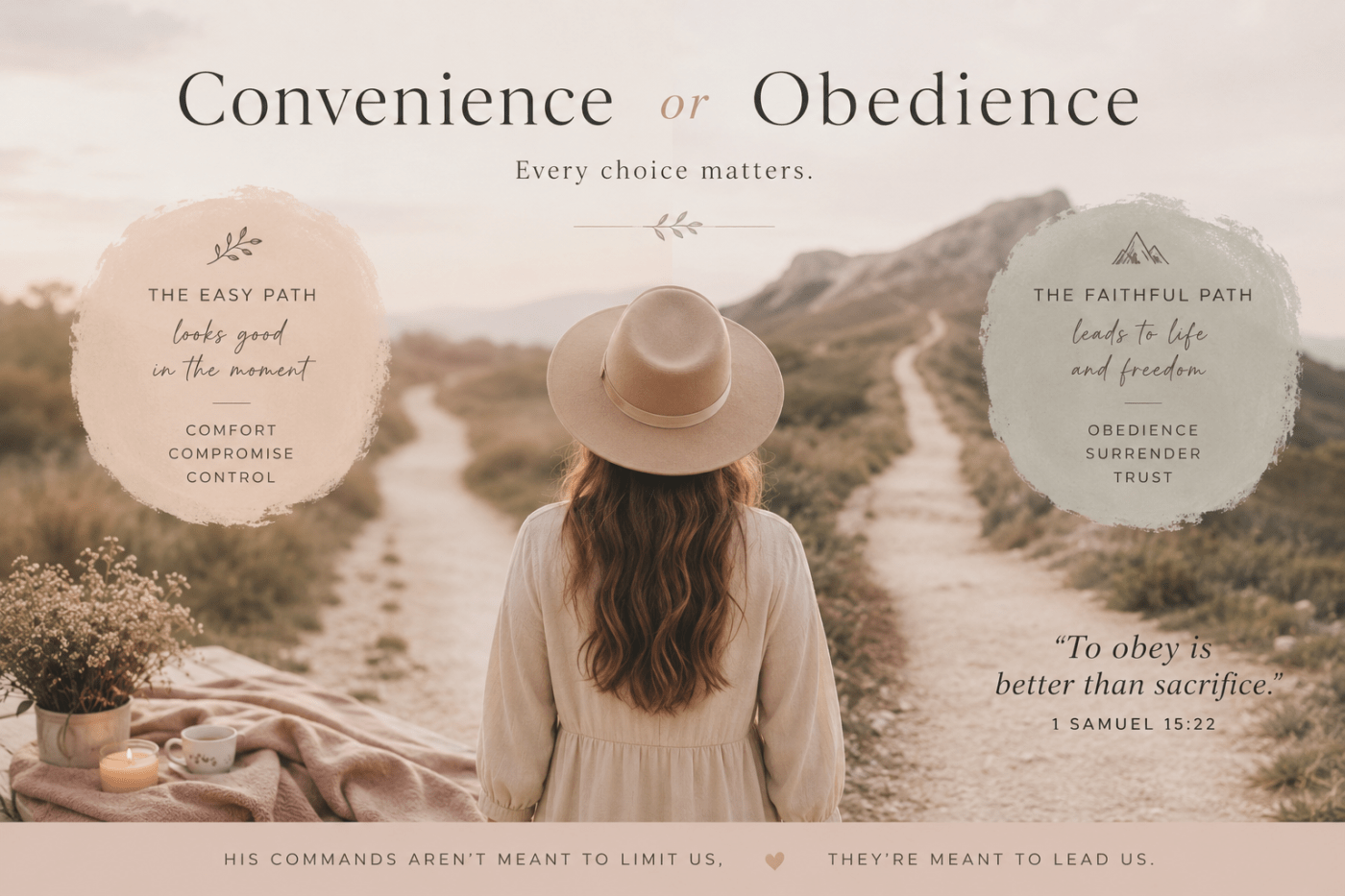
In Book of Judges 1:28–36, we encounter a quiet but dangerous pattern in the life of Israel—partial obedience. God had clearly commanded His people to drive out the inhabitants of the land. This wasn’t arbitrary; it was for their protection, knowing their weakness and tendency to fall into idolatry.
But instead of fully obeying, the Israelites chose a different path.
Again and again, the text tells us they did not drive them out. Instead, they subjected the people to forced labor. From a human perspective, it made sense. It was efficient. Economically beneficial. Less costly. Less exhausting.
But it wasn’t obedience.
As Timothy Keller insightfully puts it, here we see that “convenience trumps obedience.” What felt practical in the moment became a spiritual compromise with long-term consequences. The very people they allowed to remain would later become a snare.
Even more striking is what we read about the tribe of Dan. In Judges 1:34–35, the Amorites pressed them back into the hill country. There’s no indication that the enemy was stronger or better equipped. Instead, it appears they simply had greater resolve. Those who did not know God showed more determination than those who did.
That contrast should stop us in our tracks.
A Pattern Repeated Throughout Scripture
This isn’t an isolated moment. Scripture repeatedly shows us the subtle drift from obedience to compromise.
Consider First Book of Samuel 15. God commands King Saul to completely destroy the Amalekites. Instead, Saul spares King Agag and keeps the best of the livestock. His justification? It would be used for sacrifice to the Lord.
It sounded spiritual—but it was disobedience dressed up as worship.
The prophet Samuel’s response is piercing: “To obey is better than sacrifice.” (1 Samuel 15:22)
Saul chose what seemed reasonable over what God required.
Or look at Book of Genesis 3. Adam and Eve were given one command—do not eat from the tree. Yet when temptation came, the fruit appeared “good,” “pleasing,” and “desirable.” Convenience, desire, and reasoning overruled obedience.
The result? Separation, brokenness, and the entrance of sin into the world.
In Book of Numbers 20, Moses—faithful leader of Israel—strikes the rock instead of speaking to it as God commanded. It may have seemed like a small deviation, especially under pressure. But partial obedience is still disobedience. Even Moses experienced the consequence of not fully honoring God’s instruction.
And in the New Testament, we see a powerful example in Acts of the Apostles 5. Ananias and Sapphira sell property but secretly withhold part of the proceeds while presenting it as the full amount. Their sin wasn’t in keeping some—it was in the deception. They wanted the appearance of obedience without the cost of it.
The Danger of “Almost”
What ties these accounts together is not outright rebellion, but something more subtle—almost obedience.
- Israel didn’t reject God—they just didn’t go all the way.
- Saul didn’t ignore God—he adjusted the command.
- Adam and Eve didn’t abandon God—they doubted His word.
- Moses didn’t defy God publicly—he altered the method.
- Ananias and Sapphira didn’t refuse to give—they pretended to give fully.
In each case, convenience, reasoning, fear, or desire quietly replaced trust-filled obedience.
And the consequences were never small.
A Call to Examine Our Own Hearts
The truth is, we’re not so different.
We may not be conquering lands or ruling nations, but we face daily choices where obedience to God conflicts with what is easier, faster, or more comfortable.
- Choosing silence instead of speaking truth.
- Prioritizing comfort over calling.
- Justifying small compromises because they “make sense.”
- Trusting our logic over God’s Word.
Like Israel, we can convince ourselves that partial obedience is enough.
But God doesn’t call us to what is convenient—He calls us to what is faithful.
Obedience Requires Dependence
Judges 1 reminds us of something critical: God’s commands are not given because we are strong enough, but because He is faithful enough.
Israel’s failure wasn’t just military—it was spiritual. They relied on their own reasoning instead of God’s power.
And we’re prone to do the same.
True obedience flows from dependence. It says:
- God, Your way is better—even when it’s harder.
- Your wisdom is greater—even when I don’t understand.
- Your commands are for my good—even when they cost me something.
Final Reflection
Where in your life has convenience quietly replaced obedience?
Where have you settled for “almost” instead of fully trusting God?
The call of Scripture is clear: not partial obedience, not delayed obedience, not convenient obedience—but wholehearted, faithful surrender.
Because in the end, obedience isn’t about restriction—it’s about trust.
And trust in God is never misplaced.


Leave a Reply