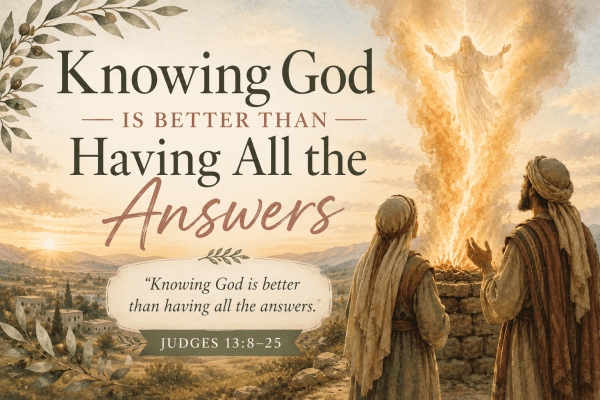
Knowing God Is Better Than Having All the Answers

Before We Dive In

You may notice some overlap between this study and the previous two Judges posts Iโ€™ve shared. Thatโ€™s intentional. In those studies, we looked at the broader movement of Judges 12โ€“13 and how the story points us forward to Christ. This time, I found myself lingering over a much smaller section of the textโ€”Judges 13:8โ€“25โ€”and discovering a lesson I wasnโ€™t ready to move past.

Sometimes Scripture is like that. We read a passage once and see the big picture. Then we come back and find the Lord gently pressing a particular truth deeper into our hearts. For me, that truth was this: knowing God is better than having all the answers.

So if some of these verses feel familiar, I hope youโ€™ll slow down with me and look again. Godโ€™s Word always has more to show us.

And perhaps thatโ€™s one of the greatest gifts of studying Scripture slowly. We donโ€™t simply gather more informationโ€”we come to know the Author more deeply. As always, my prayer is that through this study we would learn to behold Him, not ourselves, trusting that His character is enough even when we donโ€™t have all the answers.

Judges 13:8โ€“25

As I studied Judges 13 this week, I found myself identifying with Samsonโ€™s father, Manoah.

After hearing that his barren wife would bear a son, Manoah prayed:

โ€œPlease, Lord, let the man of God you sent to us come again to teach us how to bring up the boy who is to be born.โ€ (Judges 13:8)

His request is deeply relatable. He wants clarity, direction, and a plan for the future God has placed in his hands.

Iโ€™ve prayed the same way countless times.

As the mother of a son with autism, I have often asked God for guidance. Should I pursue this therapy or that one? Should I homeschool or choose public school? What does faithfulness look like in this situation?

If God would simply make the path clear, I would gladly follow it.

But Judges 13 reveals a better gift. The central lesson of Manoahโ€™s story is this:

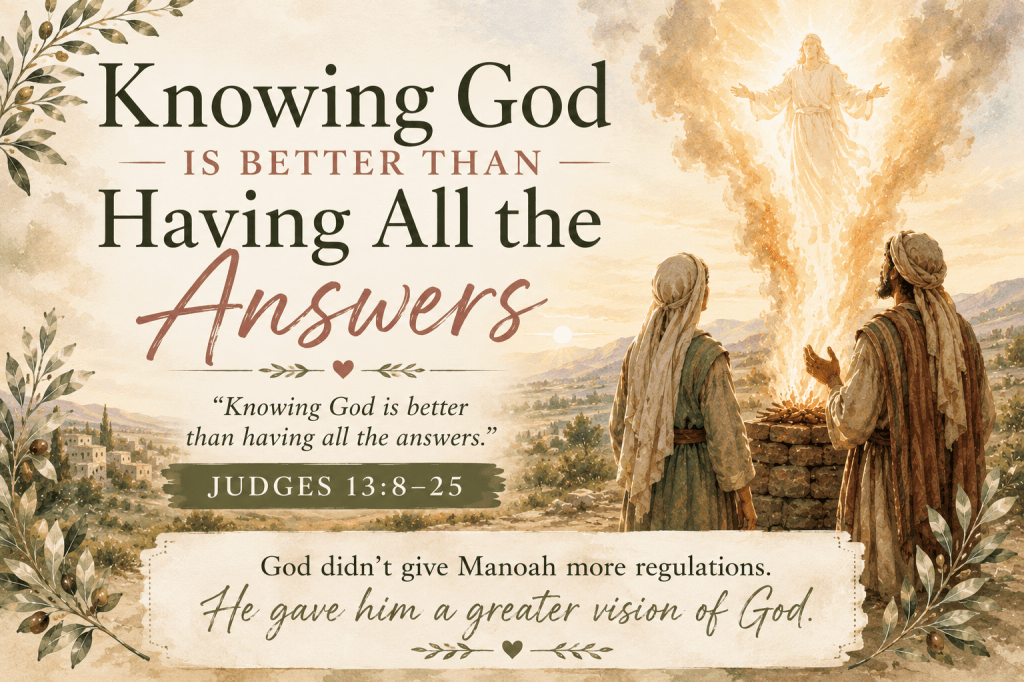
Knowing God is better than having all the answers.

Manoah asks for guidance, yet God gives him something deeperโ€”a greater revelation of Himself. And that is often how God works in our lives as well.

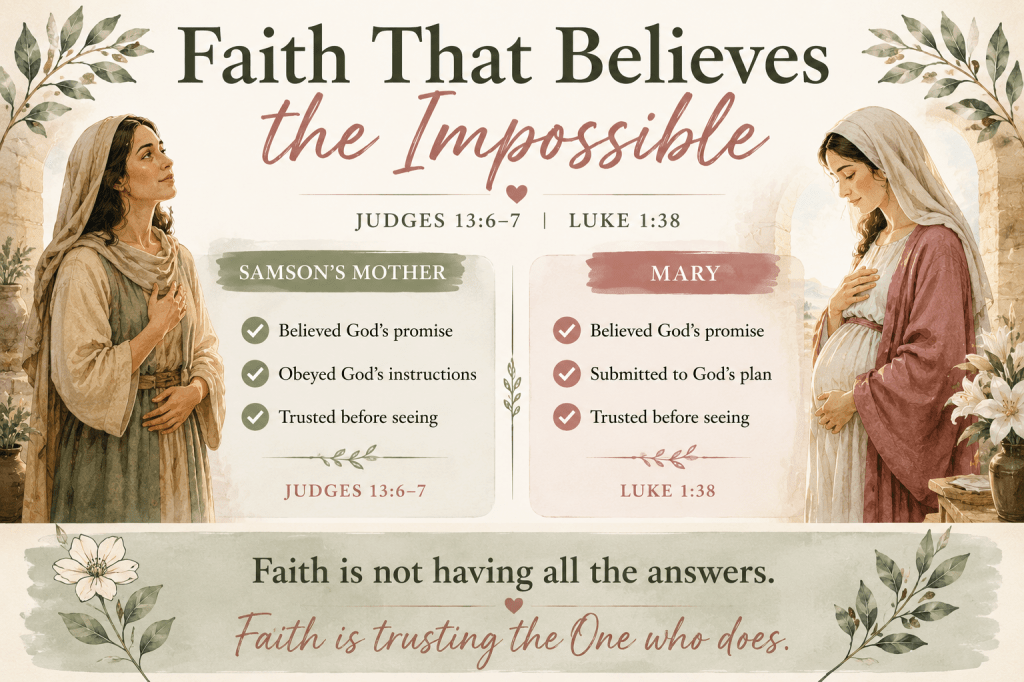
Faith That Believes the Impossible

Before we look at Manoah, we must first notice the remarkable faith of Samsonโ€™s mother.

When the angel of the Lord appeared and announced that she would conceive and bear a son, she simply believed.

There is no recorded laughter as there was with Sarah when she heard she would bear Isaac in her old age (Genesis 18:9โ€“15).

There is no disbelief like Zechariah displayed when he learned John the Baptist would be born (Luke 1:13โ€“20).

Instead, Samsonโ€™s mother receives Godโ€™s word with faith:

โ€œA man of God came to me. He looked like an angel of God, very awesome.โ€ (Judges 13:6)

She believed the promise before she saw the fulfillment.

In this way, she reminds us of another woman who would receive impossible news more than a thousand years later.

When Gabriel announced the coming birth of Jesus, Mary responded:

โ€œMay it be to me as you have said.โ€ (Luke 1:38)

Both women trusted Godโ€™s promises.

Both women submitted themselves to Godโ€™s purposes.

Both women accepted personal cost in order to participate in Godโ€™s plan.

Samsonโ€™s mother embraced the Nazarite restrictions required during her pregnancy. Mary embraced the shame and misunderstanding that would accompany an unwed pregnancy.

Both women demonstrate that faith is not merely believing God can do the impossibleโ€”it is willingly placing ourselves at His disposal.

Manoahโ€™s Request

Unlike his wife, Manoah has questions.

And honestly, I appreciate that.

His response feels very human.

Notice that he doesnโ€™t ask whether Godโ€™s promise is true.

He assumes the child will come.

His request is not for proof but for guidance.

He wants to know:

โ€œWhat is to be the rule for the boyโ€™s life and work?โ€ (Judges 13:12)

How do we raise him?

What should we do?

What rules should we follow?

Again, I find myself nodding along.

As parents, we want certainty.

We want formulas.

We want detailed instructions.

We want guarantees.

Yet when the angel returns, something surprising happens.

He doesnโ€™t provide much new information at all.

The child will be a Nazarite.

Manoahโ€™s wife must continue obeying what she has already been told.

Thatโ€™s essentially it.

No parenting manual.

No detailed roadmap.

No step-by-step guide.

Why?

The Help Manoah Wanted Versus the Help He Needed

At first it seems like God ignored Manoahโ€™s request.

But He didnโ€™t.

God answered the prayer.

Just not in the way Manoah expected.

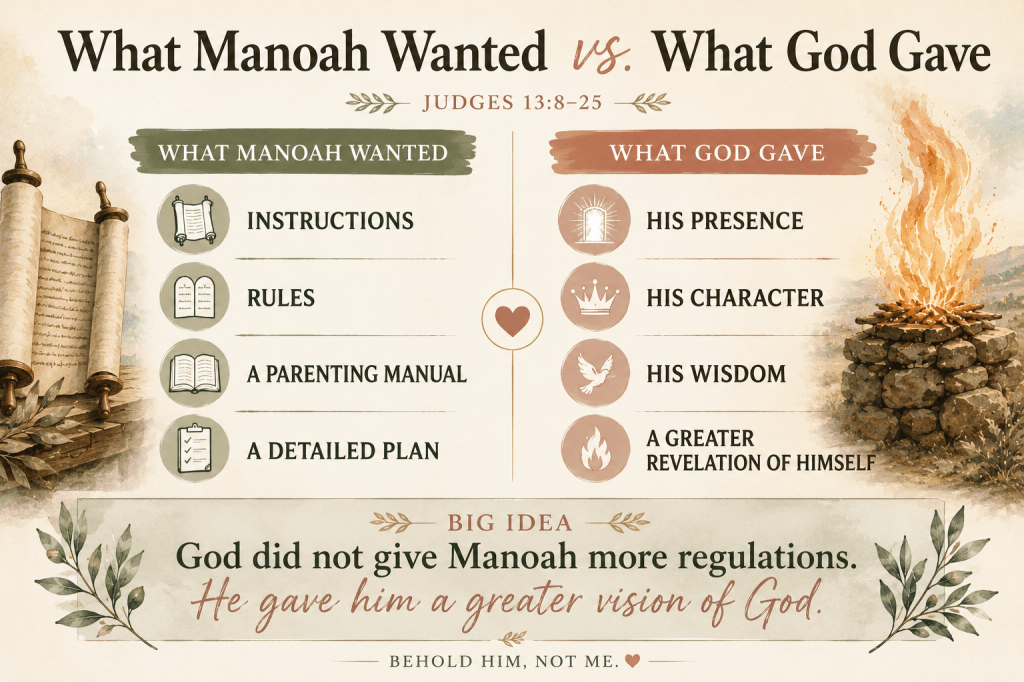
Manoah wanted information.

God gave revelation.

Manoah wanted rules.

God revealed His character.

Manoah wanted to know what to do.

God showed him who He was.

When Manoah asks the angelโ€™s name, the angel responds:

โ€œWhy do you ask my name? It is beyond understanding.โ€ (Judges 13:18)

Then the angel ascends into heaven in the flame of the sacrifice.

Suddenly Manoah realizes this was no ordinary visitor.

This was a divine encounter.

The angel of the Lord had come not merely to deliver information but to reveal Godโ€™s greatness.

That was the help Manoah truly needed.

And perhaps it is the help we need as well.

The Lesson I Keep Learning

This part of the story stopped me in my tracks.

Because I often approach God exactly the way Manoah did.

I want clarity.

I want confidence for the next step.

I want God to show me how to move forward.

As the mother of a child with autism, I have cried out to God with questions similar to Manoahโ€™s.

But Godโ€™s silence has not really been silence.

Like Manoah, I often discover that God is answering a deeper question than the one I am asking.

He is teaching me His character.

His goodness.

His faithfulness.

His wisdom.

His sovereignty.

Because the truth is this:

Knowing God is better than having all the answers.

No set of instructions can prepare us for every decision we will face.

Only a deep understanding of who God is can guide us through the countless twists and turns of life.

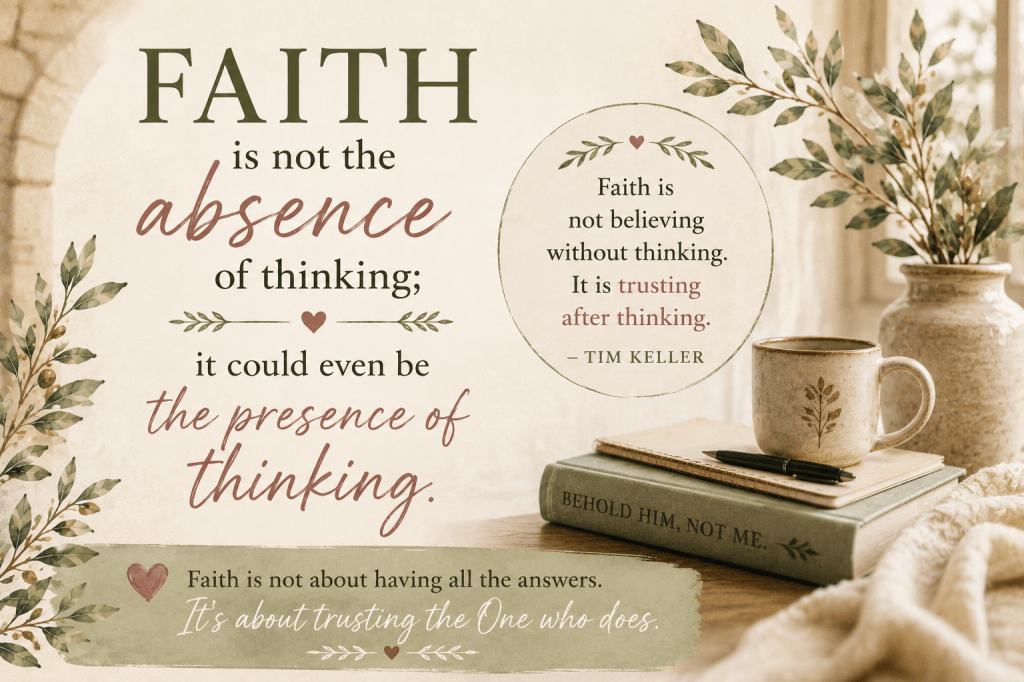
Faith Is Not the Absence of Thinking

After Manoah panics and assumes they are about to die because they have seen God, it is his wife who calmly reasons through the situation:

โ€œIf the Lord had meant to kill us, he would not have accepted a burnt offering and grain offering from our hands.โ€ (Judges 13:23)

Her response beautifully illustrates what Tim Keller wrote:

โ€œFaith is not the absence of thinking. It is thinking and acting on the basis of the Word and promises of God.โ€

She reflects on what God has already revealed.

She reasons from His character.

She trusts His promises.

That is biblical faith.

Not blind optimism.

Not wishful thinking.

But confidence rooted in who God is.

We Need God More Than More Rules

Tim Keller points out that mature relationships require fewer external rules and more internal wisdom.

Young children need constant instructions:

Donโ€™t touch that.

Donโ€™t go there.

Donโ€™t do this.

But as children mature, parents desire them to internalize wisdom and values so they can make good decisions even when specific instructions are absent.

The same is true spiritually.

Many Christians imagine Old Testament believers had a better system because they received more regulations.

Yet under the New Covenant, we have something far greater.

We have the Holy Spirit.

Paul writes:

โ€œBe transformed by the renewing of your mind.โ€ (Romans 12:2)

And:

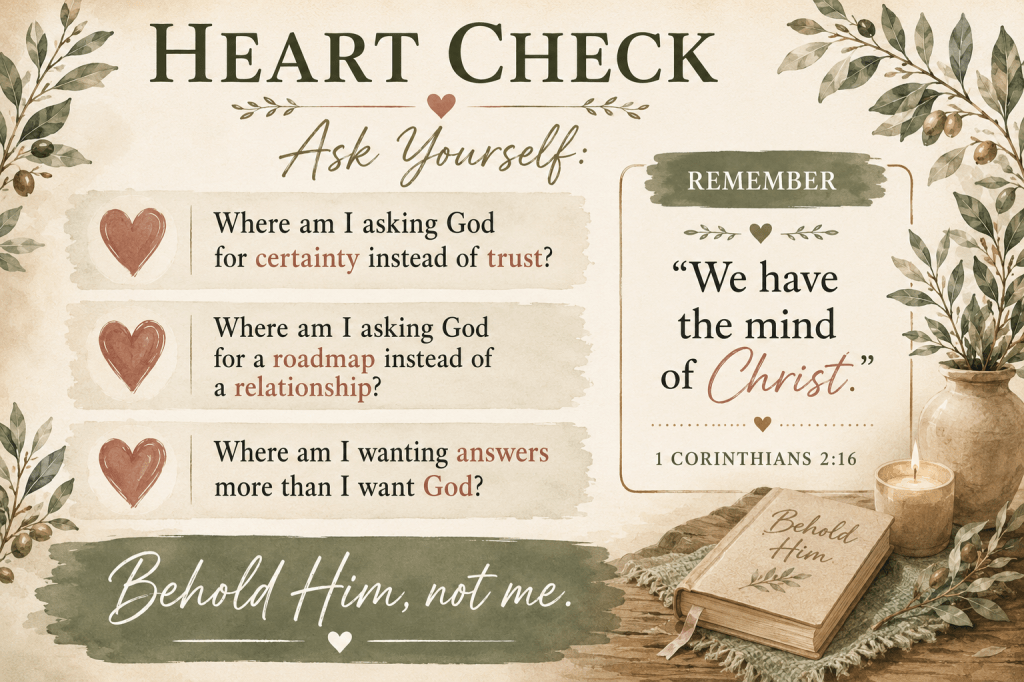
โ€œWe have the mind of Christ.โ€ (1 Corinthians 2:16)

Rather than endless prescriptions, God gives us Himself.

Rather than merely telling us what to do, He transforms who we are.

What Manoah needed most was not more regulations.

It was a greater vision of God.

And the same is true for us.

Samsonโ€™s Birth and Our Need for a Greater Savior

Finally, just as God promised, Samson is born.

The promise was never in doubt because it rested on Godโ€™s word.

The child grows.

God blesses him.

The Spirit begins to stir within him.

Everything appears poised for success.

If anyone ever had spiritual advantages, it was Samson.

Miraculous birth.

Divine calling.

Godโ€™s blessing.

The Spiritโ€™s power.

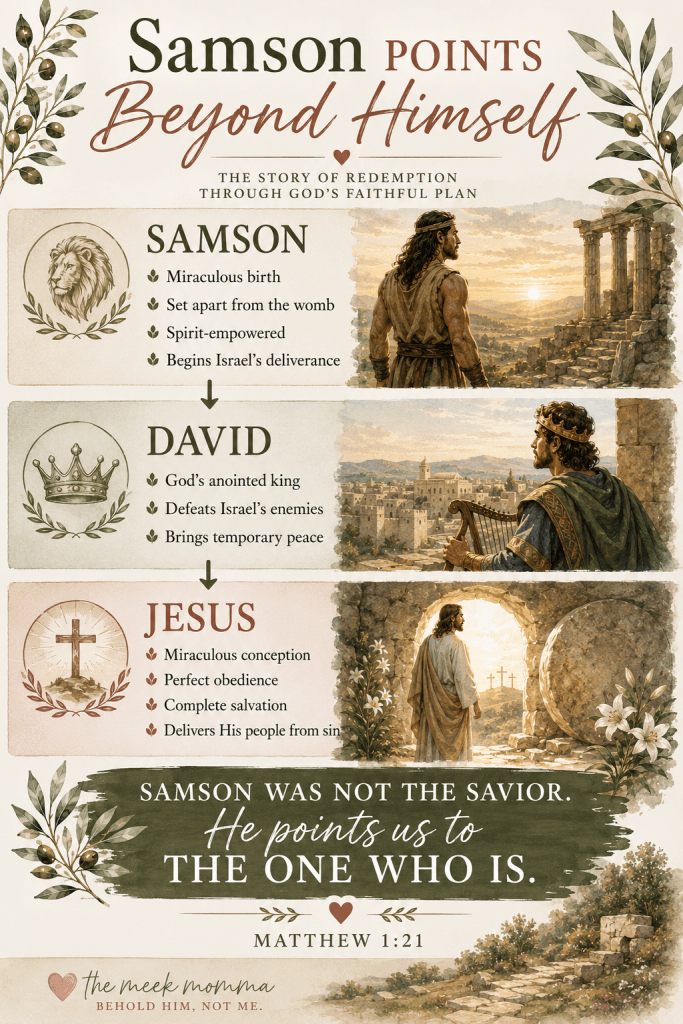
Yet as we continue through Judges, we will discover that Samson is not the Savior Israel needs.

He will disappoint us.

His flaws will become painfully evident.

And that disappointment is intentional.

Because Samson was never meant to be the final Deliverer.

He points beyond himself.

To David.

And beyond David.

To Jesus Christ.

The One who would perfectly obey.

The One who would perfectly trust.

The One who would perfectly save.

Heart Check

As I closed my Bible, one question lingered in my heart:

In what areas of my life would I rather have answers than God Himself?

Where am I asking for certainty instead of trust?

Where am I asking for a roadmap instead of a relationship?

Like Manoah, we often think we need more information.

But God knows what we truly need.

We need Him.

His character.

His wisdom.

His presence.

His promises.

Because in the end:

Knowing God is better than having all the answers.

Behold Him, not me.

When Broken People Read Scripture Wrong: Jephthah, Grace, and Learning to Read the Bible Carefully

There is something both comforting and deeply unsettling about the story of Jephthah in Judges 10โ€“11.

Comforting, because God uses a rejected and broken man.
Unsettling, because that same man carries distorted beliefs about God that lead to devastating consequences.

For many women learning to study Scripture faithfully โ€” especially young mothers, homeschool moms, women rebuilding after hardship, or believers new to the faith โ€” Jephthahโ€™s story becomes more than history. It becomes a mirror.

Because one of the hardest truths to learn as Christians is this:

We can know some truth about God while still misunderstanding Him deeply in other places.

And if we are not careful readers of Scripture, we can begin mixing biblical truth with cultural assumptions, personal wounds, fear, and worldly thinking.

That is exactly what happens in the life of Jephthah.


God Raises an Unlikely Savior

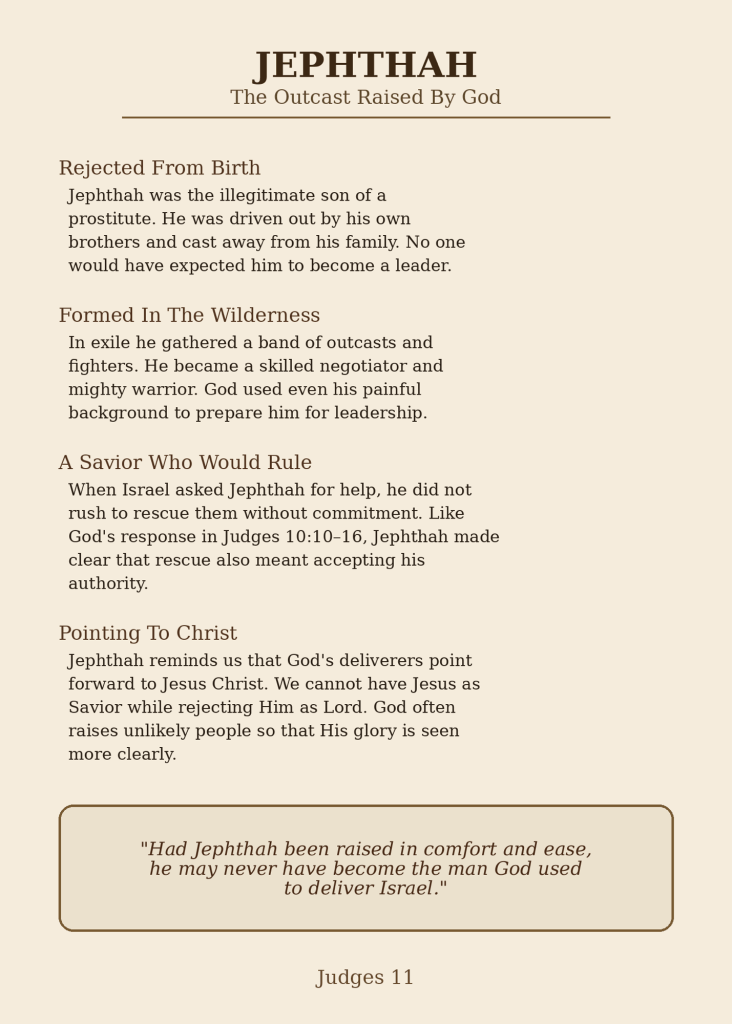
Jephthah is introduced in Judges 11 as a mighty warrior. But immediately we are told something painful about him:

He was the son of a prostitute.

His half-brothers drove him away from the family home, rejecting him and cutting him off from inheritance and belonging. He grew up as an outcast, living in the wilderness surrounded by what Scripture calls โ€œworthless fellowsโ€ โ€” essentially a band of violent men and raiders.

Humanly speaking, Jephthah is not the kind of man anyone would expect God to use.

And yet God does.

This is one of the repeated themes throughout the book of Judges: God continually rescues His people through deeply flawed deliverers.

Why?

Because the judges were never meant to be ultimate saviors. They were shadows pointing forward to the true Savior still to come โ€” Jesus Christ.

Jephthahโ€™s rejection points us toward Christ, who was also rejected by His own people.
Jephthahโ€™s suffering prepared him to lead hurting people.
His strength in battle reflected Israelโ€™s need for deliverance.

But unlike Jesus, Jephthah was deeply sinful and spiritually confused.

And Scripture does not hide that from us.

Character Profile

Learning Context Matters

One of the biggest mistakes new believers often make when reading the Bible is assuming that because the Bible describes something, God therefore approves of it.

But biblical narrative does not always equal biblical endorsement.

The book of Judges especially shows us what life looks like when โ€œeveryone did what was right in his own eyesโ€ (Judges 21:25).

The stories become darker and darker intentionally.

Judges is not simply recording heroic stories. It is showing the spiritual collapse of Israel when people drift from Godโ€™s Word.

That context matters tremendously when reading Jephthahโ€™s tragic vow.


Jephthahโ€™s Strength โ€” and His Blindness

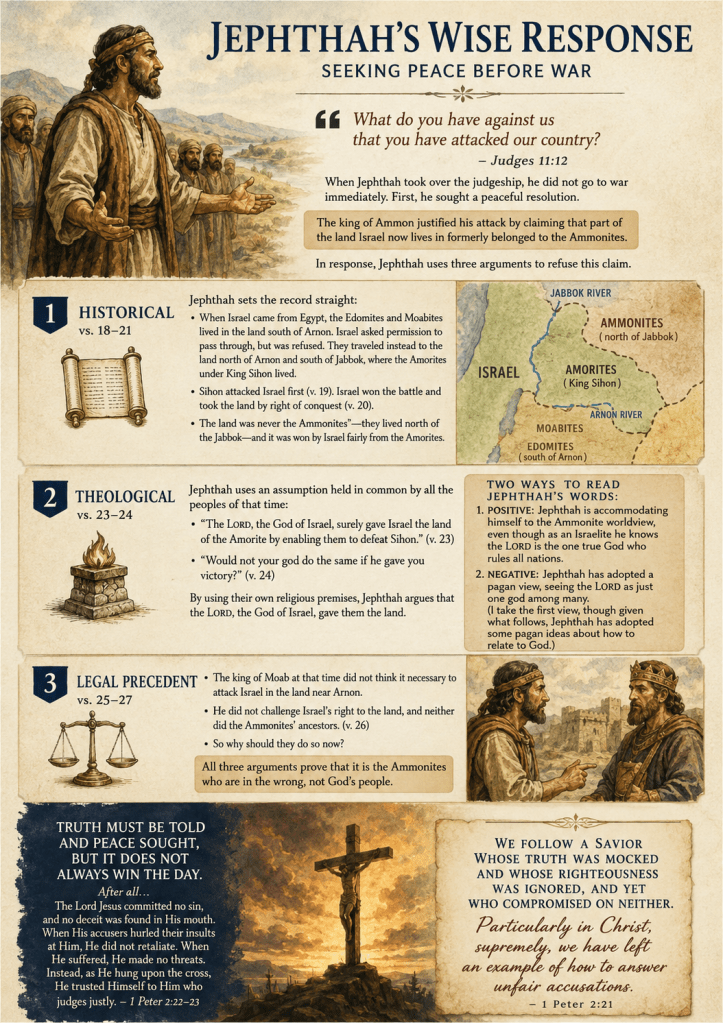
Before battle with the Ammonites, Jephthah actually shows surprising wisdom.

Instead of immediately rushing into war, he first pursues peace. He sends messengers, reasons carefully through Israelโ€™s history, and presents legal, theological, and historical arguments explaining why the Ammonites are in the wrong.

This matters because it shows Jephthah was not merely a reckless brute. He understood leadership, diplomacy, and negotiation.

God had even shaped his painful background into useful strength.

His suffering formed resilience.
His exile formed toughness.
His wilderness years formed leadership.

Sometimes the hardest parts of our lives become the very places God uses most powerfully.

But giftedness is not the same thing as spiritual maturity.

And this is where careful Bible reading becomes so important.

Because right after displaying wisdom, Jephthah makes one of the most horrific vows in all of Scripture.

Judges 11 study notes

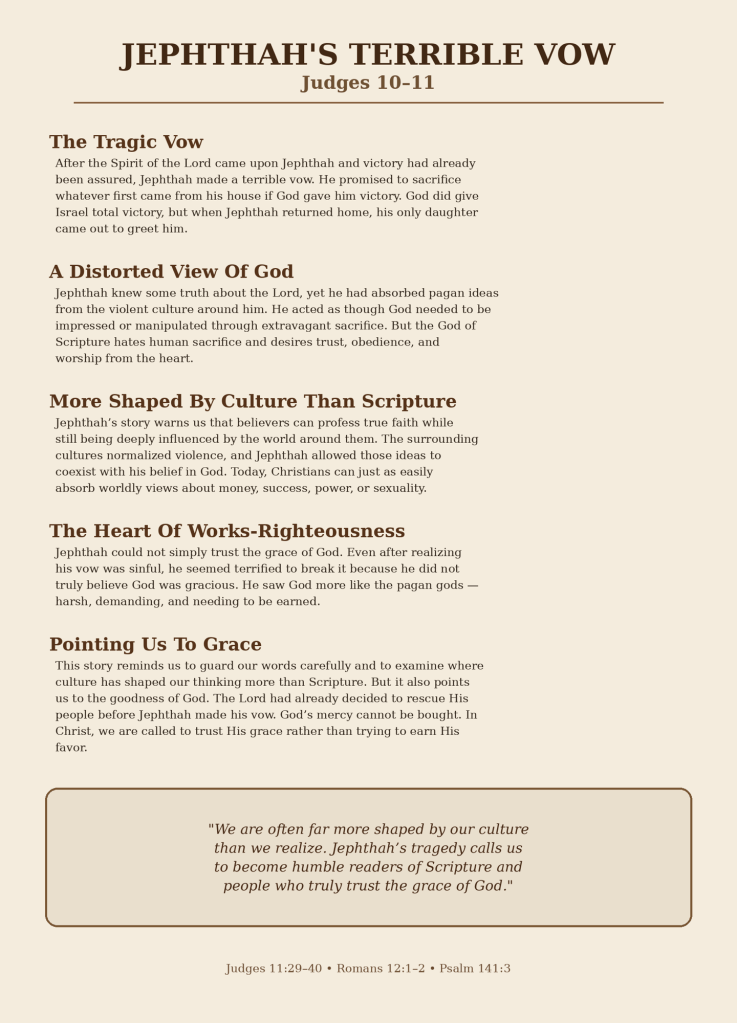
The Terrible Vow

Judges 11:29 says:

โ€œThen the Spirit of the Lord was upon Jephthahโ€ฆโ€

That detail matters.

God had already determined to give victory.

The outcome was never dependent on Jephthah bargaining with God.

Yet Jephthah vows that if God gives him victory, he will sacrifice whatever first comes from his house upon returning home.

And tragically, his daughter comes out first.

This is one of the moments where Christians must slow down and read carefully.

Some try to soften the text into something symbolic. Others suggest his daughter was merely devoted to lifelong service.

But the passage itself points toward something far darker and more tragic.

Why would Jephthah even make such a vow?

Because although he knew about God, he still thought about God in many pagan ways.

Study Notes Continued

When We Mix God With The World

The surrounding pagan cultures practiced human sacrifice. Their gods were viewed as beings who had to be manipulated, impressed, or bribed through extravagant offerings.

Jephthah had absorbed some of that thinking.

And if we are honest, we often do the same thing.

Not usually through violence or sacrifice โ€” but through worldly beliefs about success, beauty, money, relationships, motherhood, control, or worth.

We often say we believe graceโ€ฆ

Yet live as though Godโ€™s love must constantly be earned.

We assume:

  • God will love us more if we perform better.
  • God is pleased only when we are productive.
  • Godโ€™s blessing depends entirely on our perfection.
  • Rest must be earned.
  • Weakness disqualifies us.

That is not the gospel.

And that is why studying Scripture carefully matters.

Because if we are not rooted deeply in Godโ€™s Word, culture will disciple us instead.

Romans 12:2 warns:

โ€œDo not be conformed to this world, but be transformed by the renewal of your mind.โ€

Jephthahโ€™s tragedy is not merely that he made a foolish vow.

It is that he fundamentally misunderstood the character of God.


Grace Is Harder To Believe Than Rules

Perhaps the saddest part of the story is this:

Even after realizing the horror of his vow, Jephthah still seems unable to trust Godโ€™s mercy enough to repent and stop.

Why?

Because he does not truly understand grace.

He seems trapped by fear โ€” believing God must be appeased rather than trusted.

And honestly, many believers live there too.

Grace feels unsafe to us.

We would often rather manage God through rules than trust Him relationally.

But the gospel tells us something radically different:

Godโ€™s favor cannot be bought.

The Father already decided to rescue His people long before Jephthah made his vow. Likewise, Christ came for sinners before we cleaned ourselves up.

Jesus is the better Judge.

Where Jephthah sacrificed his daughter because of his sinful misunderstanding, God the Father willingly gave His own Son out of perfect love and perfect wisdom to save sinners.

One sacrifice brought death through human sin.
The other brought life through divine grace.


How Do We Read Scripture Faithfully?

Stories like this teach us several important principles for Bible study:

1. Read passages in context

Never isolate verses from the larger story of Scripture.

2. Distinguish description from approval

The Bible often records sinful actions honestly without endorsing them.

3. Let clearer passages interpret difficult ones

Scripture already clearly condemns human sacrifice elsewhere.

4. Study Godโ€™s character across the whole Bible

One distorted view of God can shape an entire life wrongly.

5. Read humbly

Every culture has blind spots. We need Scripture constantly correcting us.


A Final Encouragement For Christian Women

If you are new to studying Scripture, please do not be discouraged by difficult passages like this.

Lean into them.

Some of the deepest growth happens when we slow down, ask questions, study context, and allow Scripture to reshape how we think about God.

The goal of Bible study is not merely gathering information.

It is learning to know the Lord rightly.

And that matters because what we believe about God shapes everything:

  • how we mother,
  • how we endure suffering,
  • how we handle failure,
  • how we rest,
  • how we repent,
  • and how we love others.

Jephthahโ€™s story is tragic.

But even tragedies in Scripture are gracious warnings meant to draw us closer to the true Savior โ€” the One who does not manipulate, crush, or abandon His people, but lovingly redeems them through grace.

Bible Study Principles

When Success Becomes More Dangerous Than Failure

Lessons from Gideon for Christian Women Seeking Faithfulness

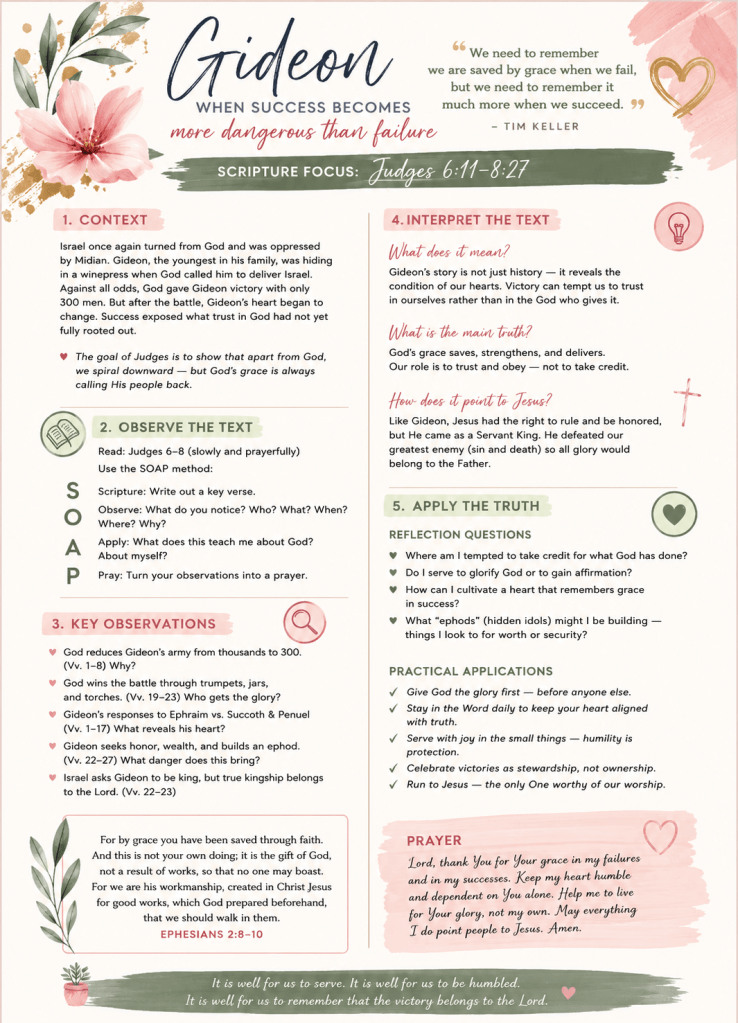
โ€œWe need to remember we are saved by grace when we fail, but we need to remember it much more when we succeed.โ€ โ€” Tim Keller

The last few days in my verse-by-verse study through the book of Book of Judges have pressed this truth deeply into my heart.

When we think of spiritual danger, we often think of failure. Falling into sin. Wandering from God. Seasons of weakness. But Gideonโ€™s story reminds us that success may actually be the greater threat to our souls.

God Reduced the Army by 99%

When Gideon marched into battle against Midian, he did not go in strong.

He went in weak.

God intentionally reduced Gideonโ€™s army from thousands down to only 300 men. The Lord stripped away every earthly reason Israel could boast in themselves.

What power there is in that truth.

Imagine what God can do with one percent.

In the Book of Judges, chapter 7, the Israelites marched into battle not with military strength, but with trumpets, jars, and torches. And when the jars shattered and the trumpets sounded, the Lord caused the enemy camp to turn against itself.

The battle belonged entirely to God.

Gideon should have walked away from that battlefield saying:

โ€œThis victory was the Lordโ€™s. My role was simply to trust and obey.โ€

And honestly, I understand this personally.

Recently, in my own work advocating for vulnerable children and families, I found myself sitting at a table with attorneys, professionals, and a judge. I come from a background very different from many of my peers. I was raised in poverty and abuse. I do not have prestigious credentials or a polished rรฉsumรฉ.

What I do have is a testimony.

I know the power of God.

And when the Lord allows even a small victory in my work, I have to consciously preach the gospel back to myself:

โ€œThis did not come from me.โ€

God uses what is weak to shame what is strong.

At the end of our lunch together, everyone stood to leave, and there was an unspoken assumption that I would clean the table and bus the dishes.

The world would call that offensive.

Pride would say:
โ€œYou deserve more honor than this.โ€

But as I carried the dishes away, I sensed the quiet kindness of God reminding me:

โ€œThis is good for you.โ€

And truly, it was.

Because humility guards the heart in ways success never can.

Serving keeps us close to Christ.

Gideon Forgot What Grace Had Done

As we move into chapter 8, Gideon begins changing.

And the shift is subtle at first.

When the tribe of Ephraim complains that Gideon did not call them into battle sooner, Gideon answers diplomatically and gently. He calms their anger with humility.

At first glance, this looks godly.

But the next interaction reveals something deeper.

When the towns of Succoth and Penuel refuse to help Gideonโ€™s exhausted men, Gideon erupts in anger and vengeance. He threatens punishment. Later, after his victory, he returns and carries out brutal revenge against his own people.

Why the different response?

Because Ephraim wounded Gideonโ€™s pride gently.

Succoth and Penuel wounded it directly.

And suddenly we begin to see that Gideonโ€™s heart has shifted from dependence on God to dependence on his own honor.

The man who once hid in a winepress trembling now expects recognition.

The man who once begged God for reassurance now lashes out when others do not respect him.

Success revealed what was already growing in Gideonโ€™s heart.

The Danger of Spiritual Success

There is a terrible danger in success.

Not because success itself is sinful, but because our hearts are desperate to believe we earned it.

We begin by thanking God for the victory.

Then slowly we begin protecting our reputation.

Defending our influence.

Needing recognition.

Wanting respect.

And before long, we are no longer serving Godโ€™s kingdom.

We are building our own.

Gideon forgot that God called him.
God equipped him.
God reassured him.
God won the battle.

And sisters, we forget too.

We forget that every good work we do was prepared beforehand by God.

We forget that faithfulness itself is grace.

We forget that motherhood, ministry, leadership, hospitality, encouragement, advocacy, teaching, and service are not trophies we earned, but gifts we were entrusted with.

Ephesians 2:8-10

โ€œFor by grace you have been saved through faith. And this is not your own doing; it is the gift of God, not a result of works, so that no one may boast.โ€

Key Takeaways

We Still Build Ephods

One of the saddest moments in Gideonโ€™s story comes after he refuses kingship.

Outwardly, Gideon says the right thing:

โ€œThe Lord will rule over you.โ€

But immediately afterward, Gideon begins living like a king anyway.

He gathers wealth.
He elevates himself.
He creates an ephod that becomes a snare to Israel.

In other words:
he rejected the title while embracing the glory.

And if we are honest, we often do the same.

We say:
โ€œAll glory to God.โ€

But inwardly we crave recognition.

We want to be the one people admire.
The one people need.
The one people look to for answers.

Ministry can quietly become self-salvation.

Motherhood can become identity worship.

Even serving others can become another way of trying to prove our worth.

We still build ephods.

Look to the Better Judge

But Gideon was never meant to be the final deliverer.

Like every judge in Scripture, he points us forward to a better Savior:
Jesus Christ.

Unlike Gideon, Jesus did not use His authority to demand honor.

Though He was King, He came as a servant.

Though He deserved glory, He washed feet.

Though He had every right to be exalted, He humbled Himself to death on a cross.

Jesus Christ did not come to be served, but to serve and give His life as a ransom for many.

And because of that, we are finally free.

Free from needing applause.
Free from proving ourselves.
Free from being crushed by failure.
Free from becoming intoxicated by success.

The gospel liberates us from both pride and despair.

A Final Encouragement

Friend, maybe God has recently given you victory in some area of life.

Maybe your marriage is flourishing.
Maybe ministry is growing.
Maybe motherhood feels fruitful.
Maybe people are finally recognizing your gifts.

Praise God for those things! Success can either deepen worship or feed self-glory.

It is well for us to serve.
It is well for us to be humbled.
It is well for us to remember that we are creatures, not the Creator.

So today, ask yourself:

  1. Are there areas of my life where I am subtly seeking honor that belongs to God alone?
  2. And how does the servant-heartedness of Christ free me from turning success into self-salvation?

May we never forget:
the victory belongs to the Lord.

When We Let the Text Speak: Deborah, Barak, and the Importance of Faithful Hermeneutics

There is something both humbling and beautiful about coming to Scripture only to realize we may have been reading our assumptions into the text all along.

Recently, while studying Judges 4 and 5, I found myself doing exactly that.

For years, I had heard โ€” and repeated โ€” the common interpretation that Deborah had to step into leadership because Barak was weak, fearful, or unwilling to obey God without her. It is such a common conclusion that many of us barely stop to ask whether the text itself actually says that.

But when I slowed down, prayed, studied carefully, compared translations, looked into the original language, considered the historical context, and read the surrounding passages alongside Hebrews 11, I realized something important:

The text never explicitly says Barak lacked faith.

In fact, Hebrews 11 includes Barak among those commended for their faith.

That realization forced me to pause and ask a difficult but necessary question:

Had I allowed cultural assumptions and familiar commentary to speak louder than the actual words of Scripture?

Deborah Was Not an Emergency Substitute

One of the most striking observations in Judges 4 is that Deborah is already introduced as a leader before Barak even appears in the narrative.

Judges 4:4 identifies Deborah as both a prophetess and a judge in Israel. She was not functioning as a temporary stand-in because no man was available. Scripture presents her as someone God Himself had raised up and appointed.

She held court under the palm of Deborah, where the people of Israel came to her for judgment and counsel. This was not a queenโ€™s throne, but a courtroom. Israel trusted her wisdom, discernment, and leadership.

Unlike many of the judges before and after her, Deborah did not primarily lead through military strength or physical might. She led through wisdom, discernment, character, and faithful proclamation of Godโ€™s Word.

We see this clearly in Judges 4:6 when she tells Barak:

โ€œThe Lord, the God of Israel, commands youโ€ฆโ€

As a prophetess, Deborah faithfully declared the Word of God. She counseled, guided, and judged the people. In many ways, she comes closer than any judge before the monarchy to modeling a ruler who shepherds with wisdom and righteousness.

Deborahโ€™s role should not be minimized simply because Barak also played a role in Godโ€™s deliverance.

The text honors both.

The Danger of Bringing Assumptions Into Scripture

As women especially, I think many of us have been quick to frame Deborahโ€™s story as proof that she only led because Barak failed.

But that interpretation may reveal more about our assumptions than about the text itself.

When Barak tells Deborah in Judges 4:8:

โ€œIf you will go with me, I will go, but if you will not go with me, I will not go,โ€

many immediately read cowardice or disobedience into his response.

And certainly, some respected commentators understand the passage that way.

But others note that Deborahโ€™s response in verse 9 can also be translated differently. Rather than being a rebuke, it may simply be a prophetic statement that the honor for Siseraโ€™s defeat would ultimately go to a woman.

That distinction matters.

Because if Barak is not being rebuked, then his request for Deborahโ€™s presence may actually demonstrate faith rather than unbelief.

After all, why would he not want the Lordโ€™s prophet with him as he marched into battle against overwhelming odds?

Hebrews 11 forced me to wrestle honestly with this possibility. Scripture itself commends Barakโ€™s faith. That means we should be careful not to build an interpretation that ultimately contradicts the broader testimony of Godโ€™s Word.

Faithful Hermeneutics Requires Humility

This study reminded me how important good hermeneutics truly are.

Hermeneutics simply means the way we interpret Scripture.

It means asking questions of the text instead of assuming we already know the answers. It means studying passages in context. It means comparing Scripture with Scripture. It means considering grammar, historical background, original language, genre, and surrounding passages. Most importantly, it means approaching Godโ€™s Word prayerfully and humbly, willing to be corrected.

So often we come to the Bible looking for confirmation instead of truth.

We read through lenses shaped by culture, church traditions, personal experiences, social media discussions, or popular teaching. Sometimes we inherit interpretations we have never personally examined.

But faithful Bible study requires us to slow down enough to let the text speak for itself.

Not forcing Scripture to fit our narrative.

Not reading motives into people that God Himself never states.

Not minimizing one person in order to elevate another.

Simply letting God say what He intended to say.

The Glory Ultimately Belongs to God

One of the most beautiful things about Judges 4 and 5 is that there is not just one human hero.

There is Deborah.
There is Barak.
There is Jael.

And yet Judges 5 makes clear where the true glory belongs.

To the Lord.

The Lord is the One who delivered Israel.

The Lord is the One who routed Sisera.

The Lord is the One who used ordinary people in different ways for His purposes.

Deborah ruled and counseled.
Barak obeyed and fought.
Jael struck the final blow.

But God alone secured the victory.

Isnโ€™t that often how the Lord works?

He delights in using different people with different gifts for the accomplishment of His purposes so that no single person can claim the glory for themselves.

A Final Encouragement

One of the greatest acts of spiritual maturity is allowing Scripture to challenge us.

Not defending our assumptions.
Not clinging to familiar interpretations.
Not reading quickly.
Not approaching Godโ€™s Word to prove a point.

But prayerfully opening the Bible and saying:

โ€œLord, help me see what is actually there.โ€

The more I study Scripture, the more I realize how dangerous it can be to approach the text with conclusions already in place.

Good hermeneutics is not cold academics.
It is an act of humility.

It is loving God enough to want His meaning more than our own opinions.

And sometimes, faithful study means being willing to say:

โ€œI may have gotten this wrong before.โ€

That is not weakness.

That is reverence for the Word of God.

When Convenience Replaces Obedience: A Lesson from Judges 1:28โ€“36

In Book of Judges 1:28โ€“36, we encounter a quiet but dangerous pattern in the life of Israelโ€”partial obedience. God had clearly commanded His people to drive out the inhabitants of the land. This wasnโ€™t arbitrary; it was for their protection, knowing their weakness and tendency to fall into idolatry.

But instead of fully obeying, the Israelites chose a different path.

Again and again, the text tells us they did not drive them out. Instead, they subjected the people to forced labor. From a human perspective, it made sense. It was efficient. Economically beneficial. Less costly. Less exhausting.

But it wasnโ€™t obedience.

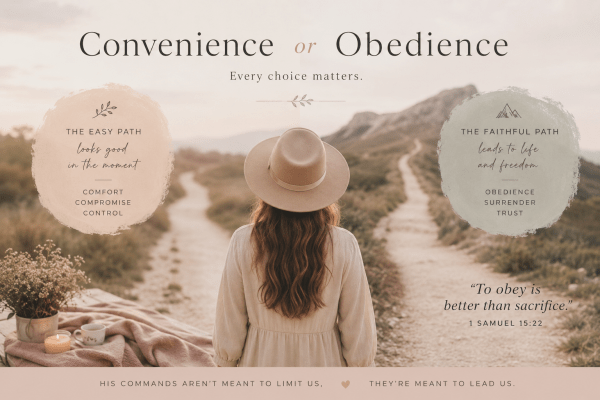
As Timothy Keller insightfully puts it, here we see that โ€œconvenience trumps obedience.โ€ What felt practical in the moment became a spiritual compromise with long-term consequences. The very people they allowed to remain would later become a snare.

Even more striking is what we read about the tribe of Dan. In Judges 1:34โ€“35, the Amorites pressed them back into the hill country. Thereโ€™s no indication that the enemy was stronger or better equipped. Instead, it appears they simply had greater resolve. Those who did not know God showed more determination than those who did.

That contrast should stop us in our tracks.


A Pattern Repeated Throughout Scripture

This isnโ€™t an isolated moment. Scripture repeatedly shows us the subtle drift from obedience to compromise.

Consider First Book of Samuel 15. God commands King Saul to completely destroy the Amalekites. Instead, Saul spares King Agag and keeps the best of the livestock. His justification? It would be used for sacrifice to the Lord.

It sounded spiritualโ€”but it was disobedience dressed up as worship.

The prophet Samuelโ€™s response is piercing: โ€œTo obey is better than sacrifice.โ€ (1 Samuel 15:22)

Saul chose what seemed reasonable over what God required.


Or look at Book of Genesis 3. Adam and Eve were given one commandโ€”do not eat from the tree. Yet when temptation came, the fruit appeared โ€œgood,โ€ โ€œpleasing,โ€ and โ€œdesirable.โ€ Convenience, desire, and reasoning overruled obedience.

The result? Separation, brokenness, and the entrance of sin into the world.


In Book of Numbers 20, Mosesโ€”faithful leader of Israelโ€”strikes the rock instead of speaking to it as God commanded. It may have seemed like a small deviation, especially under pressure. But partial obedience is still disobedience. Even Moses experienced the consequence of not fully honoring Godโ€™s instruction.


And in the New Testament, we see a powerful example in Acts of the Apostles 5. Ananias and Sapphira sell property but secretly withhold part of the proceeds while presenting it as the full amount. Their sin wasnโ€™t in keeping someโ€”it was in the deception. They wanted the appearance of obedience without the cost of it.


The Danger of โ€œAlmostโ€

What ties these accounts together is not outright rebellion, but something more subtleโ€”almost obedience.

  • Israel didnโ€™t reject Godโ€”they just didnโ€™t go all the way.
  • Saul didnโ€™t ignore Godโ€”he adjusted the command.
  • Adam and Eve didnโ€™t abandon Godโ€”they doubted His word.
  • Moses didnโ€™t defy God publiclyโ€”he altered the method.
  • Ananias and Sapphira didnโ€™t refuse to giveโ€”they pretended to give fully.

In each case, convenience, reasoning, fear, or desire quietly replaced trust-filled obedience.

And the consequences were never small.


A Call to Examine Our Own Hearts

The truth is, weโ€™re not so different.

We may not be conquering lands or ruling nations, but we face daily choices where obedience to God conflicts with what is easier, faster, or more comfortable.

  • Choosing silence instead of speaking truth.
  • Prioritizing comfort over calling.
  • Justifying small compromises because they โ€œmake sense.โ€
  • Trusting our logic over Godโ€™s Word.

Like Israel, we can convince ourselves that partial obedience is enough.

But God doesnโ€™t call us to what is convenientโ€”He calls us to what is faithful.


Obedience Requires Dependence

Judges 1 reminds us of something critical: Godโ€™s commands are not given because we are strong enough, but because He is faithful enough.

Israelโ€™s failure wasnโ€™t just militaryโ€”it was spiritual. They relied on their own reasoning instead of Godโ€™s power.

And weโ€™re prone to do the same.

True obedience flows from dependence. It says:

  • God, Your way is betterโ€”even when itโ€™s harder.
  • Your wisdom is greaterโ€”even when I donโ€™t understand.
  • Your commands are for my goodโ€”even when they cost me something.

Final Reflection

Where in your life has convenience quietly replaced obedience?

Where have you settled for โ€œalmostโ€ instead of fully trusting God?

The call of Scripture is clear: not partial obedience, not delayed obedience, not convenient obedienceโ€”but wholehearted, faithful surrender.

Because in the end, obedience isnโ€™t about restrictionโ€”itโ€™s about trust.

And trust in God is never misplaced.

When You Forget Who God Is: A Gentle Return to Psalm 103

There are days when faith feels steadyโ€ฆ and days when it feels like itโ€™s slipping through your fingers.

Maybe itโ€™s the exhaustion of motherhood.
Maybe itโ€™s the weight of unanswered prayers.
Maybe itโ€™s just the quiet doubt that creeps in when life doesnโ€™t look how you thought it would.

And in those moments, we donโ€™t just need encouragementโ€”we need truth.

Thatโ€™s exactly where Psalm 103 meets us.

More Than Forgiveness

In verses 3โ€“5, weโ€™re given a breathtaking picture of Godโ€™s heart:

He forgivesโ€”yes.
But He doesnโ€™t stop there.

He redeems your life from the pit.
He restores what feels broken.
He crowns you with steadfast love and mercy.

God is not doing the bare minimum in your life. He is abundantly, intentionally caring for youโ€”even in ways you donโ€™t yet see.

Who God Is (Even When Life Feels Uncertain)

As the psalm continues, weโ€™re reminded of truths that donโ€™t shift with our circumstances:

  • God is patient by nature (v. 8)
  • He does not treat us as our sins deserve (v. 10)
  • His forgiveness is complete and final (v. 12)
  • His compassion is relational, not distant (v. 13)
  • He knows your weakness (v. 14)
  • His mercy is continuous, not temporary (v. 17)
  • His love is covenant loveโ€”steady, committed, unbreaking

This is who God isโ€”not just on your good days, but on your worst ones too.

Worship Isnโ€™t Built on Feelings

Hereโ€™s where this psalm gently corrects us:

Worship is not emotional firstโ€”itโ€™s theological first.

We donโ€™t worship because we feel close to God.
We worship because He is worthy, whether our feelings cooperate or not.

That truth is freeing.

Because if worship depended on our emotions, weโ€™d all fall short. But it doesnโ€™tโ€”it rests on the unchanging character of God.

The God Who Never Changes

Psalm 103 intentionally echoes Exodus 34:6โ€“7, where God declares His own nature:

โ€œThe Lord, the Lord, a God merciful and gracious, slow to anger, and abounding in steadfast loveโ€ฆโ€

What God proclaimed about Himself thenโ€”His people experienced as true.

And itโ€™s still true today.

He has not changed.
Not in your waiting.
Not in your struggles.
Not in your questions.

The Reality We Canโ€™t Ignore

This psalm doesnโ€™t ignore hard truths:

Sin is real.
Judgment is deserved.
Redemption is costly.
Mercy is intentional.

And yetโ€”God chose mercy.

He chose to redeem.
He chose to love.
He chose you.

Oh, How You Are Loved

If you walk away with anything today, let it be this:

You are not held together by your ability to โ€œget it right.โ€
You are held by a God whose love is steadfast, patient, and unchanging.

So when your feelings waverโ€ฆ
When your strength feels thinโ€ฆ
When you forget who He isโ€ฆ

Come back to Psalm 103.

And remember:

Oh, how you are loved.

Word Study: Disciple

In Gospel of Mark 3:13โ€“14, we see something powerful about what it means to follow Jesus: He calls, and then He draws near. โ€œHe appointed twelveโ€ฆ so that they might be with Him and He might send them out to preach.โ€

Before anything elseโ€”before ministry, impact, or influenceโ€”there was presence. They were chosen to be with Him.

The word โ€œdiscipleโ€ comes from the Greek mathetes, meaning learner or studentโ€”someone shaped not just by what a teacher says, but by how they live. Interestingly, while followers of Jesus are called โ€œChristiansโ€ only a few times and โ€œbelieversโ€ a bit more, the word disciple appears over 200 times in Scripture. That repetition matters.

Key verses include: Matthew 28:19, John 8:31, Luke 14:27

Strongโ€™s Number: G3101

A disciple isnโ€™t just someone who believesโ€”itโ€™s someone who follows closely, learns deeply, and is formed daily.

And hereโ€™s the tension: we are all being discipled by something. What we give our time, attention, and affection to is quietly shaping who we become.

Jesus shows us the order clearly:
proximity comes before productivity.

So the question isnโ€™t just what are you doing for Christ?
Itโ€™s are you with Him?

What might it look like today to sit with Him a little longer, listen a little closer, and follow a little more intentionally?

Thatโ€™s where true discipleship begins.

Strength in the Struggle: Trusting God in the Tension

There is a tension every Christian must learn to live inโ€”the space where strength and struggle coexist. Itโ€™s not a clean, polished place. Itโ€™s messy. Itโ€™s exhausting. And often, it feels like there is very little comfort in the circumstances themselves.

Psalm 27 speaks directly into that tension.

It is a psalm of contrastโ€”lament and confidence, persecution and praise, warfare and worship. David doesnโ€™t present a neat, resolved faith. Instead, he invites us into an honest, layered conversation with God. In fact, throughout the psalm, David engages in three distinct conversations: he speaks about God with confidence, he cries out to God in desperation, and he ultimately speaks to himself with chosen faith.

The psalm begins with bold declaration:

โ€œThe Lord is my light and my salvationโ€”whom shall I fear? The Lord is the stronghold of my lifeโ€”of whom shall I be afraid?โ€

This is Davidโ€™s foundation. Before he addresses his circumstances, he anchors himself in who God is. His identity is rooted in God as his light, his salvation, and his stronghold. And that identityโ€”claimed before the stormโ€”becomes the source of his courage within it.

Verses 1โ€“6 reveal a conversation of confidence. Even with enemies surrounding him, David declares that his heart will not fear. Why? Because his โ€œone thingโ€ is clear: to dwell in the presence of the Lord, to seek Him, to gaze upon His beauty. This pursuit becomes the stabilizing force in the chaos. Seeking God first, before trying to fix everything else, is what leads to a faithful lifeโ€”and ultimately, where true comfort is found.

But the tone shifts.

In verses 7โ€“12, David cries out. This is no longer confident proclamation; this is raw, vulnerable pleading:

โ€œHear me, Lord, when I cry aloudโ€ฆ do not hide your face from meโ€ฆ do not forsake me.โ€

Here, we see desperation. Honest, unfiltered need. David brings his fears, his pain, and even his sense of abandonment before God. He doesnโ€™t pretend to be okay. He prays Scripture back to God, recalls His character, and asks Him to act.

And then, in verses 13โ€“14, something powerful happens. David speaks to himself:

โ€œI believe that I shall look upon the goodness of the Lord in the land of the livingโ€ฆ Wait for the Lord; be strong, and let your heart take courage; wait for the Lord.โ€

This is chosen faith.

Not because everything has changedโ€”but because he chooses to trust that God will show up. The word โ€œwaitโ€ here isnโ€™t passive. It means a hopeful, eager, patient expectation. It is active trust in the โ€œin-between.โ€

This is the tension: desperation and confidence, struggle and strength, all at once.

And if Iโ€™m honest, this week, I didnโ€™t handle that tension very well.

Normally, I thrive in a busy schedule. But this week felt different. I was tired in a deeper wayโ€”the kind that comes from pouring out more than Iโ€™ve been filling back up. My quiet times havenโ€™t been quiet. My workload is the heaviest itโ€™s been in years, with over 70 children and families Iโ€™m trying to serve within a deeply broken foster care system. Grant writing, grocery shopping, meal preppingโ€ฆ. The list is long.

On top of that, my mom has had ongoing medical appointments. Thursdays is a day when my office is supposed to be closed and whatโ€™s supposed to be a day of rest has turned into a full day of caregiving, emotional support, and work responsibilities. Itโ€™s been a lot to carry.

The day looked liked this:

Early morningโ€”meal prepping, feeding fish, frogs, cats, and dogs.
Loving on my sweet boy after another rough night.
Praying with him. Opening the Word togetherโ€ฆ while trying to find a few quiet moments in it for myself.

Then itโ€™s go timeโ€”
Getting ready, rushing out the door, navigating appointments, questions, waiting roomsโ€ฆ
If you know, you know.

Back home for a quick lunch.
Let the animals out.
Sit with Jackson, help with school, breathe for a second.

Then log into courtโ€”
Case after case, report after report, heavy stories, real lives.
Two, sometimes three hearings back-to-back.

And just like that, the clock resetsโ€”
45 minutes (if Iโ€™m lucky)โ€ฆ
Dinner. Sunshine. Evening routine.
Animals again. Wind down. Repeat.

And somehow, it all came to a head over something smallโ€”a grumpy cat with a bad attitude and a misplaced mess. In a moment, everything bubbling beneath the surface spilled out. I reacted in frustration, raising my voice, taking it out on the animals around me.

It wasnโ€™t my best moment.

But it was a revealing one.

In that moment, I realized how much I needed help. Not just practicallyโ€”but spiritually. I started looking into support services for my mom (and Iโ€™m still waiting on those doors to open), and her heart to soften, but more than anything, I knew I needed to return to the presence of the Lord.

Earlier that same day, I had felt prompted to step away from my study in Titus and read Psalm 27. At the time, it felt like a beautiful passageโ€”but I didnโ€™t sit with it deeply.

After my breakdown, I came back to it.

And this time, I saw it differently.

I saw the tension. I saw the honesty. I saw the way David held both struggle and faith at the same time. And I felt humbled. Because what Iโ€™m walking through, as heavy as it feels, pales in comparison to what David enduredโ€”and yet, he still chose to trust.

Scripture is full of this โ€œin-betweenโ€ waiting:

  • Abraham and Sarah waiting for a promised child
  • Joseph waiting in prison for Godโ€™s plan to unfold
  • Hannah waiting in anguish before her prayer was answered
  • David himself, anointed king but not yet crowned

These stories remind us that waiting is not wasted. God works in the tension.

And even more comfortingโ€”God understands the tension.

We are not walking through this alone. We have a Savior who stepped into humanity, who experienced struggle, temptation, exhaustion, and sorrow. He knows what it is to live in the โ€œin-between.โ€ He meets us there with compassion, not condemnation.

So when we failโ€”when we lose our patience, when we react instead of respond, when we feel overwhelmedโ€”we donโ€™t have to run away from God.

We run toward Him.

We return to His presence.

We remind ourselves of who He is.

And we choose, again, to believe:

That we will see His goodness.
That He is still working.
That He can be trusted in every season.

So today, Iโ€™m praying this:

Lord, help me not to walk in condemnation, but in the freedom You provide.
Teach me to seek Your face above everything else.
Strengthen my heart to believe that I will see Your goodnessโ€”even here, even now.
Help me to wait with hope, with courage, and with trust.

Because this is where faith is formedโ€”not outside the tension, but right in the middle of it.

Photo by dalia nava on Pexels.com

He Called My Name โ€” From Wilderness to Freedom

There was a version of me that was always searching.

Searching for peace.
Searching for quiet.
Searching for somethingโ€”anythingโ€”to numb the ache I couldnโ€™t explain.

I tried to silence it the only ways I knew howโ€ฆ in a bottle of whiskey, in pills, in relationships that promised comfort but left me emptier than before. I wasnโ€™t just making bad choicesโ€”I was running. Running from pain. Running from memories. Running from the deep, hollow place inside me that nothing in this world could fill.

On the outside, I could smile. I could function. I could blend in.

But inside?
I was lost in a wilderness.


Seen in the Wilderness

Thereโ€™s a story in Scripture that I had often read, but read it quickly and did not study it to really understand what was transpiring – until my own journey sort of forced me to. It forced me to ask the question: Where is God when I am hurting?

In Genesis, Hagar finds herself aloneโ€”used, rejected, cast out, and wandering in the desert with nothing but her pain and her child. And in that place, when she had nothing left, God met her.

โ€œThe angel of the Lord found her by a spring of water in the wildernessโ€ฆโ€ โ€” Genesis 16:7

He didnโ€™t wait for her to find her way back.
He went to her.

And He called her by name.

Hagar responded by giving God a name of her own:

โ€œYou are the God who sees me.โ€ โ€” Genesis 16:13

Thatโ€™s the God I met too.


The Moment Everything Changed

I remember the moment.

Not polished. Not perfect. Not planned.

But real.

I heard Him call my nameโ€”not audibly, but unmistakably. It cut through the chaos, through the lies, through the numbness. And for the first time, I realizedโ€ฆ He had always seen me.

Not the version I pretended to be.
Not the broken choices I tried to hide behind.

Me.

And in that moment, I had a choice:
Keep runningโ€ฆ or respond.

When I respondedโ€”everything changed.

Not overnight. Not magically. But deeply. Eternally.

The suffering that once felt meaningless suddenly made sense in light of the cross.

โ€œFor the joy set before Him He endured the crossโ€ฆโ€ โ€” Hebrews 12:2

Jesus endured suffering so that mine wouldnโ€™t be wasted.
So that my story could be redeemed.
So that I could be free.


What Freedom Looks Like Now

Today, I am not who I used to be.

By the grace of God, Iโ€™ve been sober for years.
Not by my own strengthโ€”but by His.

Now I sit across from familiesโ€”parents who are walking paths I once walked. I advocate for foster children who have endured unimaginable abuse. I step into broken places, not as someone who has it all together, but as someone who has been rescued.

And sometimesโ€ฆ the old voices try to come back.

โ€œWho do you think you are?โ€
โ€œYouโ€™re no different.โ€
โ€œYouโ€™re not worthy of this work.โ€

But those voices donโ€™t get the final say anymore.

Because now, I hear a different voice.

โ€œTherefore, if anyone is in Christ, he is a new creation. The old has passed away; behold, the new has come.โ€ โ€” 2 Corinthians 5:17

The voice of my King is louder.
The voice of my Savior is stronger.

And where His Spirit isโ€”

โ€œNow the Lord is the Spirit, and where the Spirit of the Lord is, there is freedom.โ€ โ€” 2 Corinthians 3:17


This Is My Call to You

Maybe youโ€™re reading this and you recognize yourself in my โ€œbefore.โ€

The searching.
The numbing.
The exhaustion of trying to outrun whatโ€™s inside.

Let me tell you something in love and truth:

You donโ€™t have to stay there.

God sees youโ€”right where you are.
In your wilderness.
In your pain.
In your questions.

And He is calling your name.

The same Jesus who met me is calling youโ€”not to shame you, but to save you.

โ€œRepent therefore, and turn back, that your sins may be blotted out.โ€ โ€” Acts 3:19

Repent. Turn. Come to Him.

Not when you โ€œfix yourself.โ€
Not when you feel worthy.

Today.

โ€œBehold, now is the favorable time; behold, now is the day of salvation.โ€ โ€” 2 Corinthians 6:2

Lay it down. The sin. The striving. The pain.
Believe in the One who endured the cross for you.

He will meet you there.

And I promise youโ€”
the freedom on the other side is real.


My God is the God of Redemption.

Lost in addiction – experiencing the wilderness.
Free in Christ! Found and Redeemed!

I canโ€™t seem to move past Titus 2:3โ€“5 latelyโ€ฆ itโ€™s been sitting heavy on my heart in the best way.

Paulโ€™s words to women feel both tender and weighty: teach what is good, live what is holy.

One phrase especially stopped meโ€”โ€œnot slanderers.โ€

The word we translate as โ€œslanderersโ€ here is actually the same Greek word for โ€œdevilโ€ or โ€œsatan โ€. That means when we speak maliciously, gossip, or tear one another down, it isnโ€™t small talkโ€ฆ itโ€™s aligning our words with the enemy. Literally devilish speech!

That alone is enough to make me pause before I speak.

Paul also calls women to be diligentโ€”workers at home. Not confined, not limited, but purposeful. We see this beautifully in Proverbs 31โ€”a woman who works both inside and outside her home. The heart behind it isnโ€™t restriction, itโ€™s a warning against idleness and a call to live intentionally.

There is something deeply holy about caring for a home, nurturing a family, and creating a place of peace in a chaotic world. Culture may downplay it, but Scripture lifts it up.

And submission? Itโ€™s not about inferiorityโ€”itโ€™s about humility, order, and reflecting Christ in how we love and serve. Itโ€™s strength under control, not weakness.

In a world that celebrates independence at all costs, this kind of life can feel countercultural. But maybe thatโ€™s the point.

Because at the end of the day, this isnโ€™t about rolesโ€”itโ€™s about representation.

How we speak.

How we love.

How we serve.

How we carry ourselves in the unseen, ordinary moments.

All of it is pointing to something greater.

Lord, help meโ€”and every woman reading thisโ€”to be a faithful ambassador of the gospel today. That matters more than anything.

Blog at WordPress.com.

Up ↑