When Israel Became Sodom
Judges 19
Content note: This study discusses sexual violence, physical abuse, and trauma in the context of Judges 19 and includes a personal testimony of surviving abuse.
There are chapters of Scripture that comfort us.
There are chapters that encourage us.
There are chapters that strengthen our hope, remind us of God’s faithfulness, and give us words to pray when our own words fail.
Judges 19 is not one of those chapters.
Judges 19 is meant to horrify us.
There is no deliverer.
There is no victory.
There is no miraculous rescue.
There is no repentance.
There is only a Levite, his concubine, an old man, a violent mob, a night of unspeakable abuse, the death of an unnamed woman, and a nation about to tear itself apart.
Judges 19 is one of the darkest chapters in all of Scripture.
And we should not rush through the darkness.
We should not soften the violence.
We should not turn the suffering of this woman into a convenient illustration.
We should not search so quickly for an encouraging application that we fail to sit beneath the weight of what the text is showing us.
Because Judges 19 is here for a reason.
The book of Judges has been showing us what happens when the people of God reject the rule of God.
Again and again, Israel has done what is right in their own eyes.
They have compromised.
They have worshiped idols.
They have reshaped God according to their preferences.
They have pursued comfort.
They have sought blessing without obedience.
They have built religions they could control.
And now, at the end of the book, we are shown where that road leads.
Israel has become indistinguishable from the nations around them.
Worse still, Israel has become like Sodom.
Before We Read
Before going any further, we need to acknowledge what this chapter contains.
Judges 19 describes sexual violence, abuse, dehumanization, and death.
The Bible records these events.
It does not approve of them.
Scripture is painfully honest about the evil human beings are capable of committing. The Bible does not hide the consequences of sin. It does not sanitize human depravity. It does not pretend that rebellion against God remains private, harmless, or contained.
Sin spreads.
Sin corrupts.
Sin dehumanizes.
And when people persistently reject the authority of God, other human beings bear the consequences.
The unnamed woman at the center of Judges 19 is not merely a literary device.
She is a human being made in the image of God.
She is sinned against.
She is abandoned.
She is violated.
She dies.
And the men surrounding her repeatedly treat her as though her life exists for their convenience.
We should allow the horror of that reality to trouble us.
The text intends for us to be troubled.
In Those Days There Was No King
Judges 19 begins with words we have heard before:
“In those days, when there was no king in Israel…”
This statement has become the theological backdrop of the final chapters of Judges.
Israel’s problem is not merely political.
Their deepest problem is spiritual.
There is no human king, but more importantly, Israel is living as though there is no divine King.
God has spoken.
God has given His law.
God has established His covenant.
God has told His people how to worship, how to pursue justice, how to treat the vulnerable, how to order their families, and how to live together as His holy people.
Yet everyone continues doing what is right in his own eyes.
Judges 19 shows us what happens when subjective morality reaches its logical conclusion.
When everyone becomes his own authority, the strong eventually decide what happens to the weak.
When personal desire becomes the highest standard, other people become objects to be used.
When God’s authority is rejected, human dignity does not increase.
It collapses.
A Levite Who Should Have Known Better
Once again, a Levite stands near the center of the story.
That should trouble us.
The Levites had been set apart for service connected to the worship of God.
If anyone should have known the Word of God, it was a Levite.
If anyone should have understood covenant faithfulness, justice, holiness, and the value of belonging to God, it was a Levite.
Yet the Levite in Judges 19 is not presented as a faithful spiritual leader.
He is part of the problem.
The chapter begins by introducing his concubine, who leaves him and returns to her father’s house in Bethlehem.
After four months, the Levite travels to persuade her to return.
Her father welcomes him enthusiastically.
For several days, the men eat, drink, and delay the journey.
Eventually, the Levite insists on leaving.
The decision is made late in the day.
As darkness approaches, the servant suggests that they stop in Jebus, the city that would later become Jerusalem.
But the Levite refuses.
Jebus is inhabited by foreigners.
He does not want to spend the night among people who are not Israelites.
Instead, he chooses to continue to Gibeah.
Surely they will be safer among the people of God.
They are not.
When Israel Became Sodom
The travelers arrive in Gibeah, a city belonging to the tribe of Benjamin.
They sit in the town square.
No one welcomes them.
Eventually, an old man returning from his work in the fields sees them and offers hospitality.
Then the story begins to sound disturbingly familiar.
The men of the city surround the house.
They demand that the Levite be brought outside so that they can sexually assault him.
The deliberate connection to Genesis 19 is difficult to miss.
In Genesis, the men of Sodom surround Lot’s house.
In Judges, the men of Gibeah surround the old man’s house.
In Genesis, the mob demands the male visitors.
In Judges, the mob demands the Levite.
The language is similar.
The circumstances are similar.
The depravity is similar.
But there is one devastating difference.
Gibeah is not a Canaanite city.
Gibeah belongs to Israel.
God had called Israel to be holy.
God had separated them from the nations.
God had given them His Word.
God had placed His name among them.
God had called them to display His character to the world.
But now the people who were supposed to be different have become indistinguishable from the people they were commanded not to imitate.
Israel has become Sodom.
This may be one of the most terrifying warnings in the entire book of Judges.
The people of God can live among the things of God, possess the Word of God, use the name of God, and still become increasingly unlike God.
Spiritual privilege does not make anyone immune to spiritual decay.
A people who repeatedly refuse to listen to God can eventually become unrecognizable as His people.
The Failure of Every Man in the Story
There are no heroes in Judges 19.
The men of Gibeah are wicked.
But they are not the only men who fail.
The old man offers the women of the household to the mob.
The Levite sends his concubine outside.
The men abuse her throughout the night.
In the morning, she collapses at the doorway of the house.
And when the Levite opens the door, he says:
“Get up, let us be going.”
There is no recorded grief.
No tenderness.
No attempt to help her.
No acknowledgment of what she has suffered.
When she does not respond, he places her body on his donkey and returns home.
The woman at the center of the story is repeatedly acted upon.
Men decide where she will go.
Men decide what will happen to her.
Men sacrifice her safety to protect themselves.
Men violate her.
Men speak over her.
Men use her death for their own purposes.
She is never given a voice.
And that silence is part of the horror.
The further Israel moves from the rule of God, the more vulnerable people suffer.
Throughout Scripture, the treatment of the vulnerable is repeatedly connected to the spiritual condition of God’s people.
When people love God, they are commanded to love their neighbor.
When people fear God, they are forbidden from using power merely for their own advantage.
When people reject God’s authority, power becomes something to seize, protect, and use.
Judges 19 shows us a society in which nearly everyone is protecting himself.
And the person with the least power pays the highest price.
The Banality of Evil
One of the most disturbing things about the final chapters of Judges is how ordinary everyone seems.
These are not monsters from another world.
They travel.
They eat meals.
They extend hospitality.
They have families.
They speak about God.
They belong to tribes.
They participate in religious life.
And yet beneath the ordinary surface lies profound moral corruption.
Evil does not always announce itself dramatically.
Sometimes it grows quietly.
Compromise after compromise.
Excuse after excuse.
Desire after desire.
People gradually become accustomed to what once would have horrified them.
Sin becomes normal.
Consciences become dull.
People learn to live with contradictions.
They speak the language of faith while living according to their own desires.
The final chapters of Judges show us what happens when rebellion becomes ordinary.
The people do not merely commit isolated acts of sin.
They inhabit an entire moral world in which everyone is doing what is right in his own eyes.
The Woman at the Door
There is an image near the end of the chapter that is difficult to forget.
Morning comes.
The door opens.
And the woman is lying at the threshold with her hands on the doorway.
She had almost reached shelter.
But the door remained closed.
There are times when careful Bible study requires us to resist the urge to turn every detail into a metaphor.
This woman does not need to become a symbol before we are willing to grieve what happened to her.
She was a person made in the image of God.
And she was treated as disposable.
The text does not give us her name.
But God saw her.
The men in this chapter use her.
Ignore her.
Abandon her.
Violate her.
Dismember her.
But the God who inspired Scripture does not allow Israel to forget her.
Her suffering becomes part of the testimony against a nation that has rejected its King.
Her presence in Scripture reminds us that God does not look away from the suffering human beings would prefer to ignore.
The Bible bears witness to victims whom powerful people would rather leave unnamed.
The God Who Saw Me Too
There is a reason I cannot read Judges 19 from a safe distance.
I know what it is like to be sexually abused.
For a long period of my life, I was sexually abused by my father. I was also sexually and physically abused by other men.
I know something of the deep wounds these kinds of sins leave behind.
I know what it is like to carry questions you do not know how to ask.
Does God see me?
Does He care about what happened?
Will there ever be justice?
Am I still worthy of being loved?
For many years, I did not know how to bring those questions to God. I did not know how to process what had happened to me within my theology.
Then I began learning to slow down when I read Scripture.
I stopped rushing past difficult passages.
I stopped assuming that the darkest stories in the Bible were obstacles to faith that needed to be explained away as quickly as possible.
And I began to see something I had missed.
God does not hide what evil does to people.
He does not call evil good.
He does not ask us to pretend that suffering does not matter.
He does not look away from the people others would prefer to forget.
Judges 19 does not allow us to forget this woman.
The text does not give us her name, but God preserved the testimony of what was done to her.
Her suffering is not hidden.
The evil committed against her is not erased.
Generation after generation has been forced to reckon with what happened in Gibeah because God allowed her story to remain in His Word.
And as I learned to see her, I began to understand more deeply that God saw me too.
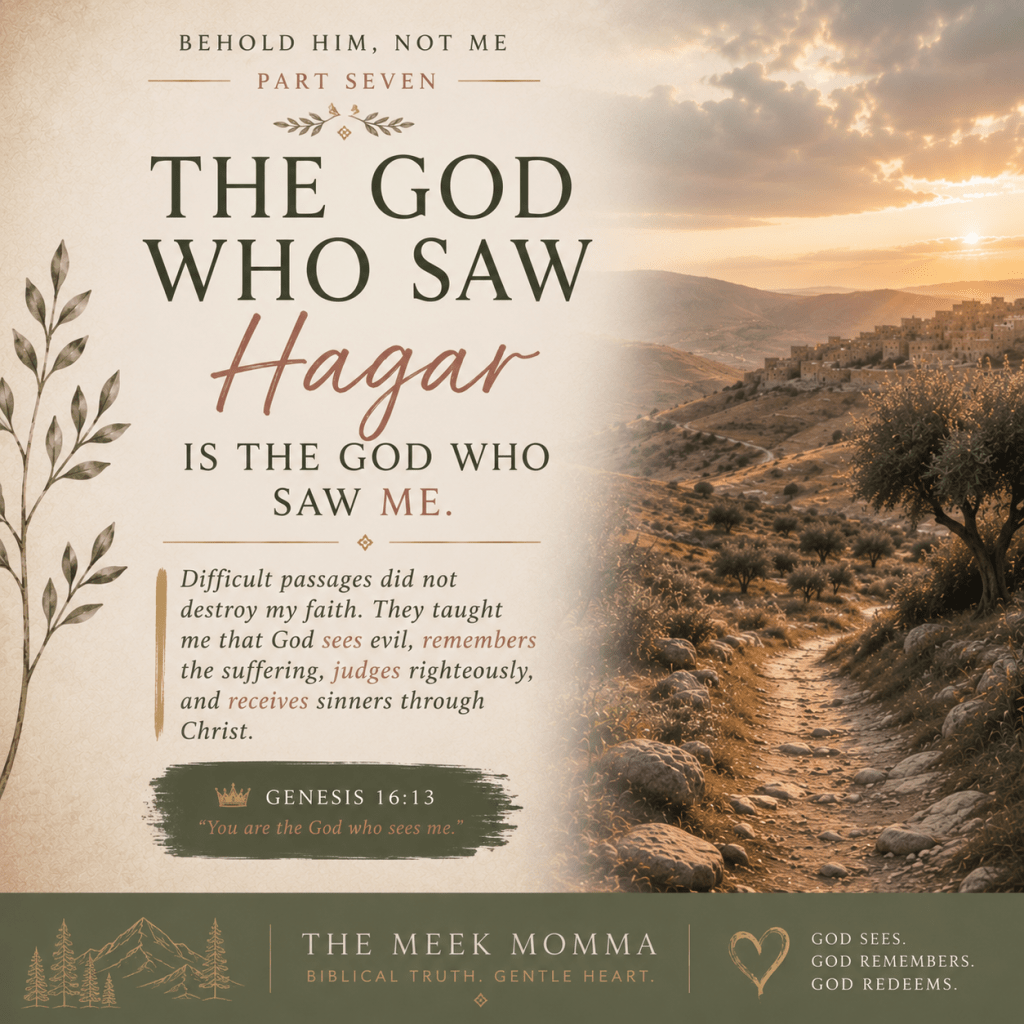
I thought about Hagar.
She was a woman caught within the sinful decisions and abuses of power of other people.
She fled into the wilderness.
And there, the angel of the LORD found her.
He called her by name.
“Hagar, servant of Sarai, where have you come from and where are you going?”
— Genesis 16:8
Hagar responded by giving God a name:
“You are a God of seeing.”
She said:
“Truly here I have seen Him who looks after me.”
— Genesis 16:13
Later, Hagar would find herself in the wilderness again, believing she was about to watch her son die.
She wept.
God heard.
And the angel of God called to her from heaven.
These passages began changing the way I understood God.
The God of Scripture is not the author of evil.
He is good.
He is just.
He sees.
He hears.
He knows.
And because He is faithful, He will keep every promise He has made.
That means evil will not be ignored forever.
Those who have harmed others will answer to God’s perfect justice.
Some of us may see justice in this life.
Some of us may not.
Human courts may fail.
People may refuse to believe us.
Those who committed evil may never acknowledge what they have done.
But there is no hidden thing that will remain hidden before the judgment of God.
The Judge of all the earth will do what is just.
For me, that truth did not make forgiveness unnecessary.
It made forgiveness possible.
I began to understand that forgiveness does not require me to call evil good.
It does not require me to pretend that justice does not matter.
It does not require me to deny what happened.
I can entrust final judgment to the God who sees perfectly, knows completely, and judges righteously.
And I can bring my wounds to Jesus.
The One who sees Hagar in the wilderness is the same God who came near to us in Christ.
Jesus saw women others ignored.
He welcomed people others rejected.
He touched those others considered unclean.
He drew near to the suffering.
He was betrayed.
He was stripped.
He was mocked.
He was beaten.
He was crucified.
And He willingly bore the judgment for sin so that sinners could be reconciled to God.
The cross taught me that God does not minimize evil.
Sin is so serious that the Son of God gave His life to save sinners from it.
And the resurrection taught me that evil, suffering, and death will not have the final word.
Slowly, the Old Testament and the New Testament began coming together for me.
The God who saw Hagar is the God who saw me.
The God who refused to let Israel forget the unnamed woman of Judges 19 had not forgotten me.
The righteous Judge before whom every evil will one day be exposed is also the Father who received me through His Son.
I began to understand that Jesus loved me deeply.
I began to receive the love of God instead of believing that what had been done to me determined my worth.
I began to seek forgiveness for my own sins.
I began learning to forgive others.
And I began trusting God with the justice I could not accomplish for myself.
These passages did not destroy my faith.
They deepened it.
They taught me that I do not need a Bible that looks away from evil.
I need a God who sees it more clearly than I ever could.
I do not need a God who offers shallow explanations for suffering.
I need the God who enters our suffering, judges with perfect justice, saves sinners through the blood of His Son, and promises that one day He will make all things new.
If you have experienced sexual violence, physical abuse, or other deep wounds, or if you love someone who has, I want you to know why I am willing to remain in difficult passages like Judges 19.
It is because I have found that slowing down in these passages has helped me know God more deeply.
You do not have to pretend that evil is less evil in order to trust Him.
You do not have to silence your grief.
You do not have to be afraid of your questions.
Bring them into the light of Scripture.
Learn the character of the God who sees.
Learn the justice of the God who will judge rightly.
Learn the mercy of the Savior who receives sinners.
Learn the love of the Father who gave His Son so that all who trust in Him might be reconciled to God.
My prayer is not merely that you will make it through the difficult chapters of the Bible with your faith intact.
My prayer is that, as you slow down and see the God who has revealed Himself there, your faith will deepen too.
The God who saw Hagar sees.
The God who preserved the testimony of the unnamed woman remembers.
The God who gave His Son saves.
And the King who is coming will judge the world in righteousness.
Come and see the God who sees.
Where Is God?
One of the unsettling realities of Judges 19 is the apparent silence of God.
There is no divine speech.
No angel appears.
No miracle interrupts the violence.
No deliverer arrives.
Where is God?
The answer is not that God has disappeared.
The entire book has shown us a people repeatedly refusing to listen to Him.
God has spoken.
Israel possesses His covenant.
Israel has His law.
Israel knows His commands.
The tragedy is not that God failed to reveal what righteousness looks like.
The tragedy is that Israel has rejected what God has revealed.
We must also be careful not to confuse God’s silence in the narrative with God’s indifference to suffering.
The chapter itself stands as testimony against Israel.
God has preserved the record of what happened.
The evil in Gibeah is not hidden from Him.
The suffering of the woman is not forgotten.
Judges 19 shows us what life looks like when human beings insist upon doing what is right in their own eyes.
And it leaves us longing for judgment, rescue, and a righteous King.
Outrage Is Not Repentance
The Levite takes the woman’s body and divides it into twelve pieces.
He sends the pieces throughout the territory of Israel.
The act is horrifying.
The response is immediate.
The people of Israel say:
“Such a thing has never happened or been seen from the day that the people of Israel came up out of the land of Egypt until this day; consider it, take counsel, and speak.”
Israel is finally shocked.
After years of idolatry.
After generations of compromise.
After repeated rejection of God’s covenant.
After everyone has done what is right in his own eyes.
Israel has finally found a sin terrible enough to produce national outrage.
But outrage is not the same thing as repentance.
It is possible to be horrified by the sins of others while remaining blind to the sin within ourselves.
It is possible to correctly identify evil and still respond to evil in ways that reveal our own estrangement from God.
That is where Judges 20 will take us.
The nation will gather.
The people will demand justice.
A civil war will begin.
Thousands will die.
And the people who are outraged by Gibeah will continue demonstrating that the deepest problem in Israel cannot be contained within one city.
The problem is everywhere.
The Road to Gibeah Was Longer Than One Night
Israel did not become Sodom overnight.
The violence of Judges 19 is the fruit of seeds planted throughout the entire book.
Israel compromised with the Canaanites.
Israel tolerated idolatry.
Israel abandoned covenant faithfulness.
Israel repeatedly cried out to God when suffering became unbearable, only to return to rebellion when relief arrived.
Israel treated God as a means of obtaining blessing rather than as their King.
By Judges 17, Micah has created his own religion.
By Judges 18, the tribe of Dan has established institutionalized idolatry.
By Judges 19, Israel has become Sodom.
This is the trajectory of sin.
Sin rarely tells us where it intends to take us.
It asks only for the next compromise.
The next excuse.
The next small act of disobedience.
The next moment when we decide that what seems right in our own eyes matters more than what God has said.
Judges 19 forces us to see the destination.
We Need a Righteous King
The book of Judges has shown us judge after judge.
Some were faithful.
Some were deeply flawed.
Some delivered Israel from external enemies while remaining unable to change the hearts of God’s people.
But now there is no judge.
There is no deliverer.
There is no faithful leader standing between the vulnerable and those who would destroy them.
The repeated refrain tells us what Israel lacks:
“In those days there was no king in Israel.”
But Israel does not merely need someone wearing a crown.
Israel needs a righteous King.
A King who will not exploit the weak.
A King who will not sacrifice others to save Himself.
A King who knows the Word of God and obeys it perfectly.
A King who sees the forgotten.
A King who defends the vulnerable.
A King who judges evil without becoming evil.
A King who can deal not only with the enemies surrounding God’s people, but with the sin dwelling within them.
Judges leaves us longing for such a King.
The gospel tells us His name.
The King Who Gave Himself
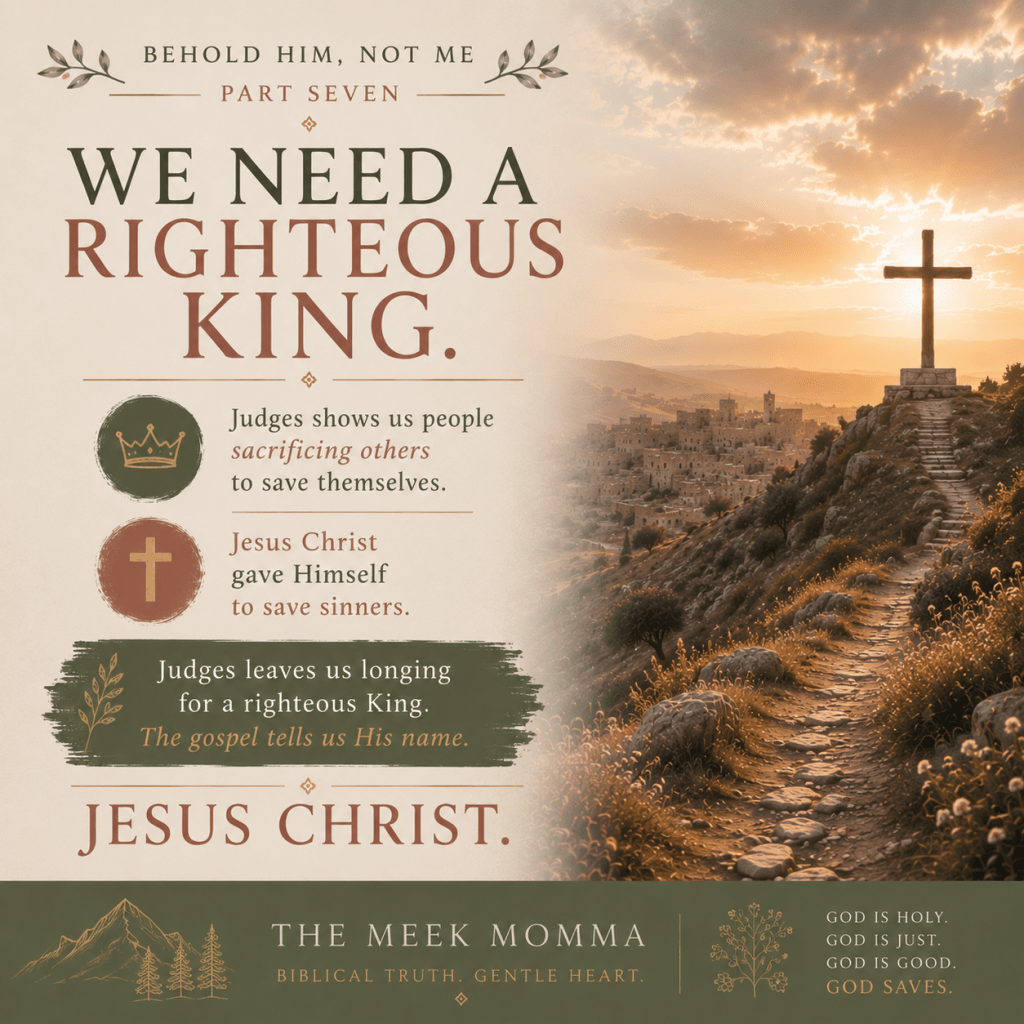
The men in Judges 19 preserve themselves by giving up someone else.
Jesus does the opposite.
Christ does not sacrifice the vulnerable to save Himself.
He gives Himself to save sinners.
The Good Shepherd does not abandon the sheep when the wolves come.
He lays down His life for the sheep.
Jesus does not use His power to protect Himself from suffering.
He willingly enters suffering.
He is betrayed.
He is mocked.
He is beaten.
He is condemned.
He is crucified.
Not because humanity is innocent.
But because humanity is guilty.
At the cross, we see both the horror of human sin and the holiness of God.
The cross does not minimize evil.
It reveals how serious sin truly is.
The righteous King bears judgment in the place of His people.
Judges 19 shows us human beings sacrificing others to save themselves.
The gospel shows us the Son of God giving Himself to save sinners.
Jesus Christ is the King Israel needed.
And He is the King we need.
The King Who Sees
Judges 19 reminds us that human beings can overlook suffering.
Communities can normalize injustice.
Religious people can become indifferent.
Powerful people can protect themselves.
Victims can remain unnamed.
But God sees.
God hears.
God knows.
And God will judge rightly.
The gospel does not ask us to pretend evil is less terrible than it is.
The gospel tells us that evil will not have the final word.
Jesus Christ was crucified.
Jesus Christ was buried.
Jesus Christ rose from the dead.
Jesus Christ reigns.
And one day the King who sees every injustice will judge the world in righteousness.
Every hidden thing will be brought into the light.
Every wrong will be answered according to perfect justice.
For those who belong to Christ, the promise of His kingdom means that suffering, violence, injustice, and death will not endure forever.
The King is coming.
Behold Him, Not Me
Judges 19 is difficult to read because it shows us what human beings become when we reject the rule of God.
Israel was called to be holy.
Israel was called to be different.
Israel was called to display the character of God among the nations.
Instead, Israel became Sodom.
The warning should humble us.
We should never assume that religious language, biblical knowledge, church attendance, ministry involvement, or spiritual heritage makes us immune to compromise.
We need more than outrage over the sins of the world.
We need more than moral reform.
We need more than better circumstances.
We need new hearts.
We need forgiveness.
We need righteousness we cannot produce for ourselves.
We need a King.
Judges leaves us searching for Him.
The rest of Scripture tells us His name.
Jesus Christ.
The righteous King.
The faithful Shepherd.
The One who sees the forgotten.
The One who judges with perfect justice.
The One who gave Himself to save sinners.
When everyone does what is right in his own eyes, look to the King.
When the world becomes accustomed to evil, look to the King.
When religious people fail, look to the King.
When human justice proves insufficient, look to the King.
When the darkness seems unbearable, look to the King.
Behold Him.
Heart Check
Am I more skilled at identifying the sins of others than examining the compromises within my own heart?
Have I become comfortable with things that Scripture calls evil?
Are there areas of my life where personal preference has become more authoritative than the Word of God?
Do I assume that being surrounded by Christian things is the same as faithfully following Christ?
How do I respond when obedience to Jesus requires me to protect, serve, or speak for people who have less power than I do?
Do I merely feel outrage over evil, or does the reality of sin lead me toward repentance, prayer, obedience, and trust in Christ?
Where am I tempted to protect myself at the expense of others?
Do I truly believe that Jesus is the righteous King I need—not only to judge the evil around me, but to save me from the sin within me?
Prayer
Father,
Judges 19 is difficult to read.
The violence is horrifying. The suffering is real. The depth of human sin is difficult to comprehend.
Yet Your Word refuses to hide what happens when people reject Your rule and do what is right in their own eyes.
Search my heart.
Show me where I have become comfortable with compromise.
Show me where I am quicker to condemn the sins of others than to repent of my own.
Guard me from a faith that knows Your Word but refuses to submit to it.
Teach me to see people as those made in Your image.
Give me courage to protect the vulnerable, speak truth, pursue justice, and refuse to make peace with evil.
For those reading who carry wounds caused by the evil of others, draw near to them.
Help them know that You see.
Help them know that You hear.
Help them know that evil is not hidden from You and that Your justice will not fail.
Lead them to the Savior who receives sinners, binds up the brokenhearted, and will one day make all things new.
And when the darkness of human sin feels overwhelming, turn our eyes toward Christ.
Thank You for giving us the King we could never produce for ourselves.
Thank You that Jesus did not sacrifice others to save Himself, but willingly gave Himself to save sinners.
Thank You that He sees the forgotten, receives the repentant, judges rightly, and reigns forever.
Teach us to trust Him.
Teach us to follow Him.
Teach us to behold Him.
Not us.
In Jesus’ name,
Amen.


Leave a comment