In 1929, the Soviet Union introduced what became known as the “continuous working week” (nepreryvka). The goal was to keep factories operating continuously and maximize industrial productivity. Instead of everyone sharing the same weekly day of rest, workers were divided into groups and assigned different days off. Four days of work were followed by one day of rest, but because everyone’s schedule was staggered, the factory could keep operating every day.
The system created an unexpected—and deeply human—problem.
Families and friends often no longer had the same day off.
A husband might have Tuesday off while his wife had Friday. Parents and children could have different schedules. Communities lost a common rhythm of rest and gathering. The arrangement also made participation in religious worship more difficult, particularly because the traditional Sunday rest had been eliminated.
The experiment ultimately failed. In 1931, the Soviet government replaced the five-day system with a six-day work cycle, and in 1940 the traditional seven-day week was restored.
Why does this matter when reading Scripture?
Because Sabbath was never merely about stopping work.
God established a rhythm of work, rest, worship, community, and remembrance.
The Sabbath created a shared rhythm for God’s people.
It reminded Israel:
We are not machines.Our worth is not measured by our productivity.God is our provider.Rest is a gift.Worship matters.Community matters.
The Soviet experiment tried to organize human beings around continuous production.
God built a rhythm into His covenant people that reminded them they belonged first to Him.
“Remember the Sabbath day, to keep it holy.” — Exodus 20:8
And perhaps that gives us another reason to slow down when we read Leviticus.
God was not merely giving Israel a list of strange regulations.
He was teaching them how to live as His people in His presence.
Even their calendar was meant to remind them who they belonged to.
This little historical story paired with my Sabbath readings really gave me a lot to chew on in a way I did not expect… it caused me to ask myself, How does my calendar reflect the things that are important to me? Does my calendar look like the world’s calendar, does my family rhythm reflect that we are a people set apart? Or are we busy to just be busy?
🌿 — A Note to Remember
God did not create us for endless production.He created us for Himself.
This morning, I found myself especially grateful for Paul’s honesty.
In Philippians 3:12, he says:
“Not that I have already obtained this or am already perfect…”
Paul admits that he hasn’t arrived.
I don’t know about you, but I find that incredibly encouraging.
Sometimes we can think that following Jesus means we should eventually have everything figured out. That if we’ve been Christians long enough, we should be past the struggle, past the weakness, past the areas where God is still working on us.
But Paul, one of the greatest apostles who ever lived, says essentially, I’m not there yet.
Neither am I.
When we come to Christ, we receive salvation by grace. But salvation isn’t the end of our journey; it’s the beginning of a lifelong process of becoming more like Christ.
We strive toward holiness, not salvation.
We aren’t working so that Christ will choose us. We pursue Him because He has already made us His own.
Paul uses the Greek word teleios (τέλειος) for “perfect” in verse 12. The word can mean complete, mature, or brought toward an intended goal.
Then Paul uses that same word again in verse 15:
“Let those of us who are mature think this way…”
There’s something wonderfully humbling about that.
One mark of Christian maturity is recognizing that we haven’t arrived.
There is still more of Christ to know, more holiness to pursue, more sin to put to death, and more grace to receive.
Paul’s confidence isn’t in how far he has come.
His confidence is in Christ, who has already taken hold of him.
Paul continues:
“But one thing I do: forgetting what lies behind and straining forward to what lies ahead…”
Paul had a lot behind him.
He had religious credentials, accomplishments, zeal, suffering, and failures. Earlier in this chapter, he lays out his impressive Jewish résumé and then calls it loss compared with the surpassing worth of knowing Christ.
He refused to allow either his accomplishments or his failures to become the place where he lived.
Sometimes what lies behind us is shame. Sometimes it’s grief. Sometimes it’s success. Sometimes it’s the version of ourselves we wish we could get back. And sometimes it’s simply everything we’ve already carried.
Paul doesn’t pretend the past didn’t happen.
He simply refuses to let it determine the direction he’s going.
His eyes are forward.
The Greek word Paul uses for “straining forward” gives us the picture of a runner stretching toward the finish line.
William Barclay describes it as a racer going hard for the finishing line, with his eyes fixed on the goal.
Paul says:
“I press on toward the goal for the prize of the upward call of God in Christ Jesus.”
The prize is not simply getting through our present circumstances.
The prize is Christ and the fullness of life with Him.
Scripture gives us glimpses of what awaits us: an imperishable inheritance, the kingdom prepared for God’s people, and the day when death, mourning, crying, and pain will be no more.
That is where we’re headed.
And knowing where we’re going changes how we walk through where we are.
This Week Has Felt Heavy
This passage felt especially personal to me this morning because this last week has been a lot.
I lost a dear friend who leaves children behind, and my heart has been breaking for them.
I spent part of the week walking through an incredibly difficult trial connected to one of the children I advocate for.
Then my mom ended up in the emergency room, and I’ve needed to stay close by, helping with medications and keeping an eye on things while also continuing to care for everything at home.
And life at home hasn’t exactly slowed down.
For my son, difficult events often show up later through increased anxiety and a greater need for control. After the hospital visit, we’ve been navigating some of those things too—difficulty focusing, increased activity, changes in eating, and struggles around routines.
It’s been a full week.
And honestly, I’m tired.
I’m someone who can usually carry a lot. But there is a difference between being strong and being exhausted.
This week has reminded me that I’m not perfect. I’m still being sanctified, and I’m still learning what it means to trust Christ in difficult places.
That’s one reason Paul’s words meant so much to me this morning.
He doesn’t tell us that mature Christians never struggle. He shows us what it looks like to remain focused on Christ while we are still struggling.
One thing that has kept me anchored through this week is simply getting up and opening my Bible.
Not because every morning has felt profound. Sometimes it has simply been obedience. Sometimes it has been the only quiet moment I could find.
But I keep coming back because I know where my strength comes from.
“The joy of the Lord is your strength” (Nehemiah 8:10).
My circumstances aren’t necessarily joyful right now.
But Christ is still faithful.
And that gives me a hope the world cannot offer.
We don’t suffer as people who have no hope.
We grieve, but not without hope.
We hurt, but not without Christ.
We become exhausted, but we are not abandoned.
I’ve found myself thinking often this week about the words at the end of Revelation:
“Surely I am coming soon.”
And John’s response:
“Amen. Come, Lord Jesus!”
There are days when I understand that prayer more deeply than others.
I long for the day when there will be no more tears, no more pain, no more death, and no more brokenness.
But until that day comes, I want to be found faithful.
Paul says in Philippians 4:11:
“I have learned in whatever situation I am to be content.”
I love that word: learned.
Contentment wasn’t something Paul simply possessed.
He learned it.
And I’m still learning it too…
Maybe that’s why Philippians 3 has been so timely for me.
Paul’s identity wasn’t ultimately defined by his accomplishments, his suffering, his failures, or his circumstances.
His identity was rooted in Christ. And mine is too.
Who I am isn’t ultimately determined by what has happened to me.
It isn’t determined by what I accomplish or by the season I’m walking through.
Who I am is based on whose I am.
I belong to Christ.
And because I belong to Christ, I can face the next thing in front of me without having to pretend that I’m strong enough for all of it.
Paul doesn’t tell us to press on because we’re strong. He tells us to press on because Christ has already made us His own.
We aren’t running to prove ourselves worthy or to earn salvation. We’re running toward the One who pursued us first.
So when the road feels heavy, we fix our eyes on Christ.
When the past tries to define us, we look ahead.
When suffering exhausts us, we remember the prize.
We haven’t arrived.
But Christ has made us His own, and He will bring us safely to the goal.
One day, the race will be finished.
The tears will be gone.
The suffering will be over.
And we will finally see the One toward whom we have been running all along.
Sacrifice of some kind was a nearly universal practice among ancient peoples. Israel’s sacrificial system shared certain similarities with the practices of surrounding nations, but it was also distinctly different in several important ways.
1. Israel’s Absolute Monotheism
Israel worshiped one true God, Yahweh. The sacrificial system was not created by Israel as a means of manipulating multiple competing gods. God Himself gave Israel specific instructions for worship and sacrifice as part of His covenant relationship with them.
2. Sacrifice Was Connected to Holiness, Ethics, and Obedience
Israel’s worship was rooted in the character of God Himself. Because God is absolutely holy, His people were called to holiness.
The sacrificial system was therefore connected to sin, repentance, atonement, forgiveness, and obedience to God’s covenant commands. Sacrifice was never intended to replace faithful obedience.
“You shall be holy, for I the LORD your God am holy.” — Leviticus 19:2
The prophets repeatedly reinforce this truth: God does not delight in ritual performed apart from righteousness and obedience (1 Samuel 15:22; Isaiah 1:11–17; Hosea 6:6; Micah 6:6–8).
3. Israel Was Forbidden to Incorporate Magic and Occult Practices
Israel’s worship was not to be blended with the religious practices of the surrounding nations. God explicitly prohibited magic, sorcery, divination, necromancy, and related practices (Leviticus 19:26, 31; 20:6; Deuteronomy 18:9–14).
Biblical sacrifice was never magic. It was not a technique for manipulating God or forcing Him to provide a desired outcome.
4. Israel’s Sacrificial System Had a High Moral Character
The biblical sacrificial system was fundamentally different from fertility religions and other surrounding practices. Israel was prohibited from incorporating ritual prostitution, sexual immorality, occult practices, and human sacrifice into its worship (Leviticus 18:21; Deuteronomy 18:9–14).
Israel’s worship was to reflect the holiness of the God they worshiped.
Sacrifice Before Sinai
Sacrifice did not begin with the Mosaic covenant.
Long before Leviticus, Scripture records people offering sacrifices to God:
Cain and Abel — Genesis 4:3–5
Noah — Genesis 8:20–22
Abraham — Genesis 12:7–8 and following
Job — Job 1:5
The biblical record clearly demonstrates that sacrifice was practiced among God’s people long before the detailed sacrificial laws given through Moses.
The Mosaic covenant therefore revealed and regulated Israel’s sacrificial worship within their covenant relationship with God.
Cain and Abel: The Importance of the Worshiper
Genesis 4:3–5 gives us one of Scripture’s earliest accounts of sacrifice.
Cain brought an offering from the fruit of the ground, while Abel brought the firstborn of his flock and their fat portions.
God regarded Abel and his offering, but did not regard Cain and his offering.
The text does not explicitly state that Cain offered his “second best.” What it does emphasize is that Abel brought the firstborn and the fat portions—the valuable portions of his flock.
The following conversation with Cain makes clear that the issue was not merely the physical offering. God addresses Cain’s conduct and heart:
“If you do well, will you not be accepted?” — Genesis 4:7
The story therefore establishes an important biblical principle:
God cares about both the offering and the heart of the worshiper.
Why Cain and Abel Matter
The story appears remarkably early in Scripture, before Sinai, the tabernacle, the priesthood, or the Levitical system.
Already, Scripture is asking:
What does it mean to approach God rightly?
Cain and Abel introduce a theme that will continue throughout Scripture:
Worship cannot be separated from the heart and conduct of the worshiper.
This becomes essential for understanding the sacrifices of Leviticus. The sacrifices were not empty rituals performed mechanically. They belonged within a relationship of covenant faithfulness, holiness, repentance, and obedience.
Noah: Sacrifice and Covenant Grace
After the flood, Noah built an altar and offered burnt offerings to the LORD (Genesis 8:20–22).
The LORD received Noah’s offering as a pleasing aroma and then declared His commitment to preserve the regular rhythms of creation:
“While the earth remains, seedtime and harvest, cold and heat, summer and winter, day and night, shall not cease.” — Genesis 8:22
The passage should not be understood as though Noah’s sacrifice manipulated God or changed Him from anger to mercy.
Rather, the sacrifice occurs within the larger story of judgment, grace, and covenant promise. God graciously commits Himself to sustaining His creation despite humanity’s continuing sinfulness.
As we enter Leviticus, we should first ask what each sacrifice meant within Israel’s own covenant relationship with God.
For each sacrifice, consider:
What was being offered?
Who brought the offering?
What was the worshiper required to do?
What did the priest do?
What happened to the blood and offering?
What portion belonged to God?
What portion, if any, belonged to the worshiper or priest?
What problem or need did the sacrifice address?
How did it relate to holiness, sin, forgiveness, fellowship, or thanksgiving?
How does the rest of Scripture develop this theme?
Where does the New Testament explicitly connect these themes to Jesus Christ?
This allows us to trace the sacrificial system toward Christ without forcing meanings onto the text that Scripture itself does not establish.
Key Thought
Sacrifice was never merely about putting something on an altar.
From the earliest pages of Scripture, sacrifice is connected with approaching God, responding to sin, worshiping rightly, honoring God’s holiness, and living in covenant relationship with Him.
Israel’s sacrificial system was not unique simply because Israel sacrificed. It was unique because Yahweh—the one true and holy God—revealed how His covenant people were to worship and approach Him.
As we study Leviticus, we will see the altar continually teaching Israel that:
sin is serious, God is holy, forgiveness is costly, and fellowship with God is a gracious gift.
The book of Leviticus begins precisely where Exodus leaves off.
The tabernacle has been completed, and the glory of the LORD has filled it. God’s presence is so overwhelming that Moses is unable to enter the tent of meeting (Exodus 40:34–35).
That detail is important.
Leviticus begins with a question:
How can a holy God dwell among an unholy people?
Leviticus breaks from much of the narrative structure of Genesis and Exodus and moves primarily into instructions concerning sacrifices, priesthood, purity, holiness, worship, and covenant life.
But these laws are not random regulations.
Moses’ inability to enter the tabernacle establishes the theological problem that drives the book:
God is holy, and His people are not.
God desires to dwell among His people, yet His holiness cannot simply overlook sin and impurity. Leviticus therefore explains how Israel is to approach God, worship Him, deal with sin and ritual impurity, and live as a people set apart for His presence.
The sacrificial system provided God-appointed means of atonement, purification, forgiveness, and restored fellowship within the Mosaic covenant.
Three Major Areas of Leviticus
The laws of Leviticus can broadly be understood through three overlapping areas:
1. Ritual
These instructions govern Israel’s worship—particularly sacrifices, offerings, festivals, holy days, and other prescribed rituals.
2. Priesthood
These laws concern the ordination, qualifications, responsibilities, and conduct of the priests, who served in Israel’s worship and ministry at the sanctuary.
3. Holiness
These instructions teach Israel what it meant to live as a people set apart to God. They address worship, morality, relationships, sexuality, food, ritual purity, justice, and everyday life.
And this is important:
Ritual impurity is not necessarily the same thing as moral sin.
Something could make an Israelite ritually unclean without that person having committed a moral offense. The purity laws distinguish between categories of clean and unclean, while the holiness laws also address moral obedience and covenant faithfulness.
Together, these laws teach Israel that life in the presence of a holy God requires distinction, reverence, and holiness.
What Do These Laws Have in Common?
Though the laws of Leviticus address many different subjects, several themes continually emerge.
They call Israel to be holy.
“You shall be holy, for I the LORD your God am holy.” — Leviticus 19:2
They set Israel apart from the surrounding nations.
Israel was not simply another ancient nation with another religious system. They belonged to Yahweh and were called to reflect His character.
They continually remind Israel of their covenant relationship with God.
Their worship, daily lives, bodies, homes, food, relationships, priests, festivals, and sacrifices all existed within the reality that they belonged to God.
And they prepare us to understand the need for a greater and final atonement.
The New Testament explicitly develops the sacrificial and priestly themes of Leviticus and shows their fulfillment in Jesus Christ (Hebrews 9–10).
We should be careful, however, not to force Christ into every individual detail of Leviticus. Instead, we watch for the connections that Scripture itself develops and allows the biblical storyline to lead us to Christ.
The Day of Atonement
At the center of Leviticus stands Leviticus 16—the Day of Atonement, or Yom Kippur.
This was the great annual ceremony in which atonement was made for the sins and impurities of Israel and the sanctuary.
Two goats were selected.
One was offered as a sin offering.
The other became the scapegoat. The high priest confessed the sins of Israel over the goat, symbolically placing their iniquities upon it, and the goat was sent away into the wilderness.
These two goats vividly communicate two dimensions of atonement:
sin requires dealing with, and sin is removed from God’s people.
The New Testament helps us see the greater fulfillment of these realities in Christ, whose sacrifice is not repeated annually but is once for all (Hebrews 9:11–14; 10:10–14).
Why Leviticus Matters
Leviticus may require a little more work to understand and apply than some of the more narrative books of Scripture.
But it gives us a profound picture of God’s character and His purposes.
It teaches us that:
God is holy.
Sin and impurity matter.
God desires to dwell with His people.
Atonement is necessary for sinners to approach a holy God.
God Himself provides the way for His people to draw near.
And as the biblical story continues, these themes lead us toward the ultimate fulfillment of God’s provision:
Jesus Christ, our perfect and once-for-all sacrifice.
A Simple Outline of Leviticus
Chapters 1–7 — The Sacrificial Offerings
Instructions concerning Israel’s various offerings, including the burnt, grain, peace, sin, and guilt offerings.
Chapters 8–10 — The Priesthood
The ordination of Aaron and his sons, their responsibilities, and the judgment that falls on Nadab and Abihu for unauthorized worship.
Chapters 11–15 — Clean and Unclean
Instructions concerning clean and unclean animals, bodily conditions, skin diseases, bodily discharges, and other matters of ritual purity.
Chapter 16 — The Day of Atonement
Instructions for Israel’s annual Day of Atonement and the cleansing of the sanctuary and people.
Chapter 17 — The Holiness of Blood and Sacrifice
Instructions concerning where sacrifices may be offered and the sacred significance of blood.
Chapters 18–20 — Holiness in Everyday Life
Commands concerning sexual morality, family relationships, idolatry, justice, and separation from the practices of the surrounding nations.
Chapters 21–22 — Priestly Holiness
Additional requirements concerning the holiness and conduct of the priests and regulations concerning acceptable offerings.
Chapter 23 — Feasts and Holy Days
Israel’s appointed times, including Passover, Unleavened Bread, Firstfruits, Weeks, Trumpets, the Day of Atonement, and Booths.
Chapter 24 — Holy Things and Covenant Community
Instructions concerning the lampstand, the bread of the Presence, and the consequences of blaspheming God’s name.
Chapter 25 — Sabbath Year and Jubilee
Instructions concerning the Sabbath year, the Year of Jubilee, land, property, debt, and care for fellow Israelites.
Chapter 26 — Covenant Blessings and Curses
A covenant call to obedience accompanied by promises of blessing and warnings concerning covenant disobedience.
Chapter 27 — Vows and Dedicated Things
Regulations concerning vows, dedications, valuations, and things devoted to the LORD.
The Big Picture
Leviticus is not simply a book of strange rules about sacrifices, food, priests, and purity.
It is a book answering a profound question:
How can a holy God dwell among a sinful people?
And as we study it carefully, we begin to see the answer unfolding:
God makes a way for His people to dwell in His presence.
The temporary and repeated provisions of the Mosaic covenant ultimately point us toward the greater reality revealed in Christ—the One whose sacrifice is sufficient once for all.
“For by a single offering he has perfected for all time those who are being sanctified.” — Hebrews 10:14
Learning to Pray for Spiritual Growth from Philippians 1:9–11
Perhaps one of the clearest measures of what we truly desire for the people we love is what we repeatedly ask God to do in their lives.
“And it is my prayer that your love may abound more and more, with knowledge and all discernment, so that you may approve what is excellent, and so be pure and blameless for the day of Christ, filled with the fruit of righteousness that comes through Jesus Christ, to the glory and praise of God.”
— Philippians 1:9–11
What do you pray for the people you love?
If someone listened carefully to your prayers for your husband, your children, your friends, your church, or the believers God has entrusted to your care, what would they discover that you most deeply desire for them?
We pray for safety, healing, provision, restored relationships, open doors, protection for our children, strength for marriages, and relief from suffering.
These are good things to bring before our Father.
But Paul’s prayer in Philippians 1:9–11 confronts us with a deeper question:
Do our prayers reveal that our greatest desire for the people we love is their spiritual maturity and conformity to Jesus Christ?
Paul writes Philippians from imprisonment. He loves these believers deeply. He has invested himself in their lives, labored for their spiritual good, and partnered with them in the advancement of the gospel.
Immediately before recording his prayer, Paul writes:
“For God is my witness, how I yearn for you all with the affection of Christ Jesus.”
— Philippians 1:8
Then Paul allows us to hear what a heart filled with the affection of Christ asks God to do in the lives of others.
He does not begin by praying that the Philippians would escape suffering or experience easier circumstances.
Paul prays for their spiritual growth.
He asks God to increase their love, deepen their knowledge, sharpen their discernment, teach them to recognize what is excellent, make them sincere and blameless, fill their lives with the fruit of righteousness through Jesus Christ, and keep them faithful until the day of Christ.
And all of it moves toward one ultimate purpose:
the glory and praise of God.
This prison prayer gives us more than a glimpse into Paul’s pastoral heart.
It teaches us how to pray for the people we love.
1. A Love That Never Stops Growing
Paul begins:
“And it is my prayer that your love may abound more and more…”
The Greek word translated abound is perisseuō (περισσεύω).
It carries the idea of increasing, overflowing, exceeding, or becoming abundant.
Paul is not writing to Christians who have no love. The Philippians have already demonstrated their affection for Paul and their partnership in the gospel.
Yet Paul prays for more.
There is no point in the Christian life when we graduate from the command to love. Spiritual maturity does not mean that we eventually become loving enough.
The more deeply we know Christ, the greater our capacity should become to love the people He has placed around us.
Paul does not explicitly state the object of the Philippians’ love in verse 9. The Greek text simply says:
ἡ ἀγάπη ὑμῶν — “your love.”
Within Paul’s letters, love for fellow believers frequently occupies a prominent place, especially in the opening sections of his letters. Paul commends the saints for their love in Ephesians 1:15, Colossians 1:4, 1 Thessalonians 1:3, and 2 Thessalonians 1:3.
Given Paul’s repeated emphasis upon the love believers should have for one another, and the relational concerns that later emerge in Philippians, love for fellow Christians is certainly included and may be especially prominent here.
But Paul’s prayer reaches even deeper.
He desires a growing Christian love—love rooted in God, shaped by truth, and expressed wisely toward others.
When Jesus identifies the greatest commandments, He first commands us to love God with our entire being and then to love our neighbor as ourselves.
Love for God and love for others belong together.
We need love that abounds still more and more.
But Paul does not pray merely for more love.
He prays for a particular kind of love.
2. A Love Governed by Truth
Paul continues:
“…with knowledge and all discernment.”
The word translated knowledge is epignōsis (ἐπίγνωσις).
It carries the idea of genuine, deep, or full knowledge.
The Reformer John Calvin explained Paul’s meaning:
“Paul means that it is full and complete, not a knowledge of all things.”
Paul is not praying that the Philippians would simply accumulate more information or become intellectually impressive.
He desires a deepening knowledge that shapes how they live and love.
The word translated discernment is aisthēsis (αἴσθησις).
It refers to moral perception, insight, or the capacity to recognize what is appropriate in a particular situation.
Paul is praying for love with eyes.
Love that sees.
Love that understands.
Love that perceives.
Love that knows how to respond wisely to real people in real situations.
Biblical love is not blind sentimentality.
It is not merely being nice.
It is not avoiding difficult conversations, affirming every decision someone makes, or doing whatever makes us feel loving.
Paul is not praying that the Philippians would become smarter, but wiser in their care for one another.
Genuine love requires spiritual wisdom.
We need discernment to know when to speak and when to remain silent. When to confront and when to comfort. When to intervene and when to wait. When to give generously and when helping in the wrong way might enable destructive patterns.
Without knowledge and discernment, sincere attempts to love can become misguided.
We may offer tenderness without truth.
Or truth without tenderness.
We may give someone what they want when faithfulness requires giving them what they need.
We may avoid necessary conversations because we have confused kindness with silence.
Paul prays for something better.
Love governed by truth and guided by discernment.
Biblical love requires more than good intentions.
We need wisdom from God.
3. A Love That Chooses What Is Excellent
Paul explains the purpose of knowledge and discernment:
“…so that you may approve what is excellent…”
The word translated approve is dokimazō (δοκιμάζω).
It means to test, examine, scrutinize, and determine whether something meets the necessary standard.
Paul prays that the Philippians would develop the spiritual ability to examine the choices before them and recognize what is truly excellent.
Steven Lawson observes that some of the most difficult choices Christians face are not between what is obviously good and evil, but between what is good, better, and best.
That is where discernment becomes necessary.
We have limited time.
Limited energy.
Limited resources.
We cannot meet every need, accept every invitation, pursue every opportunity, intervene in every situation, or say yes to every good thing.
Mature Christian love asks:
What is most excellent here?
What will genuinely serve this person’s spiritual good?
What does faithfulness require in this particular situation?
What will matter most in light of eternity?
What must I say no to so that I can say yes to what God has actually entrusted to me?
Paul does not want the Philippians to stumble through relationships guided only by emotion, pressure, guilt, or the expectations of others.
He prays that their growing love, governed by knowledge and discernment, will enable them to recognize and pursue what is excellent.
We should pray the same for our churches, our spouses, our friends, those we disciple, and our children.
Lord, teach them to recognize what matters most.
4. A Love That Produces Integrity
Paul continues:
“…and so be pure and blameless for the day of Christ…”
The word translated pure or sincere is eilikrinēs (εἰλικρινής).
It communicates genuineness, sincerity, purity of motive, and integrity.
Paul is praying for believers whose lives can withstand examination.
Christians without divided loyalties.
Without religious performance.
Without carefully constructed appearances that conceal contradictory lives.
There must not be an inconsistency between what we confess to believe and how we live.
Our theology and conduct belong together.
Our public Christianity and private character belong together.
Our doctrine and love belong together.
Every area of life should increasingly become part of one integrated whole under the lordship of Jesus Christ.
That is integrity.
Paul also prays that the Philippians would be blameless.
The Greek word is aproskopos (ἀπρόσκοπος).
It carries the idea of being without offense or not causing stumbling.
Paul wants their lives to be marked by such integrity that their conduct does not become an unnecessary obstacle in the spiritual lives of others.
It matters to God how we live.
Forgiveness of sin does not give us freedom to continue carelessly in sin.
The grace that pardons us is the same grace that purifies us.
Our hypocrisy can wound.
Our careless words can discourage.
Our uncontrolled anger can harm.
Our dishonesty can destroy trust.
Our selfishness can place obstacles in the spiritual lives of those around us.
Christian love therefore requires personal holiness.
Paul prays that this integrity would characterize the Philippians:
“…for the day of Christ.”
His prayer stretches all the way to eternity.
There is always more patience to learn, more kindness to practice, more forgiveness to extend, more selfishness to put to death, more wisdom to gain, and more Christlikeness to pursue.
The whole Christian life is lived in preparation for that great day.
When Christ returns, may He find us loving one another.
5. A Love That Bears Fruit Through Christ
Paul continues:
“…filled with the fruit of righteousness that comes through Jesus Christ…”
The Christian life produces fruit.
But notice carefully where the fruit comes from.
Through Jesus Christ.
Paul is not praying for self-generated moral improvement.
He is not asking the Philippians to become better people through greater willpower.
The righteousness visible in their lives is produced through their relationship with Jesus Christ.
This connects beautifully with the opening words of Philippians and with the foundation we established in the first blog of this series.
Paul has already addressed these believers as:
“saints in Christ Jesus.”
They belong to Christ.
They are in Christ.
They receive grace and peace from Christ.
And now Paul prays that the life of Christ would increasingly bear visible fruit through them.
The spiritual fruit of righteousness begins to grow when God makes a sinner alive in Christ.
We do not love others in order to make ourselves Christians.
We love because God has made us alive in Christ.
We do not produce spiritual fruit in order to earn acceptance from God.
Spiritual fruit grows because we have been united to Jesus Christ.
The first fruit of the Spirit listed in Galatians 5:22 is love.
Rebirth is the root.
Love is the fruit.
The Christian life is not the decoration of a dead tree.
It is the fruitfulness of a living one.
And the source of that life is Jesus Christ.
This should deeply shape how we pray.
When we pray for spiritual growth in the people we love, we are not merely asking them to try harder.
We are asking God to produce through Christ what human effort cannot manufacture.
Lord, bear the fruit of Christ in them.
6. A Love That Ends in the Glory of God
Paul reaches the destination of his prayer:
“…to the glory and praise of God.”
Paul begins with love.
But he ends with glory.
The glory of God.
Choosing what is excellent.
Sincerity and blamelessness.
Perseverance until the day of Christ.
The fruit of righteousness through Jesus Christ.
And ultimately:
The glory and praise of God.
Christian love is not ultimately about making us appear compassionate.
Spiritual maturity is not about producing impressive Christians.
The fruit of righteousness is not intended to build our reputation.
Everything terminates in the glory of God.
Paul writes:
“So, whether you eat or drink, or whatever you do, do all to the glory of God.”
— 1 Corinthians 10:31
The Puritan Thomas Brooks wrote:
“The aim of the obedient soul, in prayer, and praises, and talking, and walking, in giving, and receiving, in living, and doing, is divine glory.”
God’s glory must become the master passion of the Christian life.
The way we pray.
The way we speak.
The way we love.
The way we forgive.
The way we serve.
The way we parent.
The way we suffer.
The way we work.
All of life should increasingly be directed toward one great end:
the glory and praise of God.
What Do Your Prayers Reveal About What You Want Most?
Paul’s prayer forces us to examine our own.
What do we most deeply desire for the people we love?
Do I merely want my children to be safe, successful, healthy, well-behaved, and happy?
Do I want my husband to change primarily because his change would make my life easier?
Do I pray more frequently for the physical health of the people I love than for their holiness?
Do I pray for my church to grow numerically without praying with equal intensity that we would grow in love, discernment, integrity, and righteousness?
If someone listened to our prayers, would they know that our greatest desire for the people we love is that Christ would be formed in them?
Paul teaches us to pray beyond circumstances.
That does not mean we stop praying for healing, safety, provision, protection, reconciliation, or relief from suffering.
Our Father invites us to bring every burden to Him.
But our prayers should reach further.
Lord, whatever You do with their circumstances, make them more like Christ.
Increase their love.
Deepen their knowledge.
Sharpen their discernment.
Teach them to recognize what is excellent.
Make their lives sincere and blameless.
Fill them with the fruit of righteousness through Jesus Christ.
Keep them faithful until the day of Christ.
And through their lives, receive glory and praise.
Perhaps one of the greatest ways we can love another person is to pray for what God desires to produce in them.
Behold Christ
Paul’s prayer does not leave us staring at ourselves.
It leads us to Jesus Christ.
The love Paul desires is formed in those who know Christ.
The discernment Paul requests is wisdom God must give.
The righteousness Paul desires comes through Jesus Christ.
The perseverance Paul anticipates continues until the day of Christ.
And the glory produced through transformed lives ultimately belongs to God.
Christ is not standing at the edge of this prayer waiting for us to become better people.
He is at the center of it.
He is the source of the righteousness Paul desires.
He is the One whose life increasingly becomes visible in His people.
He is the One toward whose return the Christian life is moving.
We cannot manufacture this kind of love.
We must receive from Christ what we need in order to give ourselves faithfully to others.
So when we pray for the people we love, we are asking God for something only He can do:
Make them like Jesus.
And through their lives, glorify Your name.
Examine Your Heart
What do my prayers reveal that I most deeply desire for the people I love?
Do I pray more frequently for changed circumstances than for transformed character?
Is my love governed by biblical truth and spiritual discernment, or primarily by emotion, fear, guilt, pressure, or the desire for approval?
Is there consistency between what I confess to believe and how I live?
Am I trying to produce spiritual fruit through human effort rather than depending upon Jesus Christ?
Is the glory of God truly the highest aim of my prayers and my life?
Respond
Choose one person God has placed upon your heart.
Your spouse.
Your child.
A friend.
A church member.
Someone you disciple.
Someone who is suffering.
Someone with whom your relationship is difficult.
For the next week, pray Philippians 1:9–11 specifically for that person.
Ask God to increase their love, deepen their knowledge, sharpen their discernment, teach them to recognize what is excellent,
Pray
Father, teach me to pray for the people I love according to Your priorities and not merely my preferences.
Let our love abound more and more with knowledge and all discernment. Give us wisdom to recognize the real needs of the people You have placed in our lives and teach us to love them faithfully.
Help us recognize what is excellent and give us courage to choose what is best rather than simply what is easiest, most comfortable, or most approved by others.
Make our lives sincere and blameless. Bring every hidden inconsistency under the lordship of Jesus Christ, and keep our lives from becoming stumbling blocks to others.
Fill us with the fruit of righteousness that comes through Jesus Christ. Produce in us what we cannot manufacture ourselves. Keep us faithful until the day of Christ.
And above every other desire, teach us to live for Your glory.
Before Paul teaches us about joy, suffering, humility, contentment, or living worthy of the gospel, he begins by telling us who we are, whose we are, and where everything we need for the Christian life comes from.
“Paul and Timothy, servants of Christ Jesus, To all the saints in Christ Jesus who are at Philippi, with the overseers and deacons: Grace to you and peace from God our Father and the Lord Jesus Christ.”
— Philippians 1:1–2
There are places in Scripture where it is tempting to read quickly.
The opening greetings of New Testament letters can be one of those places.
We see the names of the author and recipients. We read the familiar words grace and peace. Then we hurry ahead, looking for the teaching we assume will begin a few verses later.
But there are no wasted words in Scripture.
Before Paul writes about joy in suffering, the advancement of the gospel, living worthy of the gospel, the humility of Christ, working out our salvation, pressing toward the goal, our heavenly citizenship, or learning the secret of contentment, he begins with two sentences that quietly establish the theological foundation beneath the entire Christian life.
Paul and Timothy are servants of Christ Jesus.
The believers in Philippi are saints in Christ Jesus.
Grace and peace come from God our Father and the Lord Jesus Christ.
Servants of Christ.
Saints in Christ.
Grace and peace from Christ.
These small words reveal an enormous reality.
The Christian life is a life that belongs to Christ, is found in Christ, and is sustained by what comes from Christ.
Servants of Christ Jesus: He Owns Us
Paul begins:
“Paul and Timothy, servants of Christ Jesus…”
The Greek word translated servants is douloi, the plural form of doulos.
The word can be translated servant, bondservant, or slave. While each English word carries different associations, the central idea is one of belonging.
A doulos lives under the authority of another.
Paul could have introduced himself in many ways.
He was an apostle.
He was a church planter.
He had suffered for the gospel.
He had received extraordinary revelation.
He had been entrusted with a significant ministry.
He had theological training, Jewish ancestry, religious accomplishments, and a testimony of radical conversion.
But Paul begins Philippians by identifying himself as one who belongs to Jesus Christ.
A servant of Christ Jesus.
Before Paul tells us what he has done, he tells us whose he is.
This confronts one of the deepest assumptions of the human heart: the belief that we belong to ourselves.
Our culture tells us to discover ourselves, define ourselves, express ourselves, protect ourselves, and build lives centered around the fulfillment of ourselves.
The gospel tells us something radically different.
“You are not your own, for you were bought with a price.”
— 1 Corinthians 6:19–20
Jesus Christ does not merely improve our lives.
He claims them.
He does not become one priority among many competing priorities.
He becomes Lord.
To belong to Christ means that our bodies belong to Him.
Our time belongs to Him.
Our homes belong to Him.
Our marriages, motherhood, work, ministry, gifts, suffering, ambitions, possessions, and plans all come under His authority.
This is not the language of oppression.
It is the language of redemption.
We were once enslaved to sin, unable to free ourselves from its dominion. Christ purchased us with His own blood, brought us under His gracious rule, and made us His own.
The Christian has not moved from belonging to a cruel master to belonging to no master at all.
We have been brought under the lordship of Jesus Christ.
The question is no longer merely:
What do I want to do with my life?
The better question is:
Lord Jesus, what would You have me do with the life that belongs to You?
Saints in Christ Jesus: He Defines Us
Paul continues:
“To all the saints in Christ Jesus who are at Philippi…”
The word translated saints is hagioi, the plural form of hagios, meaning holy ones or those set apart for God.
Paul is not writing to a small group of spiritually exceptional Christians.
He is writing to all the saints.
Every believer in Philippi is addressed this way.
The struggling believer.
The mature believer.
The suffering believer.
The believer still learning obedience.
The believer who will need correction.
The believer involved in disagreement.
All the saints.
Why can Paul call ordinary Christians saints?
The answer is found in the three words that follow:
“in Christ Jesus.”
Their holiness is inseparable from their relationship to Christ.
They have been set apart by God and brought into union with His Son.
Steven Lawson writes:
“Being in Christ Jesus makes all the difference to everything.”
Before their conversion, the Philippians belonged to this present evil world and lived under the dominion of darkness. But through the saving work of God, they had been delivered from darkness and brought into vital union and communion with Jesus Christ.
They had been washed in His blood.
Given a new standing in grace.
Made citizens of the kingdom of God.
They were no longer defined by who they had been apart from Christ.
They were now in Christ Jesus.
This little prepositional phrase carries enormous theological weight.
Paul does not merely say that the saints believe about Christ.
Or admire Christ.
Or follow the teachings of Christ.
They are in Christ.
The New Testament repeatedly uses this language to describe the believer’s union with Jesus.
We have died with Christ.
We have been raised with Christ.
We are seated with Christ.
Our lives are hidden with Christ.
We are justified in Christ.
We are being sanctified in Christ.
We will be raised because we belong to Christ.
Christianity is not fundamentally the renovation of the old life.
It is not God helping us become improved versions of ourselves.
The gospel brings us into an entirely new realm of existence.
Once we were in Adam.
Now we are in Christ.
Once we belonged to the kingdom of darkness.
Now we have been transferred into the kingdom of God’s beloved Son.
Once we stood condemned in our sin.
Now there is no condemnation for those who are in Christ Jesus.
The Philippians lived in a real city.
They lived under Roman authority.
They had families, responsibilities, occupations, struggles, relationships, suffering, weaknesses, and disagreements.
Geographically, they were in Philippi.
But their spiritual location was somewhere else.
They were in Christ Jesus.
Where they lived was not the same thing as where their lives were found.
Later Paul will remind them:
“But our citizenship is in heaven, and from it we await a Savior, the Lord Jesus Christ.”
— Philippians 3:20
The Philippians lived in Rome’s world.
But they belonged to Christ’s kingdom.
They lived in Philippi.
But they were in Christ.
The same is true for every believer today.
We live in homes and communities.
We are wives, mothers, daughters, friends, employees, church members, caregivers, and neighbors.
We carry histories.
We experience failures.
We endure suffering.
We receive responsibilities.
We walk through circumstances that profoundly affect us.
But none of those things occupies the position Christ occupies.
Our circumstances describe where God has placed us.
Our responsibilities describe where God has called us to faithfulness.
Our past may explain some of the battles we fight.
But Christ defines who we are.
The Christian’s deepest identity is not found by looking inward.
It is found by looking to Christ.
Grace and Peace From Christ: He Sustains Us
Paul finishes his greeting:
“Grace to you and peace from God our Father and the Lord Jesus Christ.”
The Greek word translated grace is charis.
The word translated peace is eirēnē.
These words were familiar features of Paul’s letters, but familiarity should not cause us to overlook their theological significance.
Grace and peace have a source.
They come from God our Father and the Lord Jesus Christ.
The Christian life begins with grace.
We are saved by grace.
We stand in grace.
We are strengthened by grace.
We are sanctified by grace.
We serve by grace.
We persevere by grace.
And one day, we will be brought safely into the presence of Christ because the God who began His work in us will bring it to completion.
Everything begins with God’s initiative.
Everything depends upon God’s provision.
Everything ends with God receiving the glory.
The Christian life is not merely difficult without the grace of God.
It is impossible.
We cannot manufacture the resources necessary to sustain ourselves.
We cannot produce our own righteousness.
We cannot regenerate our own hearts.
We cannot sanctify ourselves through willpower.
We cannot preserve ourselves by determination.
We cannot carry ourselves into glory.
We need grace.
Grace upon grace.
Grace that saves.
And from reconciliation with God flows peace.
Later in Philippians, Paul will write about the peace of God that surpasses all understanding.
Then he will speak of the God of peace who will be with His people.
But here, at the very beginning of the letter, Paul pronounces grace and peace over the saints.
The Christian does not live from an empty supply.
The fullness of Christ’s all-sufficient life flows to those who belong to Him.
We do not begin by grace and then continue by our own strength.
The same Christ who saves us sustains us.
Of Christ. In Christ. From Christ.
The late British theologian J. Alec Motyer draws attention to the exclusive place Jesus Christ occupies in relation to the Christian.
Paul’s opening greeting presents this relationship through three small but significant words:
We are servants of Christ Jesus.
We are saints in Christ Jesus.
We receive grace and peace from the Lord Jesus Christ.
We belong to Him.
We are found in Him.
We receive everything necessary for life with God from Him.
The Christian life is Christ-centered from beginning to end.
Jesus is not merely the One who saves us and then sends us away to build our own lives.
He is not an addition to an identity we have already created.
He is not one relationship among many equally defining relationships.
He occupies an exclusive place.
He is our Lord.
He is our righteousness.
He is our life.
He is our peace.
He is our hope.
He is our sufficiency.
When Something Else Takes the Place That Belongs to Christ
The truth of Philippians 1:1–2 does more than teach us doctrine.
It examines us.
If Christ occupies an exclusive place in relation to the Christian, then we must ask what we are tempted to place where only Christ belongs.
What defines you?
Is it your marriage?
Your motherhood?
Your children?
Your appearance?
Your ministry?
Your success?
Your failures?
Your suffering?
Your past?
Your political identity?
The approval of other people?
Even good gifts become crushing masters when we ask them to tell us who we are.
Motherhood is a gift.
Marriage is a gift.
Ministry is a gift.
Work is a gift.
Friendship is a gift.
But none of them can bear the weight of becoming our deepest identity.
Only Christ can occupy that place.
Perhaps you are exhausted because you are trying to produce what can only be received from Christ.
You are trying to make yourself righteous enough.
Strong enough.
Useful enough.
Disciplined enough.
Loved enough.
Holy enough.
You are trying to sustain by human effort a life that can only be sustained by divine grace.
Philippians begins by redirecting our eyes.
Before Paul tells us what to do, he reminds us whose we are.
Before he commands Christian obedience, he establishes Christian identity.
Before he teaches us how to rejoice, suffer, serve, persevere, or live worthy of the gospel, he points us to Jesus Christ.
Behold Christ
Look again at Philippians 1:1–2.
Christ is the Master to whom Paul belongs.
Christ is the One in whom the saints are found.
Christ is the Lord from whom grace and peace come.
Everything leads us back to Him.
The Christian life cannot be understood apart from Jesus Christ because the Christian life does not exist apart from union with Jesus Christ.
We belong to Christ.
We are in Christ.
We receive from Christ.
And perhaps this is where we should begin our journey through Philippians.
Not first by asking how to become happier.
Not first by searching for the secret of contentment.
Not first by learning how to endure suffering.
But by asking a more foundational question:
Do I understand what it means to belong to Jesus Christ?
Because before Paul teaches us about joy, he reminds us where true joy must begin.
In Christ.
Do I think of my life as belonging entirely to Jesus Christ, or are there areas I still insist belong only to me?
What identity am I most afraid of losing?
Where am I trying to manufacture strength, peace, righteousness, or perseverance that I can only receive through the grace of God?
Lord Jesus, forgive me for the ways I have lived as though my life belonged to me. Forgive me for allowing created things, even good gifts, to occupy the place that belongs to You alone.
Content note: This study discusses sexual violence, physical abuse, and trauma in the context of Judges 19 and includes a personal testimony of surviving abuse.
There are chapters of Scripture that comfort us.
There are chapters that encourage us.
There are chapters that strengthen our hope, remind us of God’s faithfulness, and give us words to pray when our own words fail.
Judges 19 is not one of those chapters.
Judges 19 is meant to horrify us.
There is no deliverer.
There is no victory.
There is no miraculous rescue.
There is no repentance.
There is only a Levite, his concubine, an old man, a violent mob, a night of unspeakable abuse, the death of an unnamed woman, and a nation about to tear itself apart.
Judges 19 is one of the darkest chapters in all of Scripture.
And we should not rush through the darkness.
We should not soften the violence.
We should not turn the suffering of this woman into a convenient illustration.
We should not search so quickly for an encouraging application that we fail to sit beneath the weight of what the text is showing us.
Because Judges 19 is here for a reason.
The book of Judges has been showing us what happens when the people of God reject the rule of God.
Again and again, Israel has done what is right in their own eyes.
They have compromised.
They have worshiped idols.
They have reshaped God according to their preferences.
They have pursued comfort.
They have sought blessing without obedience.
They have built religions they could control.
And now, at the end of the book, we are shown where that road leads.
Israel has become indistinguishable from the nations around them.
Worse still, Israel has become like Sodom.
Before We Read
Before going any further, we need to acknowledge what this chapter contains.
Judges 19 describes sexual violence, abuse, dehumanization, and death.
The Bible records these events.
It does not approve of them.
Scripture is painfully honest about the evil human beings are capable of committing. The Bible does not hide the consequences of sin. It does not sanitize human depravity. It does not pretend that rebellion against God remains private, harmless, or contained.
Sin spreads.
Sin corrupts.
Sin dehumanizes.
And when people persistently reject the authority of God, other human beings bear the consequences.
The unnamed woman at the center of Judges 19 is not merely a literary device.
She is a human being made in the image of God.
She is sinned against.
She is abandoned.
She is violated.
She dies.
And the men surrounding her repeatedly treat her as though her life exists for their convenience.
We should allow the horror of that reality to trouble us.
The text intends for us to be troubled.
In Those Days There Was No King
Judges 19 begins with words we have heard before:
“In those days, when there was no king in Israel…”
This statement has become the theological backdrop of the final chapters of Judges.
Israel’s problem is not merely political.
Their deepest problem is spiritual.
There is no human king, but more importantly, Israel is living as though there is no divine King.
God has spoken.
God has given His law.
God has established His covenant.
God has told His people how to worship, how to pursue justice, how to treat the vulnerable, how to order their families, and how to live together as His holy people.
Yet everyone continues doing what is right in his own eyes.
Judges 19 shows us what happens when subjective morality reaches its logical conclusion.
When everyone becomes his own authority, the strong eventually decide what happens to the weak.
When personal desire becomes the highest standard, other people become objects to be used.
When God’s authority is rejected, human dignity does not increase.
It collapses.
A Levite Who Should Have Known Better
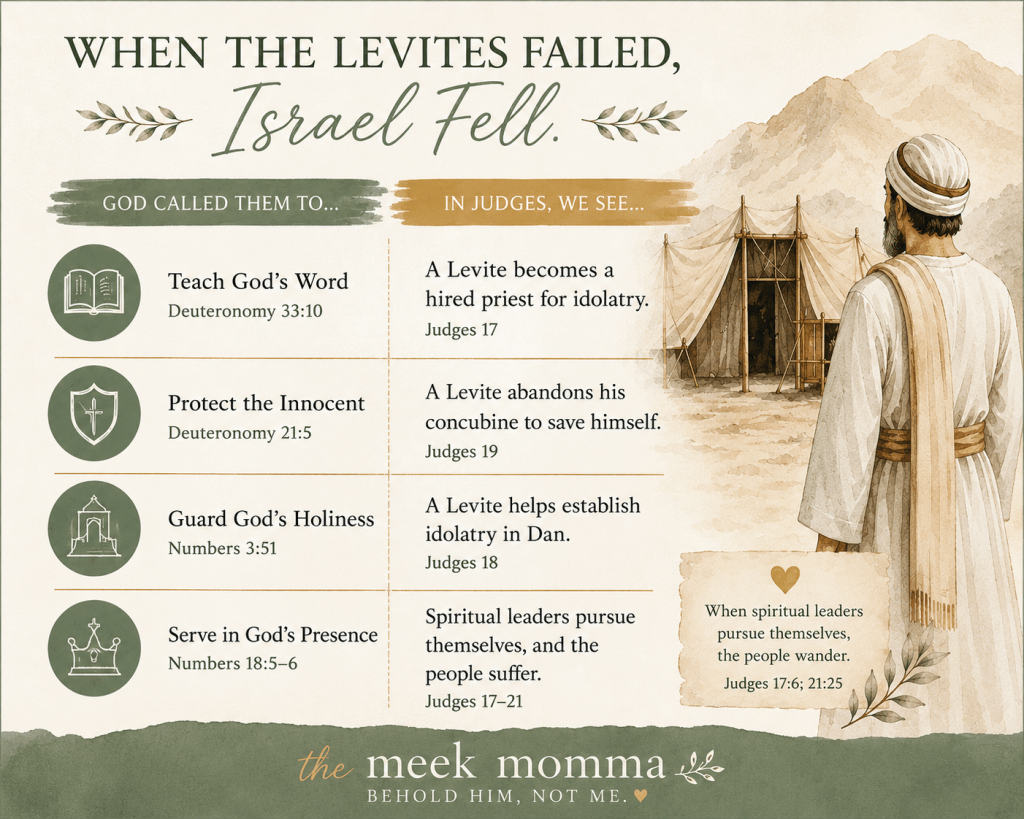
Once again, a Levite stands near the center of the story.
That should trouble us.
The Levites had been set apart for service connected to the worship of God.
If anyone should have known the Word of God, it was a Levite.
If anyone should have understood covenant faithfulness, justice, holiness, and the value of belonging to God, it was a Levite.
Yet the Levite in Judges 19 is not presented as a faithful spiritual leader.
He is part of the problem.
The chapter begins by introducing his concubine, who leaves him and returns to her father’s house in Bethlehem.
After four months, the Levite travels to persuade her to return.
Her father welcomes him enthusiastically.
For several days, the men eat, drink, and delay the journey.
Eventually, the Levite insists on leaving.
The decision is made late in the day.
As darkness approaches, the servant suggests that they stop in Jebus, the city that would later become Jerusalem.
But the Levite refuses.
Jebus is inhabited by foreigners.
He does not want to spend the night among people who are not Israelites.
Instead, he chooses to continue to Gibeah.
Surely they will be safer among the people of God.
They are not.
When Israel Became Sodom
The travelers arrive in Gibeah, a city belonging to the tribe of Benjamin.
They sit in the town square.
No one welcomes them.
Eventually, an old man returning from his work in the fields sees them and offers hospitality.
Then the story begins to sound disturbingly familiar.
The men of the city surround the house.
They demand that the Levite be brought outside so that they can sexually assault him.
The deliberate connection to Genesis 19 is difficult to miss.
In Genesis, the men of Sodom surround Lot’s house.
In Judges, the men of Gibeah surround the old man’s house.
In Genesis, the mob demands the male visitors.
In Judges, the mob demands the Levite.
The language is similar.
The circumstances are similar.
The depravity is similar.
But there is one devastating difference.
Gibeah is not a Canaanite city.
Gibeah belongs to Israel.
God had called Israel to be holy.
God had separated them from the nations.
God had given them His Word.
God had placed His name among them.
God had called them to display His character to the world.
But now the people who were supposed to be different have become indistinguishable from the people they were commanded not to imitate.
Israel has become Sodom.
This may be one of the most terrifying warnings in the entire book of Judges.
The people of God can live among the things of God, possess the Word of God, use the name of God, and still become increasingly unlike God.
Spiritual privilege does not make anyone immune to spiritual decay.
A people who repeatedly refuse to listen to God can eventually become unrecognizable as His people.
The Failure of Every Man in the Story
There are no heroes in Judges 19.
The men of Gibeah are wicked.
But they are not the only men who fail.
The old man offers the women of the household to the mob.
The Levite sends his concubine outside.
The men abuse her throughout the night.
In the morning, she collapses at the doorway of the house.
And when the Levite opens the door, he says:
“Get up, let us be going.”
There is no recorded grief.
No tenderness.
No attempt to help her.
No acknowledgment of what she has suffered.
When she does not respond, he places her body on his donkey and returns home.
The woman at the center of the story is repeatedly acted upon.
Men decide where she will go.
Men decide what will happen to her.
Men sacrifice her safety to protect themselves.
Men violate her.
Men speak over her.
Men use her death for their own purposes.
She is never given a voice.
And that silence is part of the horror.
The further Israel moves from the rule of God, the more vulnerable people suffer.
Throughout Scripture, the treatment of the vulnerable is repeatedly connected to the spiritual condition of God’s people.
When people love God, they are commanded to love their neighbor.
When people fear God, they are forbidden from using power merely for their own advantage.
When people reject God’s authority, power becomes something to seize, protect, and use.
Judges 19 shows us a society in which nearly everyone is protecting himself.
And the person with the least power pays the highest price.
The Banality of Evil
One of the most disturbing things about the final chapters of Judges is how ordinary everyone seems.
These are not monsters from another world.
They travel.
They eat meals.
They extend hospitality.
They have families.
They speak about God.
They belong to tribes.
They participate in religious life.
And yet beneath the ordinary surface lies profound moral corruption.
Evil does not always announce itself dramatically.
Sometimes it grows quietly.
Compromise after compromise.
Excuse after excuse.
Desire after desire.
People gradually become accustomed to what once would have horrified them.
Sin becomes normal.
Consciences become dull.
People learn to live with contradictions.
They speak the language of faith while living according to their own desires.
The final chapters of Judges show us what happens when rebellion becomes ordinary.
The people do not merely commit isolated acts of sin.
They inhabit an entire moral world in which everyone is doing what is right in his own eyes.
The Woman at the Door
There is an image near the end of the chapter that is difficult to forget.
Morning comes.
The door opens.
And the woman is lying at the threshold with her hands on the doorway.
She had almost reached shelter.
But the door remained closed.
There are times when careful Bible study requires us to resist the urge to turn every detail into a metaphor.
This woman does not need to become a symbol before we are willing to grieve what happened to her.
She was a person made in the image of God.
And she was treated as disposable.
The text does not give us her name.
But God saw her.
The men in this chapter use her.
Ignore her.
Abandon her.
Violate her.
Dismember her.
But the God who inspired Scripture does not allow Israel to forget her.
Her suffering becomes part of the testimony against a nation that has rejected its King.
Her presence in Scripture reminds us that God does not look away from the suffering human beings would prefer to ignore.
The Bible bears witness to victims whom powerful people would rather leave unnamed.
The God Who Saw Me Too
There is a reason I cannot read Judges 19 from a safe distance.
I know what it is like to be sexually abused.
For a long period of my life, I was sexually abused by my father. I was also sexually and physically abused by other men.
I know something of the deep wounds these kinds of sins leave behind.
I know what it is like to carry questions you do not know how to ask.
Does God see me?
Does He care about what happened?
Will there ever be justice?
Am I still worthy of being loved?
For many years, I did not know how to bring those questions to God. I did not know how to process what had happened to me within my theology.
Then I began learning to slow down when I read Scripture.
I stopped rushing past difficult passages.
I stopped assuming that the darkest stories in the Bible were obstacles to faith that needed to be explained away as quickly as possible.
And I began to see something I had missed.
God does not hide what evil does to people.
He does not call evil good.
He does not ask us to pretend that suffering does not matter.
He does not look away from the people others would prefer to forget.
Judges 19 does not allow us to forget this woman.
The text does not give us her name, but God preserved the testimony of what was done to her.
Her suffering is not hidden.
The evil committed against her is not erased.
Generation after generation has been forced to reckon with what happened in Gibeah because God allowed her story to remain in His Word.
And as I learned to see her, I began to understand more deeply that God saw me too.
I thought about Hagar.
She was a woman caught within the sinful decisions and abuses of power of other people.
She fled into the wilderness.
And there, the angel of the LORD found her.
He called her by name.
“Hagar, servant of Sarai, where have you come from and where are you going?”
— Genesis 16:8
Hagar responded by giving God a name:
“You are a God of seeing.”
She said:
“Truly here I have seen Him who looks after me.”
— Genesis 16:13
Later, Hagar would find herself in the wilderness again, believing she was about to watch her son die.
She wept.
God heard.
And the angel of God called to her from heaven.
These passages began changing the way I understood God.
The God of Scripture is not the author of evil.
He is good.
He is just.
He sees.
He hears.
He knows.
And because He is faithful, He will keep every promise He has made.
That means evil will not be ignored forever.
Those who have harmed others will answer to God’s perfect justice.
Some of us may see justice in this life.
Some of us may not.
Human courts may fail.
People may refuse to believe us.
Those who committed evil may never acknowledge what they have done.
But there is no hidden thing that will remain hidden before the judgment of God.
The Judge of all the earth will do what is just.
For me, that truth did not make forgiveness unnecessary.
It made forgiveness possible.
I began to understand that forgiveness does not require me to call evil good.
It does not require me to pretend that justice does not matter.
It does not require me to deny what happened.
I can entrust final judgment to the God who sees perfectly, knows completely, and judges righteously.
And I can bring my wounds to Jesus.
The One who sees Hagar in the wilderness is the same God who came near to us in Christ.
Jesus saw women others ignored.
He welcomed people others rejected.
He touched those others considered unclean.
He drew near to the suffering.
He was betrayed.
He was stripped.
He was mocked.
He was beaten.
He was crucified.
And He willingly bore the judgment for sin so that sinners could be reconciled to God.
The cross taught me that God does not minimize evil.
Sin is so serious that the Son of God gave His life to save sinners from it.
And the resurrection taught me that evil, suffering, and death will not have the final word.
Slowly, the Old Testament and the New Testament began coming together for me.
The God who saw Hagar is the God who saw me.
The God who refused to let Israel forget the unnamed woman of Judges 19 had not forgotten me.
The righteous Judge before whom every evil will one day be exposed is also the Father who received me through His Son.
I began to understand that Jesus loved me deeply.
I began to receive the love of God instead of believing that what had been done to me determined my worth.
I began to seek forgiveness for my own sins.
I began learning to forgive others.
And I began trusting God with the justice I could not accomplish for myself.
These passages did not destroy my faith.
They deepened it.
They taught me that I do not need a Bible that looks away from evil.
I need a God who sees it more clearly than I ever could.
I do not need a God who offers shallow explanations for suffering.
I need the God who enters our suffering, judges with perfect justice, saves sinners through the blood of His Son, and promises that one day He will make all things new.
If you have experienced sexual violence, physical abuse, or other deep wounds, or if you love someone who has, I want you to know why I am willing to remain in difficult passages like Judges 19.
It is because I have found that slowing down in these passages has helped me know God more deeply.
You do not have to pretend that evil is less evil in order to trust Him.
You do not have to silence your grief.
You do not have to be afraid of your questions.
Bring them into the light of Scripture.
Learn the character of the God who sees.
Learn the justice of the God who will judge rightly.
Learn the mercy of the Savior who receives sinners.
Learn the love of the Father who gave His Son so that all who trust in Him might be reconciled to God.
My prayer is not merely that you will make it through the difficult chapters of the Bible with your faith intact.
My prayer is that, as you slow down and see the God who has revealed Himself there, your faith will deepen too.
The God who saw Hagar sees.
The God who preserved the testimony of the unnamed woman remembers.
The God who gave His Son saves.
And the King who is coming will judge the world in righteousness.
Come and see the God who sees.
Where Is God?
One of the unsettling realities of Judges 19 is the apparent silence of God.
There is no divine speech.
No angel appears.
No miracle interrupts the violence.
No deliverer arrives.
Where is God?
The answer is not that God has disappeared.
The entire book has shown us a people repeatedly refusing to listen to Him.
God has spoken.
Israel possesses His covenant.
Israel has His law.
Israel knows His commands.
The tragedy is not that God failed to reveal what righteousness looks like.
The tragedy is that Israel has rejected what God has revealed.
We must also be careful not to confuse God’s silence in the narrative with God’s indifference to suffering.
The chapter itself stands as testimony against Israel.
God has preserved the record of what happened.
The evil in Gibeah is not hidden from Him.
The suffering of the woman is not forgotten.
Judges 19 shows us what life looks like when human beings insist upon doing what is right in their own eyes.
And it leaves us longing for judgment, rescue, and a righteous King.
Outrage Is Not Repentance
The Levite takes the woman’s body and divides it into twelve pieces.
He sends the pieces throughout the territory of Israel.
The act is horrifying.
The response is immediate.
The people of Israel say:
“Such a thing has never happened or been seen from the day that the people of Israel came up out of the land of Egypt until this day; consider it, take counsel, and speak.”
Israel is finally shocked.
After years of idolatry.
After generations of compromise.
After repeated rejection of God’s covenant.
After everyone has done what is right in his own eyes.
Israel has finally found a sin terrible enough to produce national outrage.
But outrage is not the same thing as repentance.
It is possible to be horrified by the sins of others while remaining blind to the sin within ourselves.
It is possible to correctly identify evil and still respond to evil in ways that reveal our own estrangement from God.
That is where Judges 20 will take us.
The nation will gather.
The people will demand justice.
A civil war will begin.
Thousands will die.
And the people who are outraged by Gibeah will continue demonstrating that the deepest problem in Israel cannot be contained within one city.
The problem is everywhere.
The Road to Gibeah Was Longer Than One Night
Israel did not become Sodom overnight.
The violence of Judges 19 is the fruit of seeds planted throughout the entire book.
Israel compromised with the Canaanites.
Israel tolerated idolatry.
Israel abandoned covenant faithfulness.
Israel repeatedly cried out to God when suffering became unbearable, only to return to rebellion when relief arrived.
Israel treated God as a means of obtaining blessing rather than as their King.
By Judges 17, Micah has created his own religion.
By Judges 18, the tribe of Dan has established institutionalized idolatry.
By Judges 19, Israel has become Sodom.
This is the trajectory of sin.
Sin rarely tells us where it intends to take us.
It asks only for the next compromise.
The next excuse.
The next small act of disobedience.
The next moment when we decide that what seems right in our own eyes matters more than what God has said.
Judges 19 forces us to see the destination.
We Need a Righteous King
The book of Judges has shown us judge after judge.
Some were faithful.
Some were deeply flawed.
Some delivered Israel from external enemies while remaining unable to change the hearts of God’s people.
But now there is no judge.
There is no deliverer.
There is no faithful leader standing between the vulnerable and those who would destroy them.
The repeated refrain tells us what Israel lacks:
“In those days there was no king in Israel.”
But Israel does not merely need someone wearing a crown.
Israel needs a righteous King.
A King who will not exploit the weak.
A King who will not sacrifice others to save Himself.
A King who knows the Word of God and obeys it perfectly.
A King who sees the forgotten.
A King who defends the vulnerable.
A King who judges evil without becoming evil.
A King who can deal not only with the enemies surrounding God’s people, but with the sin dwelling within them.
Judges leaves us longing for such a King.
The gospel tells us His name.
The King Who Gave Himself
The men in Judges 19 preserve themselves by giving up someone else.
Jesus does the opposite.
Christ does not sacrifice the vulnerable to save Himself.
He gives Himself to save sinners.
The Good Shepherd does not abandon the sheep when the wolves come.
He lays down His life for the sheep.
Jesus does not use His power to protect Himself from suffering.
He willingly enters suffering.
He is betrayed.
He is mocked.
He is beaten.
He is condemned.
He is crucified.
Not because humanity is innocent.
But because humanity is guilty.
At the cross, we see both the horror of human sin and the holiness of God.
The cross does not minimize evil.
It reveals how serious sin truly is.
The righteous King bears judgment in the place of His people.
Judges 19 shows us human beings sacrificing others to save themselves.
The gospel shows us the Son of God giving Himself to save sinners.
Jesus Christ is the King Israel needed.
And He is the King we need.
The King Who Sees
Judges 19 reminds us that human beings can overlook suffering.
Communities can normalize injustice.
Religious people can become indifferent.
Powerful people can protect themselves.
Victims can remain unnamed.
But God sees.
God hears.
God knows.
And God will judge rightly.
The gospel does not ask us to pretend evil is less terrible than it is.
The gospel tells us that evil will not have the final word.
Jesus Christ was crucified.
Jesus Christ was buried.
Jesus Christ rose from the dead.
Jesus Christ reigns.
And one day the King who sees every injustice will judge the world in righteousness.
Every hidden thing will be brought into the light.
Every wrong will be answered according to perfect justice.
For those who belong to Christ, the promise of His kingdom means that suffering, violence, injustice, and death will not endure forever.
The King is coming.
Behold Him, Not Me
Judges 19 is difficult to read because it shows us what human beings become when we reject the rule of God.
Israel was called to be holy.
Israel was called to be different.
Israel was called to display the character of God among the nations.
Instead, Israel became Sodom.
The warning should humble us.
We should never assume that religious language, biblical knowledge, church attendance, ministry involvement, or spiritual heritage makes us immune to compromise.
We need more than outrage over the sins of the world.
We need more than moral reform.
We need more than better circumstances.
We need new hearts.
We need forgiveness.
We need righteousness we cannot produce for ourselves.
We need a King.
Judges leaves us searching for Him.
The rest of Scripture tells us His name.
Jesus Christ.
The righteous King.
The faithful Shepherd.
The One who sees the forgotten.
The One who judges with perfect justice.
The One who gave Himself to save sinners.
When everyone does what is right in his own eyes, look to the King.
When the world becomes accustomed to evil, look to the King.
When religious people fail, look to the King.
When human justice proves insufficient, look to the King.
When the darkness seems unbearable, look to the King.
Behold Him.
Heart Check
Am I more skilled at identifying the sins of others than examining the compromises within my own heart?
Have I become comfortable with things that Scripture calls evil?
Are there areas of my life where personal preference has become more authoritative than the Word of God?
Do I assume that being surrounded by Christian things is the same as faithfully following Christ?
How do I respond when obedience to Jesus requires me to protect, serve, or speak for people who have less power than I do?
Do I merely feel outrage over evil, or does the reality of sin lead me toward repentance, prayer, obedience, and trust in Christ?
Where am I tempted to protect myself at the expense of others?
Do I truly believe that Jesus is the righteous King I need—not only to judge the evil around me, but to save me from the sin within me?
Prayer
Father,
Judges 19 is difficult to read.
The violence is horrifying. The suffering is real. The depth of human sin is difficult to comprehend.
Yet Your Word refuses to hide what happens when people reject Your rule and do what is right in their own eyes.
Search my heart.
Show me where I have become comfortable with compromise.
Show me where I am quicker to condemn the sins of others than to repent of my own.
Guard me from a faith that knows Your Word but refuses to submit to it.
Teach me to see people as those made in Your image.
Give me courage to protect the vulnerable, speak truth, pursue justice, and refuse to make peace with evil.
For those reading who carry wounds caused by the evil of others, draw near to them.
Help them know that You see.
Help them know that You hear.
Help them know that evil is not hidden from You and that Your justice will not fail.
Lead them to the Savior who receives sinners, binds up the brokenhearted, and will one day make all things new.
And when the darkness of human sin feels overwhelming, turn our eyes toward Christ.
Thank You for giving us the King we could never produce for ourselves.
Thank You that Jesus did not sacrifice others to save Himself, but willingly gave Himself to save sinners.
Thank You that He sees the forgotten, receives the repentant, judges rightly, and reigns forever.
Why Their Story Matters—Especially in the Book of Judges
“In those days there was no king in Israel. Everyone did what was right in his own eyes.” — Judges 21:25
If you’ve been reading through the final chapters of Judges, you’ve probably noticed something surprising.
The main characters aren’t kings.
They aren’t judges.
Instead, the narrative repeatedly places Levites at the center of Israel’s darkest moments.
A Levite serves as priest in an idolatrous household (Judges 17–18).
Another Levite abandons his concubine to protect himself (Judges 19).
Why?
Because the author wants us to see something deeper than political chaos.
He wants us to see spiritual collapse.
To understand why these stories are so shocking, we first need to understand who the Levites were and what God had called them to be.
Read the Passage
Primary Reading:
Genesis 49:5–7
Exodus 32:25–29
Numbers 3:5–13
Numbers 8:5–26
Deuteronomy 10:8–9
Deuteronomy 33:8–11
Judges 17–21
Observe the Text
Before we ask what these passages mean, notice a few repeated themes.
God Himself chose the Levites.
They belonged to Him in a unique way.
They were scattered throughout Israel.
They had no tribal inheritance of land.
Their lives revolved around worship.
Their purpose was to help Israel remain faithful to the covenant.
Yet by Judges 17–21…
they are doing the exact opposite.
Who Were the Levites?
The Levites were descendants of Levi, one of the twelve sons of Jacob.
Unlike the other tribes, they were never intended to become wealthy landowners.
Instead, God declared:
“The LORD is their inheritance.”
Think about that.
Every other tribe received fertile valleys, vineyards, fields, and cities.
The Levites received something far greater.
They received the privilege of belonging wholly to God.
Their identity wasn’t rooted in possessions.
It was rooted in God’s presence.
From Judgment to Grace
Levi’s story doesn’t begin well.
In Genesis 34, Levi and his brother Simeon responded to the assault of their sister Dinah by slaughtering an entire city.
Years later, Jacob declared:
“I will divide them in Jacob and scatter them in Israel.”
At first glance, this sounds like nothing but judgment.
Yet God, in His mercy, transformed that judgment into a blessing.
Rather than being scattered in disgrace, the Levites were scattered throughout Israel so every tribe would have teachers of God’s Word living among them.
Only God can redeem a curse into a calling.
Why Did God Choose the Levites?
The defining moment comes after Israel worshiped the golden calf.
While the nation bowed before an idol, Moses cried out:
“Who is on the LORD’S side?”
Only the Levites responded.
Because of their zeal for God’s holiness, the Lord formally set them apart for His service.
They became Israel’s ministers, teachers, guardians, and servants of the Tabernacle.
What Were They Called to Do?
The Levites weren’t simply ancient church janitors.
Their responsibilities touched every part of Israel’s spiritual life.
They guarded God’s dwelling.
They cared for the Tabernacle.
They transported it.
They protected it from being treated as ordinary.
They taught God’s Word.
The Levites instructed Israel in God’s Law.
They explained the covenant.
They answered difficult questions.
They helped people distinguish truth from error.
They preserved holiness.
Again and again, Scripture connects the Levites with the distinction between holy and common, clean and unclean.
Their lives continually reminded Israel:
God is holy.
They shepherded God’s people.
Though they held no throne, they exercised tremendous spiritual influence.
They were meant to lead Israel toward faithful worship.
Their Greatest Possession
Perhaps the most beautiful truth about the Levites is this:
They received no inheritance because God Himself was their inheritance.
This wasn’t a punishment.
It was a privilege.
Their lives declared:
Nothing is greater than belonging to the Lord.
Then Comes Judges…
Now everything changes.
The Levites who once destroyed idols…
begin serving idols.
The Levites who once guarded holiness…
participate in profound wickedness.
The Levites who should have defended the vulnerable…
exploit them.
This is why the stories in Judges are so disturbing.
The author isn’t simply showing us that Israel sinned.
He’s showing us that even Israel’s spiritual leaders have become indistinguishable from the surrounding nations.
Israel hasn’t merely failed to remove Canaanite influence.
Israel has become Canaanite.
The Tragedy of Judges
Notice the progression.
In Exodus…
the Levites answer God’s call.
In Judges…
they answer the highest bidder.
In Exodus…
they defend true worship.
In Judges…
they help establish false worship.
In Exodus…
they stand for God’s holiness.
In Judges…
they abandon righteousness to protect themselves.
The nation’s spiritual decline is visible in the very people who were supposed to lead it.
Behold Christ
Every faithful Levite pointed forward to a greater Priest.
Every corrupt Levite reminded Israel they still needed Him.
The Levites guarded God’s house.
Jesus is the true Temple.
The Levites offered sacrifices.
Jesus became the sacrifice.
The Levites taught God’s Law.
Jesus is the Word made flesh.
The Levites entered God’s presence on behalf of the people.
Jesus opened the way into God’s presence forever.
The Levites failed repeatedly.
Christ never failed once.
Where Judges leaves us longing for faithful spiritual leadership, the Gospel answers that longing in Jesus Christ, our perfect High Priest.
Examine Your Heart
As you reflect on the Levites, consider these questions:
Is my greatest inheritance God Himself, or have I come to treasure His gifts more than His presence?
Am I careful to distinguish between what God calls holy and what the world calls acceptable?
Where am I tempted to “do what is right in my own eyes” rather than submit to God’s Word?
How am I using whatever influence God has given me to point others toward Him?
Respond
Repent: Confess any tendency to seek comfort, approval, or success above faithfulness to God.
Believe: Trust that Christ is the perfect High Priest who never abandons His people.
Obey: Ask God to make your life a testimony to His holiness and grace.
Pray:
Father, thank You for preserving Your Word so that we might learn from both the faithfulness and failures of those who came before us. Guard my heart from doing what is right in my own eyes. Help me treasure You above every earthly inheritance, and teach me to look to Jesus, my perfect High Priest, who never fails to lead His people into Your presence. Amen.
If you’ve ever read Ecclesiastes, you know it can feel surprisingly heavy.
Traditionally attributed to Solomon—the son of David and king of Israel—Ecclesiastes is part of Scripture’s Wisdom Literature. It isn’t a book of commands telling us to despair or to chase pleasure while we can. Rather, it is a Spirit-inspired record of one man’s honest observations about life in a fallen world. Through poetic language, paradox, and reflection, Solomon invites us into holy wrestling with life’s hardest questions.
He exposes the emptiness of pursuing wisdom, wealth, pleasure, or achievement apart from God while calling us to something far better: to fear the Lord and trust Him, even when we cannot understand all that He is doing (Ecclesiastes 12:9–14).
This morning, I found myself lingering over Ecclesiastes 3.
“He has made everything beautiful in its time. Also, he has put eternity into man’s heart, yet so that he cannot find out what God has done from the beginning to the end.” — Ecclesiastes 3:11 (ESV)
The Hebrew word translated “beautiful” is yāpeh, which carries the idea of something that is fitting, appropriate, or timely—not merely attractive.
That changes how I read this verse.
God isn’t promising that every season will feel beautiful.
He is promising that every season has a fitting place within His perfect plan.
There is a time to plant and a time to harvest.
A time to weep and a time to laugh.
A time to mourn and a time to dance.
While our lives often feel uncertain, fragmented, and fleeting, every season is held securely in the hands of a sovereign God.
Ecclesiastes also tells us that God has “put eternity into man’s heart.” We were created to long for something this world can never fully satisfy. That longing isn’t a flaw—it’s evidence that we were made for more. We were created for God Himself.
This is why so much of life can feel like chasing the wind. No amount of success, comfort, possessions, or earthly wisdom can quiet the longing for eternity that God has placed within us.
Yet Solomon doesn’t leave us in despair.
Just a few verses later he writes:
“I perceived that whatever God does endures forever; nothing can be added to it, nor anything taken from it. God has done it, so that people fear before him.” — Ecclesiastes 3:14
Our work is temporary.
God’s work is eternal.
Our plans change.
His purposes never fail.
Our understanding is limited.
His wisdom is perfect.
What feels like chaos to us is never outside His sovereign care.
The Apostle Paul echoes this same hope when he reminds us that creation itself has been subjected to futility because of the Fall, yet it eagerly awaits the day of redemption (Romans 8:20–23). One day, every longing will find its fulfillment in Christ, and what is now broken will be made whole.
Until then, faith does not require us to understand everything.
It calls us to trust the One who does.
Today’s Takeaway
Every season—from planting to harvesting, from mourning to dancing—is held in God’s hands. What feels fleeting is part of His eternal plan, and in His perfect wisdom, He makes everything fitting in its time.
Sometimes the most faithful thing we can do is stop demanding to know the whole story and instead rest in the Author who is writing it.
“The most dangerous idols are often the ones we create in God’s name.”
A Note to Readers
As we continue our journey through Judges, some readers may be wondering why there are still five chapters left in the book. After all, Samson was the last of Israel’s twelve judges.
The answer is that the final chapters of Judges are not a continuation of the judges’ cycle. Instead, they serve as a double conclusion to the entire book.
Earlier chapters gave us a bird’s-eye view of Israel’s history. We watched cycles of sin, oppression, repentance, and rescue unfold across generations. We saw judges rise and fall. We witnessed God’s mercy displayed again and again toward a people who continually wandered from Him.
Now the author zooms in.
The final chapters provide a ground-level view of what life actually looked like during those dark days.
These stories are not primarily about foreign enemies.
They are about the spiritual condition of God’s people themselves.
The middle of Judges showed us how God repeatedly rescued Israel.
The final chapters show us what He was rescuing them from.
And what we find is sobering.
Again and again we will hear the refrain:
“In those days there was no king in Israel. Everyone did what was right in his own eyes.” (Judges 17:6)
That verse is not merely describing Israel.
It is describing the human heart apart from God’s rule.
Judges 17 is our first case study.
And what makes this story so unsettling is that it is not a story about atheism.
It is a story about religion.
Lots of religion.
The problem is that it is religion shaped by human preference rather than God’s revelation.
It is worship that looks right but isn’t.
It is devotion that sounds sincere but is fundamentally distorted.
And if we are honest, it is a temptation that remains just as dangerous today.
A Hollow Man
The story begins with a man named Micah from the hill country of Ephraim.
Micah had stolen eleven hundred shekels of silver from his mother. Later, after hearing her pronounce a curse upon the thief, he confesses and returns the money.
At first glance, Micah is difficult to categorize.
He does not appear thoroughly wicked.
After all, he returns the money.
Yet neither does he appear righteous.
A righteous man would never have stolen it in the first place.
The text gives us the impression of a weak man with weak convictions—a man moved more by fear than by conscience.
A man without much moral substance.
Perhaps that is what makes him so relatable.
Most people do not see themselves in Pharaoh.
Or Jezebel.
Or Judas.
But many of us can recognize compromise.
We recognize drift.
We recognize moments when fear of consequences moved us more than love for righteousness.
Micah is not a monster.
He is simply a man doing what seems right in his own eyes.
And that is exactly the problem.
Grace Without Repentance
Micah’s mother responds by reversing her curse and pronouncing a blessing over him.
There is something admirable in her willingness to forgive.
Yet there is also something deeply concerning.
She quickly restores the relationship without ever addressing the deeper issue.
There is blessing.
But no repentance.
Restoration.
But no transformation.
No examination of Micah’s heart.
No discussion of why he stole the money.
No acknowledgment of his need for grace.
No call to humility.
As parents, this is an important warning.
A condemning parent can wound a child.
But an excusing parent can wound a child as well.
True love does not merely remove consequences.
It seeks the transformation of the heart.
Micah’s mother appears eager to move past the offense, but in doing so she misses the opportunity to shepherd her son toward genuine repentance.
And as the story unfolds, we will see that Micah remains exactly the same man he was before.
Forgiveness is beautiful.
But biblical restoration always aims at something deeper than simply making conflict disappear.
It aims at reconciliation with God.
The God We Want vs. The God Who Is
The story takes an unexpected turn when Micah’s mother declares:
“I dedicate this silver to the Lord from my hand for my son, to make a carved image and a metal image.” (Judges 17:3)
If that sounds contradictory, it should.
She claims to dedicate the silver to the Lord.
Then she uses it to violate one of His clearest commands.
God had explicitly forbidden the making of images for worship:
“You shall not make for yourself a carved image…” (Exodus 20:4)
This was not a minor detail in Israel’s faith.
It was the Second Commandment.
So why was God so concerned about images?
The issue was never artistic ability.
The issue was theological accuracy.
Any image of God automatically reveals one aspect of His character while concealing others.
Consider Aaron’s golden calf in the wilderness.
The calf may have symbolized strength and power.
But it could not communicate God’s holiness.
His justice.
His mercy.
His wisdom.
His love.
Every image inevitably distorts what it attempts to represent.
God refuses to be reduced to something fashioned by human hands because He cannot be contained by human imagination.
Yet the deeper problem is not the image itself.
The deeper problem is the heart behind the image.
Worshiping God through images reveals a desire to reshape Him into someone we find more comfortable.
It is an attempt to edit God.
To soften the attributes we dislike.
To emphasize the attributes we prefer.
To create a version of God that fits our expectations.
Tim Keller observed that the fundamental problem behind idolatry is a refusal to let God be Himself.
In modern terms, it is a refusal to submit to God as He has revealed Himself.
And if we’re honest, we do this all the time.
Most of us do not carve idols out of silver.
But we often create versions of God in our minds.
How often have we heard someone say:
“I don’t believe in a God who would do that.”
Or:
“I like to think of God as…”
At first those statements sound thoughtful.
But they reveal something dangerous.
They place us in the position of deciding who God should be.
Instead of allowing Scripture to reveal God to us, we attempt to recreate Him according to our preferences.
Like Micah’s family, we begin shaping God instead of allowing God to shape us.
The Comfortable God
There are many ways we attempt to remake God.
Sometimes we do it intellectually.
We encounter something in Scripture that offends our modern sensibilities, so we quietly dismiss it.
We decide that God could not possibly mean what He says.
After all, our culture has progressed beyond such things.
Yet what we are really saying is that our culture has become the authority rather than God.
Other times we do it psychologically.
We simply avoid the parts of God’s character that make us uncomfortable.
Perhaps we love God’s grace but ignore His holiness.
Perhaps we celebrate His love but avoid His authority.
Perhaps we cling to His promises while neglecting His commands.
Still other times we do it practically.
We know what Scripture teaches.
Yet we follow our feelings instead.
We follow our desires instead.
We follow our culture instead.
And then we reassure ourselves by saying:
“I prayed about it.”
“I feel peace about it.”
But peace is not the measure of truth.
God’s Word is.
This is exactly what Micah’s family is doing.
They are not abandoning religion.
They are customizing it.
They follow the commands they like.
They ignore the commands they dislike.
They keep enough of God’s truth to feel spiritual while discarding enough of it to remain comfortable.
The most dangerous idols are often the ones we create in God’s name.
Why This Matters
A counterfeit god can never save us.
More than that, a counterfeit god can never truly know us.
Real relationships require wrestling.
A real person can disagree with you.
Correct you.
Challenge you.
Say no to you.
The same is true in our relationship with God.
When Scripture confronts us, we have an opportunity to wrestle honestly with Him.
To submit where we disagree.
To grow where we are resistant.
To deepen our understanding of His character.
But if we simply ignore every truth we dislike, we are not relating to God at all.
We are relating to a projection of ourselves.
We may have created a more comfortable god.
But we have also created a nonexistent one.
And that may be the most sobering lesson in Judges 17.
Micah’s greatest problem was not that he rejected God.
It was that he remade Him.
Jesus: The True Image
Micah’s mother believed she could fashion something with silver that would help her worship God.
Yet every image created by human hands inevitably distorts the One it seeks to represent.
But in Jesus Christ, God has given us the perfect image of Himself.
Paul writes:
“He is the image of the invisible God.” (Colossians 1:15)
Unlike Micah’s idol, Jesus does not distort God’s character.
He reveals it perfectly.
If we want to know what God is like, we do not look at statues.
We look at Christ.
In Jesus we see God’s holiness.
His mercy.
His justice.
His compassion.
His truth.
His love.
Micah attempted to create an image of God.
God gave us the real thing.
We never need to imagine what God is like.
God has shown us.
Behold Him, Not Me
Micah’s problem was not that he stopped worshiping.
His problem was that he wanted a version of God that fit comfortably inside his own preferences.
Every idol ultimately asks the same question:
Will I worship God as He is?
Or will I create a god I prefer?
The answer is not better religion.
The answer is Christ.
The true image of God.
As we continue through the closing chapters of Judges, may we learn to lay aside our preferences, our assumptions, and our attempts to remake God according to our own image.
May we instead allow God to reveal Himself through His Word and through His Son.
And may we learn, once again, to behold Him—not ourselves.
Heart Check Questions
• What parts of God’s Word do I most wish were different?
• Have I been wrestling honestly with those truths or avoiding them?
• Are there attributes of God I emphasize while ignoring others?
• Where am I tempted to shape God according to culture rather than Scripture?
• Am I worshiping God as He is—or as I would prefer Him to be?
Prayer
Father,
Forgive me for the ways I try to reshape You according to my preferences. Forgive me for the times I have emphasized the parts of Your character that comfort me while ignoring the parts that challenge me.
Thank You for revealing Yourself through Your Word and through Your Son. Thank You that I do not have to imagine what You are like because You have shown me in Jesus Christ.
Help me to worship You as You are, not as I wish You to be.
Give me humility where I resist Your truth.
Give me faith where I struggle to understand.
Give me courage to submit even when Your Word confronts my desires.
Teach me to behold Christ more clearly, trust Him more deeply, and follow Him more faithfully.
May I stop creating gods in my own image and instead be transformed into Yours.
In Jesus’ name,
Amen.
The most dangerous idols are often the ones we create in God’s name.