
Philippians 2:1–11
What does it look like to live a life worthy of the gospel?
In Philippians 1:27, Paul calls the church to live in a way worthy of Christ. As we enter chapter 2, he begins to show us what that looks like in our relationships with one another.
Philippians 2:1–4 gives us the foundation: because of what we have received from Christ, we can learn to live with greater unity and humility. Then, in verses 5–11, Paul points us to Christ Himself as the perfect example.
Because Christ Has Changed Us
Paul begins:
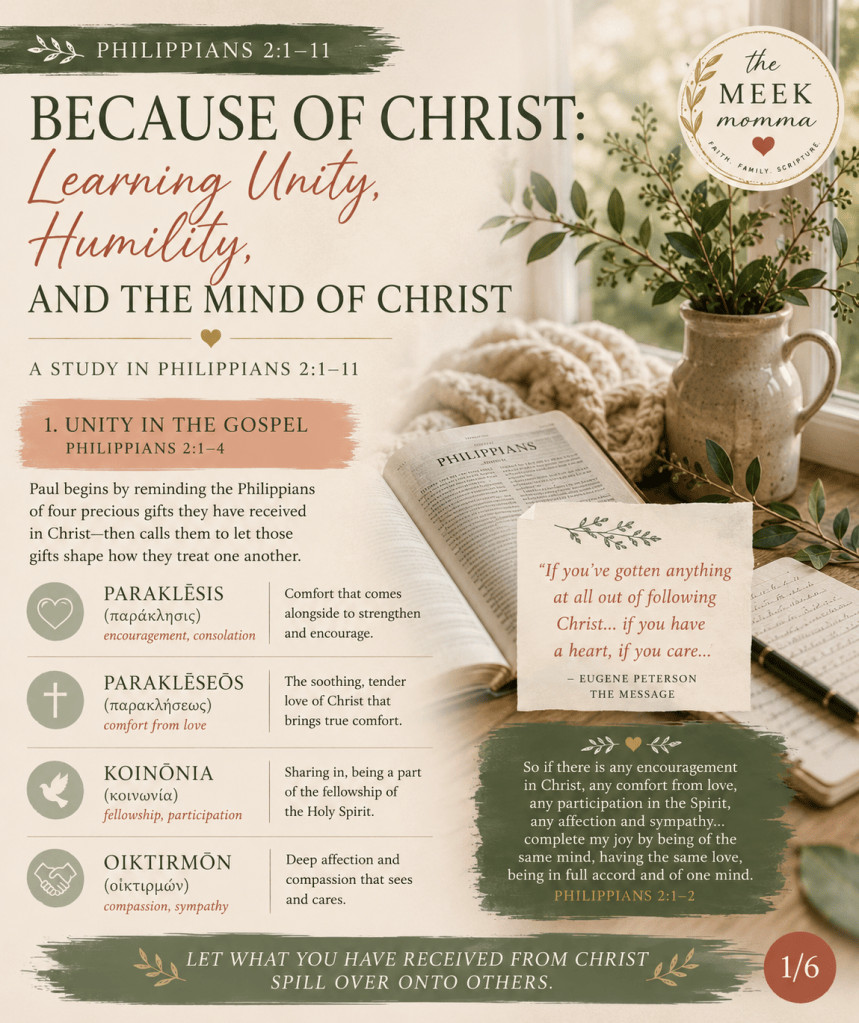
“So if there is any encouragement in Christ, any comfort from love, any participation in the Spirit, any affection and sympathy…”
The word if here is not expressing doubt. Paul is essentially saying, “Since these things are true…”
Since you have experienced encouragement in Christ, comfort from His love, fellowship in the Spirit, and His compassion, let those things shape the way you treat other people.
Eugene Peterson paraphrases the thought in The Message: “If you’ve gotten anything at all out of following Christ, if his love has made any difference in your life, being in a community of the Spirit means anything to you, if you have a heart, if you care…”
I love the simplicity of that. Paul isn’t asking the Philippians to manufacture unity and humility on their own. He is reminding them of what they have already received.
We have been loved, so we learn to love. We have been shown grace, so we extend grace. Christ has served us, so we learn to serve others.
That is the motivation behind Paul’s instruction.
Unity Without Sameness
Paul’s desire is that the Philippians would be “of the same mind, having the same love, being in full accord and of one mind.”
This does not mean they must all be identical. G. W. Hansen explains that Paul is not squelching human creativity or prohibiting personal diversity; he is calling believers to seek the same goal with a like mind.
Christian unity does not require uniformity. We can have different personalities, gifts, backgrounds, and perspectives while still being united around Christ and the gospel.
Revelation 7:9–10 gives us a beautiful picture of this: people from every nation, tribe, people, and language worshiping together before the throne. They are wonderfully diverse, but their worship is centered on the same Lord.
Paul wants the Philippians to share the same gospel-centered purpose, and he knows that humility is essential to maintaining that unity.
The Humility That Protects Unity
Paul continues:
“Do nothing from selfish ambition or conceit, but in humility count others more significant than yourselves.”
This is where Paul’s teaching becomes very practical. Unity is difficult when we are primarily concerned with ourselves—our preferences, our recognition, our comfort, our rights, or our desire to be right.
The Greek word translated humility is tapeinophrosynē (ταπεινοφροσύνη), carrying the idea of lowliness of mind or a humble disposition.
Biblical humility does not mean believing that we have no value. It means learning to think rightly about ourselves before God and allowing that right understanding to change how we treat others.
Humility makes room for another person. It is willing to listen, serve, yield a preference, celebrate someone else’s success, or use what God has given us for another person’s good.
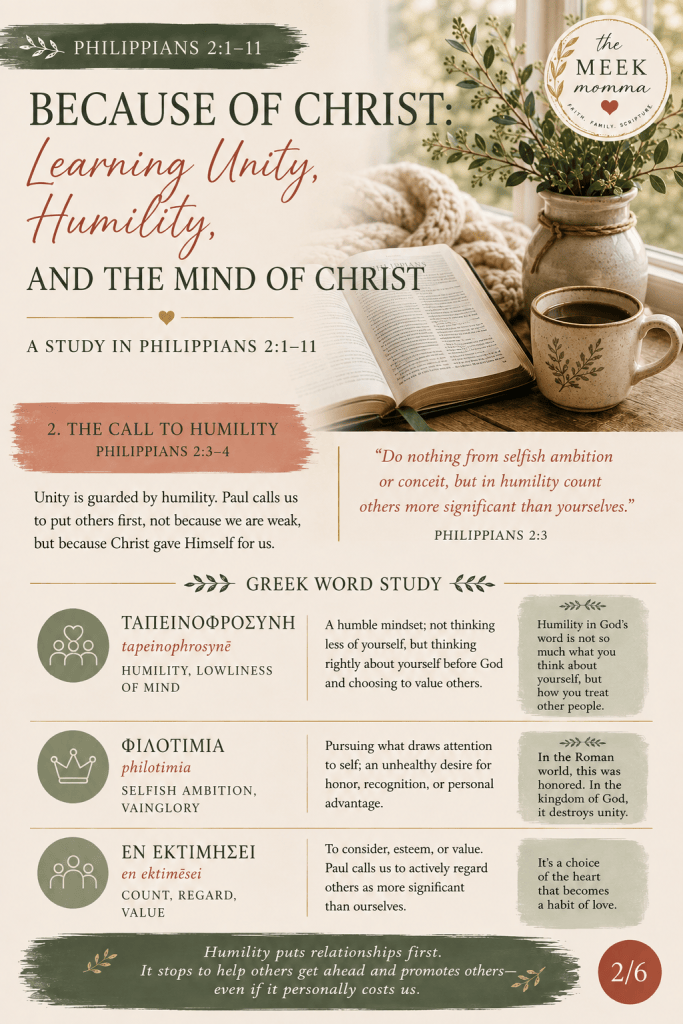
That would have sounded radically different in the ancient world. Humility was not generally admired as a virtue; it was associated with low status and weakness. Yet Christianity placed humility near the center of Christian character because our Savior Himself chose the path of humility.
Pastor Dan Hamel summarizes Paul’s logic well: in order for the Philippians to live a life worthy of the gospel, they must be united; and in order for them to be united, they must treat one another better than they treat themselves.
Gospel-shaped living produces gospel-shaped relationships.
Looking to the Interests of Others
Paul makes the application even clearer:
“Let each of you look not only to his own interests, but also to the interests of others.”
I think the word also is important. Paul isn’t telling us that our own needs don’t matter. He is telling us that they cannot be the only needs we see.
This is where Philippians 2 meets ordinary life—in marriage, parenting, friendship, church, work, and family. Humility becomes visible when our preferences are challenged and we have an opportunity to choose between self-interest and self-giving love.
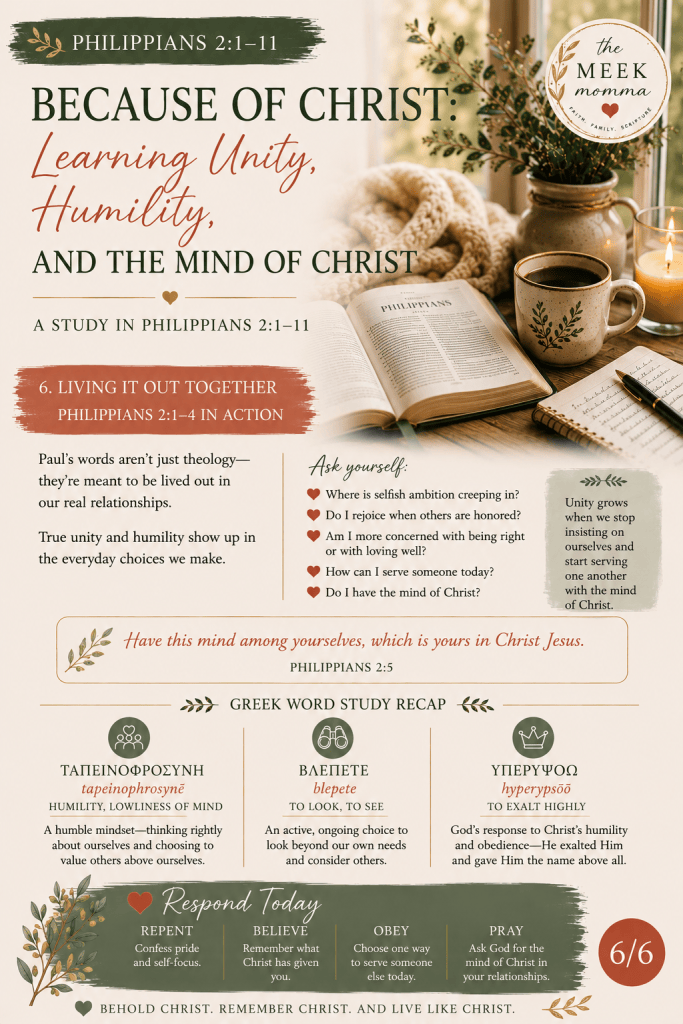
Where might I need to listen instead of insist? Where might I need to yield? Whose needs have I overlooked because I have been too focused on my own?
At this point, Paul’s instructions could feel almost impossible. Unity. Humility. Considering others more significant than ourselves. Looking to their interests.
How do sinful and self-protective people actually live this way?
Paul doesn’t tell us to try harder.
He says:
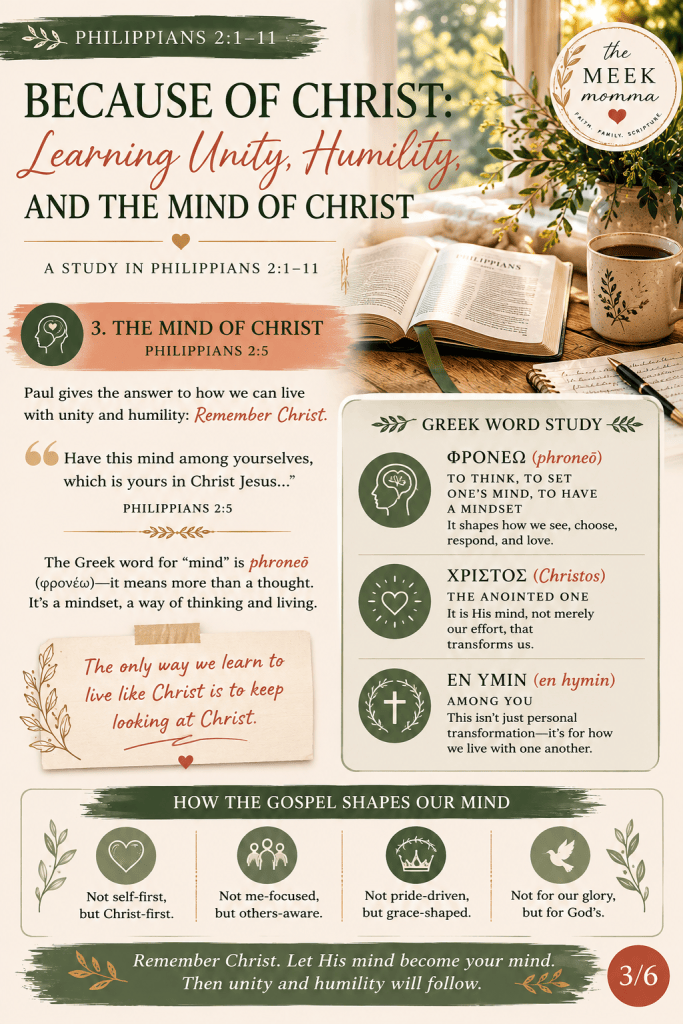
“Have this mind among yourselves, which is yours in Christ Jesus…”
And now Paul takes our eyes off ourselves and puts them on Christ.
Behold Christ
Philippians 2:5–11 is one of the most profound Christological passages in the New Testament. Paul has just told us to consider others more significant than ourselves, and then he shows us the One who did this perfectly.
William Barclay described this as one of the greatest and most moving passages Paul ever wrote about Jesus.
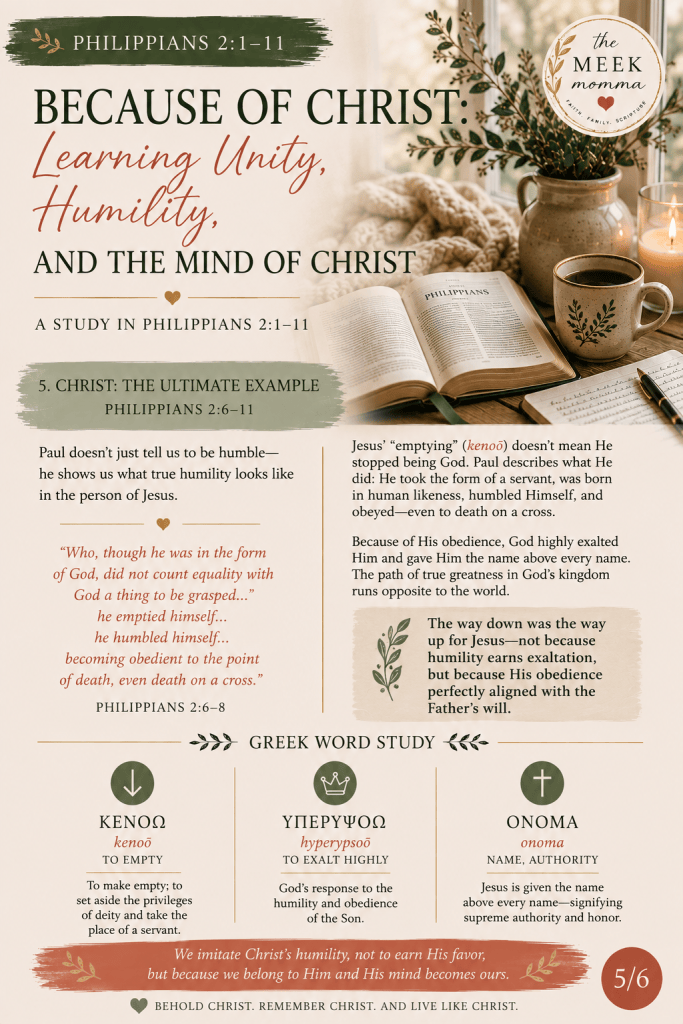
Christ, who existed in the form of God, humbled Himself. He took the form of a servant, became obedient, and went all the way to death—even death on a cross.
This is essential to understanding Christian humility. Paul is not simply giving us a moral example and saying, “Be nicer.” He is showing us the mindset of our Savior.
And when Paul says Christ “emptied himself,” we should not understand this to mean that Jesus stopped being God or surrendered His deity. The passage explains His self-emptying through what follows: He took the form of a servant and humbled Himself in obedience.
Christ’s humility was not a denial of who He was. It was the willing expression of who He was.
“Therefore God has highly exalted him…”
Christ humbled Himself, and the Father exalted Him.
The point isn’t that humility is a strategy for becoming important. The point is that Christ’s obedience was perfectly pleasing to the Father, and He is worthy of our obedience even when that obedience requires us to lay down our own desires.
This brings us back to verse 5:
“Have this mind among yourselves, which is yours in Christ Jesus.”
The Greek verb phroneō (φρονέω) refers not merely to a passing thought, but to a mindset or disposition—a way of thinking that shapes how we live.
Paul is calling believers to develop a Christ-shaped way of thinking.
Instead of always asking, “What do I want?” we begin asking, “How can I serve?” Instead of being consumed with recognition, we learn to rejoice when someone else is honored. Instead of insisting on our own way, we begin asking what love requires of us.
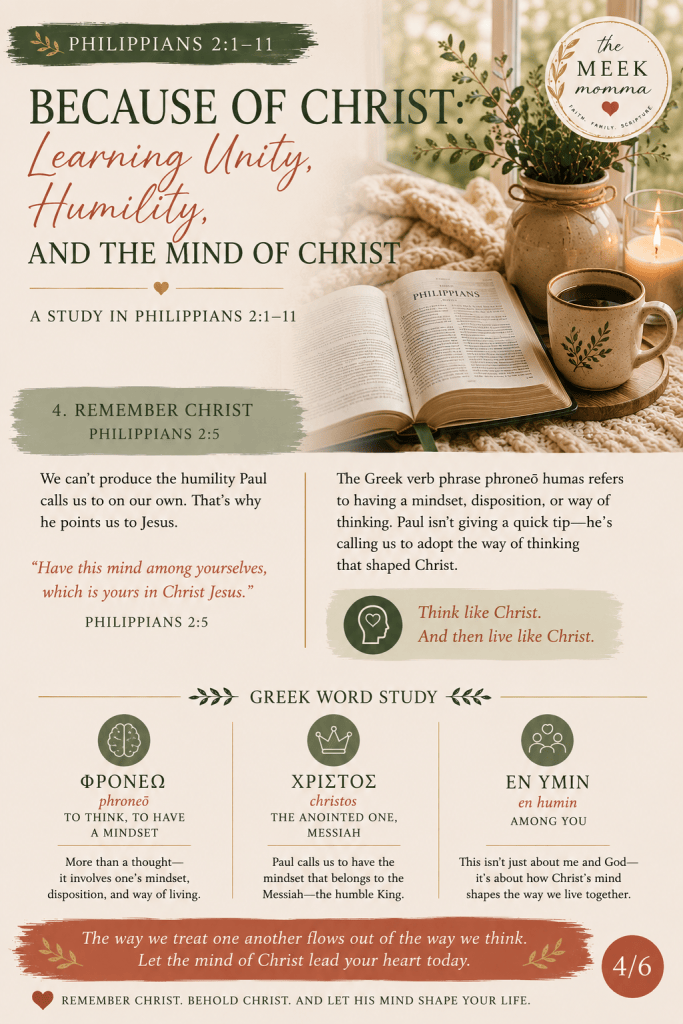
This is where theology becomes practice. The gospel changes how we see Christ, and seeing Christ changes how we see ourselves and others.
Philippians 2 makes me want to slow down and examine my own relationships.
This is especially worth considering in our homes. Paul’s teaching belongs in our marriages, our parenting, our friendships, and the everyday moments when we have to decide whether our own comfort or another person’s good will have greater weight.
Philippians 2 begins with unity and humility, but Paul doesn’t leave us staring at a command that feels impossible.
He gives us Jesus.
Christ is the pattern for our humility, but He is also the One we are ultimately called to behold. He humbled Himself, became a servant, obeyed the Father, and went to the cross. And the Father exalted Him.
So when humility feels difficult, we don’t simply look harder at ourselves. We look again at Christ.
He is worthy when we don’t get our way. He is worthy when serving costs us. He is worthy when obedience requires us to lay down our own desires.
We are sheep, not peacocks. We are servants, not sovereigns. And if Christ is to fill our lives, we must be willing to empty ourselves—not because we are worthless, but because He is worthy.



Leave a Reply