The book of Titus is a powerful reminder that sound doctrine should always lead to transformed living. In this short but rich letter, Paul urges the church to live in a way that reflects the truth of the gospel—marked by integrity, self-control, and a deep love for what is good.

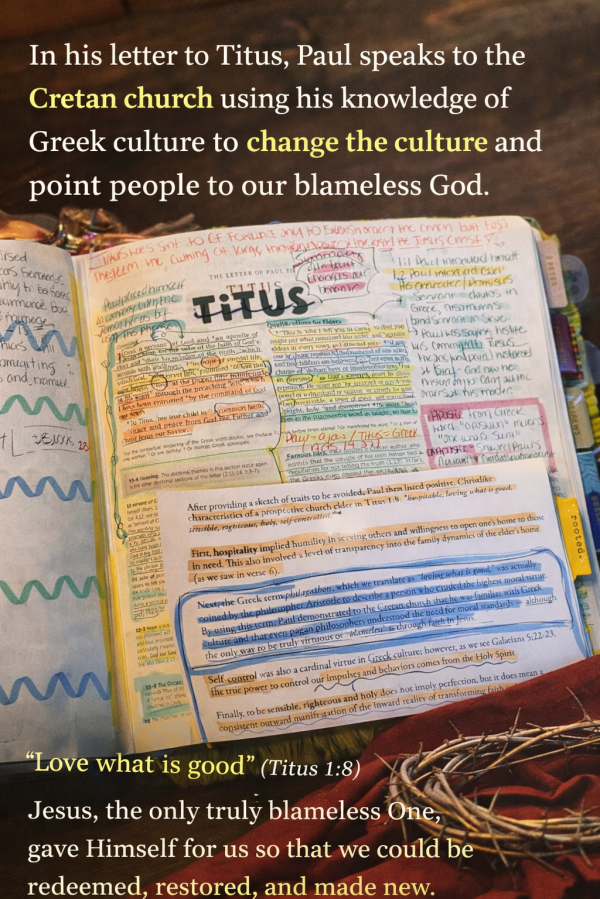
What’s incredible is how Paul engages the culture around him. He doesn’t ignore it—he understands it. When he calls believers to “love what is good,” he uses the Greek idea philagathon, a term familiar in their world and even used by philosophers like Aristotle to describe the highest moral virtue. Paul meets the Cretan people where they are, acknowledging that even their own thinkers recognized the need for goodness and moral standards—but then he points them to something greater: the only true source of blamelessness, Jesus Christ.

The same is true with self-control. Highly valued in Greek culture, yet ultimately unattainable in its fullness apart from God. As we see in Galatians 5:22–23, true self-control is not something we manufacture—it is fruit produced by the Holy Spirit within us.

To be sensible, righteous, and holy isn’t about perfection. It’s about a consistent outward life that reflects an inward transformation—a heart changed by faith in Jesus.

And this is where the beauty of Good Friday meets us. The call to live differently isn’t rooted in striving—it’s rooted in surrender. Jesus, the only truly blameless One, gave Himself for us so that we could be redeemed, restored, and made new.

This Good Friday, we remember: the gift is already given. Freedom is already offered. All that remains is to repent, believe, and receive the grace that changes everything.
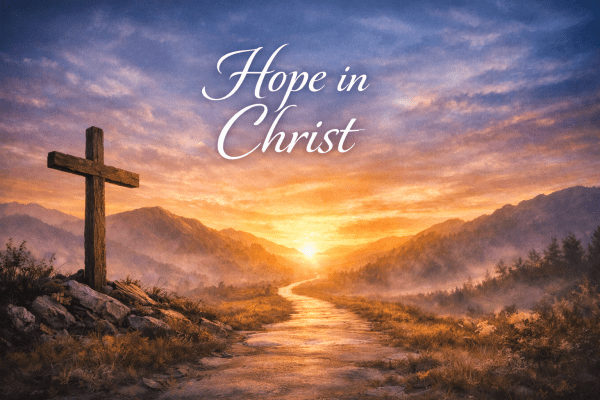
Deep dive through Titus this month.

God’s Faithful Promises (Titus 1:2)

A promise is only as good as the one who makes it. We measure trust by two things: a person’s character and their ability to follow through. When the apostle Paul opens his letter to Titus, he doesn’t start with instruction—he starts with God.

“in hope of eternal life, which God, who never lies, promised before the ages began”
‭‭Titus‬ ‭1‬:‭2‬ ‭ESV‬‬

He reminds us that God is both pure in character and perfect in capability. In this Epistle to Titus, we are told that God “cannot lie.” That simple truth changes everything. Our hope of eternal life is not wishful thinking—it is anchored in the very nature of the One who promised it.

This stood in sharp contrast to the culture around the Cretan Christians. In Crete, people were surrounded by stories and worship of gods like Zeus—depicted as deceptive, impulsive, and morally flawed. These so-called gods reflected human brokenness, not divine perfection. But Paul points believers back to the one true God, whose truth never wavers and whose promises never fail.

The psalmist echoes this in Psalm 119: “All your commands are true… you established them to last forever.” God’s Word is not temporary or uncertain—it is eternal, just like Him.

Because of this, our hope in Christ is secure. Eternal life is not based on our performance but on God’s unchanging character. And that truth doesn’t just comfort us—it transforms us.

If we follow a God who cannot lie, then we are called to be people of integrity in a world full of compromise. If we trust in a God who is eternal, then we are invited to live with eternal perspective, not just temporary concerns.

Today, rest in this: God keeps His promises. Every single one.

And as you walk through a world that doesn’t yet know Him, remember—you carry the message of a faithful God whose truth changes everything.

The bright light of the gospel is meant to be shared! Will we hoard the gospel or hand it out as freely as it was given to us?

“So then, brothers, stand firm and hold to the traditions that you were taught by us, either by our spoken word or by our letter. Now may our Lord Jesus Christ himself, and God our Father, who loved us and gave us eternal comfort and good hope through grace, comfort your hearts and establish them in every good work and word.”
‭‭2 Thessalonians‬ ‭2‬:‭15‬-‭17‬ ‭ESV‬‬

When the Week Breaks Your Heart, Hope Still Stands

“Blessed is the man who trusts in the Lord, and whose hope is the Lord.” — Jeremiah 17:7

Some weeks leave your heart heavier than others.

This week was spent in courtrooms advocating for children—children who have endured horrific abuse and neglect. Children who were left in dangerous circumstances far longer than they ever should have been. Children whose small voices were ignored while the systems meant to protect them moved far too slowly.

And sometimes, painfully, the world seems to turn the story upside down. Adults who caused harm are called victims, while the suffering of the child fades into the background. Justice feels delayed. Accountability feels uncertain. And the weight of it all presses down on the heart.

On days like these, everything can feel upside down. The tears come intermittently. My heart is grieved.

But one thing remains unchanged:

God is still good.

When the brokenness of the world is on full display, I find myself clinging more tightly to the only hope that cannot fail. Thank you, Jesus, for the hope I can have regardless of present circumstances.

For the believer, the word hopeless has no place in our vocabulary. If the Lord is present, hope is present.

Scripture reminds us again and again that hope is not wishful thinking—it is a confident expectation rooted in God Himself.

The Word of God tells us that regardless of how dark or desperate a situation may seem, hope abides (1 Corinthians 13:13). Hope is not extinguished by the darkness of the world.

Our hope is anchored in Jesus Christ (1 Peter 3:15–16), which means it can withstand every accusation, every injustice, every heartbreak we witness.

And perhaps most comforting of all, nothing can separate us from the love of God (Romans 8:38–39). Not the failures of systems. Not the evil done by people. Not the grief we carry after hearing the stories of wounded children.

Nothing.

When the courtroom doors close and the weight of the week lingers, I am reminded that we must learn to look beyond our immediate circumstances—beyond the worry, the injustice, and the despair that so easily grips our hearts.

We look instead toward the light –

That light is the hope God gives in His Word.

It is a hope that does not deny the darkness but outshines it.

And that hope—that confident expectation in the goodness and justice of God—is what carries me.

Every single day. ✨

Where you find OR place your identity matters for eternity.

Paul opens up Ephesians by clearly stating his identity:

“This letter is from Paul, chosen by the will of God to be an apostle of Christ Jesus. I am writing to God’s holy people in Ephesus, who are faithful followers of Christ Jesus.”
‭‭Ephesians‬ ‭1‬:‭1‬

Then – In Ephesians 1:4-10, Paul immediately begins by reminding us of our identity. Our identity in Christ is that we are holy and dearly loved children of God. We get this identity when we receive God’s gift of salvation through the sacrificial death of Jesus Christ. This identity is not based on us, but rather, it is placed on us because we have been adopted into God’s family. Just like when a baby is placed into a family either through birth or adoption, they become a son or a daughter and take that family’s name as their identity. It is the same with our identity in Christ.

This isn’t because of our work, our successes or how good we try to be. We become children of God by grace through faith in Christ.

Paul wants our spiritual identity to frame our minds and thoughts. He desires to help us think rightly so that we may speak and act rightly.

An important truth is that our adoption to the Father is an action of pure love by a God who is not impersonal, but deeply connected and concerned with the objects of His love, you and I! 🥰🥰🥰

I was reminded of this powerful truth this morning – the longer I walk with the Lord sometimes I forget just how broken I was before I surrendered everything to him, and before I understood that my identity comes from him. I grew up in a deeply broken home. My father’s hands were representations of pain, hurt, abuse. My mother was so concerned with her own survival that she represented competition, coldness, self centeredness. This all led me to believe I was unworthy of love, safety, I felt as though I had no value.

Just hearing the simple gospel message had the power to begin to change me, it made me spiritually new, but it did not do the deep work inside of me to change where I found my own identity – only through diligent study of God’s word and submitting everything to him first before the world – have I been able to come to know and believe that I am my father’s daughter.

Friends, let’s not forget that our adoption as children of God comes with an expectation.
When we remember and think of the great and glorious truth of being adopted by the King of heaven and earth, and that we share in the inheritance of the King, it should result in a desire to reflect and live up to the standard of the King and His Kingdom. This means instead of just going along with what the world deems acceptable in our thoughts and our words, that we set a higher standard for ourselves to “be holy and blameless before him” (Ephesians 1:4). To be holy and blameless includes allowing the truth of our adoption to lace the words that come from our mouth and inform every action of our hands and feet. It doesn’t mean we will always do this perfectly, but it does mean that we are daily checking and intentionally redirecting our thoughts and our words to stay in line with God’s instructions. It’s not because we are guilted into it but because we desire to stay free of the entrapments of the enemy that come from thoughts polluted with lies and words tainted with bitterness, slander and harshness.

Adoption means we now have God as our Father. It means that we receive the inheritance that could only legally be given to a son.

This is profound.

#IdentityInChrist #IdentityExploration #themeekmomma #biblejournaling #autismfamily #solagratia #GraceAlone #adoption #testimony

Blog at WordPress.com.

Up ↑