Humility 101: A Thanksgiving Week Reminder

I’ve been spending time in 1 Corinthians these last few weeks, reading through chapters 1–4, and one thought keeps coming to mind:

Humility 101.

And goodness, don’t we all need a refresher course from time to time? I know I do.

As Paul writes to the church in Corinth, he is addressing a people struggling with division, pride, comparison, and an inflated view of themselves and the people they follow.

Sound familiar?

What struck me as I worked through these first four chapters is how Paul continually brings them back to the same truth: It’s not about you. It’s about Christ.

Consider what Paul reminds these believers:

  • You were called into fellowship with Jesus Christ, not because of your goodness, but because of God’s grace. (1 Corinthians 1:4–9)
  • God chose what the world considers foolish, weak, and lowly so that no one could boast before Him. (1 Corinthians 1:27–31)
  • Even Paul came in weakness, so their faith would rest not in the wisdom of men but in the power of God. (1 Corinthians 2:1–5)
  • Spiritual understanding is not something we manufacture through our own intelligence. It is graciously given through the Spirit of God. (1 Corinthians 2:12)
  • We may plant, we may water, but God gives the growth. (1 Corinthians 3:6–7)
  • And then comes the question that ought to stop every one of us in our tracks:

“What do you have that you did not receive?” — 1 Corinthians 4:7

Your gifts? Received.

Your abilities? Received.

Your opportunities? Received.

Your salvation? Entirely by grace.

Even our ability to understand the very Word we are reading is a gift from God.

And yet, how quickly we can begin to act as though we are the source of our own goodness, wisdom, success, or spiritual maturity.

We compare. We complain. We take credit. We become frustrated when things don’t go our way. We elevate our opinions, our preferences, our accomplishments, and sometimes even our ministries.

And somewhere along the way, we can forget that we are merely servants of the One who deserves all the glory.

I’ve been thinking about this in the context of the work the Lord has placed before me, the people He has entrusted to my care, and the many circumstances I cannot control.

There are days when we work so hard, advocate so fiercely, pray so earnestly, and still cannot make things turn out the way we believe they should.

But Paul’s words are a needed reminder: We are called to be faithful servants, not the authors of the outcome.

We plant. We water. We remain faithful with what has been entrusted to us.

And we trust God with the growth.

As we head into a new workweek and the week of Thanksgiving, I wonder if this is a good place for all of us to examine our hearts.

Not merely to make a list of the things we are thankful for, although that is certainly good, but to consider the posture of our hearts toward the One from whom every good gift comes.

Are we grateful only when things are going well?

Can we give thanks when the answer is no, when the work is hard, when the circumstances are painful, or when our plans are interrupted?

Can we rejoice in someone else’s success without comparing it to our own?

Can we serve faithfully when no one notices?

Can we receive correction without defensiveness?

Can we acknowledge that even the good we see in ourselves is evidence of God’s grace at work?

Friends, humility is not thinking less of the gifts God has given us. It is remembering who gave them to us and what they are for.

“Let the one who boasts, boast in the Lord.” — 1 Corinthians 1:31

My encouragement to you this week is simple:

Go to work. Love your family. Serve your neighbor. Open your Bible. Pray for those who are difficult to love. Be faithful in the small things. Give thanks in the hard things.

And resist the temptation to make yourself the center of the story.

Because the story has always been about Him.

May our Thanksgiving be more than a holiday or a table full of blessings. May it be a genuine posture of worship before the God who has graciously given us everything we have, and most importantly, His Son.

Lord, keep us humble, grateful, teachable, and faithful. Remind us that everything we have is from Your hand. Forgive us when we seek the glory that belongs to You alone. Teach us to serve without needing recognition, to trust You with what we cannot control, and to boast in nothing but Jesus Christ.

Amen.

Soli Deo Gloria. To God alone be the glory.
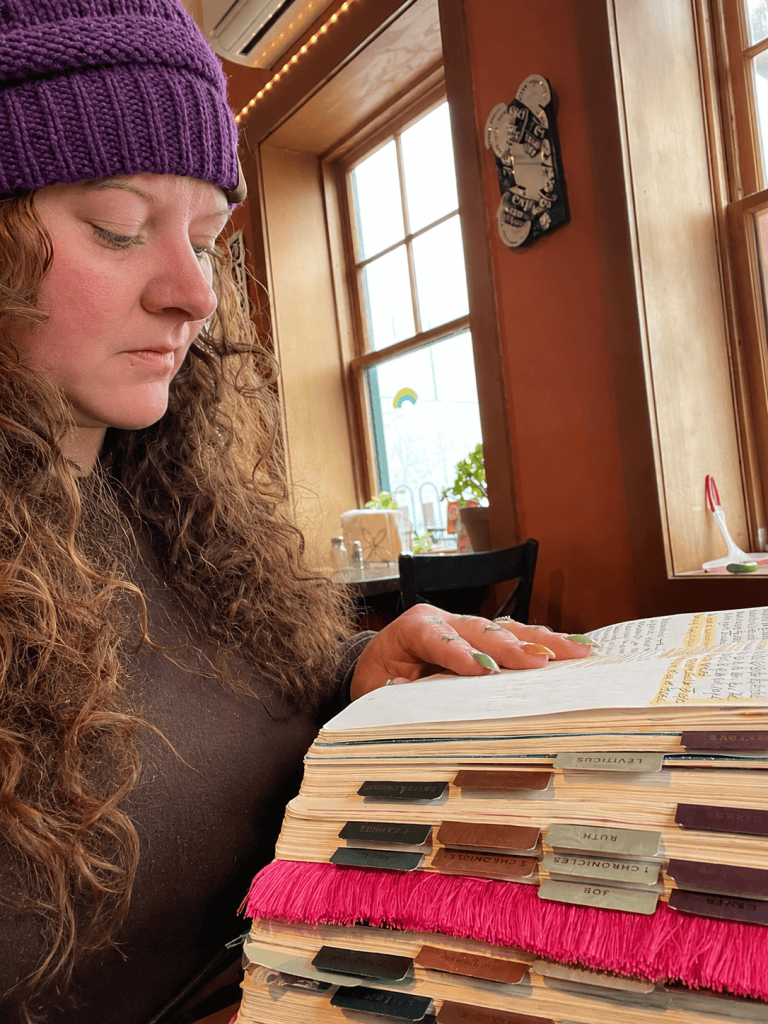
When faith walks with a limp

This morning, as I finished studying Genesis 25–39, I came to a reflection on Jacob wrestling with God that met me in a place I have been struggling to put into words.

This has been a particularly heavy season.

In my work advocating for children, I have encountered some heartbreaking circumstances recently. A child who witnessed his father’s murder. Young children who have experienced sexual abuse, exploitation, and unimaginable harm. Precious children, made in the image of God, carrying suffering they never chose and should never have had to endure.

I have found myself wrestling with deep sadness, righteous anger, and a longing for justice. And unexpectedly, some of these experiences have stirred up physical and emotional responses connected to suffering in my own past.

For years now, my identity has been firmly rooted in Christ rather than in what happened to me. The Lord has done a tremendous work in my life. Yet lately, I have experienced some familiar struggles: restless nights, difficulty concentrating, and moments when my emotions feel heavier than I can manage.

It has been unsettling.

I know who I am in Christ. I know what is true. But knowing the truth does not mean we are immune to the weight of living in a broken world.

And I think that is something we need to remember.

In Genesis 32, Jacob wrestled through the night and emerged with both a blessing and a limp. His encounter with God did not leave him untouched. It left him changed, and with a lasting reminder of his dependence upon the Lord.

The reflection I read this morning reminded me that sometimes we need the Lord to sit with us in our sorrow. Sometimes we need to wrestle honestly before Him. Sometimes we need to be reminded of His faithfulness when our own strength has been exhausted. And sometimes we need His mercy to cover the places where we feel most vulnerable.

There is room for all of that in our relationship with God.

Psalm 34:18 tells us that the Lord is near to the brokenhearted. Romans 8:22 reminds us that the whole creation has been groaning together. We live in a world deeply affected by sin, and we should not be surprised when its suffering grieves us.

But neither should we become so accustomed to our own comforts that we forget the suffering around us.

Somewhere today, a child is going without the safety of a loving family. Another is carrying trauma that no child should have to comprehend. Others are living without the security, protection, and ordinary comforts that many of us take for granted.

These children did not choose their circumstances.

I wonder how differently we might approach our daily frustrations if we spent more time remembering the blessings we have been given and the responsibility we have toward those who are vulnerable.

Not to dismiss the genuine difficulties in our own lives, but to gain perspective. To complain less about inconveniences. To pray more intentionally. To extend compassion more freely. And to be willing to do something when we see suffering and injustice.

Micah 6:8 calls us to do justice, love kindness, and walk humbly with our God.

I am learning again that walking humbly sometimes means admitting how weary I am. It means bringing my anger, sadness, and questions before the Lord rather than pretending I have everything neatly resolved.

And it means remembering that my hope is not in my ability to endure, but in the faithfulness of the God who holds me.

This morning, I am thankful that the Lord meets us in the hard places. Not always by immediately removing the circumstances, but by remaining faithful in the midst of them.

We may come away from those places with a limp, but we do not have to walk away without hope.

Until Christ makes all things new, may we remain rooted in His Word, tenderhearted toward those who suffer, and faithful with whatever He has placed before us.

“The LORD is near to the brokenhearted and saves the crushed in spirit.” — Psalm 34:18

And may we never become so comfortable in our own blessings that we forget to see the precious image bearers who are suffering around us.

What Are We Building, and Will It Matter?

A Reflection on Wisdom, Repentance, and Living Before Christ

I’ve been reading Contend by Philip Anthony Mitchell, and several passages have brought me back to something the Lord has been impressing upon my heart through my own study of Scripture, writing, and teaching over these last several months.

At our Mom Fight Club retreat, we spent time in Proverbs 14:1, considering the woman who builds her house through wisdom and the woman who tears it down through folly. We talked about how wisdom is not simply knowing what is right, but living in reverence and obedience to the Lord. How the things we do quietly, consistently, and sometimes without anyone noticing are shaping our homes and our lives.

I’ve also been thinking about Paul’s warning in 2 Timothy 3 concerning those who are “always learning and never able to arrive at a knowledge of the truth” (verse 7).

What a sobering description of something we can recognize in our own generation.

We have access to more sermons, podcasts, Bible studies, teachers, books, and Christian content than we could possibly consume in a lifetime. Yet access to biblical information is not the same thing as spiritual maturity. We can know what everyone is saying about God while spending very little time actually listening to what God has said in His Word.

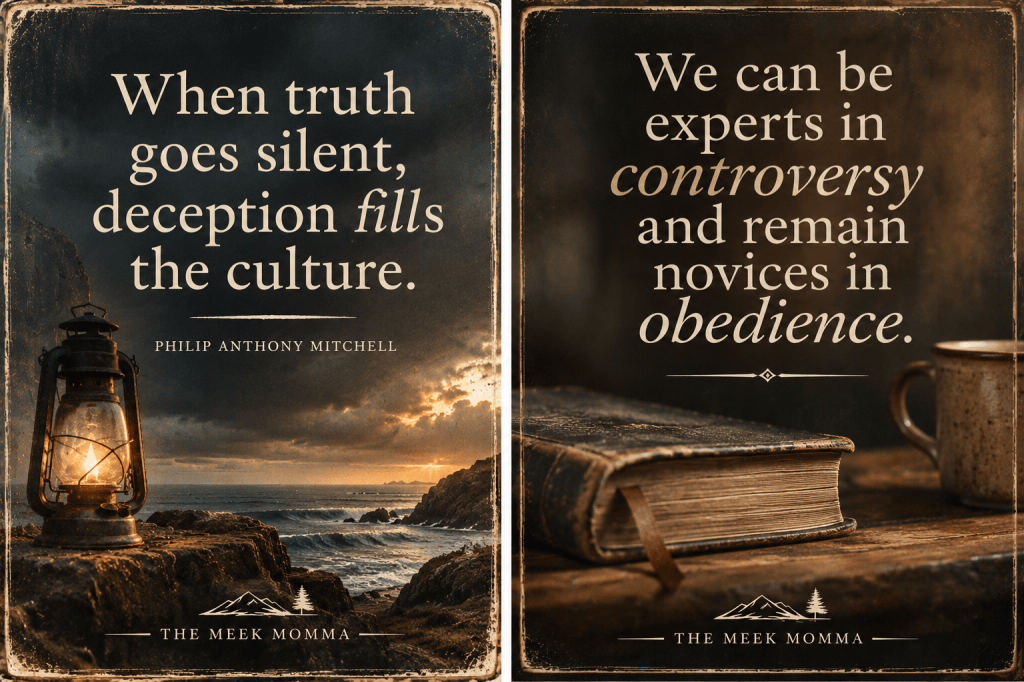
We can become experts in controversy and remain novices in obedience.

And perhaps most concerning, we can become so preoccupied with the sins of the world, the failures of church leaders, and the deception we see around us that we neglect to examine the condition of our own hearts.

In Jude 3, believers are urged to contend for the faith once delivered to the saints. That is a necessary charge. Truth matters. Doctrine matters. We are not free to reshape Christianity around our preferences, feelings, or the changing convictions of the culture.

But contending for the faith must never become a substitute for actually living the faith.

Jude doesn’t merely warn against false teachers. He goes on to instruct believers to build themselves up in the faith, pray in the Holy Spirit, keep themselves in the love of God, and wait for the mercy of Jesus Christ (Jude 20–21).

Notice how much of that instruction requires our own faithful participation.

And this brings me back to Proverbs 14:1.

What are we building?

What are we allowing to shape our thinking, our affections, our conversations, and our homes? What are we teaching our children about what matters, not merely through the things we tell them, but through the things they watch us pursue?

Are we becoming more patient? More humble? More generous? More acquainted with Scripture? More willing to confess our sins and turn from them?

Or are we simply becoming more informed, more opinionated, more distracted, and more comfortable with the things God has called us to put away?

I ask these questions of myself as much as anyone else.

Because repentance is not merely the doorway through which we entered the Christian life. It ought to remain an ongoing posture of the Christian heart.

Not because Christ’s sacrifice was insufficient, but because His grace is continually teaching us to renounce ungodliness and live godly lives (Titus 2:11–12).

We should be growing in our willingness to be corrected by Scripture. We should be quicker to recognize our own sin, quicker to confess it, and increasingly unwilling to make peace with the things that grieve the Lord.

And we should never confuse repentance with despair. The Christian does not turn from sin toward hopelessness. We turn toward Christ, whose mercy is sufficient and whose grace continues to transform us.

Lately, I’ve been thinking more about the judgment seat of Christ.

Paul writes in 2 Corinthians 5:9–10 that his aim is to please the Lord, because we must all appear before the judgment seat of Christ and give account for what we have done in the body.

One day, we will stand before Him.

And I wonder how much of what consumes us today will seem terribly insignificant in that moment.

The arguments we felt compelled to win. The opinions we needed everyone to hear. The endless hours spent consuming information that did little to make us more faithful. The comforts we protected, the distractions we justified, and the opportunities to love and serve that we allowed to pass us by.

How differently might we live today if we remembered that our lives are being lived before the Lord?

Not every faithful act will be impressive to the world. Much of it may look like ordinary obedience. Loving our families. Speaking truth graciously. Repenting when we are wrong. Praying when no one sees. Refusing to compromise. Opening our Bibles when something else would be easier. Serving faithfully in the places God has assigned to us.

These things matter.

And none of this is about earning our standing before God. Our salvation rests entirely upon the finished work of Jesus Christ. But the grace that saves us is also the grace that changes us.

I don’t want to spend my life collecting Christian knowledge while resisting the very transformation that knowledge ought to produce.

I don’t want to be so busy identifying the foolishness around me that I fail to recognize the foolishness I am allowing into my own home.

And I certainly don’t want to stand before Christ having devoted more attention to the temporary things of this world than to the eternal things He entrusted to me.

Psalm 1 describes the blessed person as one who delights in the instruction of the Lord and meditates on it day and night. That person is compared to a tree planted by streams of water, bearing fruit in its season.

There is something encouraging about that picture.

The tree does not produce fruit by chasing every passing thing. It bears fruit because it is rooted, nourished, and sustained.

Perhaps that is where we need to return.

Not to another personality, another controversy, or another endless stream of content, but to the Word of God. To prayer. To repentance. To the ordinary, often unseen work of faithfully following Jesus.

Are we allowing biblical truth to govern the way we actually live?

Because one day we will see our lives in the light of eternity, and I pray that what matters to Christ will have mattered to us.

May we be women who build wisely, repent readily, contend faithfully, and rest wholly in the grace of our Savior.

We do not need to wait until eternity to begin caring about the things that will matter in eternity.

“So whether we are at home or away, we make it our aim to please him.” — 2 Corinthians 5:9

The Meek Momma

The Righteous Shall Live by Faith

Reflections on Election Morning

This morning, I woke up with a heavy heart as I considered the results of last night’s election. I’ve spent much of the morning praying, thinking about the condition of our nation, and returning to the Scriptures.

My disappointment isn’t simply about political parties or who won and who lost. My concern is much deeper than that. As Christians, we are called to examine what we value, what we approve of, and what we place our hope in. We ought to be asking whether our convictions are being shaped by the Word of God or by the desires of our flesh, our pursuit of comfort, our love of money, and the things this world promises us.

And that examination must begin with ourselves.

Paul writes in Romans 1:16–17:

“For I am not ashamed of the gospel, for it is the power of God for salvation to everyone who believes, to the Jew first and also to the Greek. For in it the righteousness of God is revealed from faith for faith, as it is written, ‘The righteous shall live by faith.’”

Paul continues in Romans 1:18–32 by describing humanity’s rejection of God. Although God has made Himself known through creation, sinful humanity has exchanged the truth about God for a lie, worshiping and serving the creature rather than the Creator.

What a sobering description of the human heart.

We are so prone to elevate created things into places of ultimate importance. Power, prosperity, security, comfort, approval, and even our political convictions can become idols when we allow them to occupy the place that belongs to God alone.

But Romans doesn’t leave us merely examining the sins of the world around us. Paul goes on to establish that all have sinned and fall short of the glory of God (Romans 3:23). None of us stands righteous before God on our own merit. Yet Romans 3:24 reminds us that sinners can be justified by His grace as a gift, through the redemption that is in Christ Jesus.

That is the gospel. And that is where our hope must remain.

Something else has been on my heart this morning as I think about the women I’ve been teaching and the passages of Scripture we’ve been studying together.

When Paul writes, “The righteous shall live by faith,” he is quoting Habakkuk 2:4.

Habakkuk was a prophet who looked around at the wickedness, injustice, and violence of his own day and cried out to the Lord. He struggled to understand what God was doing and why He seemed to allow evil to continue.

Doesn’t that sound familiar?

But what I find so beautiful about Habakkuk is that he doesn’t abandon the Lord in his confusion. Instead, he positions himself to watch and wait.

“I will take my stand at my watchpost and station myself on the tower, and look out to see what he will say to me.”
— Habakkuk 2:1

In the ancient world, watchmen stood upon city walls, looking for approaching danger or messengers. Habakkuk uses this imagery to describe his posture before God. He doesn’t have all the answers, but he is determined to wait upon the Lord.

And God’s answer includes this remarkable declaration:

“But the righteous shall live by his faith.”
— Habakkuk 2:4

Faith does not mean having every answer. It does not require circumstances to change before we trust God. It means trusting His character, His promises, and His purposes even when the outcome is not yet visible.

By the end of Habakkuk’s book, his circumstances have not suddenly become easy. Yet he declares that even if the fig tree should not blossom, the fields yield no food, and the flocks disappear, he will rejoice in the Lord and take joy in the God of his salvation (Habakkuk 3:17–19).

What a beautiful picture of faith in the in-between.

This is what I want to remember this morning.

My joy cannot depend upon election results, political leadership, financial security, or the direction of our culture. If it does, my peace will always be as unstable as my circumstances.

But Christ is not unstable. His throne is not threatened. His promises have not changed, and His return is certain.

So yes, I am grieved. I am praying for repentance, for revival, and for hearts to turn back to the living God. I am praying that the Church would be faithful to His Word, unwilling to exchange truth for comfort or compromise for acceptance.

But I am also reminded that our calling has not changed.

We are still called to proclaim the gospel, love our neighbors, pursue righteousness, speak truth, repent of our own sins, and live by faith.

Our hope was never supposed to rest in the outcome of an election. It rests in the risen and returning Christ.

So my prayer today echoes the words of King Jehoshaphat in 2 Chronicles 20:12:

“We do not know what to do, but our eyes are on you.”

Lord, may our eyes remain fixed upon You. Bring us to repentance. Revive Your Church. Teach us to be faithful in the waiting, steadfast in truth, and joyful in Your salvation.

For the righteous shall live by faith.

The Meek Momma

Blog at WordPress.com.

Up ↑