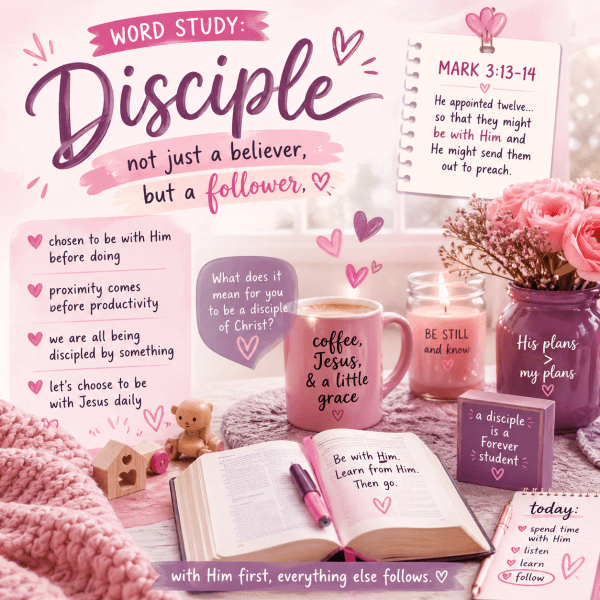
In Gospel of Mark 3:13–14, we see something powerful about what it means to follow Jesus: He calls, and then He draws near. “He appointed twelve… so that they might be with Him and He might send them out to preach.”
Before anything else—before ministry, impact, or influence—there was presence. They were chosen to be with Him.
The word “disciple” comes from the Greek mathetes, meaning learner or student—someone shaped not just by what a teacher says, but by how they live. Interestingly, while followers of Jesus are called “Christians” only a few times and “believers” a bit more, the word disciple appears over 200 times in Scripture. That repetition matters.
Key verses include: Matthew 28:19, John 8:31, Luke 14:27
Strong’s Number: G3101
A disciple isn’t just someone who believes—it’s someone who follows closely, learns deeply, and is formed daily.
And here’s the tension: we are all being discipled by something. What we give our time, attention, and affection to is quietly shaping who we become.
Jesus shows us the order clearly: proximity comes before productivity.
So the question isn’t just what are you doing for Christ? It’s are you with Him?
What might it look like today to sit with Him a little longer, listen a little closer, and follow a little more intentionally?
There is a tension every Christian must learn to live in—the space where strength and struggle coexist. It’s not a clean, polished place. It’s messy. It’s exhausting. And often, it feels like there is very little comfort in the circumstances themselves.
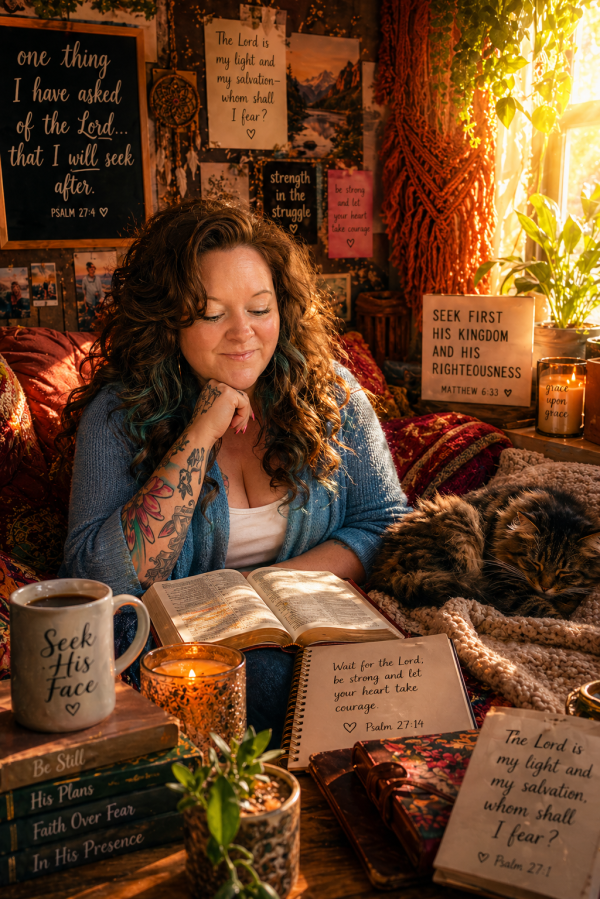
Psalm 27 speaks directly into that tension.
It is a psalm of contrast—lament and confidence, persecution and praise, warfare and worship. David doesn’t present a neat, resolved faith. Instead, he invites us into an honest, layered conversation with God. In fact, throughout the psalm, David engages in three distinct conversations: he speaks about God with confidence, he cries out to God in desperation, and he ultimately speaks to himself with chosen faith.
The psalm begins with bold declaration:
“The Lord is my light and my salvation—whom shall I fear? The Lord is the stronghold of my life—of whom shall I be afraid?”
This is David’s foundation. Before he addresses his circumstances, he anchors himself in who God is. His identity is rooted in God as his light, his salvation, and his stronghold. And that identity—claimed before the storm—becomes the source of his courage within it.
Verses 1–6 reveal a conversation of confidence. Even with enemies surrounding him, David declares that his heart will not fear. Why? Because his “one thing” is clear: to dwell in the presence of the Lord, to seek Him, to gaze upon His beauty. This pursuit becomes the stabilizing force in the chaos. Seeking God first, before trying to fix everything else, is what leads to a faithful life—and ultimately, where true comfort is found.
But the tone shifts.
In verses 7–12, David cries out. This is no longer confident proclamation; this is raw, vulnerable pleading:
“Hear me, Lord, when I cry aloud… do not hide your face from me… do not forsake me.”
Here, we see desperation. Honest, unfiltered need. David brings his fears, his pain, and even his sense of abandonment before God. He doesn’t pretend to be okay. He prays Scripture back to God, recalls His character, and asks Him to act.
And then, in verses 13–14, something powerful happens. David speaks to himself:
“I believe that I shall look upon the goodness of the Lord in the land of the living… Wait for the Lord; be strong, and let your heart take courage; wait for the Lord.”
This is chosen faith.
Not because everything has changed—but because he chooses to trust that God will show up. The word “wait” here isn’t passive. It means a hopeful, eager, patient expectation. It is active trust in the “in-between.”
This is the tension: desperation and confidence, struggle and strength, all at once.
And if I’m honest, this week, I didn’t handle that tension very well.
Normally, I thrive in a busy schedule. But this week felt different. I was tired in a deeper way—the kind that comes from pouring out more than I’ve been filling back up. My quiet times haven’t been quiet. My workload is the heaviest it’s been in years, with over 70 children and families I’m trying to serve within a deeply broken foster care system. Grant writing, grocery shopping, meal prepping…. The list is long.
On top of that, my mom has had ongoing medical appointments. Thursdays is a day when my office is supposed to be closed and what’s supposed to be a day of rest has turned into a full day of caregiving, emotional support, and work responsibilities. It’s been a lot to carry.
The day looked liked this:
Early morning—meal prepping, feeding fish, frogs, cats, and dogs. Loving on my sweet boy after another rough night. Praying with him. Opening the Word together… while trying to find a few quiet moments in it for myself.
Then it’s go time— Getting ready, rushing out the door, navigating appointments, questions, waiting rooms… If you know, you know.
Back home for a quick lunch. Let the animals out. Sit with Jackson, help with school, breathe for a second.
Then log into court— Case after case, report after report, heavy stories, real lives. Two, sometimes three hearings back-to-back.
And just like that, the clock resets— 45 minutes (if I’m lucky)… Dinner. Sunshine. Evening routine. Animals again. Wind down. Repeat.
And somehow, it all came to a head over something small—a grumpy cat with a bad attitude and a misplaced mess. In a moment, everything bubbling beneath the surface spilled out. I reacted in frustration, raising my voice, taking it out on the animals around me.
It wasn’t my best moment.
But it was a revealing one.
In that moment, I realized how much I needed help. Not just practically—but spiritually. I started looking into support services for my mom (and I’m still waiting on those doors to open), and her heart to soften, but more than anything, I knew I needed to return to the presence of the Lord.
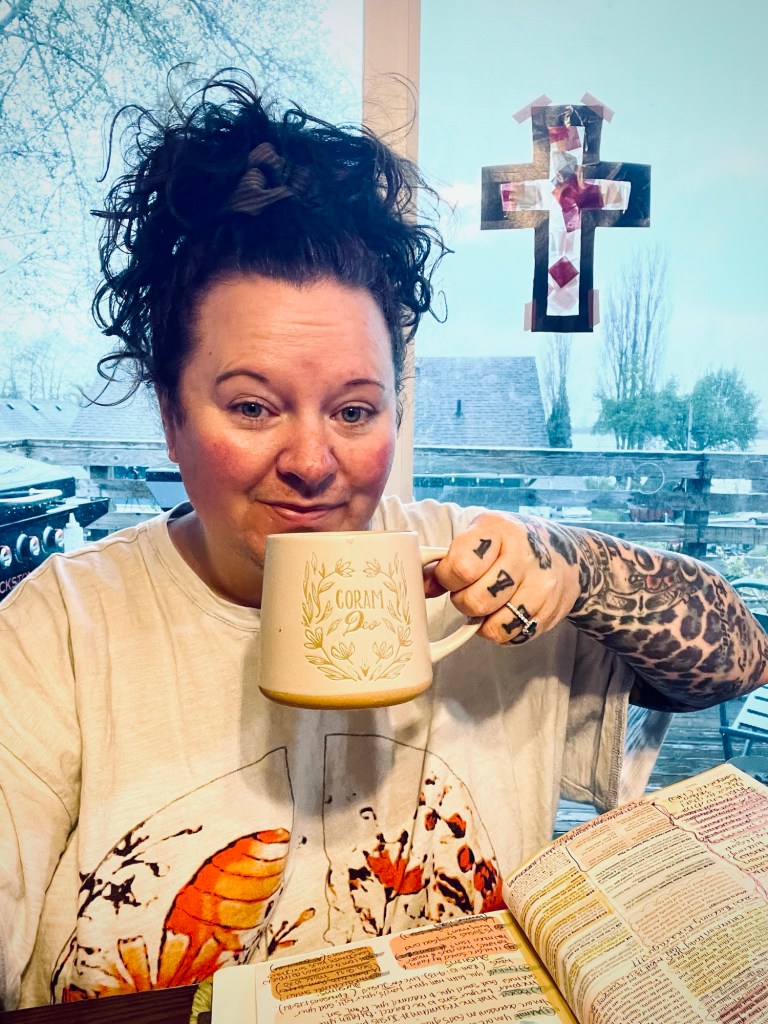
Earlier that same day, I had felt prompted to step away from my study in Titus and read Psalm 27. At the time, it felt like a beautiful passage—but I didn’t sit with it deeply.
After my breakdown, I came back to it.
And this time, I saw it differently.
I saw the tension. I saw the honesty. I saw the way David held both struggle and faith at the same time. And I felt humbled. Because what I’m walking through, as heavy as it feels, pales in comparison to what David endured—and yet, he still chose to trust.
Scripture is full of this “in-between” waiting:
Abraham and Sarah waiting for a promised child
Joseph waiting in prison for God’s plan to unfold
Hannah waiting in anguish before her prayer was answered
David himself, anointed king but not yet crowned
These stories remind us that waiting is not wasted. God works in the tension.
And even more comforting—God understands the tension.
We are not walking through this alone. We have a Savior who stepped into humanity, who experienced struggle, temptation, exhaustion, and sorrow. He knows what it is to live in the “in-between.” He meets us there with compassion, not condemnation.
So when we fail—when we lose our patience, when we react instead of respond, when we feel overwhelmed—we don’t have to run away from God.
We run toward Him.
We return to His presence.
We remind ourselves of who He is.
And we choose, again, to believe:
That we will see His goodness. That He is still working. That He can be trusted in every season.
So today, I’m praying this:
Lord, help me not to walk in condemnation, but in the freedom You provide. Teach me to seek Your face above everything else. Strengthen my heart to believe that I will see Your goodness—even here, even now. Help me to wait with hope, with courage, and with trust.
Because this is where faith is formed—not outside the tension, but right in the middle of it.
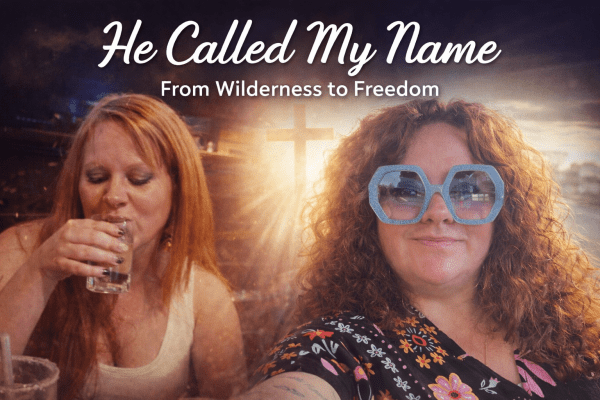
There was a version of me that was always searching.
Searching for peace. Searching for quiet. Searching for something—anything—to numb the ache I couldn’t explain.
I tried to silence it the only ways I knew how… in a bottle of whiskey, in pills, in relationships that promised comfort but left me emptier than before. I wasn’t just making bad choices—I was running. Running from pain. Running from memories. Running from the deep, hollow place inside me that nothing in this world could fill.
On the outside, I could smile. I could function. I could blend in.
But inside? I was lost in a wilderness.
Seen in the Wilderness
There’s a story in Scripture that I had often read, but read it quickly and did not study it to really understand what was transpiring – until my own journey sort of forced me to. It forced me to ask the question: Where is God when I am hurting?
In Genesis, Hagar finds herself alone—used, rejected, cast out, and wandering in the desert with nothing but her pain and her child. And in that place, when she had nothing left, God met her.
“The angel of the Lord found her by a spring of water in the wilderness…” — Genesis 16:7
He didn’t wait for her to find her way back. He went to her.
And He called her by name.
Hagar responded by giving God a name of her own:
“You are the God who sees me.” — Genesis 16:13
That’s the God I met too.
The Moment Everything Changed
I remember the moment.
Not polished. Not perfect. Not planned.
But real.
I heard Him call my name—not audibly, but unmistakably. It cut through the chaos, through the lies, through the numbness. And for the first time, I realized… He had always seen me.
Not the version I pretended to be. Not the broken choices I tried to hide behind.
Me.
And in that moment, I had a choice: Keep running… or respond.
When I responded—everything changed.
Not overnight. Not magically. But deeply. Eternally.
The suffering that once felt meaningless suddenly made sense in light of the cross.
“For the joy set before Him He endured the cross…” — Hebrews 12:2
Jesus endured suffering so that mine wouldn’t be wasted. So that my story could be redeemed. So that I could be free.
What Freedom Looks Like Now
Today, I am not who I used to be.
By the grace of God, I’ve been sober for years. Not by my own strength—but by His.
Now I sit across from families—parents who are walking paths I once walked. I advocate for foster children who have endured unimaginable abuse. I step into broken places, not as someone who has it all together, but as someone who has been rescued.
And sometimes… the old voices try to come back.
“Who do you think you are?” “You’re no different.” “You’re not worthy of this work.”
But those voices don’t get the final say anymore.
Because now, I hear a different voice.
“Therefore, if anyone is in Christ, he is a new creation. The old has passed away; behold, the new has come.” — 2 Corinthians 5:17
The voice of my King is louder. The voice of my Savior is stronger.
And where His Spirit is—
“Now the Lord is the Spirit, and where the Spirit of the Lord is, there is freedom.” — 2 Corinthians 3:17
This Is My Call to You
Maybe you’re reading this and you recognize yourself in my “before.”
The searching. The numbing. The exhaustion of trying to outrun what’s inside.
Let me tell you something in love and truth:
You don’t have to stay there.
God sees you—right where you are. In your wilderness. In your pain. In your questions.
And He is calling your name.
The same Jesus who met me is calling you—not to shame you, but to save you.
“Repent therefore, and turn back, that your sins may be blotted out.” — Acts 3:19
Repent. Turn. Come to Him.
Not when you “fix yourself.” Not when you feel worthy.
Today.
“Behold, now is the favorable time; behold, now is the day of salvation.” — 2 Corinthians 6:2
Lay it down. The sin. The striving. The pain. Believe in the One who endured the cross for you.
He will meet you there.
And I promise you— the freedom on the other side is real.
My God is the God of Redemption.
Lost in addiction – experiencing the wilderness.Free in Christ! Found and Redeemed!
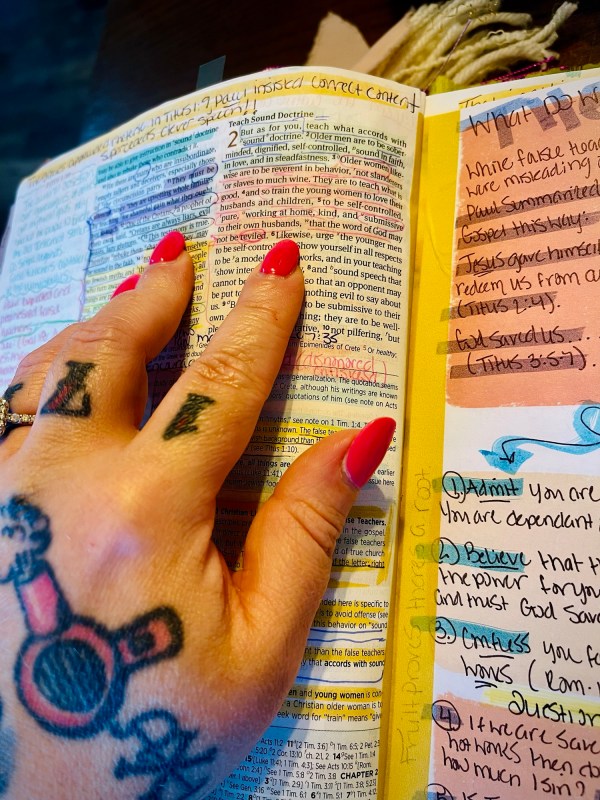
Paul’s words to women feel both tender and weighty: teach what is good, live what is holy.
One phrase especially stopped me—“not slanderers.”
The word we translate as “slanderers” here is actually the same Greek word for “devil” or “satan ”. That means when we speak maliciously, gossip, or tear one another down, it isn’t small talk… it’s aligning our words with the enemy. Literally devilish speech!
That alone is enough to make me pause before I speak.
Paul also calls women to be diligent—workers at home. Not confined, not limited, but purposeful. We see this beautifully in Proverbs 31—a woman who works both inside and outside her home. The heart behind it isn’t restriction, it’s a warning against idleness and a call to live intentionally.
There is something deeply holy about caring for a home, nurturing a family, and creating a place of peace in a chaotic world. Culture may downplay it, but Scripture lifts it up.
And submission? It’s not about inferiority—it’s about humility, order, and reflecting Christ in how we love and serve. It’s strength under control, not weakness.
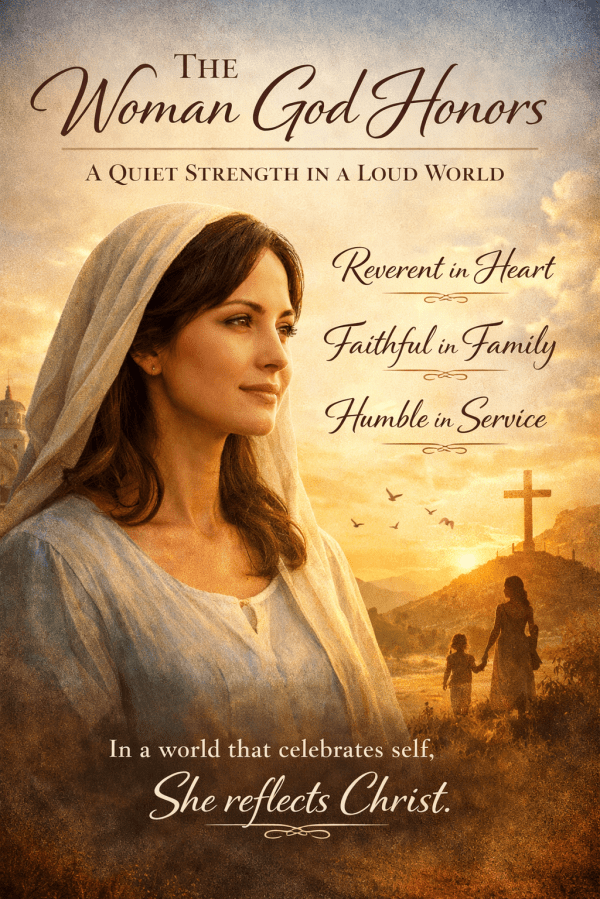
In a world that celebrates independence at all costs, this kind of life can feel countercultural. But maybe that’s the point.
Because at the end of the day, this isn’t about roles—it’s about representation.
How we speak.
How we love.
How we serve.
How we carry ourselves in the unseen, ordinary moments.
All of it is pointing to something greater.
Lord, help me—and every woman reading this—to be a faithful ambassador of the gospel today. That matters more than anything.
There has always been a cultural narrative telling women who they should be.
In our world today, it often sounds like this: Be louder. Be independent at all costs. Put yourself first. Define your own truth. Don’t let anything—or anyone—limit you.
But this isn’t new.
Long before modern feminism took center stage, there was another movement shaping the identity of women—one that looked strikingly similar.
A Look Back: The “New Roman Woman”
In the days of Paul the Apostle, a cultural shift was taking place across the Roman Empire. Scholars often refer to it as the rise of the “new Roman woman.”
Wealthy women were gaining social and financial independence. With that freedom, many began to step outside the traditional structure of family life—not simply to contribute, but often to abandon it altogether. Some pursued multiple sexual relationships. Others avoided marriage entirely. Still others sought influence in public spaces while neglecting the responsibilities within their own homes.
This movement grew so prominent that Augustus himself enacted laws to try to slow the moral and familial decline. Birth rates were falling. Marriages were weakening. The foundation of the family was beginning to crack.
Sound familiar?
Paul’s Response: A Different Kind of Freedom
When Paul wrote to Titus, he wasn’t giving random instructions—he was offering a God-centered response to a culture in confusion.
In his Epistle to Titus, particularly in chapter 2, Paul outlines a vision for women that stands in stark contrast to both the ancient Roman movement and much of what we see today.
3 Older women likewise are to be reverent in behavior, not slanderers or slaves to much wine. They are to teach what is good, 4 and so train the young women to love their husbands and children, 5 to be self-controlled, pure, working at home, kind, and submissive to their own husbands, that the word of God may not be reviled.
He speaks of women who are:
Reverent in the way they live Self-controlled, Pure, Devoted to their families, Kind and intentional in their influence.
At first glance, this might feel restrictive to some. But when we look deeper, we see something radically different from oppression—we see purpose, dignity, and eternal impact.
Two Voices, Two Visions
The world often defines a woman’s worth by how loudly she asserts herself, how much independence she claims, or how little she needs anyone else.
Biblical womanhood, however, tells a different story.
It says:
-Your strength is not proven in self-promotion, but in self-control. Your value is not found in independence from others, but in faithfulness to God. Your influence is not diminished in the home—it is multiplied there.
-Modern feminism, at its core, often elevates the individual woman above all else—her desires, her ambitions, her autonomy. And while there are elements that rightly acknowledge dignity and value, it can easily drift into a self-centered pursuit where serving others is seen as weakness.
But the Kingdom of God flips that completely.
The Beauty of a Servant’s Heart
Jesus Himself modeled this truth—greatness is found in serving.
A Christian woman who walks in reverence toward God carries a quiet strength the world cannot manufacture. She understands that caring for her family, loving well, living with purity, and walking in obedience is not lesser work—it is holy work.
This kind of life may not always be applauded by culture, but it is deeply honored by God.
And it is powerful.
Throughout Scripture, we see women who embodied this beautifully:
Lydia of Thyatira, whose faith and hospitality helped establish the early church Priscilla, who labored alongside her husband in ministry Phoebe, commended as a servant of the church Junia, recognized among the apostles
These women were not insignificant. They were not silenced. They were faithful—and their faithfulness shaped the Church.
What This Means for Us Today
As women of different ages, backgrounds, and seasons of life, we all feel the pull of culture in one way or another.
Some of us are raising children.
Some are working demanding jobs.
Some are doing both.
Some are in seasons of waiting, healing, or rebuilding.
The call of God is not one-size-fits-all in appearance—but it is unified in heart.
We are called to live in reverence.
To love deeply.
To serve willingly.
To walk in purity and self-control.
To reflect the goodness of God in how we move through the world.
Not because we are less—but because we belong to Him.
A Better Way
The question isn’t whether women have value—we absolutely do. That is not up for debate.
The question is: Where does that value come from?
Is it rooted in self, constantly striving to prove worth?
Or is it anchored in God, already secure, already known, already loved?
The woman who fears the Lord doesn’t need to fight for significance—she lives from it.
And in a world that tells her to grasp, she chooses to give.
In a culture that tells her to elevate herself, she chooses to serve.
In a moment that celebrates self, she reflects Christ.
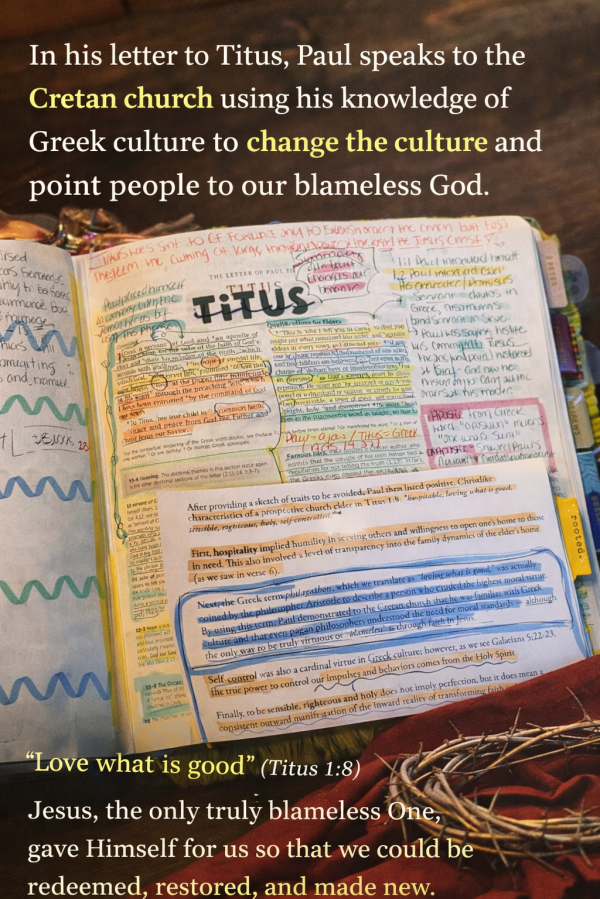
What’s incredible is how Paul engages the culture around him. He doesn’t ignore it—he understands it. When he calls believers to “love what is good,” he uses the Greek idea philagathon, a term familiar in their world and even used by philosophers like Aristotle to describe the highest moral virtue. Paul meets the Cretan people where they are, acknowledging that even their own thinkers recognized the need for goodness and moral standards—but then he points them to something greater: the only true source of blamelessness, Jesus Christ.
The same is true with self-control. Highly valued in Greek culture, yet ultimately unattainable in its fullness apart from God. As we see in Galatians 5:22–23, true self-control is not something we manufacture—it is fruit produced by the Holy Spirit within us.
To be sensible, righteous, and holy isn’t about perfection. It’s about a consistent outward life that reflects an inward transformation—a heart changed by faith in Jesus.
And this is where the beauty of Good Friday meets us. The call to live differently isn’t rooted in striving—it’s rooted in surrender. Jesus, the only truly blameless One, gave Himself for us so that we could be redeemed, restored, and made new.
This Good Friday, we remember: the gift is already given. Freedom is already offered. All that remains is to repent, believe, and receive the grace that changes everything.
A promise is only as good as the one who makes it. We measure trust by two things: a person’s character and their ability to follow through. When the apostle Paul opens his letter to Titus, he doesn’t start with instruction—he starts with God.
“in hope of eternal life, which God, who never lies, promised before the ages began” Titus 1:2 ESV
He reminds us that God is both pure in character and perfect in capability. In this Epistle to Titus, we are told that God “cannot lie.” That simple truth changes everything. Our hope of eternal life is not wishful thinking—it is anchored in the very nature of the One who promised it.
This stood in sharp contrast to the culture around the Cretan Christians. In Crete, people were surrounded by stories and worship of gods like Zeus—depicted as deceptive, impulsive, and morally flawed. These so-called gods reflected human brokenness, not divine perfection. But Paul points believers back to the one true God, whose truth never wavers and whose promises never fail.
The psalmist echoes this in Psalm 119: “All your commands are true… you established them to last forever.” God’s Word is not temporary or uncertain—it is eternal, just like Him.
Because of this, our hope in Christ is secure. Eternal life is not based on our performance but on God’s unchanging character. And that truth doesn’t just comfort us—it transforms us.
If we follow a God who cannot lie, then we are called to be people of integrity in a world full of compromise. If we trust in a God who is eternal, then we are invited to live with eternal perspective, not just temporary concerns.
Today, rest in this: God keeps His promises. Every single one.
And as you walk through a world that doesn’t yet know Him, remember—you carry the message of a faithful God whose truth changes everything.
The bright light of the gospel is meant to be shared! Will we hoard the gospel or hand it out as freely as it was given to us?
“So then, brothers, stand firm and hold to the traditions that you were taught by us, either by our spoken word or by our letter. Now may our Lord Jesus Christ himself, and God our Father, who loved us and gave us eternal comfort and good hope through grace, comfort your hearts and establish them in every good work and word.” 2 Thessalonians 2:15-17 ESV
“Blessed is the man who trusts in the Lord, and whose hope is the Lord.” — Jeremiah 17:7
Some weeks leave your heart heavier than others.
This week was spent in courtrooms advocating for children—children who have endured horrific abuse and neglect. Children who were left in dangerous circumstances far longer than they ever should have been. Children whose small voices were ignored while the systems meant to protect them moved far too slowly.
And sometimes, painfully, the world seems to turn the story upside down. Adults who caused harm are called victims, while the suffering of the child fades into the background. Justice feels delayed. Accountability feels uncertain. And the weight of it all presses down on the heart.
On days like these, everything can feel upside down. The tears come intermittently. My heart is grieved.
But one thing remains unchanged:
God is still good.
When the brokenness of the world is on full display, I find myself clinging more tightly to the only hope that cannot fail. Thank you, Jesus, for the hope I can have regardless of present circumstances.
For the believer, the word hopeless has no place in our vocabulary. If the Lord is present, hope is present.
Scripture reminds us again and again that hope is not wishful thinking—it is a confident expectation rooted in God Himself.
The Word of God tells us that regardless of how dark or desperate a situation may seem, hope abides (1 Corinthians 13:13). Hope is not extinguished by the darkness of the world.
Our hope is anchored in Jesus Christ (1 Peter 3:15–16), which means it can withstand every accusation, every injustice, every heartbreak we witness.
And perhaps most comforting of all, nothing can separate us from the love of God (Romans 8:38–39). Not the failures of systems. Not the evil done by people. Not the grief we carry after hearing the stories of wounded children.
Nothing.
When the courtroom doors close and the weight of the week lingers, I am reminded that we must learn to look beyond our immediate circumstances—beyond the worry, the injustice, and the despair that so easily grips our hearts.
We look instead toward the light –
That light is the hope God gives in His Word.
It is a hope that does not deny the darkness but outshines it.
And that hope—that confident expectation in the goodness and justice of God—is what carries me.
Paul opens up Ephesians by clearly stating his identity:
“This letter is from Paul, chosen by the will of God to be an apostle of Christ Jesus. I am writing to God’s holy people in Ephesus, who are faithful followers of Christ Jesus.” Ephesians 1:1
Then – In Ephesians 1:4-10, Paul immediately begins by reminding us of our identity. Our identity in Christ is that we are holy and dearly loved children of God. We get this identity when we receive God’s gift of salvation through the sacrificial death of Jesus Christ. This identity is not based on us, but rather, it is placed on us because we have been adopted into God’s family. Just like when a baby is placed into a family either through birth or adoption, they become a son or a daughter and take that family’s name as their identity. It is the same with our identity in Christ.
This isn’t because of our work, our successes or how good we try to be. We become children of God by grace through faith in Christ.
Paul wants our spiritual identity to frame our minds and thoughts. He desires to help us think rightly so that we may speak and act rightly.
An important truth is that our adoption to the Father is an action of pure love by a God who is not impersonal, but deeply connected and concerned with the objects of His love, you and I! 🥰🥰🥰
I was reminded of this powerful truth this morning – the longer I walk with the Lord sometimes I forget just how broken I was before I surrendered everything to him, and before I understood that my identity comes from him. I grew up in a deeply broken home. My father’s hands were representations of pain, hurt, abuse. My mother was so concerned with her own survival that she represented competition, coldness, self centeredness. This all led me to believe I was unworthy of love, safety, I felt as though I had no value.
Just hearing the simple gospel message had the power to begin to change me, it made me spiritually new, but it did not do the deep work inside of me to change where I found my own identity – only through diligent study of God’s word and submitting everything to him first before the world – have I been able to come to know and believe that I am my father’s daughter.
Friends, let’s not forget that our adoption as children of God comes with an expectation. When we remember and think of the great and glorious truth of being adopted by the King of heaven and earth, and that we share in the inheritance of the King, it should result in a desire to reflect and live up to the standard of the King and His Kingdom. This means instead of just going along with what the world deems acceptable in our thoughts and our words, that we set a higher standard for ourselves to “be holy and blameless before him” (Ephesians 1:4). To be holy and blameless includes allowing the truth of our adoption to lace the words that come from our mouth and inform every action of our hands and feet. It doesn’t mean we will always do this perfectly, but it does mean that we are daily checking and intentionally redirecting our thoughts and our words to stay in line with God’s instructions. It’s not because we are guilted into it but because we desire to stay free of the entrapments of the enemy that come from thoughts polluted with lies and words tainted with bitterness, slander and harshness.
Adoption means we now have God as our Father. It means that we receive the inheritance that could only legally be given to a son.