When Faith Feels Weak: What Gideon Teaches Us About Knowing God Through His Word

Are We Letting Scripture Shape Us?

One of the greatest dangers for Christians today is not always outright rebellion against Godโ€”it is slowly drifting into a faith where our emotions, assumptions, culture, and personal experiences begin shaping our understanding of Him more than His Word does.

This can happen so subtly.

We stop opening our Bibles consistently. We rely more on inspirational content than Scripture itself. We begin approaching God through our feelings instead of allowing His truth to inform our hearts. And before long, we can find ourselves asking questions about God that reveal just how little we truly know of His character.

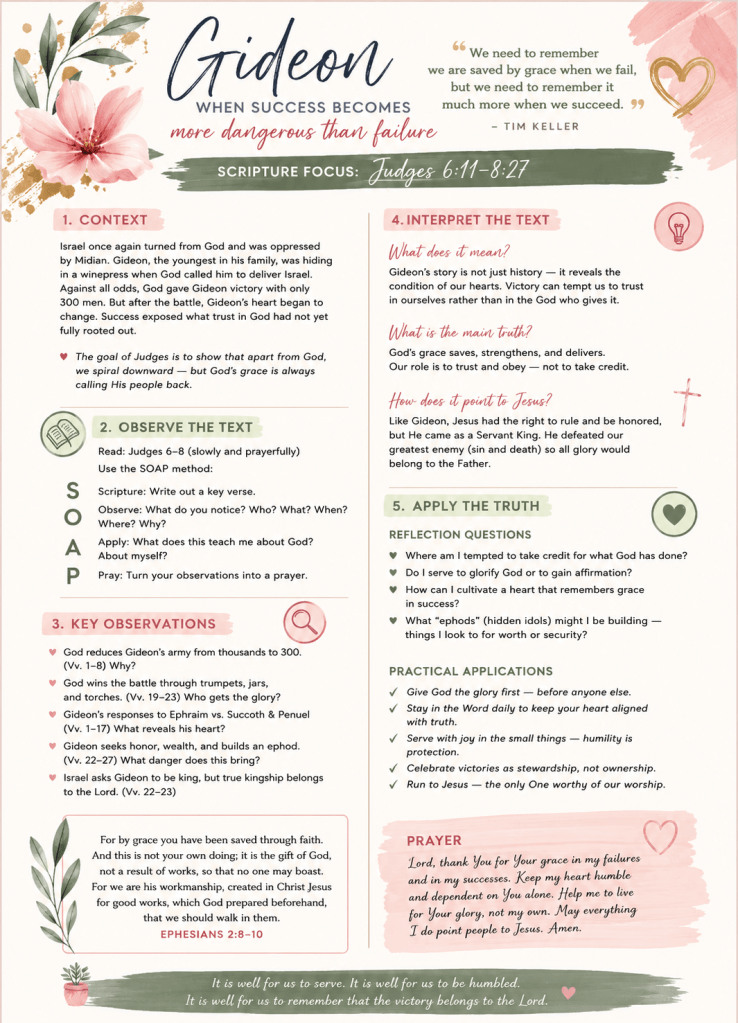
This is exactly why the story of Gideon in Book of Judges chapter 6 is so encouraging for weary believers, young women in the faith, busy mothers, and even mature Christians who may have grown distant from daily time in Godโ€™s Word.

Because Gideonโ€™s story is not ultimately about a brave manโ€”it is about a gracious God who patiently reveals Himself to weak and fearful people.


โ€œIf God Is Really With Usโ€ฆโ€

When we first meet Gideon in Judges 6, Israel is suffering under Midianite oppression because they had abandoned the Lord and turned toward false gods.

Gideonโ€™s response to the angel of the Lord sounds strikingly familiar:

โ€œPlease, my lord, if the Lord is with us, why then has all this happened to us?โ€
โ€” Judges 6:13

How many of us have quietly asked the same question?

If God is with me, why is motherhood so exhausting? Why does suffering continue? Why does obedience feel costly? Why does life feel heavy? Why are prayers unanswered?

Gideon struggled to reconcile his circumstances with the promises of God. Yet what is remarkable is that God does not respond harshly to Gideonโ€™s weakness.

Instead, the Lord answers:

โ€œGo in this might of yoursโ€ฆ do not I send you?โ€
โ€” Judges 6:14

God was already at work accomplishing His purposes through a man who felt weak, fearful, and inadequate.

And that should deeply encourage us.

Because throughout Scripture, God has never required perfect strength from His people before using them. He calls us to trust Him in the midst of our weakness.


God Reveals Himself to Weak Faith

One of the most comforting parts of this chapter is seeing how patient God is with Gideon.

After encountering the angel of the Lord, Gideon becomes afraid and believes he may die. But the Lord reassures him:

โ€œPeace be to you. Do not fear; you shall not die.โ€
โ€” Judges 6:23

The Lord was not pushing Gideon away because his faith was weak. He was drawing him closer.

This matters because many Christians wrongly assume that struggling believers are immediately met with frustration from God. But throughout Scripture we repeatedly see the Lord patiently strengthening weak faith.

That does not mean God celebrates unbelief. But it does mean He is compassionate toward those who genuinely desire to know Him and trust Him more fully.


Before Public Victory Came Private Obedience

After comforting Gideon, God gives him a difficult command.

In Judges 6:25โ€“26, Gideon is told to tear down his fatherโ€™s altar to Baal, cut down the Asherah pole beside it, and build an altar to the Lord in its place.

This was a bold act of obedience.

The bull being sacrificed symbolized devotion to Baal, the false god Israel had been worshiping. By tearing down these idols, Gideon publicly declared that the gods Israel trusted were powerless.

But before God would use Gideon to deliver Israel publicly, Gideon first had to obey privately.

And honestly, this is where many of us struggle too.

Sometimes the idols in our lives are not obvious statues or pagan altars. Sometimes they are comfort, control, approval from others, entertainment, political identity, self-sufficiency, busyness, or even our own feelings.

When we neglect Godโ€™s Word long enough, we slowly begin creating a version of God that fits our preferences rather than submitting ourselves to who He truly is.

Scripture was never meant to conform to us.

We are meant to be conformed by Scripture.


What About Gideon and the Fleece?

One of the most misunderstood parts of Gideonโ€™s story is the sign of the fleece in Judges 6:36โ€“40.

Many people use this passage to justify asking God for random signs:

โ€œLord, if you want me to take this job, let someone call me today.โ€

But Tim Keller points out in Judges For You that Gideon was not asking for vague personal signs to help him make ordinary decisions.

Gideon was specifically asking God to reveal His nature.

Baal was believed to be a storm and fertility god tied to nature. Gideonโ€™s request involving dew and dry ground was actually asking God to demonstrate that He alone was sovereign over creation itself.

Gideonโ€™s faith was weak, but his questioning was leading him toward a deeper understanding of who God truly was.

That distinction matters.

Because there is a difference between demanding signs from God out of unbelief and asking God to strengthen weak faith through greater understanding of His character.


We Have What Gideon Longed For

One of the most humbling realities in this passage is recognizing that Gideon did not have what believers today possess.

He did not have the completed Word of God.

He did not know Christ as we do now.

He did not have the ordinary means of grace God has given the Church through Scripture, Christian fellowship, baptism, and the Lordโ€™s Supper.

Hebrews 1:1โ€“2 says:

โ€œLong ago, at many times and in many ways, God spoke to our fathers by the prophets, but in these last he has spoken to us by his Sonโ€ฆโ€

Gideonโ€™s request was to help build up his faith. God in his Grace responded twice and when we make the same request – God graciously responds by pointing us to the fullest and final revelation of his character and his purposes – the Lord Jesus.

When we find ourselves doubting Godโ€™s promises or Godโ€™s presence, we can ask him to point us again to his son saying, โ€œI do believe help me overcome my unbeliefโ€ (Mark 924). This is what Gideon needed and received. God will do the same for us.

Are there parts of your life today where you need to ask God to point you to his son so that you can trust more fully in His promises?

When We Let the Text Speak: Deborah, Barak, and the Importance of Faithful Hermeneutics

There is something both humbling and beautiful about coming to Scripture only to realize we may have been reading our assumptions into the text all along.

Recently, while studying Judges 4 and 5, I found myself doing exactly that.

For years, I had heard โ€” and repeated โ€” the common interpretation that Deborah had to step into leadership because Barak was weak, fearful, or unwilling to obey God without her. It is such a common conclusion that many of us barely stop to ask whether the text itself actually says that.

But when I slowed down, prayed, studied carefully, compared translations, looked into the original language, considered the historical context, and read the surrounding passages alongside Hebrews 11, I realized something important:

The text never explicitly says Barak lacked faith.

In fact, Hebrews 11 includes Barak among those commended for their faith.

That realization forced me to pause and ask a difficult but necessary question:

Had I allowed cultural assumptions and familiar commentary to speak louder than the actual words of Scripture?

Deborah Was Not an Emergency Substitute

One of the most striking observations in Judges 4 is that Deborah is already introduced as a leader before Barak even appears in the narrative.

Judges 4:4 identifies Deborah as both a prophetess and a judge in Israel. She was not functioning as a temporary stand-in because no man was available. Scripture presents her as someone God Himself had raised up and appointed.

She held court under the palm of Deborah, where the people of Israel came to her for judgment and counsel. This was not a queenโ€™s throne, but a courtroom. Israel trusted her wisdom, discernment, and leadership.

Unlike many of the judges before and after her, Deborah did not primarily lead through military strength or physical might. She led through wisdom, discernment, character, and faithful proclamation of Godโ€™s Word.

We see this clearly in Judges 4:6 when she tells Barak:

โ€œThe Lord, the God of Israel, commands youโ€ฆโ€

As a prophetess, Deborah faithfully declared the Word of God. She counseled, guided, and judged the people. In many ways, she comes closer than any judge before the monarchy to modeling a ruler who shepherds with wisdom and righteousness.

Deborahโ€™s role should not be minimized simply because Barak also played a role in Godโ€™s deliverance.

The text honors both.

The Danger of Bringing Assumptions Into Scripture

As women especially, I think many of us have been quick to frame Deborahโ€™s story as proof that she only led because Barak failed.

But that interpretation may reveal more about our assumptions than about the text itself.

When Barak tells Deborah in Judges 4:8:

โ€œIf you will go with me, I will go, but if you will not go with me, I will not go,โ€

many immediately read cowardice or disobedience into his response.

And certainly, some respected commentators understand the passage that way.

But others note that Deborahโ€™s response in verse 9 can also be translated differently. Rather than being a rebuke, it may simply be a prophetic statement that the honor for Siseraโ€™s defeat would ultimately go to a woman.

That distinction matters.

Because if Barak is not being rebuked, then his request for Deborahโ€™s presence may actually demonstrate faith rather than unbelief.

After all, why would he not want the Lordโ€™s prophet with him as he marched into battle against overwhelming odds?

Hebrews 11 forced me to wrestle honestly with this possibility. Scripture itself commends Barakโ€™s faith. That means we should be careful not to build an interpretation that ultimately contradicts the broader testimony of Godโ€™s Word.

Faithful Hermeneutics Requires Humility

This study reminded me how important good hermeneutics truly are.

Hermeneutics simply means the way we interpret Scripture.

It means asking questions of the text instead of assuming we already know the answers. It means studying passages in context. It means comparing Scripture with Scripture. It means considering grammar, historical background, original language, genre, and surrounding passages. Most importantly, it means approaching Godโ€™s Word prayerfully and humbly, willing to be corrected.

So often we come to the Bible looking for confirmation instead of truth.

We read through lenses shaped by culture, church traditions, personal experiences, social media discussions, or popular teaching. Sometimes we inherit interpretations we have never personally examined.

But faithful Bible study requires us to slow down enough to let the text speak for itself.

Not forcing Scripture to fit our narrative.

Not reading motives into people that God Himself never states.

Not minimizing one person in order to elevate another.

Simply letting God say what He intended to say.

The Glory Ultimately Belongs to God

One of the most beautiful things about Judges 4 and 5 is that there is not just one human hero.

There is Deborah.
There is Barak.
There is Jael.

And yet Judges 5 makes clear where the true glory belongs.

To the Lord.

The Lord is the One who delivered Israel.

The Lord is the One who routed Sisera.

The Lord is the One who used ordinary people in different ways for His purposes.

Deborah ruled and counseled.
Barak obeyed and fought.
Jael struck the final blow.

But God alone secured the victory.

Isnโ€™t that often how the Lord works?

He delights in using different people with different gifts for the accomplishment of His purposes so that no single person can claim the glory for themselves.

A Final Encouragement

One of the greatest acts of spiritual maturity is allowing Scripture to challenge us.

Not defending our assumptions.
Not clinging to familiar interpretations.
Not reading quickly.
Not approaching Godโ€™s Word to prove a point.

But prayerfully opening the Bible and saying:

โ€œLord, help me see what is actually there.โ€

The more I study Scripture, the more I realize how dangerous it can be to approach the text with conclusions already in place.

Good hermeneutics is not cold academics.
It is an act of humility.

It is loving God enough to want His meaning more than our own opinions.

And sometimes, faithful study means being willing to say:

โ€œI may have gotten this wrong before.โ€

That is not weakness.

That is reverence for the Word of God.

When Convenience Replaces Obedience: A Lesson from Judges 1:28โ€“36

In Book of Judges 1:28โ€“36, we encounter a quiet but dangerous pattern in the life of Israelโ€”partial obedience. God had clearly commanded His people to drive out the inhabitants of the land. This wasnโ€™t arbitrary; it was for their protection, knowing their weakness and tendency to fall into idolatry.

But instead of fully obeying, the Israelites chose a different path.

Again and again, the text tells us they did not drive them out. Instead, they subjected the people to forced labor. From a human perspective, it made sense. It was efficient. Economically beneficial. Less costly. Less exhausting.

But it wasnโ€™t obedience.

As Timothy Keller insightfully puts it, here we see that โ€œconvenience trumps obedience.โ€ What felt practical in the moment became a spiritual compromise with long-term consequences. The very people they allowed to remain would later become a snare.

Even more striking is what we read about the tribe of Dan. In Judges 1:34โ€“35, the Amorites pressed them back into the hill country. Thereโ€™s no indication that the enemy was stronger or better equipped. Instead, it appears they simply had greater resolve. Those who did not know God showed more determination than those who did.

That contrast should stop us in our tracks.


A Pattern Repeated Throughout Scripture

This isnโ€™t an isolated moment. Scripture repeatedly shows us the subtle drift from obedience to compromise.

Consider First Book of Samuel 15. God commands King Saul to completely destroy the Amalekites. Instead, Saul spares King Agag and keeps the best of the livestock. His justification? It would be used for sacrifice to the Lord.

It sounded spiritualโ€”but it was disobedience dressed up as worship.

The prophet Samuelโ€™s response is piercing: โ€œTo obey is better than sacrifice.โ€ (1 Samuel 15:22)

Saul chose what seemed reasonable over what God required.


Or look at Book of Genesis 3. Adam and Eve were given one commandโ€”do not eat from the tree. Yet when temptation came, the fruit appeared โ€œgood,โ€ โ€œpleasing,โ€ and โ€œdesirable.โ€ Convenience, desire, and reasoning overruled obedience.

The result? Separation, brokenness, and the entrance of sin into the world.


In Book of Numbers 20, Mosesโ€”faithful leader of Israelโ€”strikes the rock instead of speaking to it as God commanded. It may have seemed like a small deviation, especially under pressure. But partial obedience is still disobedience. Even Moses experienced the consequence of not fully honoring Godโ€™s instruction.


And in the New Testament, we see a powerful example in Acts of the Apostles 5. Ananias and Sapphira sell property but secretly withhold part of the proceeds while presenting it as the full amount. Their sin wasnโ€™t in keeping someโ€”it was in the deception. They wanted the appearance of obedience without the cost of it.


The Danger of โ€œAlmostโ€

What ties these accounts together is not outright rebellion, but something more subtleโ€”almost obedience.

  • Israel didnโ€™t reject Godโ€”they just didnโ€™t go all the way.
  • Saul didnโ€™t ignore Godโ€”he adjusted the command.
  • Adam and Eve didnโ€™t abandon Godโ€”they doubted His word.
  • Moses didnโ€™t defy God publiclyโ€”he altered the method.
  • Ananias and Sapphira didnโ€™t refuse to giveโ€”they pretended to give fully.

In each case, convenience, reasoning, fear, or desire quietly replaced trust-filled obedience.

And the consequences were never small.


A Call to Examine Our Own Hearts

The truth is, weโ€™re not so different.

We may not be conquering lands or ruling nations, but we face daily choices where obedience to God conflicts with what is easier, faster, or more comfortable.

  • Choosing silence instead of speaking truth.
  • Prioritizing comfort over calling.
  • Justifying small compromises because they โ€œmake sense.โ€
  • Trusting our logic over Godโ€™s Word.

Like Israel, we can convince ourselves that partial obedience is enough.

But God doesnโ€™t call us to what is convenientโ€”He calls us to what is faithful.


Obedience Requires Dependence

Judges 1 reminds us of something critical: Godโ€™s commands are not given because we are strong enough, but because He is faithful enough.

Israelโ€™s failure wasnโ€™t just militaryโ€”it was spiritual. They relied on their own reasoning instead of Godโ€™s power.

And weโ€™re prone to do the same.

True obedience flows from dependence. It says:

  • God, Your way is betterโ€”even when itโ€™s harder.
  • Your wisdom is greaterโ€”even when I donโ€™t understand.
  • Your commands are for my goodโ€”even when they cost me something.

Final Reflection

Where in your life has convenience quietly replaced obedience?

Where have you settled for โ€œalmostโ€ instead of fully trusting God?

The call of Scripture is clear: not partial obedience, not delayed obedience, not convenient obedienceโ€”but wholehearted, faithful surrender.

Because in the end, obedience isnโ€™t about restrictionโ€”itโ€™s about trust.

And trust in God is never misplaced.

When You Forget Who God Is: A Gentle Return to Psalm 103

There are days when faith feels steadyโ€ฆ and days when it feels like itโ€™s slipping through your fingers.

Maybe itโ€™s the exhaustion of motherhood.
Maybe itโ€™s the weight of unanswered prayers.
Maybe itโ€™s just the quiet doubt that creeps in when life doesnโ€™t look how you thought it would.

And in those moments, we donโ€™t just need encouragementโ€”we need truth.

Thatโ€™s exactly where Psalm 103 meets us.

More Than Forgiveness

In verses 3โ€“5, weโ€™re given a breathtaking picture of Godโ€™s heart:

He forgivesโ€”yes.
But He doesnโ€™t stop there.

He redeems your life from the pit.
He restores what feels broken.
He crowns you with steadfast love and mercy.

God is not doing the bare minimum in your life. He is abundantly, intentionally caring for youโ€”even in ways you donโ€™t yet see.

Who God Is (Even When Life Feels Uncertain)

As the psalm continues, weโ€™re reminded of truths that donโ€™t shift with our circumstances:

  • God is patient by nature (v. 8)
  • He does not treat us as our sins deserve (v. 10)
  • His forgiveness is complete and final (v. 12)
  • His compassion is relational, not distant (v. 13)
  • He knows your weakness (v. 14)
  • His mercy is continuous, not temporary (v. 17)
  • His love is covenant loveโ€”steady, committed, unbreaking

This is who God isโ€”not just on your good days, but on your worst ones too.

Worship Isnโ€™t Built on Feelings

Hereโ€™s where this psalm gently corrects us:

Worship is not emotional firstโ€”itโ€™s theological first.

We donโ€™t worship because we feel close to God.
We worship because He is worthy, whether our feelings cooperate or not.

That truth is freeing.

Because if worship depended on our emotions, weโ€™d all fall short. But it doesnโ€™tโ€”it rests on the unchanging character of God.

The God Who Never Changes

Psalm 103 intentionally echoes Exodus 34:6โ€“7, where God declares His own nature:

โ€œThe Lord, the Lord, a God merciful and gracious, slow to anger, and abounding in steadfast loveโ€ฆโ€

What God proclaimed about Himself thenโ€”His people experienced as true.

And itโ€™s still true today.

He has not changed.
Not in your waiting.
Not in your struggles.
Not in your questions.

The Reality We Canโ€™t Ignore

This psalm doesnโ€™t ignore hard truths:

Sin is real.
Judgment is deserved.
Redemption is costly.
Mercy is intentional.

And yetโ€”God chose mercy.

He chose to redeem.
He chose to love.
He chose you.

Oh, How You Are Loved

If you walk away with anything today, let it be this:

You are not held together by your ability to โ€œget it right.โ€
You are held by a God whose love is steadfast, patient, and unchanging.

So when your feelings waverโ€ฆ
When your strength feels thinโ€ฆ
When you forget who He isโ€ฆ

Come back to Psalm 103.

And remember:

Oh, how you are loved.

Word Study: Disciple

In Gospel of Mark 3:13โ€“14, we see something powerful about what it means to follow Jesus: He calls, and then He draws near. โ€œHe appointed twelveโ€ฆ so that they might be with Him and He might send them out to preach.โ€

Before anything elseโ€”before ministry, impact, or influenceโ€”there was presence. They were chosen to be with Him.

The word โ€œdiscipleโ€ comes from the Greek mathetes, meaning learner or studentโ€”someone shaped not just by what a teacher says, but by how they live. Interestingly, while followers of Jesus are called โ€œChristiansโ€ only a few times and โ€œbelieversโ€ a bit more, the word disciple appears over 200 times in Scripture. That repetition matters.

Key verses include: Matthew 28:19, John 8:31, Luke 14:27

Strongโ€™s Number: G3101

A disciple isnโ€™t just someone who believesโ€”itโ€™s someone who follows closely, learns deeply, and is formed daily.

And hereโ€™s the tension: we are all being discipled by something. What we give our time, attention, and affection to is quietly shaping who we become.

Jesus shows us the order clearly:
proximity comes before productivity.

So the question isnโ€™t just what are you doing for Christ?
Itโ€™s are you with Him?

What might it look like today to sit with Him a little longer, listen a little closer, and follow a little more intentionally?

Thatโ€™s where true discipleship begins.

Blog at WordPress.com.

Up ↑