Behold Him, Not Me: Part Five

The Restless Heart

Judges 18:1โ€“20

One of the most sobering realities in the Christian life is that it is possible to spend years chasing what we think will satisfy us only to discover that the problem was never our circumstances.

The problem was our hearts.

As we enter Judges 18, we encounter one of the darkest and most revealing chapters in the entire book.

The stories at the end of Judges are not primarily about military victories or heroic deliverers. Samson has already come and gone. The judges have finished their work.

Yet five chapters remain.

Why?

Because the final chapters of Judges pull back the curtain and reveal the spiritual condition of Godโ€™s people during these years.

The earlier chapters gave us the birdโ€™s-eye view.

These chapters give us the ground-level reality.

We are shown what life looks like when people who belong to God stop trusting God.

The result is not freedom.

It is confusion.

It is compromise.

It is restlessness.

Judges 18 opens with a familiar reminder:

โ€œIn those days there was no king in Israel.โ€

This statement is about far more than politics.

Israelโ€™s greatest problem was never a lack of human leadership.

Their greatest problem was that they had rejected the rule of God.

And nowhere is that more evident than in the story of the tribe of Dan.
The Tribe That Never Took Possession

As the chapter begins, we learn that the tribe of Dan is still searching for a place to settle.

At first glance, that may not seem unusual.

After all, everyone needs a home.

Everyone needs security.

Everyone needs a place to belong.

But the reason Dan is still searching is important.

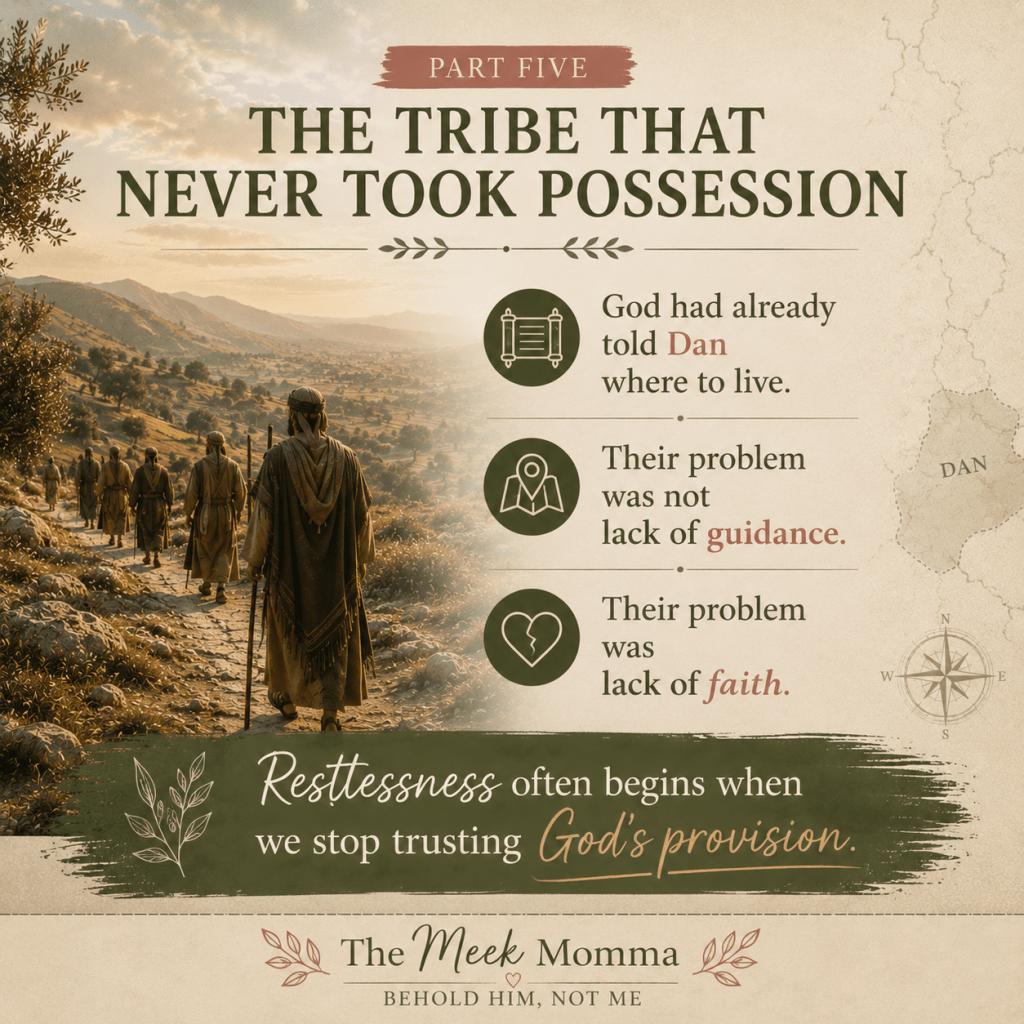
Unlike the other tribes, Dan had never taken possession of the inheritance God had already given them.

When Israel entered the Promised Land, each tribe received territory assigned by God.

Danโ€™s inheritance had been established.

God had already told them where to live.

God had already provided for them.

God had already made His will known.

The problem was not a lack of guidance.

The problem was a lack of faith.

The Danites failed to drive out the Canaanites as God commanded. Instead, they were pushed back into the hill country and forced into a semi-nomadic existence.

Years later, they are still looking for something better.

The tragedy is that they are searching for what God had already given them.

How often do we do the same thing?

God has spoken.

God has provided.

God has revealed His will.

Yet our hearts continue searching because we secretly believe something better exists somewhere else.

We imagine that satisfaction is always one step away.

One opportunity away.

One relationship away.

One answered prayer away.

One life change away.

Yet the issue is rarely our circumstances.

More often, the issue is our hearts.

Danโ€™s restlessness was not ultimately geographical.

It was spiritual.
The Curse of the Restless Heart

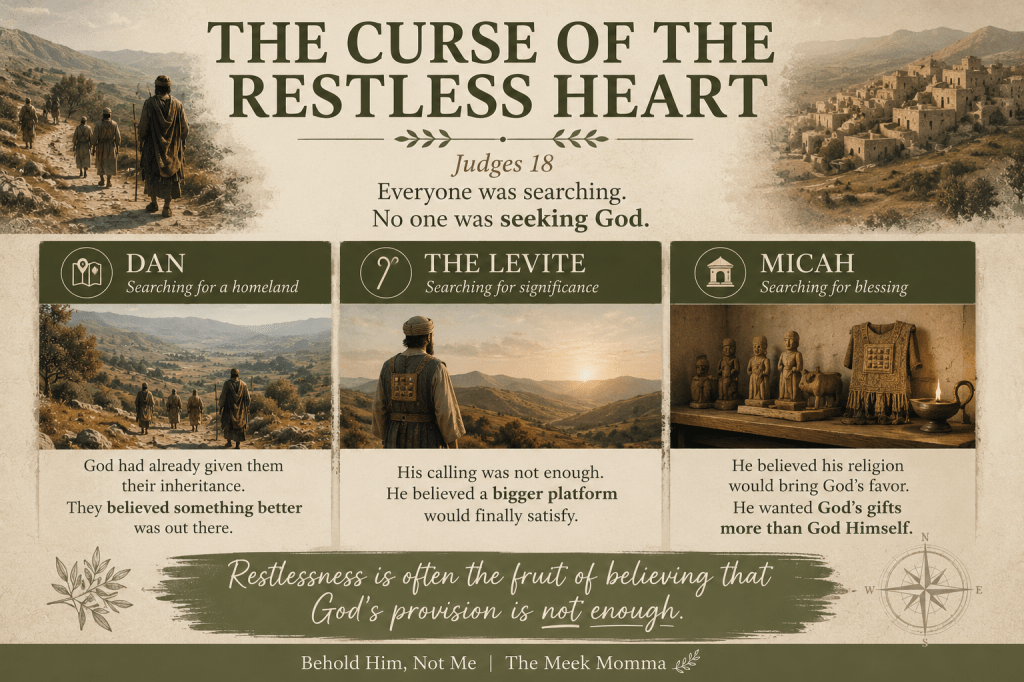
As I studied this passage, I could not help but notice that every major character in Judges 18 seems restless.

The tribe of Dan is restless.

Micah is restless.

The Levite is restless.

Everyone is searching.

Everyone is moving.

Everyone is looking for something they believe they do not currently possess.

The Danites are searching for land.

Micah is searching for blessing.

The Levite is searching for opportunity.

Yet none of them are seeking the Lord.

That observation feels painfully relevant.

Our culture constantly tells us that fulfillment is found in the next thing.

The next purchase.

The next promotion.

The next relationship.

The next achievement.

The next season of life.

We are taught to believe that contentment is always somewhere ahead of us.

But Scripture consistently points us in the opposite direction.

The problem with a restless heart is that it cannot enjoy Godโ€™s provision because it is always looking somewhere else.

The Danites could not enjoy the inheritance God had assigned because they wanted a different one.

The Levite could not enjoy the calling God had given because he wanted a more impressive position.

Micah could not enjoy worshiping God as God commanded because he wanted a religion tailored to his own preferences.

And before we judge them too harshly, we should ask ourselves an uncomfortable question:

Where am I still searching for what I already have in Christ?

Sometimes our greatest spiritual problem is not rebellion.

It is dissatisfaction.

We have forgotten that God Himself is our inheritance.
A Promotion Without a Calling

As the Danites search for a new homeland, they stop at Micahโ€™s house and encounter the Levite we met in the previous chapter.

Immediately they recognize his voice and ask him to inquire of God on their behalf.

Notice how spiritually confused the situation has become.

The Danites are consulting a Levite who is serving at an idolatrous shrine.

They are asking for guidance from a priest who has already abandoned Godโ€™s commands.

And yet no one seems bothered by this.

In fact, they appear completely reassured.

The Levite gives them exactly what they want to hear:

โ€œGo in peace. The journey on which you go is under the eye of the Lord.โ€ (Judges 18:6)

Whether he truly knows Godโ€™s will is beside the point.

The Danites are not looking for Godโ€™s direction.

They are looking for Godโ€™s approval.

There is a difference.

Sometimes we approach God the same way.

We are not asking,

โ€œLord, what would You have me do?โ€

Instead we ask,

โ€œLord, will You bless what I have already decided to do?โ€

The Danites had already chosen their path.

The Levite simply provided spiritual language to justify it.

The Ministry of Self-Promotion

Later in the chapter, the Danites return with six hundred armed men.

As they prepare to relocate, they stop again at Micahโ€™s house.

This time they take the idols.

They take the ephod.

They take the household gods.

And then they make the Levite an offer:

โ€œIs it better for you to be priest to the household of one man, or to be priest to a tribe and clan in Israel?โ€ (Judges 18:19)

The question reveals everything.

The Danites understand exactly what motivates him.

Status.

Influence.

Advancement.

A bigger platform.

A more impressive ministry.

And the Levite gladly accepts.

The text says:

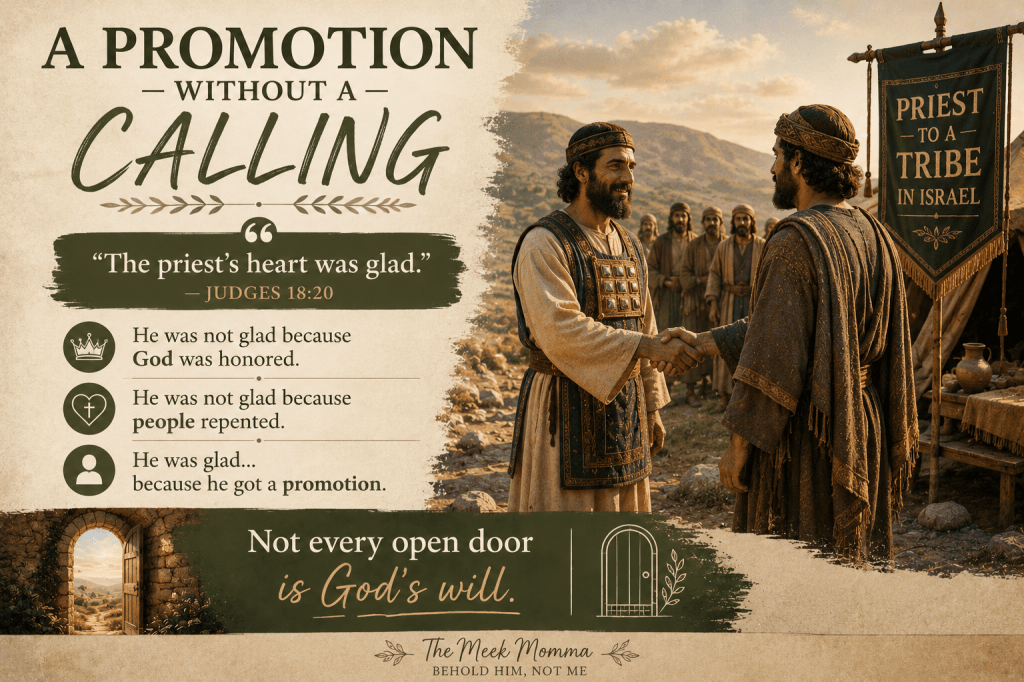
โ€œAnd the priestโ€™s heart was glad.โ€ (Judges 18:20)

That statement is devastating.

His heart is not glad because God is being honored.

His heart is not glad because people are returning to true worship.

His heart is glad because he got a promotion.

The Levite serves whoever benefits him most.

His loyalty is not to God.

His loyalty is to himself.

Not every promotion is a blessing.

Not every opportunity is Godโ€™s will.

Not every open door should be walked through.

The Leviteโ€™s life warns us that it is possible to climb higher and higher while moving further and further away from God.

The Land That Looked Perfect

The Danite spies eventually arrive at a place called Laish.

What they find appears almost too good to be true.

The people are living securely.

The land is fertile.

The city is prosperous.

There are no nearby allies.

There are no obvious obstacles.

Everything looks easy.

Everything looks safe.

Everything looks desirable.

The spies return and declare:

โ€œArise, and let us go up against them. For we have seen the land, and behold, it is very good.โ€ (Judges 18:9)

The language sounds remarkably similar to Joshua and Caleb.

Yet there is one critical difference.

Joshua and Caleb trusted Godโ€™s promises.

The Danites trusted their own calculations.

The city looked vulnerable.

The battle looked manageable.

The reward looked substantial.

The entire plan was built upon what they could see.

There is remarkably little mention of trusting God.

How often do we do the same thing?

We evaluate opportunities based upon ease, safety, and apparent success.

Yet ease is not always evidence of Godโ€™s blessing.

Sometimes the easiest path is the path furthest from obedience.

The Danites wanted a land they could conquer without depending on God.

They found one.

The tragedy is that God had already given them a land.

What they lacked was not opportunity.

What they lacked was faith.

The Restless Heart Finds Rest

As I studied Judges 18, I found myself asking a simple question:

What is every character in this chapter actually looking for?

Dan is looking for a homeland.

The Levite is looking for significance.

Micah is looking for blessing.

Everyone is searching.

Everyone is moving.

Everyone believes that what they need lies somewhere beyond their current circumstances.

Yet none of them find peace.

Because none of them are ultimately seeking God.

Augustine famously wrote:

โ€œYou have made us for Yourself, and our hearts are restless until they find their rest in You.โ€

Centuries before Augustine, Judges 18 was illustrating that truth.

The tribe of Dan had a restless heart.

The Levite had a restless heart.

Micah had a restless heart.

And if we are honest, so do we.

The human heart can turn any blessing into an idol and any gift into a substitute for God.

If we are looking to circumstances to provide what only God can provide, we will never stop searching.

The Better Homeland

The tribe of Dan believed they needed a different inheritance.

Yet the Bible teaches that Godโ€™s people have always been looking for a better country.

Not merely a different piece of land.

A heavenly one.

Dan thought they needed Laish.

What they truly needed was God.

Every earthly home points beyond itself.

Every earthly security eventually fades.

Every earthly kingdom eventually falls.

But Christ offers a kingdom that cannot be shaken.

The Better Significance

The Levite believed significance would come through promotion.

Yet significance built upon position is always fragile.

The gospel offers something far more secure.

Our value is not rooted in our accomplishments.

Our significance is not rooted in our platform.

Our identity is rooted in being known and loved by Christ.

The Levite spent his life climbing.

Jesus spent His life descending.

The Son of God humbled Himself and became obedient to the point of deathโ€”even death on a cross.

The path to significance in Godโ€™s kingdom is not self-promotion.

It is surrender.

The Better Blessing

Micah spent chapters constructing a religion that he believed would bring blessing.

Yet he wanted Godโ€™s gifts more than God Himself.

That temptation remains one of the greatest dangers in the Christian life.

We can seek peace instead of the Prince of Peace.

Provision instead of the Provider.

Guidance instead of the Guide.

Gifts instead of the Giver.

But every blessing was always meant to lead us back to Christ.

The greatest gift God gives is not prosperity.

It is His presence.
Come to Me

Against the backdrop of all this searching, Jesus speaks words that feel especially precious:

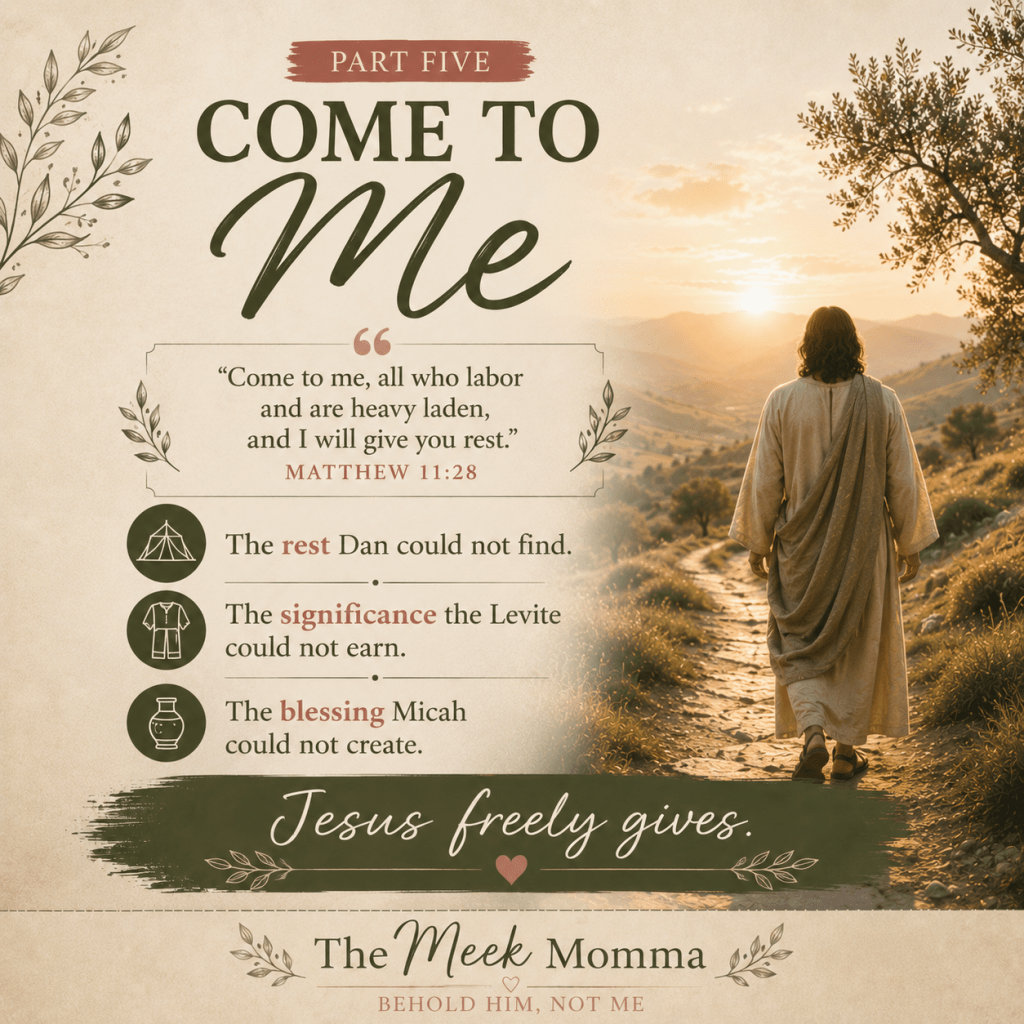
โ€œCome to me, all who labor and are heavy laden, and I will give you rest.โ€ (Matthew 11:28)

Notice what Jesus does not say.

He does not say:

Come to a better opportunity.

Come to a better circumstance.

Come to a better plan.

He says:

โ€œCome to Me.โ€

The rest Dan could not find.

The security Micah could not create.

The significance the Levite could not achieve.

Jesus freely gives.

The answer to a restless heart is not finding a new location.

A new opportunity.

Or a new season.

It is a Person.

And His name is Jesus Christ.

Behold Him, Not Me

Judges 18 is a chapter full of searching.

A searching tribe.

A searching priest.

A searching people.

Yet every path they take only leads them further from God.

Their story reminds us that restlessness is often a symptom of a deeper problem.

We have forgotten that God Himself is our inheritance.

The invitation of the gospel is not to search harder.

It is to stop searching.

To come to Christ.

To trust Christ.

To rest in Christ.

The world tells us that peace lies somewhere out there.

Jesus tells us that peace is found in Him.

May we learn to say with the psalmist:

โ€œWhom have I in heaven but You? And there is nothing on earth that I desire besides You.โ€ (Psalm 73:25)

And may we learn once again to behold Him, not ourselves.


Heart Check

โ€ข Where am I currently looking for satisfaction apart from God?

โ€ข What circumstances do I believe must change before I can be content?

โ€ข Am I seeking Godโ€™s gifts more than God Himself?

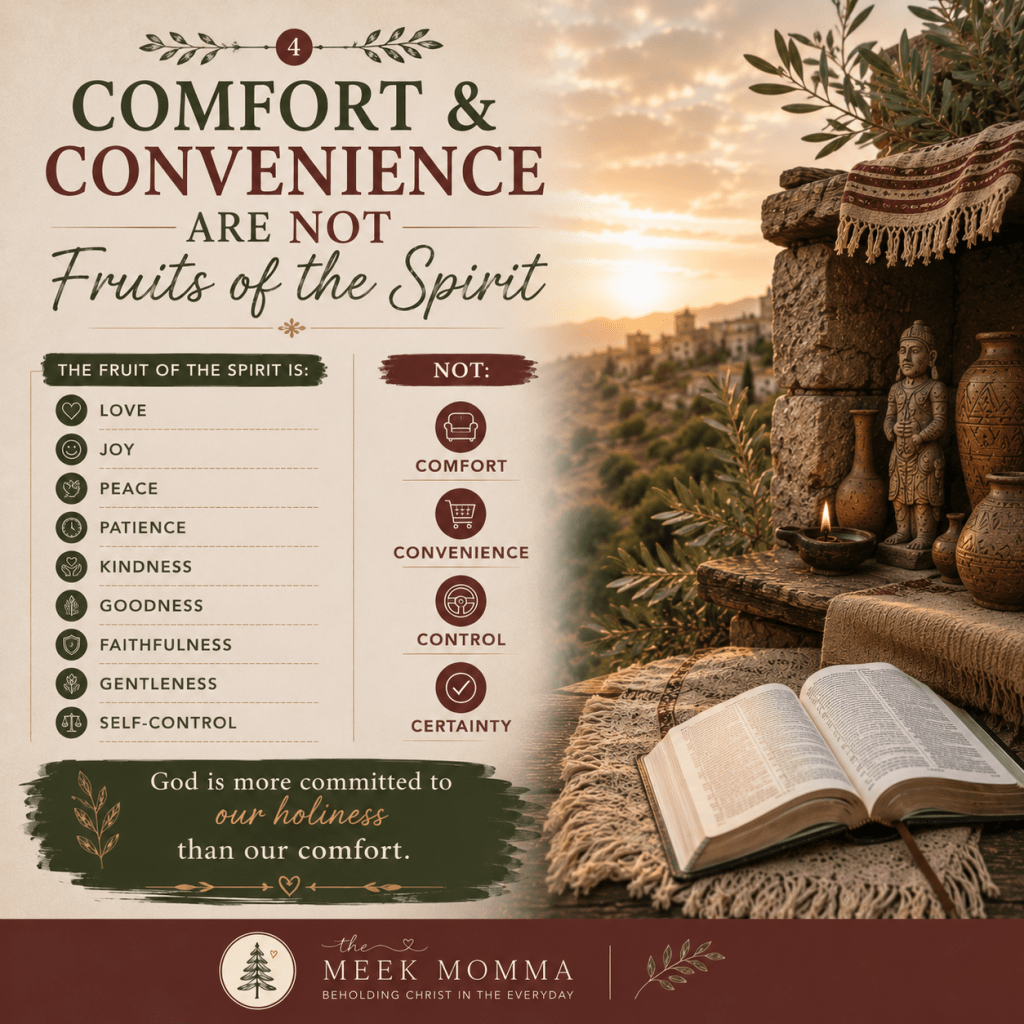
โ€ข Have I confused comfort with contentment?

โ€ข What would it look like to rest in Christ today rather than continue searching for something else?


Prayer

Father,

Forgive me for the ways I continually search for satisfaction outside of You.

Thank You for reminding me that You alone are my inheritance.

Help me to stop chasing what cannot satisfy and to find my rest in Christ.

When my heart becomes restless, remind me that true peace is not found in a place, a possession, or a position.

It is found in You.

Teach me to behold Christ more clearly, trust Him more deeply, and rest in Him more fully.

In Jesusโ€™ name,

Amen.

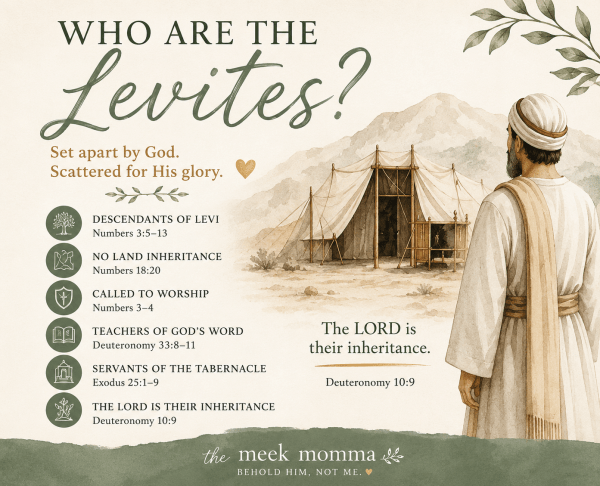
Bonus Material: Who Are the Levites?

Why Their Story Mattersโ€”Especially in the Book of Judges

โ€œIn those days there was no king in Israel. Everyone did what was right in his own eyes.โ€ โ€” Judges 21:25

If youโ€™ve been reading through the final chapters of Judges, youโ€™ve probably noticed something surprising.

The main characters arenโ€™t kings.

They arenโ€™t judges.

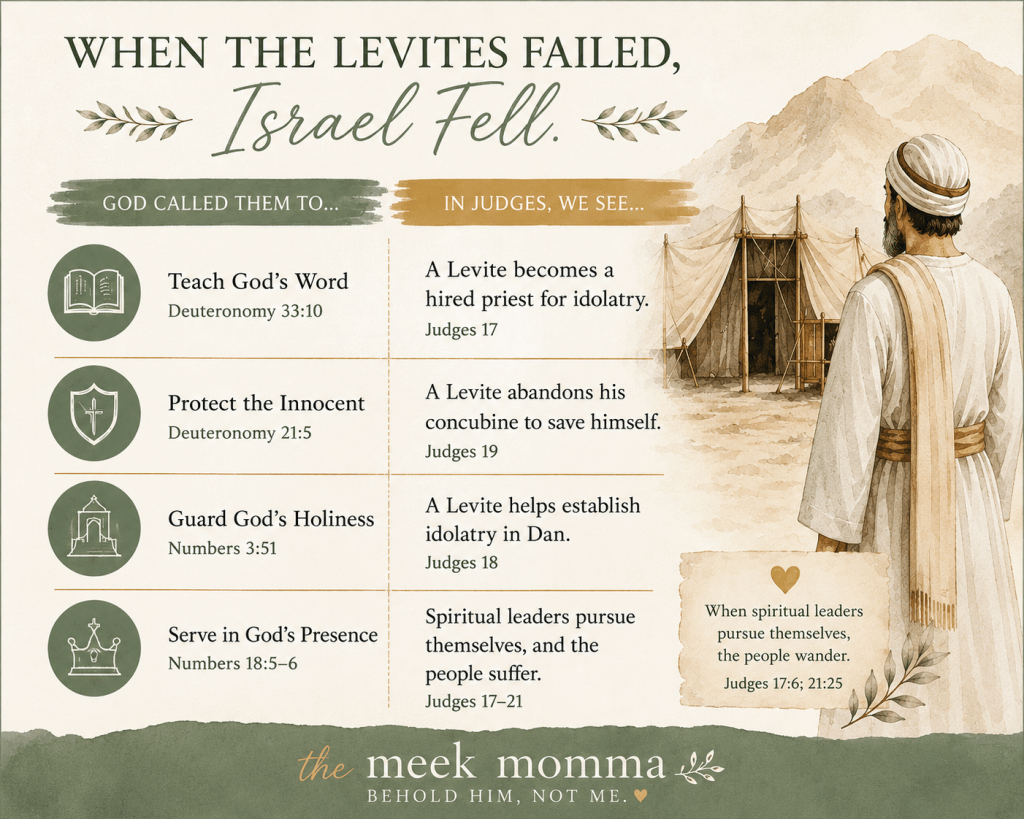
Instead, the narrative repeatedly places Levites at the center of Israelโ€™s darkest moments.

A Levite serves as priest in an idolatrous household (Judges 17โ€“18).

Another Levite abandons his concubine to protect himself (Judges 19).

Why?

Because the author wants us to see something deeper than political chaos.

He wants us to see spiritual collapse.

To understand why these stories are so shocking, we first need to understand who the Levites were and what God had called them to be.


Read the Passage

Primary Reading:

  • Genesis 49:5โ€“7
  • Exodus 32:25โ€“29
  • Numbers 3:5โ€“13
  • Numbers 8:5โ€“26
  • Deuteronomy 10:8โ€“9
  • Deuteronomy 33:8โ€“11
  • Judges 17โ€“21

Observe the Text

Before we ask what these passages mean, notice a few repeated themes.

  • God Himself chose the Levites.
  • They belonged to Him in a unique way.
  • They were scattered throughout Israel.
  • They had no tribal inheritance of land.
  • Their lives revolved around worship.
  • Their purpose was to help Israel remain faithful to the covenant.

Yet by Judges 17โ€“21โ€ฆ

they are doing the exact opposite.


Who Were the Levites?

The Levites were descendants of Levi, one of the twelve sons of Jacob.

Unlike the other tribes, they were never intended to become wealthy landowners.

Instead, God declared:

โ€œThe LORD is their inheritance.โ€

Think about that.

Every other tribe received fertile valleys, vineyards, fields, and cities.

The Levites received something far greater.

They received the privilege of belonging wholly to God.

Their identity wasnโ€™t rooted in possessions.

It was rooted in Godโ€™s presence.


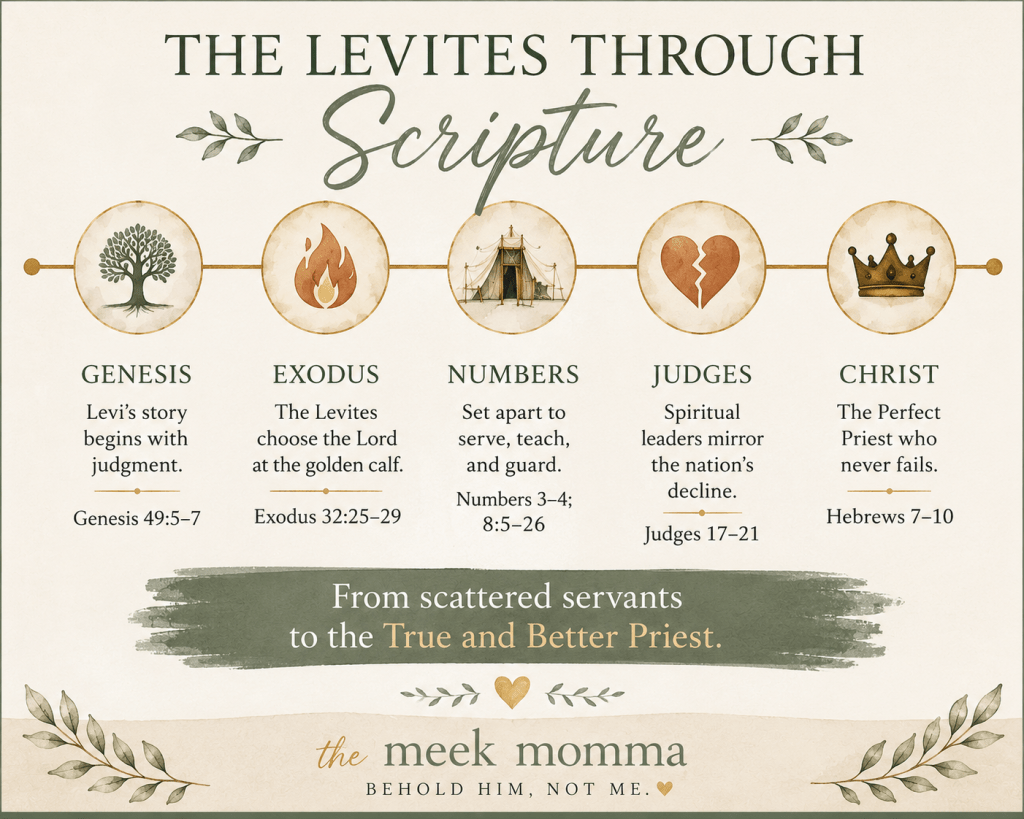
From Judgment to Grace

Leviโ€™s story doesnโ€™t begin well.

In Genesis 34, Levi and his brother Simeon responded to the assault of their sister Dinah by slaughtering an entire city.

Years later, Jacob declared:

โ€œI will divide them in Jacob and scatter them in Israel.โ€

At first glance, this sounds like nothing but judgment.

Yet God, in His mercy, transformed that judgment into a blessing.

Rather than being scattered in disgrace, the Levites were scattered throughout Israel so every tribe would have teachers of Godโ€™s Word living among them.

Only God can redeem a curse into a calling.


Why Did God Choose the Levites?

The defining moment comes after Israel worshiped the golden calf.

While the nation bowed before an idol, Moses cried out:

โ€œWho is on the LORDโ€™S side?โ€

Only the Levites responded.

Because of their zeal for Godโ€™s holiness, the Lord formally set them apart for His service.

They became Israelโ€™s ministers, teachers, guardians, and servants of the Tabernacle.


What Were They Called to Do?

The Levites werenโ€™t simply ancient church janitors.

Their responsibilities touched every part of Israelโ€™s spiritual life.

They guarded Godโ€™s dwelling.

They cared for the Tabernacle.

They transported it.

They protected it from being treated as ordinary.


They taught Godโ€™s Word.

The Levites instructed Israel in Godโ€™s Law.

They explained the covenant.

They answered difficult questions.

They helped people distinguish truth from error.


They preserved holiness.

Again and again, Scripture connects the Levites with the distinction between holy and common, clean and unclean.

Their lives continually reminded Israel:

God is holy.


They shepherded Godโ€™s people.

Though they held no throne, they exercised tremendous spiritual influence.

They were meant to lead Israel toward faithful worship.


Their Greatest Possession

Perhaps the most beautiful truth about the Levites is this:

They received no inheritance because God Himself was their inheritance.

This wasnโ€™t a punishment.

It was a privilege.

Their lives declared:

Nothing is greater than belonging to the Lord.


Then Comes Judgesโ€ฆ

Now everything changes.

The Levites who once destroyed idolsโ€ฆ

begin serving idols.

The Levites who once guarded holinessโ€ฆ

participate in profound wickedness.

The Levites who should have defended the vulnerableโ€ฆ

exploit them.

This is why the stories in Judges are so disturbing.

The author isnโ€™t simply showing us that Israel sinned.

Heโ€™s showing us that even Israelโ€™s spiritual leaders have become indistinguishable from the surrounding nations.

Israel hasnโ€™t merely failed to remove Canaanite influence.

Israel has become Canaanite.


The Tragedy of Judges

Notice the progression.

In Exodusโ€ฆ

the Levites answer Godโ€™s call.

In Judgesโ€ฆ

they answer the highest bidder.

In Exodusโ€ฆ

they defend true worship.

In Judgesโ€ฆ

they help establish false worship.

In Exodusโ€ฆ

they stand for Godโ€™s holiness.

In Judgesโ€ฆ

they abandon righteousness to protect themselves.

The nationโ€™s spiritual decline is visible in the very people who were supposed to lead it.


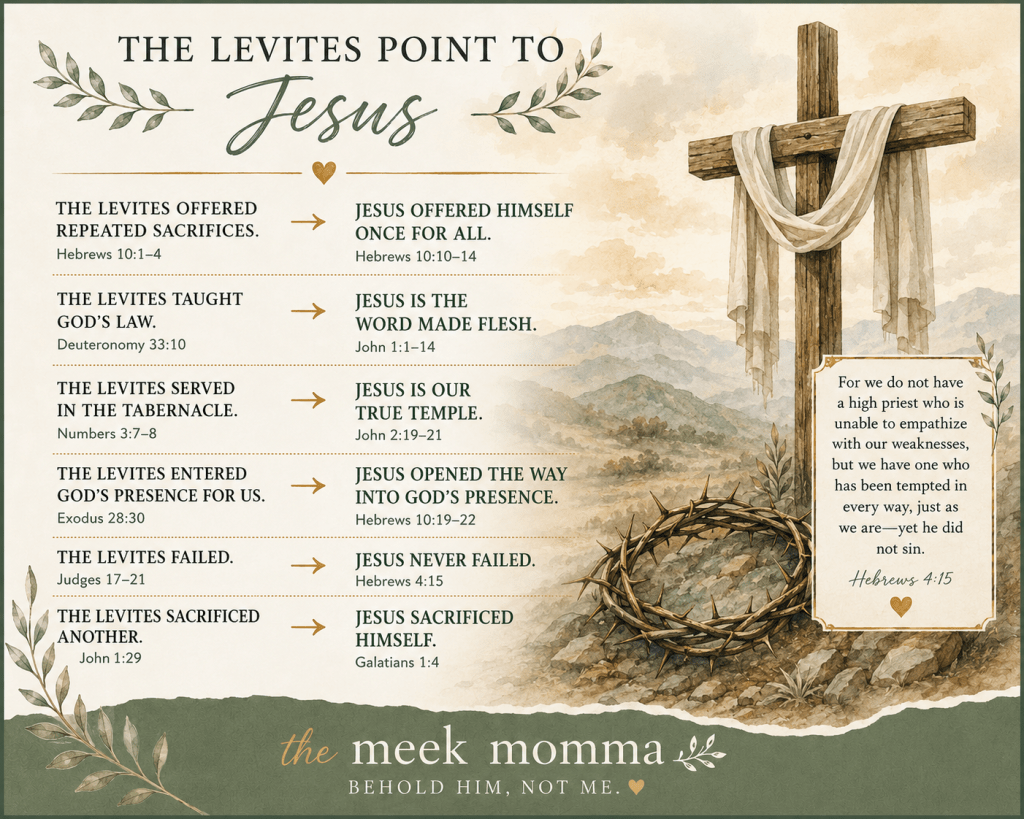
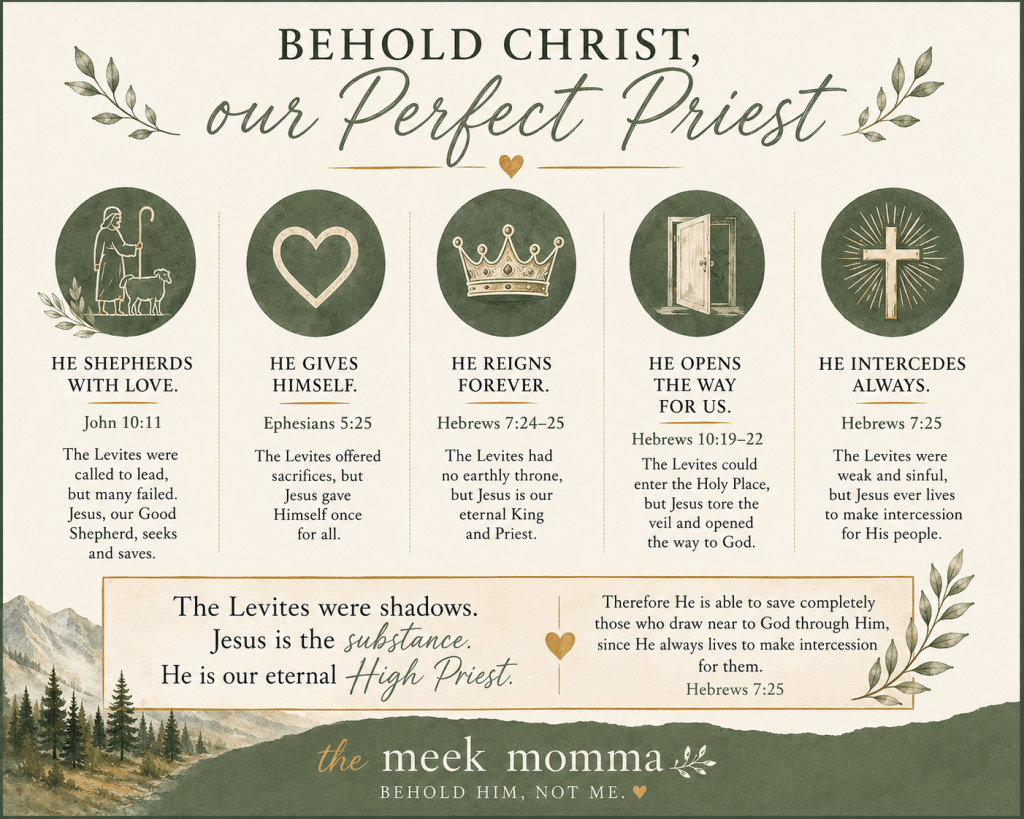
Behold Christ

Every faithful Levite pointed forward to a greater Priest.

Every corrupt Levite reminded Israel they still needed Him.

The Levites guarded Godโ€™s house.

Jesus is the true Temple.

The Levites offered sacrifices.

Jesus became the sacrifice.

The Levites taught Godโ€™s Law.

Jesus is the Word made flesh.

The Levites entered Godโ€™s presence on behalf of the people.

Jesus opened the way into Godโ€™s presence forever.

The Levites failed repeatedly.

Christ never failed once.

Where Judges leaves us longing for faithful spiritual leadership, the Gospel answers that longing in Jesus Christ, our perfect High Priest.


Examine Your Heart

As you reflect on the Levites, consider these questions:

  • Is my greatest inheritance God Himself, or have I come to treasure His gifts more than His presence?
  • Am I careful to distinguish between what God calls holy and what the world calls acceptable?
  • Where am I tempted to โ€œdo what is right in my own eyesโ€ rather than submit to Godโ€™s Word?
  • How am I using whatever influence God has given me to point others toward Him?

Respond

Repent: Confess any tendency to seek comfort, approval, or success above faithfulness to God.

Believe: Trust that Christ is the perfect High Priest who never abandons His people.

Obey: Ask God to make your life a testimony to His holiness and grace.

Pray:

Father, thank You for preserving Your Word so that we might learn from both the faithfulness and failures of those who came before us. Guard my heart from doing what is right in my own eyes. Help me treasure You above every earthly inheritance, and teach me to look to Jesus, my perfect High Priest, who never fails to lead His people into Your presence. Amen.

He Makes Everything Beautiful in Its Time

Finding Hope in Ecclesiastes 3

If youโ€™ve ever read Ecclesiastes, you know it can feel surprisingly heavy.

Traditionally attributed to Solomonโ€”the son of David and king of Israelโ€”Ecclesiastes is part of Scriptureโ€™s Wisdom Literature. It isnโ€™t a book of commands telling us to despair or to chase pleasure while we can. Rather, it is a Spirit-inspired record of one manโ€™s honest observations about life in a fallen world. Through poetic language, paradox, and reflection, Solomon invites us into holy wrestling with lifeโ€™s hardest questions.

He exposes the emptiness of pursuing wisdom, wealth, pleasure, or achievement apart from God while calling us to something far better: to fear the Lord and trust Him, even when we cannot understand all that He is doing (Ecclesiastes 12:9โ€“14).

This morning, I found myself lingering over Ecclesiastes 3.

โ€œHe has made everything beautiful in its time. Also, he has put eternity into manโ€™s heart, yet so that he cannot find out what God has done from the beginning to the end.โ€
โ€” Ecclesiastes 3:11 (ESV)

The Hebrew word translated โ€œbeautifulโ€ is yฤpeh, which carries the idea of something that is fitting, appropriate, or timelyโ€”not merely attractive.

That changes how I read this verse.

God isnโ€™t promising that every season will feel beautiful.

He is promising that every season has a fitting place within His perfect plan.

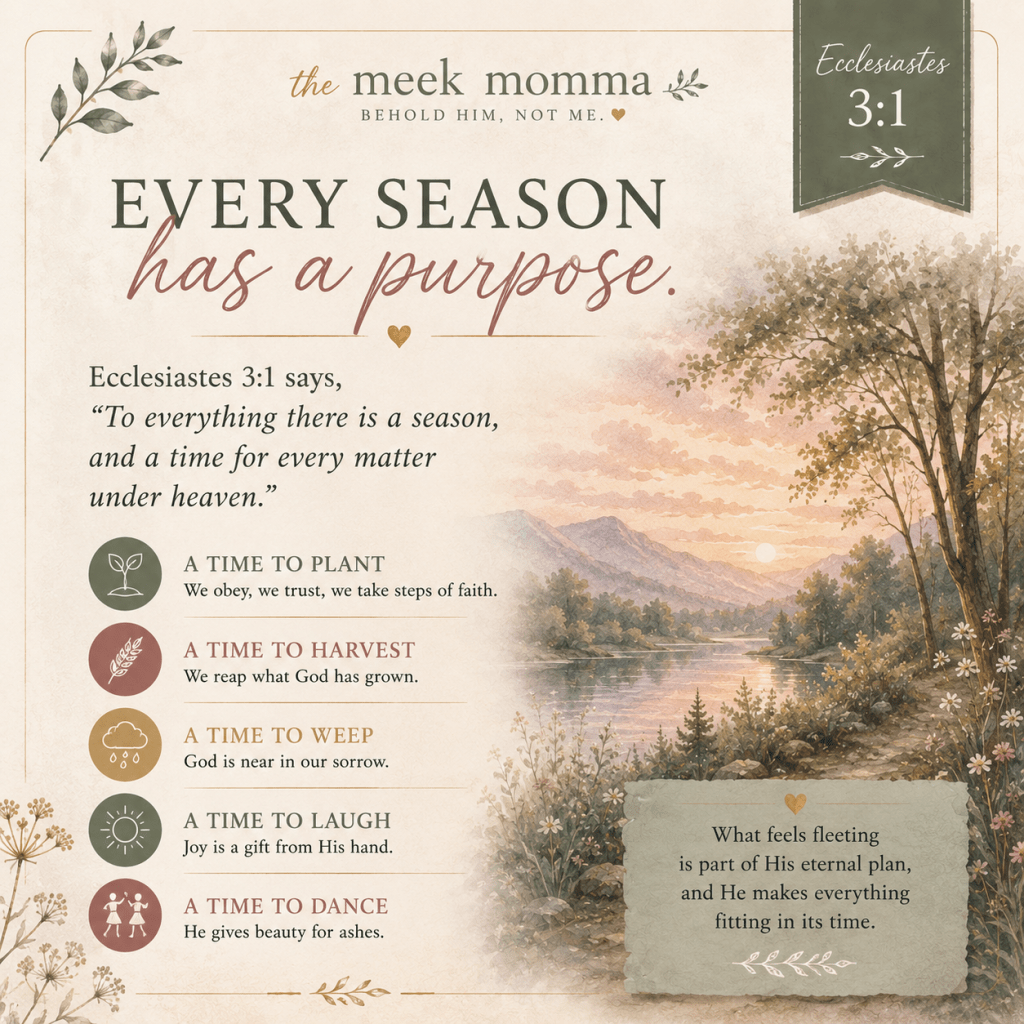
There is a time to plant and a time to harvest.

A time to weep and a time to laugh.

A time to mourn and a time to dance.

While our lives often feel uncertain, fragmented, and fleeting, every season is held securely in the hands of a sovereign God.

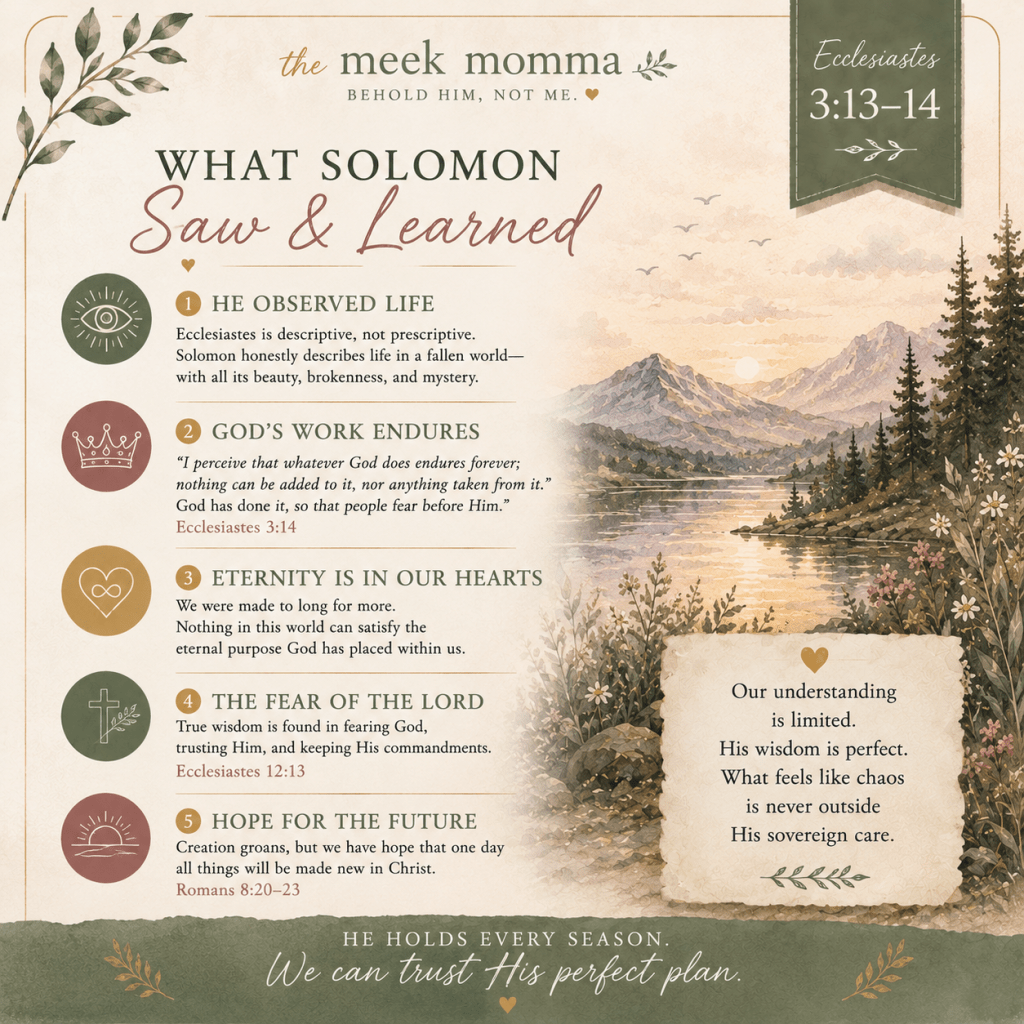
Ecclesiastes also tells us that God has โ€œput eternity into manโ€™s heart.โ€ We were created to long for something this world can never fully satisfy. That longing isnโ€™t a flawโ€”itโ€™s evidence that we were made for more. We were created for God Himself.

This is why so much of life can feel like chasing the wind. No amount of success, comfort, possessions, or earthly wisdom can quiet the longing for eternity that God has placed within us.

Yet Solomon doesnโ€™t leave us in despair.

Just a few verses later he writes:

โ€œI perceived that whatever God does endures forever; nothing can be added to it, nor anything taken from it. God has done it, so that people fear before him.โ€
โ€” Ecclesiastes 3:14

Our work is temporary.

Godโ€™s work is eternal.

Our plans change.

His purposes never fail.

Our understanding is limited.

His wisdom is perfect.

What feels like chaos to us is never outside His sovereign care.

The Apostle Paul echoes this same hope when he reminds us that creation itself has been subjected to futility because of the Fall, yet it eagerly awaits the day of redemption (Romans 8:20โ€“23). One day, every longing will find its fulfillment in Christ, and what is now broken will be made whole.

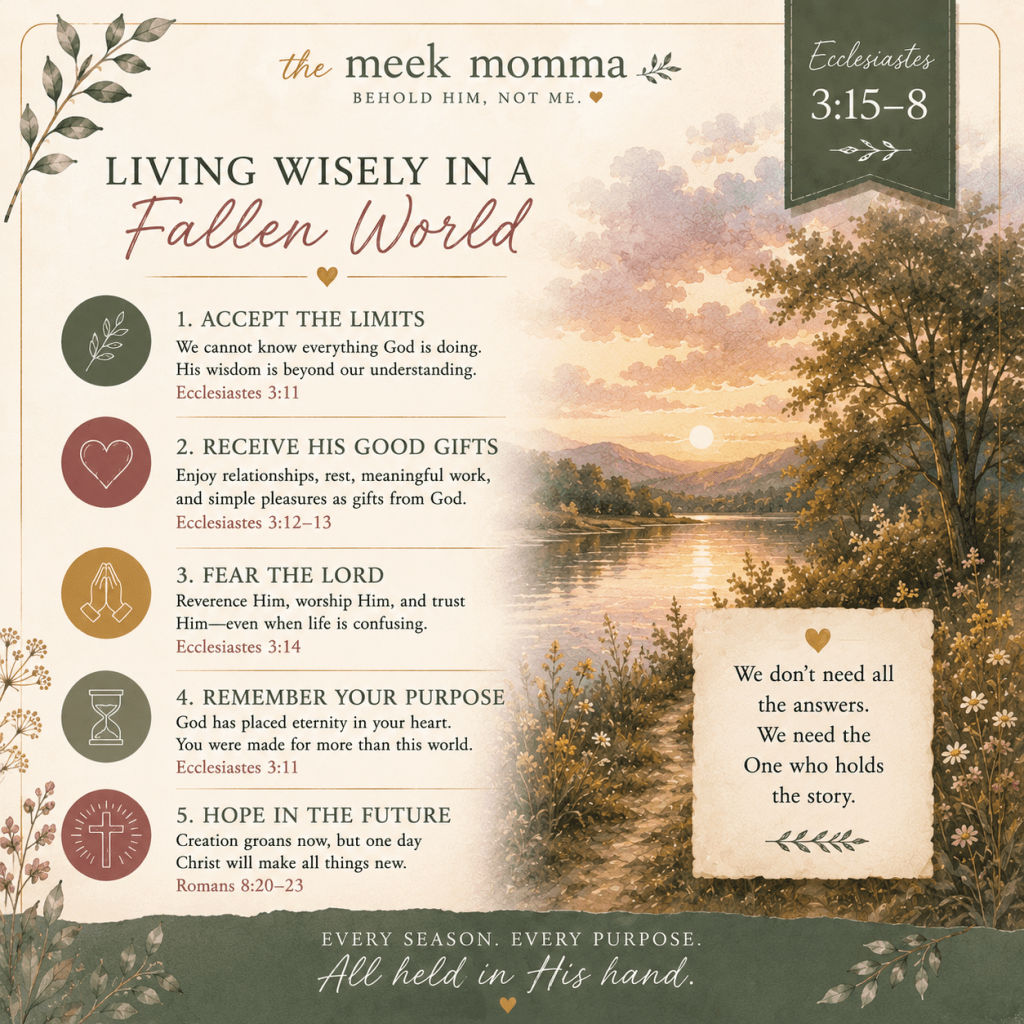
Until then, faith does not require us to understand everything.

It calls us to trust the One who does.

Todayโ€™s Takeaway

Every seasonโ€”from planting to harvesting, from mourning to dancingโ€”is held in Godโ€™s hands. What feels fleeting is part of His eternal plan, and in His perfect wisdom, He makes everything fitting in its time.

Sometimes the most faithful thing we can do is stop demanding to know the whole story and instead rest in the Author who is writing it.

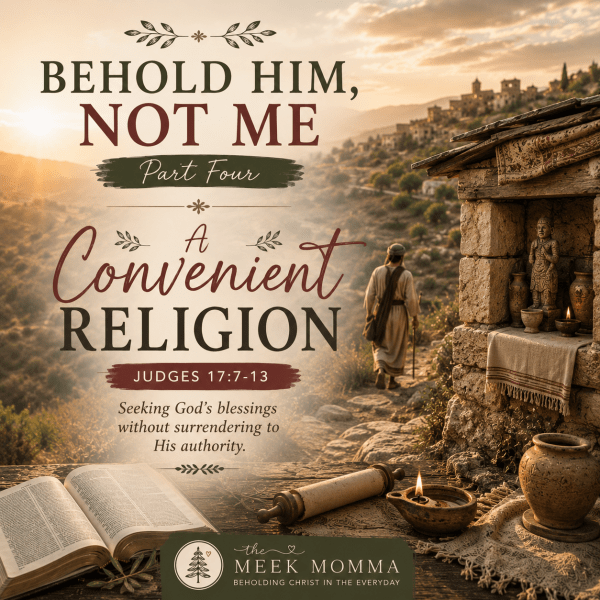
Behold Him, Not Me: Part Four

A Convenient Religion

Judges 17:7โ€“13

โ€œIt is possible to seek Godโ€™s blessing while refusing Godโ€™s authority.โ€


The Most Dangerous Kind of Religion

If someone asked you what spiritual rebellion looks like, what would you picture?

Would you imagine someone abandoning church?

Rejecting Christianity?

Walking away from God altogether?

That is often what we think rebellion looks like.

Yet Judges 17 presents a far more subtle danger.

Micah does not reject religion.

In fact, he becomes increasingly religious.

He has a shrine.

He has idols.

He has an ephod.

He has household gods.

Now he wants a priest.

The problem is not a lack of religious activity.

The problem is that everything revolves around Micah.

The religion is designed for his convenience.

His preferences.

His control.

And if we are honest, that temptation remains alive in every generation.


A Levite Looking for a Better Opportunity

The story introduces a young Levite from Bethlehem in Judah.

This should immediately raise questions.

The Levites were the tribe set apart by God for spiritual service. Their inheritance was not land but the privilege of serving the Lord and teaching His people.

Yet here we find a Levite wandering the countryside looking for a place to settle.

Why?

The text does not tell us directly.

But it reveals something troubling.

The spiritual leadership of Israel has become just as unstable as the people they are meant to shepherd.

The Levite arrives at Micahโ€™s house, and Micah quickly sees an opportunity.

He offers him a position:

โ€œStay with me, and be to me a father and a priest.โ€ (Judges 17:10)

Notice the language.

Micah does not ask what God desires.

He asks what will benefit him.

He wants a personal priest.

Someone attached to his private shrine.

Someone who can provide religious legitimacy to a system God never authorized.

And the Levite accepts.

Not because it is faithful.

But because it is profitable.

For ten shekels of silver, clothing, and food, he becomes Micahโ€™s employee.

The arrangement appears spiritual.

But underneath it is a business transaction.

Micah gets religious credibility.

The Levite gets security.

Neither appears concerned with obedience to God.


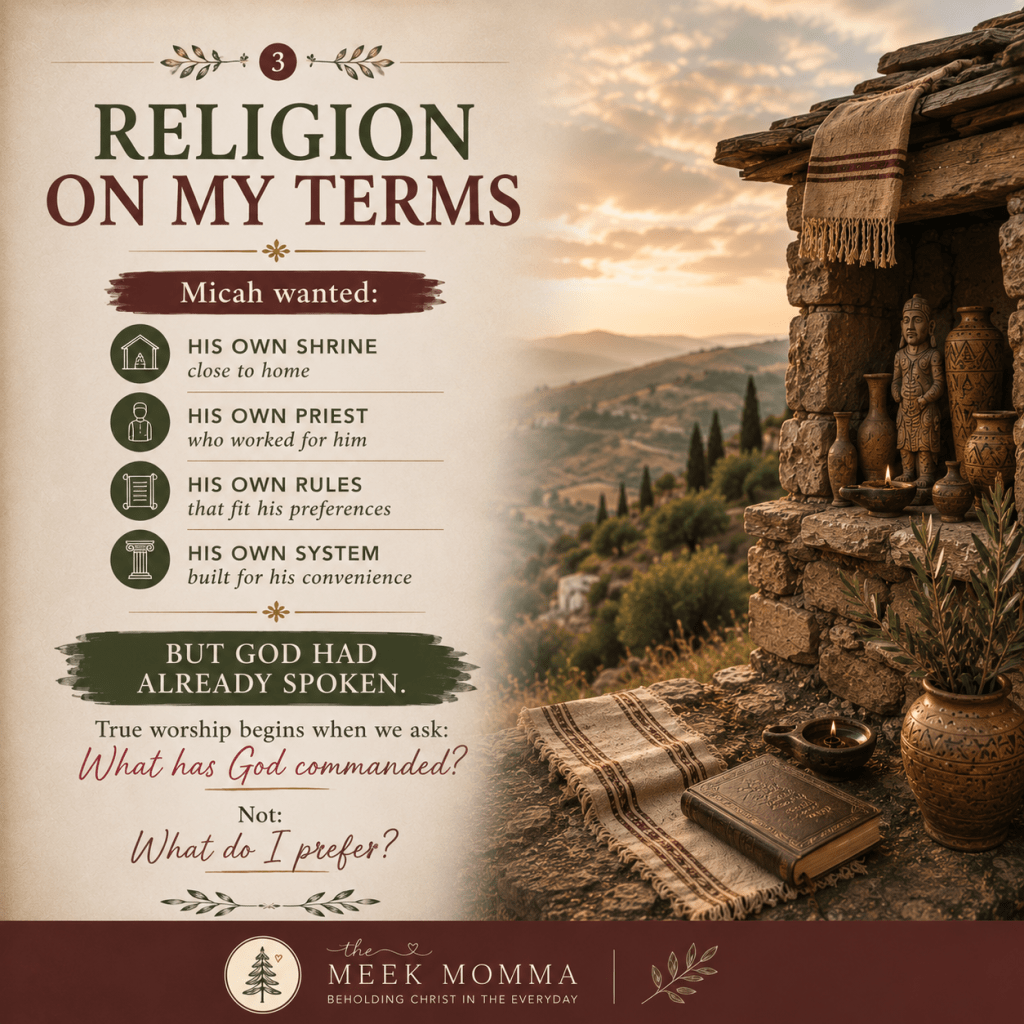
Religion on Our Terms

What Micah is building is not true worship.

It is personalized religion.

God had already established where and how Israel was to worship.

The tabernacle stood as the place where sacrifices were offered and Godโ€™s presence was uniquely displayed among His people.

Yet Micah decides that Godโ€™s arrangement is inconvenient.

He creates his own.

His own shrine.

His own priest.

His own system.

His own rules.

Everything is customized according to his preferences.

This is the natural progression of the human heart.

When we begin reshaping God, we eventually begin reshaping worship.

Tim Keller summarizes the problem well:

โ€œGod says, worship Me as I am, not as you want Me to be. Worship Me as My Word directs, not as your heart suggests.โ€

That is precisely what Micah refuses to do.

And before we judge him too harshly, we should recognize how often we are tempted to do the same.

We may not build shrines in our homes.

But we frequently approach faith as consumers rather than disciples.

We ask:

What works for me?

What makes me comfortable?

What fits my schedule?

What aligns with my preferences?

The modern world encourages us to customize everything.

Our entertainment.

Our news.

Our shopping.

Our social media feeds.

And if we are not careful, we begin treating Christianity the same way.

Instead of asking, โ€œWhat has God commanded?โ€

We ask, โ€œWhat do I like?โ€


Wanting Godโ€™s Blessing Without Godโ€™s Authority

The climax of the story comes in verse 13.

Micah proudly declares:

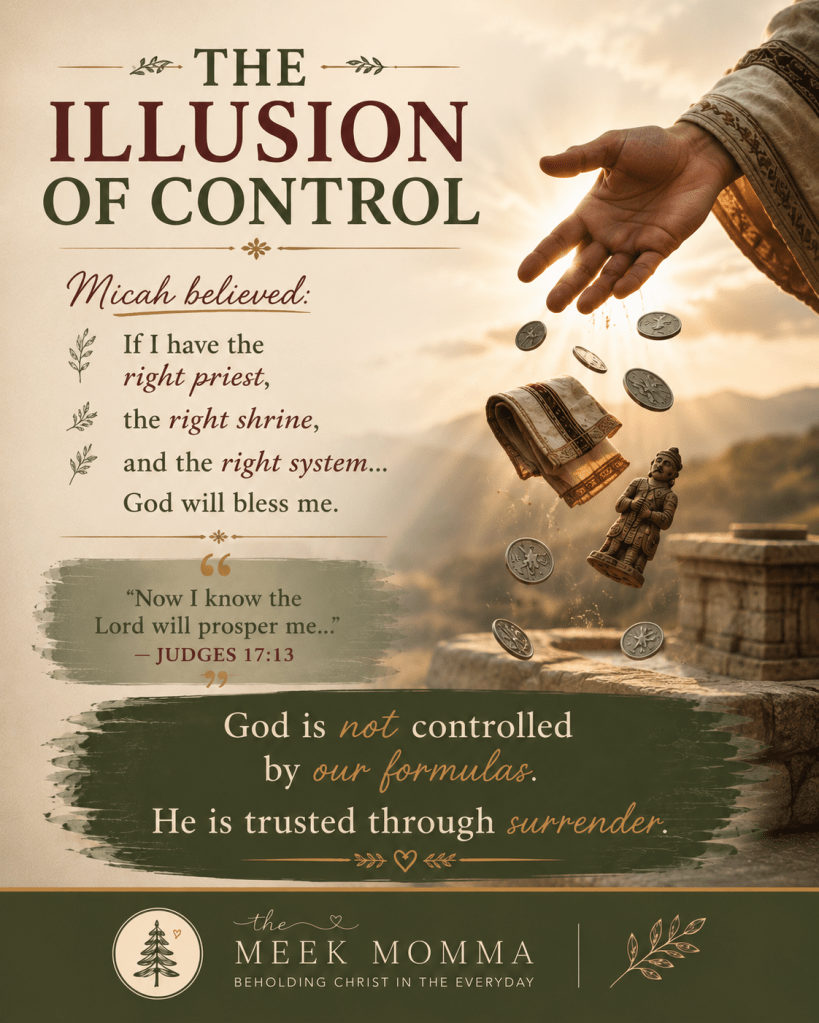
โ€œNow I know that the Lord will prosper me, because I have a Levite as priest.โ€

This statement reveals the true condition of his heart.

Micah believes he has found the formula for blessing.

He has assembled all the religious pieces.

He has the shrine.

Yet Micah has misunderstood something fundamental.

He has the idols.

He has the priest.

Surely now God will bless him.

Godโ€™s blessing is not a reward for manipulating religious systems.

God cannot be controlled.

He cannot be purchased.

He cannot be managed.

Micah treats worship almost like a superstition.

As though gathering enough religious objects and religious people will guarantee divine favor.

Yet genuine faith is not about controlling God.

It is about surrendering to Him.

This temptation remains incredibly common today.

We can begin treating prayer like a formula.

Church attendance like a transaction.

Bible reading like a spiritual insurance policy.

We subtly convince ourselves that if we perform the right activities, God owes us certain outcomes.

But God is not interested in being used.

He desires to be worshiped.


The Better Priest

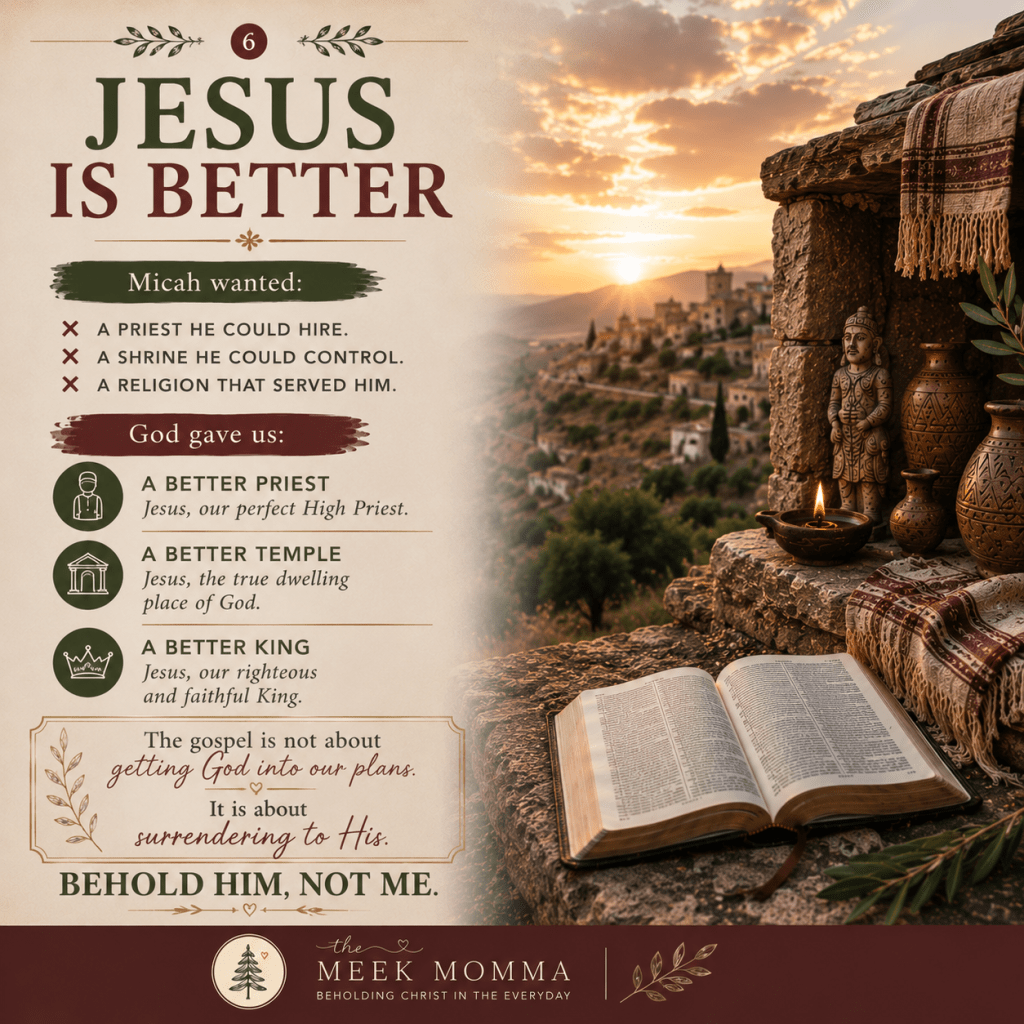
Micah wanted a priest who belonged to him.

A priest who would serve his interests.

A priest he could hire.

A priest he could control.

But Godโ€™s people do not need a priest of their own making.

We have been given a perfect High Priest.

The book of Hebrews tells us that Jesus Christ serves as our great High Priest before the Father.

Unlike Micahโ€™s priest, Jesus cannot be bought.

Unlike Micahโ€™s priest, Jesus never compromises.

Unlike Micahโ€™s priest, Jesus perfectly represents God to His people and His people before God.

The wandering Levite points us toward humanityโ€™s need for a faithful priest.

Jesus fulfills that need completely.


The Better Temple

Micah built a shrine.

God provided something better.

Throughout the Old Testament, Godโ€™s presence was associated with the tabernacle and later the temple.

But even these pointed beyond themselves.

Jesus declared:

โ€œDestroy this temple, and in three days I will raise it up.โ€ (John 2:19)

He was speaking about His own body.

Jesus is the true meeting place between God and humanity.

Micah attempted to create a sacred space that would guarantee Godโ€™s favor.

God gave us Christ.

We do not travel to a private shrine to find Him.

We come to Jesus.


The Better King

The repeated refrain of Judges reminds us:

โ€œIn those days there was no king in Israel. Everyone did what was right in his own eyes.โ€

Micahโ€™s story illustrates exactly what happens when people become their own authority.

They reshape God.

They reshape worship.

They reshape truth.

They reshape morality.

They become kings of their own lives.

Yet the Bibleโ€™s answer is not better self-help.

The answer is a better King.

Jesus does not simply offer advice.

He reigns.

And unlike every human leader, His rule is good.

His commands are good.

His authority is good.

True freedom is not found in doing whatever seems right in our own eyes.

True freedom is found in joyful submission to the King who sees clearly.


Behold Him, Not Me

Micahโ€™s religion looked impressive.

He had all the right pieces.

A shrine.

A priest.

Religious language.

Religious activity.

Religious confidence.

Yet none of it brought him closer to God because it was ultimately centered on himself.

The danger of Judges 17 is not merely false religion.

It is self-centered religion.

A faith that uses God rather than worships Him.

A faith that seeks blessings without surrender.

A faith that wants Godโ€™s gifts more than God Himself.

The gospel offers something infinitely better.

Not a convenient religion.

Not a customized spirituality.

Not a God made in our image.

But Jesus Christ.

Our better Priest.

Our better Temple.

Our better King.

The One who does not exist to serve our preferences.

The One who came to rescue us from ourselves.

May we learn to stop asking how God can fit into our plans.

And instead ask how our lives can be shaped by His.

Behold Him, not me.


Heart Check

โ€ข Are there areas where I want Godโ€™s blessings more than Godโ€™s authority?

โ€ข Have I been treating faith as a relationship or as a transaction?

โ€ข Do I approach God seeking surrender or control?

โ€ข Are there parts of my life I have customized according to my preferences rather than Godโ€™s Word?

โ€ข What would joyful submission to Christ look like in my life today?


Prayer

Father,

Forgive me for the ways I seek Your blessings while resisting Your authority. Forgive me for the times I have approached faith as a transaction rather than a relationship.

Thank You for giving me something far better than self-made religion. Thank You for Jesus, my perfect High Priest, my true Temple, and my rightful King.

Teach me to surrender areas of my life that I have kept under my own control. Help me to trust Your wisdom more than my preferences and Your Word more than my feelings.

May my faith not be built around convenience, comfort, or personal gain, but around knowing and worshiping You.

Teach me to behold Christ more clearly and to follow Him more faithfully.

In Jesusโ€™ name,

Amen.

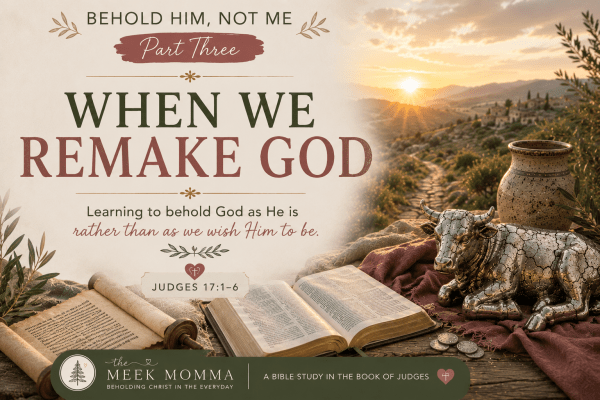
Behold Him, Not Me: Part Three

When We Remake God

Judges 17:1โ€“6

โ€œThe most dangerous idols are often the ones we create in Godโ€™s name.โ€


A Note to Readers

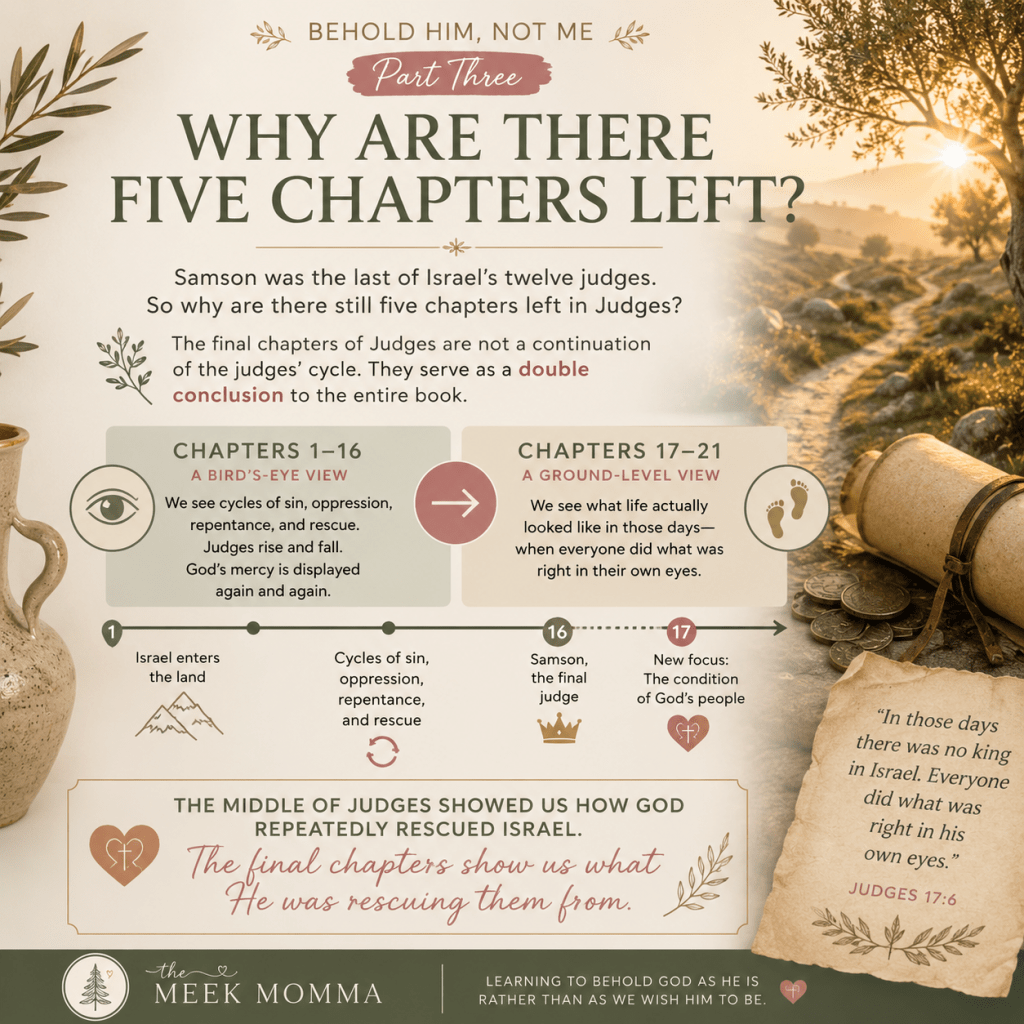
As we continue our journey through Judges, some readers may be wondering why there are still five chapters left in the book. After all, Samson was the last of Israelโ€™s twelve judges.

The answer is that the final chapters of Judges are not a continuation of the judgesโ€™ cycle. Instead, they serve as a double conclusion to the entire book.

Earlier chapters gave us a birdโ€™s-eye view of Israelโ€™s history. We watched cycles of sin, oppression, repentance, and rescue unfold across generations. We saw judges rise and fall. We witnessed Godโ€™s mercy displayed again and again toward a people who continually wandered from Him.

Now the author zooms in.

The final chapters provide a ground-level view of what life actually looked like during those dark days.

These stories are not primarily about foreign enemies.

They are about the spiritual condition of Godโ€™s people themselves.

The middle of Judges showed us how God repeatedly rescued Israel.

The final chapters show us what He was rescuing them from.

And what we find is sobering.

Again and again we will hear the refrain:

โ€œIn those days there was no king in Israel. Everyone did what was right in his own eyes.โ€ (Judges 17:6)

That verse is not merely describing Israel.

It is describing the human heart apart from Godโ€™s rule.

Judges 17 is our first case study.

And what makes this story so unsettling is that it is not a story about atheism.

It is a story about religion.

Lots of religion.

The problem is that it is religion shaped by human preference rather than Godโ€™s revelation.

It is worship that looks right but isnโ€™t.

It is devotion that sounds sincere but is fundamentally distorted.

And if we are honest, it is a temptation that remains just as dangerous today.


A Hollow Man

The story begins with a man named Micah from the hill country of Ephraim.

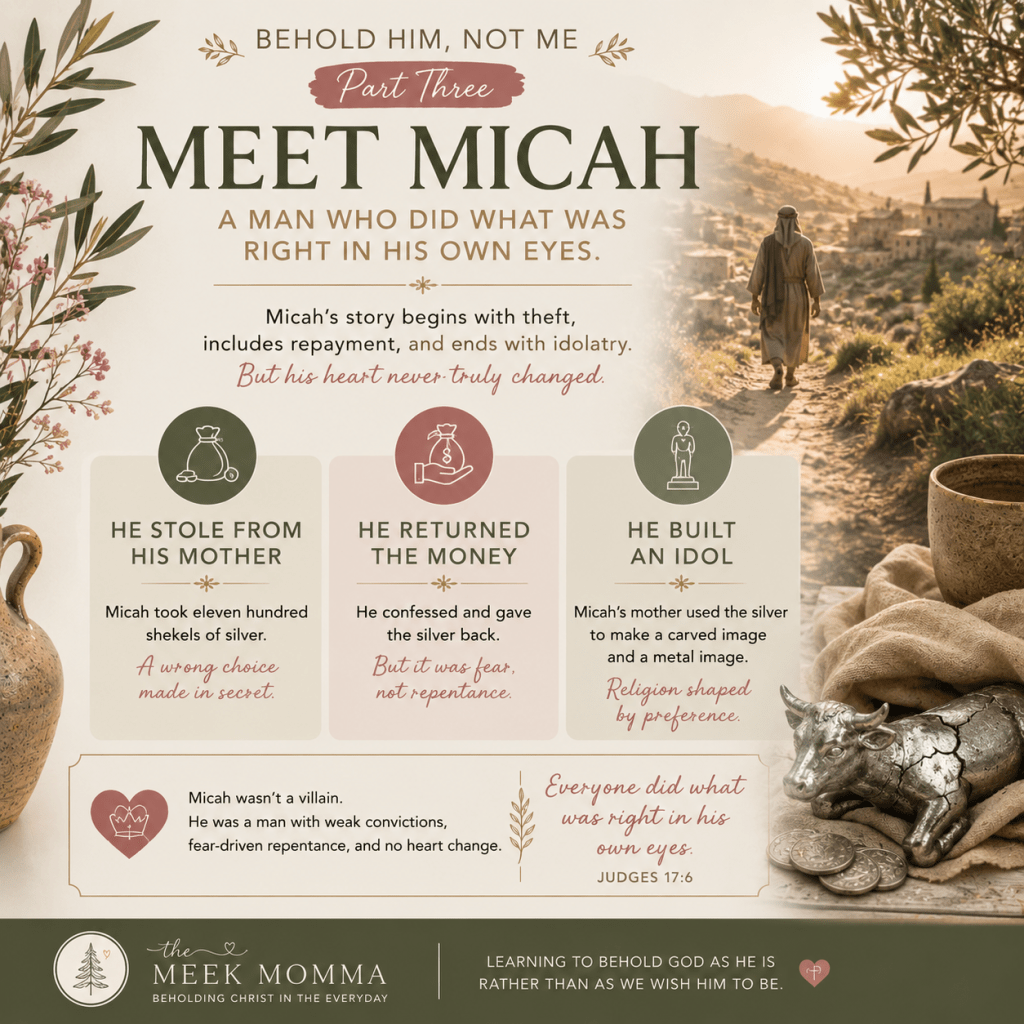
Micah had stolen eleven hundred shekels of silver from his mother. Later, after hearing her pronounce a curse upon the thief, he confesses and returns the money.

At first glance, Micah is difficult to categorize.

He does not appear thoroughly wicked.

After all, he returns the money.

Yet neither does he appear righteous.

A righteous man would never have stolen it in the first place.

The text gives us the impression of a weak man with weak convictionsโ€”a man moved more by fear than by conscience.

A man without much moral substance.

Perhaps that is what makes him so relatable.

Most people do not see themselves in Pharaoh.

Or Jezebel.

Or Judas.

But many of us can recognize compromise.

We recognize drift.

We recognize moments when fear of consequences moved us more than love for righteousness.

Micah is not a monster.

He is simply a man doing what seems right in his own eyes.

And that is exactly the problem.


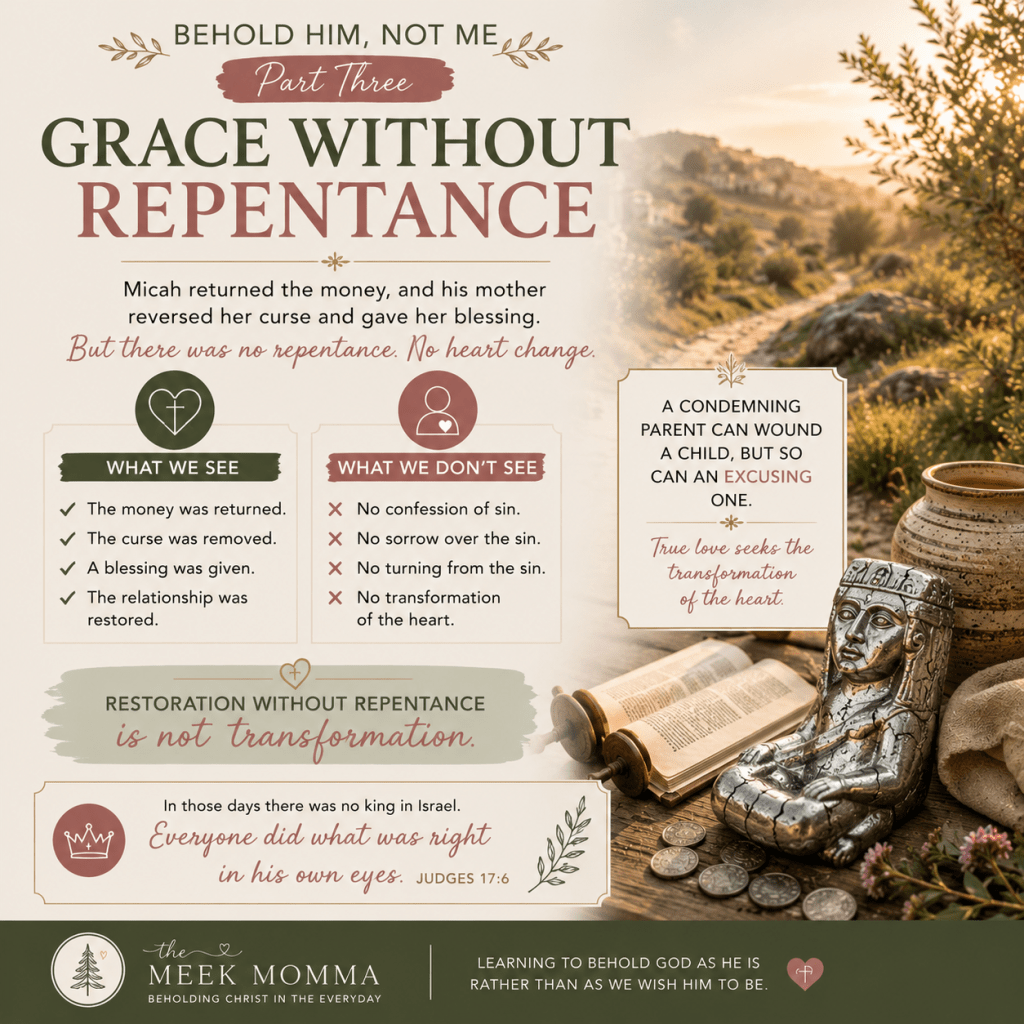
Grace Without Repentance

Micahโ€™s mother responds by reversing her curse and pronouncing a blessing over him.

There is something admirable in her willingness to forgive.

Yet there is also something deeply concerning.

She quickly restores the relationship without ever addressing the deeper issue.

There is blessing.

But no repentance.

Restoration.

But no transformation.

No examination of Micahโ€™s heart.

No discussion of why he stole the money.

No acknowledgment of his need for grace.

No call to humility.

As parents, this is an important warning.

A condemning parent can wound a child.

But an excusing parent can wound a child as well.

True love does not merely remove consequences.

It seeks the transformation of the heart.

Micahโ€™s mother appears eager to move past the offense, but in doing so she misses the opportunity to shepherd her son toward genuine repentance.

And as the story unfolds, we will see that Micah remains exactly the same man he was before.

Forgiveness is beautiful.

But biblical restoration always aims at something deeper than simply making conflict disappear.

It aims at reconciliation with God.


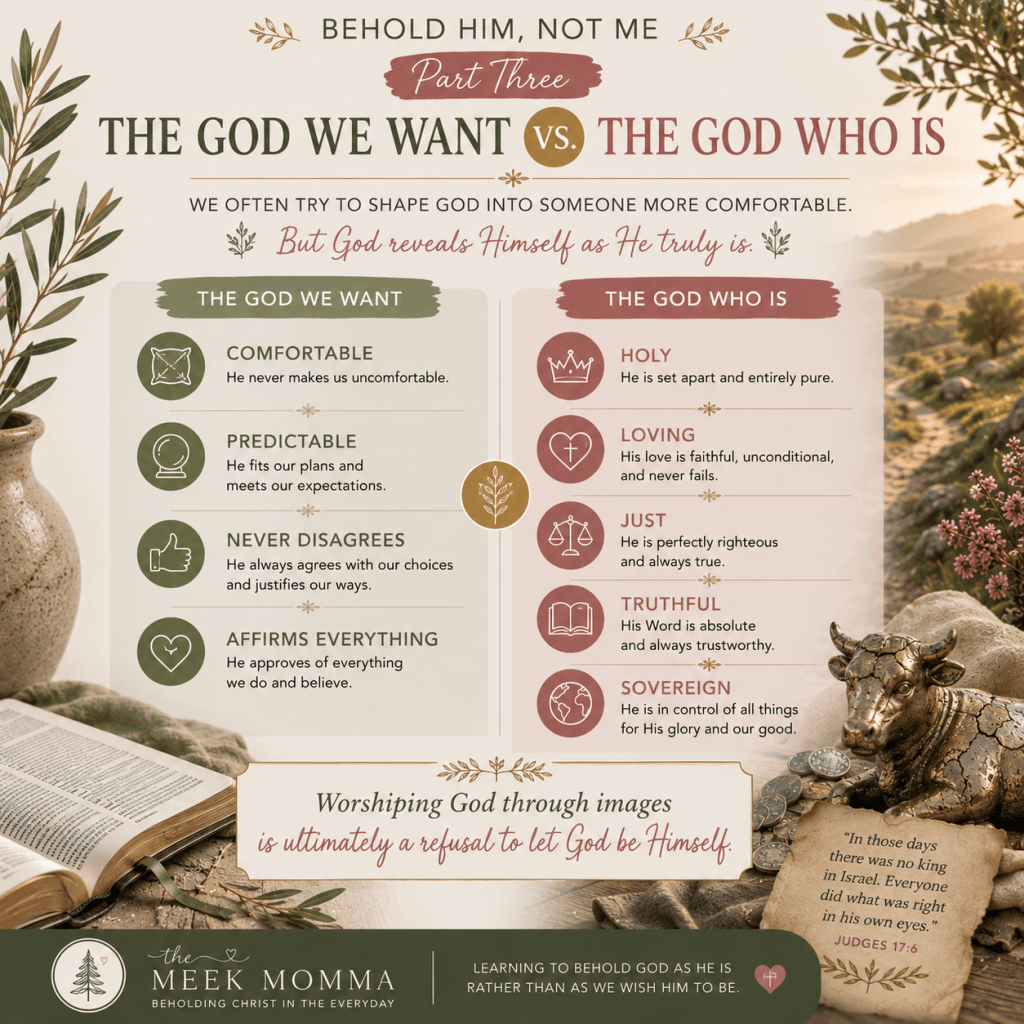
The God We Want vs. The God Who Is

The story takes an unexpected turn when Micahโ€™s mother declares:

โ€œI dedicate this silver to the Lord from my hand for my son, to make a carved image and a metal image.โ€ (Judges 17:3)

If that sounds contradictory, it should.

She claims to dedicate the silver to the Lord.

Then she uses it to violate one of His clearest commands.

God had explicitly forbidden the making of images for worship:

โ€œYou shall not make for yourself a carved imageโ€ฆโ€ (Exodus 20:4)

This was not a minor detail in Israelโ€™s faith.

It was the Second Commandment.

So why was God so concerned about images?

The issue was never artistic ability.

The issue was theological accuracy.

Any image of God automatically reveals one aspect of His character while concealing others.

Consider Aaronโ€™s golden calf in the wilderness.

The calf may have symbolized strength and power.

But it could not communicate Godโ€™s holiness.

His justice.

His mercy.

His wisdom.

His love.

Every image inevitably distorts what it attempts to represent.

God refuses to be reduced to something fashioned by human hands because He cannot be contained by human imagination.

Yet the deeper problem is not the image itself.

The deeper problem is the heart behind the image.

Worshiping God through images reveals a desire to reshape Him into someone we find more comfortable.

It is an attempt to edit God.

To soften the attributes we dislike.

To emphasize the attributes we prefer.

To create a version of God that fits our expectations.

Tim Keller observed that the fundamental problem behind idolatry is a refusal to let God be Himself.

In modern terms, it is a refusal to submit to God as He has revealed Himself.

And if weโ€™re honest, we do this all the time.

Most of us do not carve idols out of silver.

But we often create versions of God in our minds.

How often have we heard someone say:

โ€œI donโ€™t believe in a God who would do that.โ€

Or:

โ€œI like to think of God asโ€ฆโ€

At first those statements sound thoughtful.

But they reveal something dangerous.

They place us in the position of deciding who God should be.

Instead of allowing Scripture to reveal God to us, we attempt to recreate Him according to our preferences.

Like Micahโ€™s family, we begin shaping God instead of allowing God to shape us.


The Comfortable God

There are many ways we attempt to remake God.

Sometimes we do it intellectually.

We encounter something in Scripture that offends our modern sensibilities, so we quietly dismiss it.

We decide that God could not possibly mean what He says.

After all, our culture has progressed beyond such things.

Yet what we are really saying is that our culture has become the authority rather than God.

Other times we do it psychologically.

We simply avoid the parts of Godโ€™s character that make us uncomfortable.

Perhaps we love Godโ€™s grace but ignore His holiness.

Perhaps we celebrate His love but avoid His authority.

Perhaps we cling to His promises while neglecting His commands.

Still other times we do it practically.

We know what Scripture teaches.

Yet we follow our feelings instead.

We follow our desires instead.

We follow our culture instead.

And then we reassure ourselves by saying:

โ€œI prayed about it.โ€

โ€œI feel peace about it.โ€

But peace is not the measure of truth.

Godโ€™s Word is.

This is exactly what Micahโ€™s family is doing.

They are not abandoning religion.

They are customizing it.

They follow the commands they like.

They ignore the commands they dislike.

They keep enough of Godโ€™s truth to feel spiritual while discarding enough of it to remain comfortable.

The most dangerous idols are often the ones we create in Godโ€™s name.


Why This Matters

A counterfeit god can never save us.

More than that, a counterfeit god can never truly know us.

Real relationships require wrestling.

A real person can disagree with you.

Correct you.

Challenge you.

Say no to you.

The same is true in our relationship with God.

When Scripture confronts us, we have an opportunity to wrestle honestly with Him.

To submit where we disagree.

To grow where we are resistant.

To deepen our understanding of His character.

But if we simply ignore every truth we dislike, we are not relating to God at all.

We are relating to a projection of ourselves.

We may have created a more comfortable god.

But we have also created a nonexistent one.

And that may be the most sobering lesson in Judges 17.

Micahโ€™s greatest problem was not that he rejected God.

It was that he remade Him.


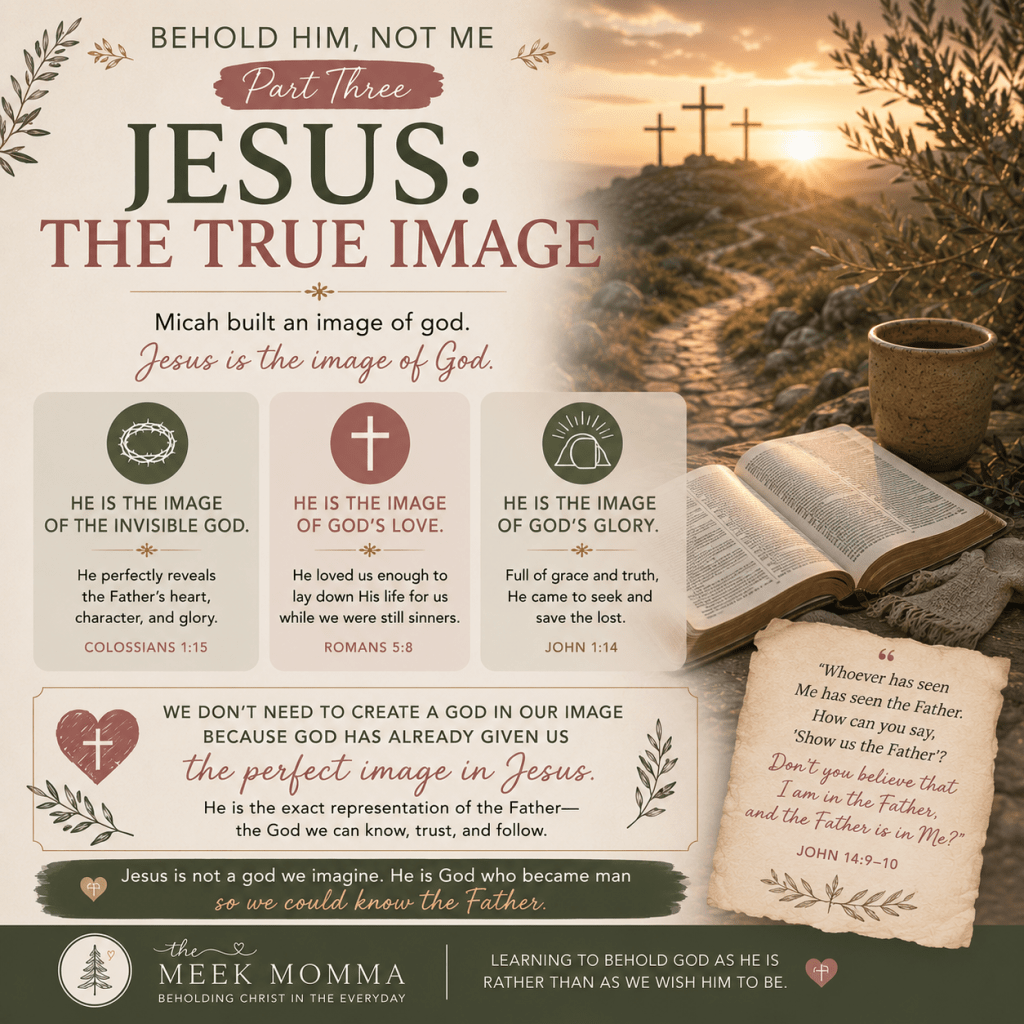
Jesus: The True Image

Micahโ€™s mother believed she could fashion something with silver that would help her worship God.

Yet every image created by human hands inevitably distorts the One it seeks to represent.

But in Jesus Christ, God has given us the perfect image of Himself.

Paul writes:

โ€œHe is the image of the invisible God.โ€ (Colossians 1:15)

Unlike Micahโ€™s idol, Jesus does not distort Godโ€™s character.

He reveals it perfectly.

If we want to know what God is like, we do not look at statues.

We look at Christ.

In Jesus we see Godโ€™s holiness.

His mercy.

His justice.

His compassion.

His truth.

His love.

Micah attempted to create an image of God.

God gave us the real thing.

We never need to imagine what God is like.

God has shown us.


Behold Him, Not Me

Micahโ€™s problem was not that he stopped worshiping.

His problem was that he wanted a version of God that fit comfortably inside his own preferences.

Every idol ultimately asks the same question:

Will I worship God as He is?

Or will I create a god I prefer?

The answer is not better religion.

The answer is Christ.

The true image of God.

As we continue through the closing chapters of Judges, may we learn to lay aside our preferences, our assumptions, and our attempts to remake God according to our own image.

May we instead allow God to reveal Himself through His Word and through His Son.

And may we learn, once again, to behold Himโ€”not ourselves.


Heart Check Questions

โ€ข What parts of Godโ€™s Word do I most wish were different?

โ€ข Have I been wrestling honestly with those truths or avoiding them?

โ€ข Are there attributes of God I emphasize while ignoring others?

โ€ข Where am I tempted to shape God according to culture rather than Scripture?

โ€ข Am I worshiping God as He isโ€”or as I would prefer Him to be?


Prayer

Father,

Forgive me for the ways I try to reshape You according to my preferences. Forgive me for the times I have emphasized the parts of Your character that comfort me while ignoring the parts that challenge me.

Thank You for revealing Yourself through Your Word and through Your Son. Thank You that I do not have to imagine what You are like because You have shown me in Jesus Christ.

Help me to worship You as You are, not as I wish You to be.

Give me humility where I resist Your truth.

Give me faith where I struggle to understand.

Give me courage to submit even when Your Word confronts my desires.

Teach me to behold Christ more clearly, trust Him more deeply, and follow Him more faithfully.

May I stop creating gods in my own image and instead be transformed into Yours.

In Jesusโ€™ name,

Amen.


The most dangerous idols are often the ones we create in Godโ€™s name.

Behold Him, not me.

Blog at WordPress.com.

Up ↑