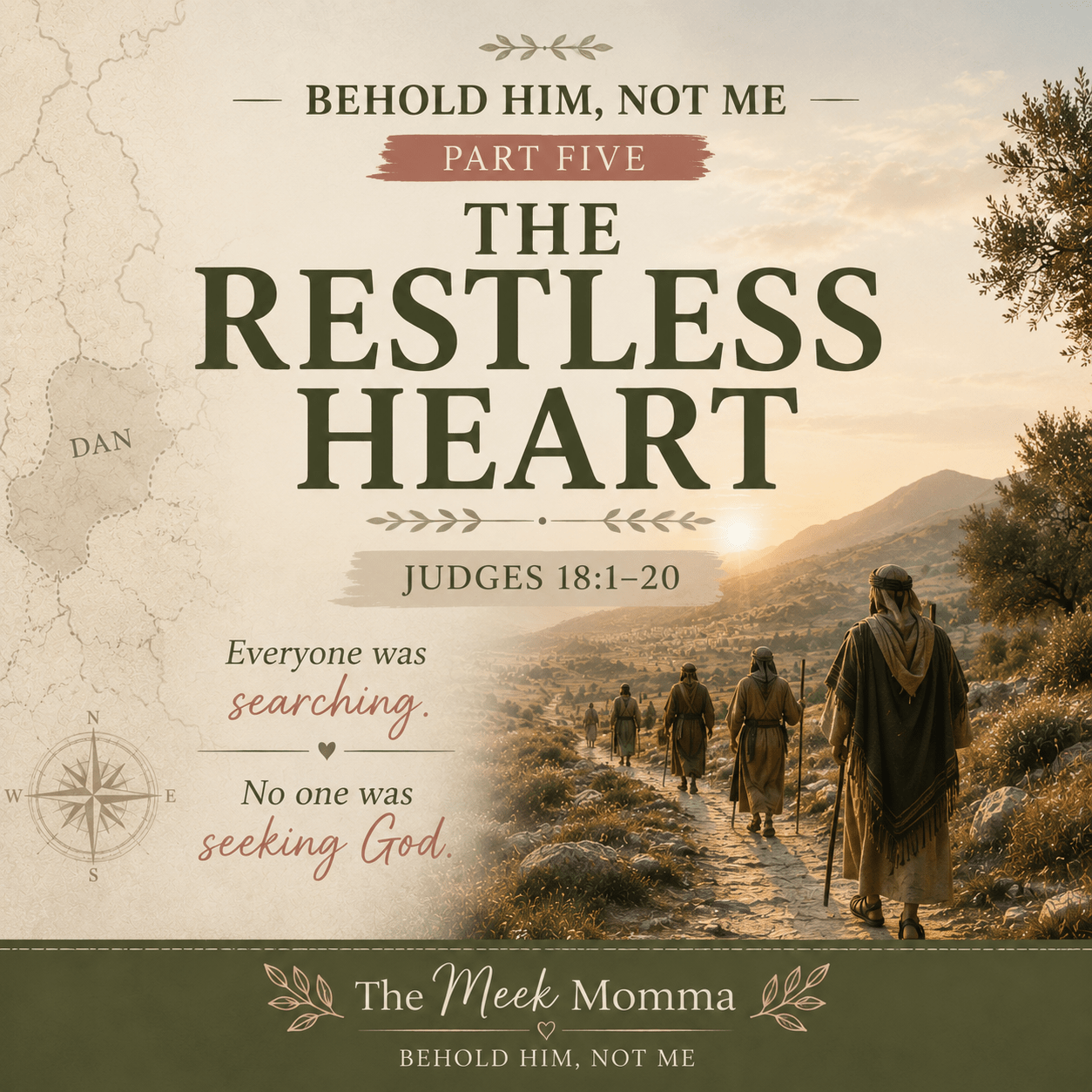
The Restless Heart
Judges 18:1–20
One of the most sobering realities in the Christian life is that it is possible to spend years chasing what we think will satisfy us only to discover that the problem was never our circumstances.
The problem was our hearts.
As we enter Judges 18, we encounter one of the darkest and most revealing chapters in the entire book.
The stories at the end of Judges are not primarily about military victories or heroic deliverers. Samson has already come and gone. The judges have finished their work.
Yet five chapters remain.
Why?
Because the final chapters of Judges pull back the curtain and reveal the spiritual condition of God’s people during these years.
The earlier chapters gave us the bird’s-eye view.
These chapters give us the ground-level reality.
We are shown what life looks like when people who belong to God stop trusting God.
The result is not freedom.
It is confusion.
It is compromise.
It is restlessness.
Judges 18 opens with a familiar reminder:
“In those days there was no king in Israel.”
This statement is about far more than politics.
Israel’s greatest problem was never a lack of human leadership.
Their greatest problem was that they had rejected the rule of God.
And nowhere is that more evident than in the story of the tribe of Dan.
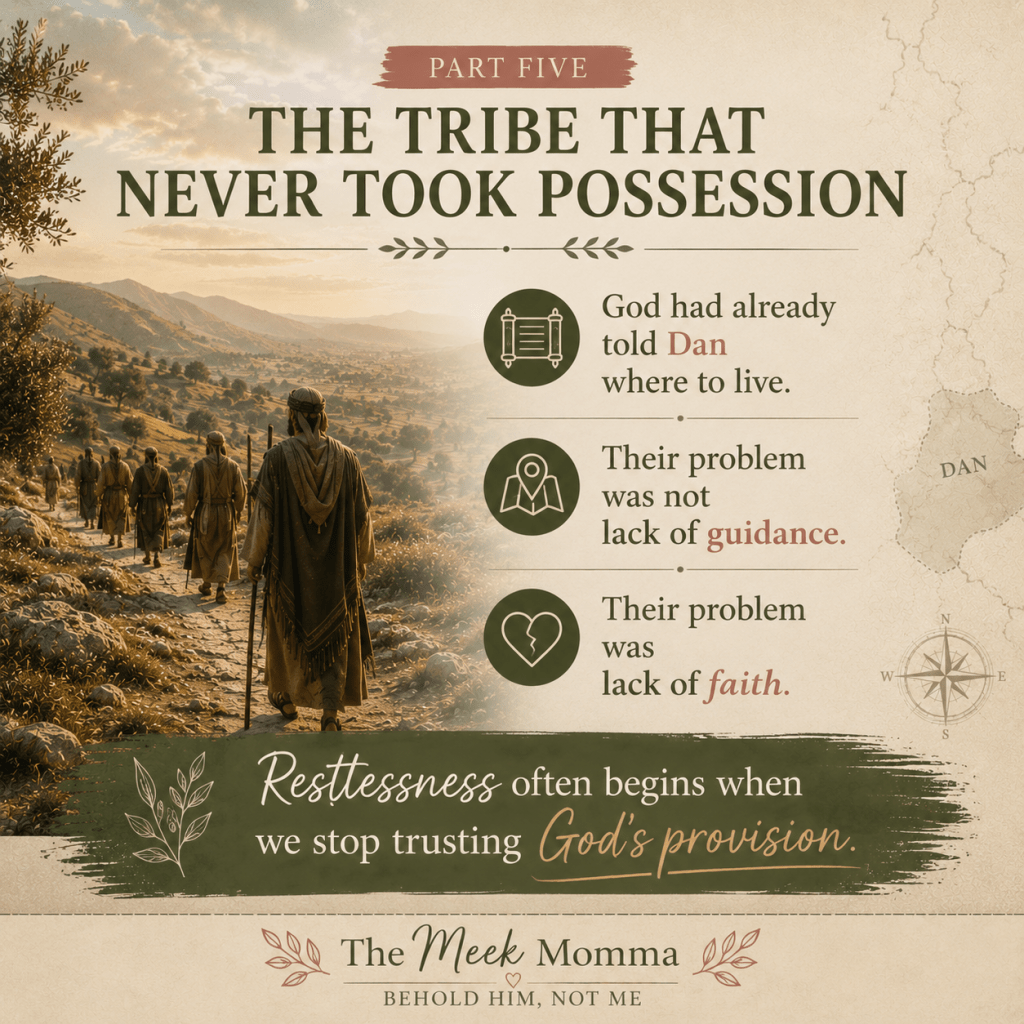
The Tribe That Never Took Possession
As the chapter begins, we learn that the tribe of Dan is still searching for a place to settle.
At first glance, that may not seem unusual.
After all, everyone needs a home.
Everyone needs security.
Everyone needs a place to belong.
But the reason Dan is still searching is important.
Unlike the other tribes, Dan had never taken possession of the inheritance God had already given them.
When Israel entered the Promised Land, each tribe received territory assigned by God.
Dan’s inheritance had been established.
God had already told them where to live.
God had already provided for them.
God had already made His will known.
The problem was not a lack of guidance.
The problem was a lack of faith.
The Danites failed to drive out the Canaanites as God commanded. Instead, they were pushed back into the hill country and forced into a semi-nomadic existence.
Years later, they are still looking for something better.
The tragedy is that they are searching for what God had already given them.
How often do we do the same thing?
God has spoken.
God has provided.
God has revealed His will.
Yet our hearts continue searching because we secretly believe something better exists somewhere else.
We imagine that satisfaction is always one step away.
One opportunity away.
One relationship away.
One answered prayer away.
One life change away.
Yet the issue is rarely our circumstances.
More often, the issue is our hearts.
Dan’s restlessness was not ultimately geographical.
It was spiritual.
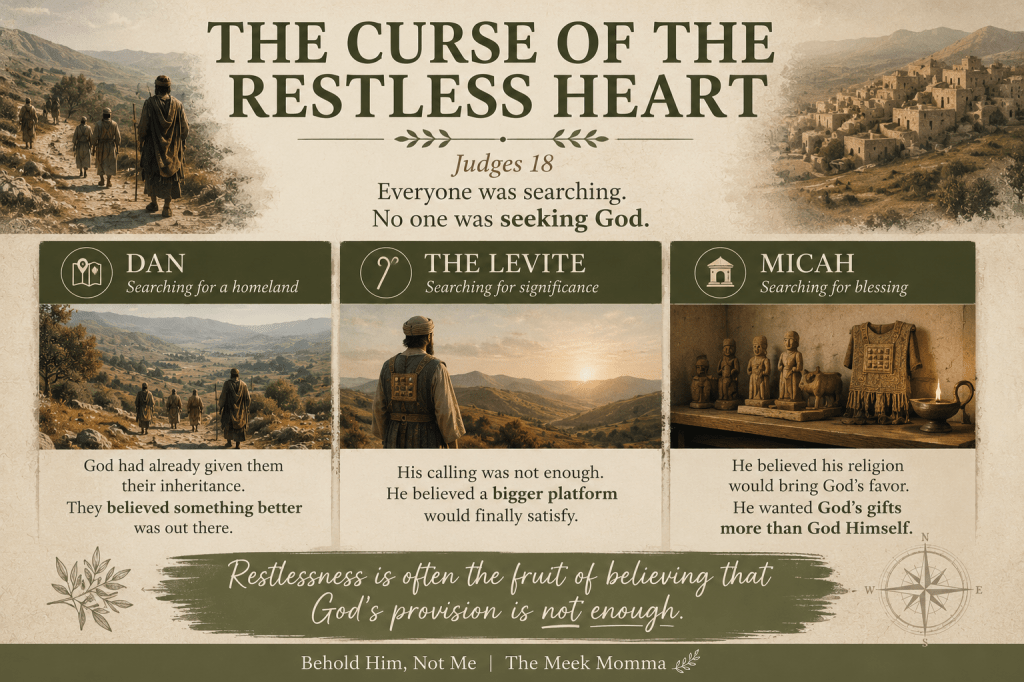
The Curse of the Restless Heart
As I studied this passage, I could not help but notice that every major character in Judges 18 seems restless.
The tribe of Dan is restless.
Micah is restless.
The Levite is restless.
Everyone is searching.
Everyone is moving.
Everyone is looking for something they believe they do not currently possess.
The Danites are searching for land.
Micah is searching for blessing.
The Levite is searching for opportunity.
Yet none of them are seeking the Lord.
That observation feels painfully relevant.
Our culture constantly tells us that fulfillment is found in the next thing.
The next purchase.
The next promotion.
The next relationship.
The next achievement.
The next season of life.
We are taught to believe that contentment is always somewhere ahead of us.
But Scripture consistently points us in the opposite direction.
The problem with a restless heart is that it cannot enjoy God’s provision because it is always looking somewhere else.
The Danites could not enjoy the inheritance God had assigned because they wanted a different one.
The Levite could not enjoy the calling God had given because he wanted a more impressive position.
Micah could not enjoy worshiping God as God commanded because he wanted a religion tailored to his own preferences.
And before we judge them too harshly, we should ask ourselves an uncomfortable question:
Where am I still searching for what I already have in Christ?
Sometimes our greatest spiritual problem is not rebellion.
It is dissatisfaction.
We have forgotten that God Himself is our inheritance.
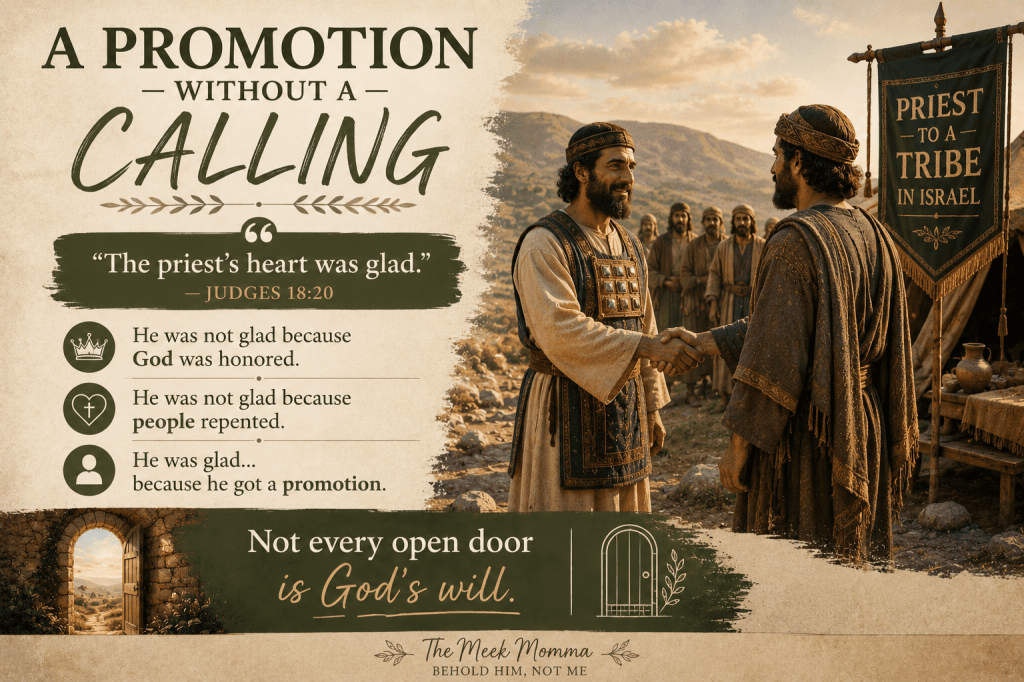
A Promotion Without a Calling
As the Danites search for a new homeland, they stop at Micah’s house and encounter the Levite we met in the previous chapter.
Immediately they recognize his voice and ask him to inquire of God on their behalf.
Notice how spiritually confused the situation has become.
The Danites are consulting a Levite who is serving at an idolatrous shrine.
They are asking for guidance from a priest who has already abandoned God’s commands.
And yet no one seems bothered by this.
In fact, they appear completely reassured.
The Levite gives them exactly what they want to hear:
“Go in peace. The journey on which you go is under the eye of the Lord.” (Judges 18:6)
Whether he truly knows God’s will is beside the point.
The Danites are not looking for God’s direction.
They are looking for God’s approval.
There is a difference.
Sometimes we approach God the same way.
We are not asking,
“Lord, what would You have me do?”
Instead we ask,
“Lord, will You bless what I have already decided to do?”
The Danites had already chosen their path.
The Levite simply provided spiritual language to justify it.
The Ministry of Self-Promotion
Later in the chapter, the Danites return with six hundred armed men.
As they prepare to relocate, they stop again at Micah’s house.
This time they take the idols.
They take the ephod.
They take the household gods.
And then they make the Levite an offer:
“Is it better for you to be priest to the household of one man, or to be priest to a tribe and clan in Israel?” (Judges 18:19)
The question reveals everything.
The Danites understand exactly what motivates him.
Status.
Influence.
Advancement.
A bigger platform.
A more impressive ministry.
And the Levite gladly accepts.
The text says:
“And the priest’s heart was glad.” (Judges 18:20)
That statement is devastating.
His heart is not glad because God is being honored.
His heart is not glad because people are returning to true worship.
His heart is glad because he got a promotion.
The Levite serves whoever benefits him most.
His loyalty is not to God.
His loyalty is to himself.
Not every promotion is a blessing.
Not every opportunity is God’s will.
Not every open door should be walked through.
The Levite’s life warns us that it is possible to climb higher and higher while moving further and further away from God.
The Land That Looked Perfect
The Danite spies eventually arrive at a place called Laish.
What they find appears almost too good to be true.
The people are living securely.
The land is fertile.
The city is prosperous.
There are no nearby allies.
There are no obvious obstacles.
Everything looks easy.
Everything looks safe.
Everything looks desirable.
The spies return and declare:
“Arise, and let us go up against them. For we have seen the land, and behold, it is very good.” (Judges 18:9)
The language sounds remarkably similar to Joshua and Caleb.
Yet there is one critical difference.
Joshua and Caleb trusted God’s promises.
The Danites trusted their own calculations.
The city looked vulnerable.
The battle looked manageable.
The reward looked substantial.
The entire plan was built upon what they could see.
There is remarkably little mention of trusting God.
How often do we do the same thing?
We evaluate opportunities based upon ease, safety, and apparent success.
Yet ease is not always evidence of God’s blessing.
Sometimes the easiest path is the path furthest from obedience.
The Danites wanted a land they could conquer without depending on God.
They found one.
The tragedy is that God had already given them a land.
What they lacked was not opportunity.
What they lacked was faith.
The Restless Heart Finds Rest
As I studied Judges 18, I found myself asking a simple question:
What is every character in this chapter actually looking for?
Dan is looking for a homeland.
The Levite is looking for significance.
Micah is looking for blessing.
Everyone is searching.
Everyone is moving.
Everyone believes that what they need lies somewhere beyond their current circumstances.
Yet none of them find peace.
Because none of them are ultimately seeking God.
Augustine famously wrote:
“You have made us for Yourself, and our hearts are restless until they find their rest in You.”
Centuries before Augustine, Judges 18 was illustrating that truth.
The tribe of Dan had a restless heart.
The Levite had a restless heart.
Micah had a restless heart.
And if we are honest, so do we.
The human heart can turn any blessing into an idol and any gift into a substitute for God.
If we are looking to circumstances to provide what only God can provide, we will never stop searching.
The Better Homeland
The tribe of Dan believed they needed a different inheritance.
Yet the Bible teaches that God’s people have always been looking for a better country.
Not merely a different piece of land.
A heavenly one.
Dan thought they needed Laish.
What they truly needed was God.
Every earthly home points beyond itself.
Every earthly security eventually fades.
Every earthly kingdom eventually falls.
But Christ offers a kingdom that cannot be shaken.
The Better Significance
The Levite believed significance would come through promotion.
Yet significance built upon position is always fragile.
The gospel offers something far more secure.
Our value is not rooted in our accomplishments.
Our significance is not rooted in our platform.
Our identity is rooted in being known and loved by Christ.
The Levite spent his life climbing.
Jesus spent His life descending.
The Son of God humbled Himself and became obedient to the point of death—even death on a cross.
The path to significance in God’s kingdom is not self-promotion.
It is surrender.
The Better Blessing
Micah spent chapters constructing a religion that he believed would bring blessing.
Yet he wanted God’s gifts more than God Himself.
That temptation remains one of the greatest dangers in the Christian life.
We can seek peace instead of the Prince of Peace.
Provision instead of the Provider.
Guidance instead of the Guide.
Gifts instead of the Giver.
But every blessing was always meant to lead us back to Christ.
The greatest gift God gives is not prosperity.
It is His presence.
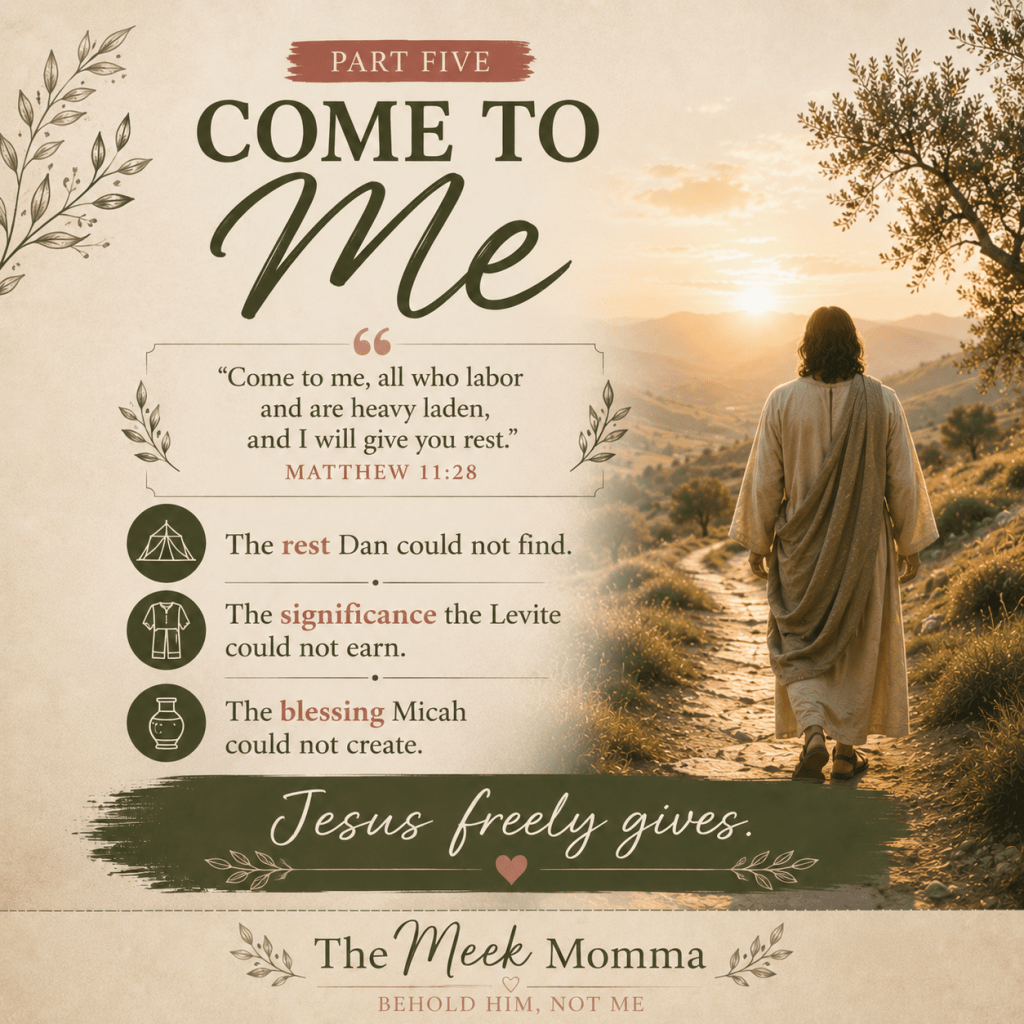
Come to Me
Against the backdrop of all this searching, Jesus speaks words that feel especially precious:
“Come to me, all who labor and are heavy laden, and I will give you rest.” (Matthew 11:28)
Notice what Jesus does not say.
He does not say:
Come to a better opportunity.
Come to a better circumstance.
Come to a better plan.
He says:
“Come to Me.”
The rest Dan could not find.
The security Micah could not create.
The significance the Levite could not achieve.
Jesus freely gives.
The answer to a restless heart is not finding a new location.
A new opportunity.
Or a new season.
It is a Person.
And His name is Jesus Christ.
Behold Him, Not Me
Judges 18 is a chapter full of searching.
A searching tribe.
A searching priest.
A searching people.
Yet every path they take only leads them further from God.
Their story reminds us that restlessness is often a symptom of a deeper problem.
We have forgotten that God Himself is our inheritance.
The invitation of the gospel is not to search harder.
It is to stop searching.
To come to Christ.
To trust Christ.
To rest in Christ.
The world tells us that peace lies somewhere out there.
Jesus tells us that peace is found in Him.
May we learn to say with the psalmist:
“Whom have I in heaven but You? And there is nothing on earth that I desire besides You.” (Psalm 73:25)
And may we learn once again to behold Him, not ourselves.
Heart Check
• Where am I currently looking for satisfaction apart from God?
• What circumstances do I believe must change before I can be content?
• Am I seeking God’s gifts more than God Himself?
• Have I confused comfort with contentment?
• What would it look like to rest in Christ today rather than continue searching for something else?
Prayer
Father,
Forgive me for the ways I continually search for satisfaction outside of You.
Thank You for reminding me that You alone are my inheritance.
Help me to stop chasing what cannot satisfy and to find my rest in Christ.
When my heart becomes restless, remind me that true peace is not found in a place, a possession, or a position.
It is found in You.
Teach me to behold Christ more clearly, trust Him more deeply, and rest in Him more fully.
In Jesus’ name,
Amen.


Leave a Reply