Behold Him, Not Me: Part Seven

When Israel Became Sodom

Judges 19

Content note: This study discusses sexual violence, physical abuse, and trauma in the context of Judges 19 and includes a personal testimony of surviving abuse.

There are chapters of Scripture that comfort us.

There are chapters that encourage us.

There are chapters that strengthen our hope, remind us of Godโ€™s faithfulness, and give us words to pray when our own words fail.

Judges 19 is not one of those chapters.

Judges 19 is meant to horrify us.

There is no deliverer.

There is no victory.

There is no miraculous rescue.

There is no repentance.

There is only a Levite, his concubine, an old man, a violent mob, a night of unspeakable abuse, the death of an unnamed woman, and a nation about to tear itself apart.

Judges 19 is one of the darkest chapters in all of Scripture.

And we should not rush through the darkness.

We should not soften the violence.

We should not turn the suffering of this woman into a convenient illustration.

We should not search so quickly for an encouraging application that we fail to sit beneath the weight of what the text is showing us.

Because Judges 19 is here for a reason.

The book of Judges has been showing us what happens when the people of God reject the rule of God.

Again and again, Israel has done what is right in their own eyes.

They have compromised.

They have worshiped idols.

They have reshaped God according to their preferences.

They have pursued comfort.

They have sought blessing without obedience.

They have built religions they could control.

And now, at the end of the book, we are shown where that road leads.

Israel has become indistinguishable from the nations around them.

Worse still, Israel has become like Sodom.

Before We Read

Before going any further, we need to acknowledge what this chapter contains.

Judges 19 describes sexual violence, abuse, dehumanization, and death.

The Bible records these events.

It does not approve of them.

Scripture is painfully honest about the evil human beings are capable of committing. The Bible does not hide the consequences of sin. It does not sanitize human depravity. It does not pretend that rebellion against God remains private, harmless, or contained.

Sin spreads.

Sin corrupts.

Sin dehumanizes.

And when people persistently reject the authority of God, other human beings bear the consequences.

The unnamed woman at the center of Judges 19 is not merely a literary device.

She is a human being made in the image of God.

She is sinned against.

She is abandoned.

She is violated.

She dies.

And the men surrounding her repeatedly treat her as though her life exists for their convenience.

We should allow the horror of that reality to trouble us.

The text intends for us to be troubled.

In Those Days There Was No King

Judges 19 begins with words we have heard before:

โ€œIn those days, when there was no king in Israelโ€ฆโ€

This statement has become the theological backdrop of the final chapters of Judges.

Israelโ€™s problem is not merely political.

Their deepest problem is spiritual.

There is no human king, but more importantly, Israel is living as though there is no divine King.

God has spoken.

God has given His law.

God has established His covenant.

God has told His people how to worship, how to pursue justice, how to treat the vulnerable, how to order their families, and how to live together as His holy people.

Yet everyone continues doing what is right in his own eyes.

Judges 19 shows us what happens when subjective morality reaches its logical conclusion.

When everyone becomes his own authority, the strong eventually decide what happens to the weak.

When personal desire becomes the highest standard, other people become objects to be used.

When Godโ€™s authority is rejected, human dignity does not increase.

It collapses.
A Levite Who Should Have Known Better

Once again, a Levite stands near the center of the story.

That should trouble us.

The Levites had been set apart for service connected to the worship of God.

If anyone should have known the Word of God, it was a Levite.

If anyone should have understood covenant faithfulness, justice, holiness, and the value of belonging to God, it was a Levite.

Yet the Levite in Judges 19 is not presented as a faithful spiritual leader.

He is part of the problem.

The chapter begins by introducing his concubine, who leaves him and returns to her fatherโ€™s house in Bethlehem.

After four months, the Levite travels to persuade her to return.

Her father welcomes him enthusiastically.

For several days, the men eat, drink, and delay the journey.

Eventually, the Levite insists on leaving.

The decision is made late in the day.

As darkness approaches, the servant suggests that they stop in Jebus, the city that would later become Jerusalem.

But the Levite refuses.

Jebus is inhabited by foreigners.

He does not want to spend the night among people who are not Israelites.

Instead, he chooses to continue to Gibeah.

Surely they will be safer among the people of God.

They are not.

When Israel Became Sodom

The travelers arrive in Gibeah, a city belonging to the tribe of Benjamin.

They sit in the town square.

No one welcomes them.

Eventually, an old man returning from his work in the fields sees them and offers hospitality.

Then the story begins to sound disturbingly familiar.

The men of the city surround the house.

They demand that the Levite be brought outside so that they can sexually assault him.

The deliberate connection to Genesis 19 is difficult to miss.

In Genesis, the men of Sodom surround Lotโ€™s house.

In Judges, the men of Gibeah surround the old manโ€™s house.

In Genesis, the mob demands the male visitors.

In Judges, the mob demands the Levite.

The language is similar.

The circumstances are similar.

The depravity is similar.

But there is one devastating difference.

Gibeah is not a Canaanite city.

Gibeah belongs to Israel.

God had called Israel to be holy.

God had separated them from the nations.

God had given them His Word.

God had placed His name among them.

God had called them to display His character to the world.

But now the people who were supposed to be different have become indistinguishable from the people they were commanded not to imitate.

Israel has become Sodom.

This may be one of the most terrifying warnings in the entire book of Judges.

The people of God can live among the things of God, possess the Word of God, use the name of God, and still become increasingly unlike God.

Spiritual privilege does not make anyone immune to spiritual decay.

A people who repeatedly refuse to listen to God can eventually become unrecognizable as His people.
The Failure of Every Man in the Story

There are no heroes in Judges 19.

The men of Gibeah are wicked.

But they are not the only men who fail.

The old man offers the women of the household to the mob.

The Levite sends his concubine outside.

The men abuse her throughout the night.

In the morning, she collapses at the doorway of the house.

And when the Levite opens the door, he says:

โ€œGet up, let us be going.โ€

There is no recorded grief.

No tenderness.

No attempt to help her.

No acknowledgment of what she has suffered.

When she does not respond, he places her body on his donkey and returns home.

The woman at the center of the story is repeatedly acted upon.

Men decide where she will go.

Men decide what will happen to her.

Men sacrifice her safety to protect themselves.

Men violate her.

Men speak over her.

Men use her death for their own purposes.

She is never given a voice.

And that silence is part of the horror.

The further Israel moves from the rule of God, the more vulnerable people suffer.

Throughout Scripture, the treatment of the vulnerable is repeatedly connected to the spiritual condition of Godโ€™s people.

When people love God, they are commanded to love their neighbor.

When people fear God, they are forbidden from using power merely for their own advantage.

When people reject Godโ€™s authority, power becomes something to seize, protect, and use.

Judges 19 shows us a society in which nearly everyone is protecting himself.

And the person with the least power pays the highest price.

The Banality of Evil

One of the most disturbing things about the final chapters of Judges is how ordinary everyone seems.

These are not monsters from another world.

They travel.

They eat meals.

They extend hospitality.

They have families.

They speak about God.

They belong to tribes.

They participate in religious life.

And yet beneath the ordinary surface lies profound moral corruption.

Evil does not always announce itself dramatically.

Sometimes it grows quietly.

Compromise after compromise.

Excuse after excuse.

Desire after desire.

People gradually become accustomed to what once would have horrified them.

Sin becomes normal.

Consciences become dull.

People learn to live with contradictions.

They speak the language of faith while living according to their own desires.

The final chapters of Judges show us what happens when rebellion becomes ordinary.

The people do not merely commit isolated acts of sin.

They inhabit an entire moral world in which everyone is doing what is right in his own eyes.
The Woman at the Door

There is an image near the end of the chapter that is difficult to forget.

Morning comes.

The door opens.

And the woman is lying at the threshold with her hands on the doorway.

She had almost reached shelter.

But the door remained closed.

There are times when careful Bible study requires us to resist the urge to turn every detail into a metaphor.

This woman does not need to become a symbol before we are willing to grieve what happened to her.

She was a person made in the image of God.

And she was treated as disposable.

The text does not give us her name.

But God saw her.

The men in this chapter use her.

Ignore her.

Abandon her.

Violate her.

Dismember her.

But the God who inspired Scripture does not allow Israel to forget her.

Her suffering becomes part of the testimony against a nation that has rejected its King.

Her presence in Scripture reminds us that God does not look away from the suffering human beings would prefer to ignore.

The Bible bears witness to victims whom powerful people would rather leave unnamed.

The God Who Saw Me Too

There is a reason I cannot read Judges 19 from a safe distance.

I know what it is like to be sexually abused.

For a long period of my life, I was sexually abused by my father. I was also sexually and physically abused by other men.

I know something of the deep wounds these kinds of sins leave behind.

I know what it is like to carry questions you do not know how to ask.

Does God see me?

Does He care about what happened?

Will there ever be justice?

Am I still worthy of being loved?

For many years, I did not know how to bring those questions to God. I did not know how to process what had happened to me within my theology.

Then I began learning to slow down when I read Scripture.

I stopped rushing past difficult passages.

I stopped assuming that the darkest stories in the Bible were obstacles to faith that needed to be explained away as quickly as possible.

And I began to see something I had missed.

God does not hide what evil does to people.

He does not call evil good.

He does not ask us to pretend that suffering does not matter.

He does not look away from the people others would prefer to forget.

Judges 19 does not allow us to forget this woman.

The text does not give us her name, but God preserved the testimony of what was done to her.

Her suffering is not hidden.

The evil committed against her is not erased.

Generation after generation has been forced to reckon with what happened in Gibeah because God allowed her story to remain in His Word.

And as I learned to see her, I began to understand more deeply that God saw me too.

I thought about Hagar.

She was a woman caught within the sinful decisions and abuses of power of other people.

She fled into the wilderness.

And there, the angel of the LORD found her.

He called her by name.

โ€œHagar, servant of Sarai, where have you come from and where are you going?โ€

โ€” Genesis 16:8

Hagar responded by giving God a name:

โ€œYou are a God of seeing.โ€

She said:

โ€œTruly here I have seen Him who looks after me.โ€

โ€” Genesis 16:13

Later, Hagar would find herself in the wilderness again, believing she was about to watch her son die.

She wept.

God heard.

And the angel of God called to her from heaven.

These passages began changing the way I understood God.

The God of Scripture is not the author of evil.

He is good.

He is just.

He sees.

He hears.

He knows.

And because He is faithful, He will keep every promise He has made.

That means evil will not be ignored forever.

Those who have harmed others will answer to Godโ€™s perfect justice.

Some of us may see justice in this life.

Some of us may not.

Human courts may fail.

People may refuse to believe us.

Those who committed evil may never acknowledge what they have done.

But there is no hidden thing that will remain hidden before the judgment of God.

The Judge of all the earth will do what is just.

For me, that truth did not make forgiveness unnecessary.

It made forgiveness possible.

I began to understand that forgiveness does not require me to call evil good.

It does not require me to pretend that justice does not matter.

It does not require me to deny what happened.

I can entrust final judgment to the God who sees perfectly, knows completely, and judges righteously.

And I can bring my wounds to Jesus.

The One who sees Hagar in the wilderness is the same God who came near to us in Christ.

Jesus saw women others ignored.

He welcomed people others rejected.

He touched those others considered unclean.

He drew near to the suffering.

He was betrayed.

He was stripped.

He was mocked.

He was beaten.

He was crucified.

And He willingly bore the judgment for sin so that sinners could be reconciled to God.

The cross taught me that God does not minimize evil.

Sin is so serious that the Son of God gave His life to save sinners from it.

And the resurrection taught me that evil, suffering, and death will not have the final word.

Slowly, the Old Testament and the New Testament began coming together for me.

The God who saw Hagar is the God who saw me.

The God who refused to let Israel forget the unnamed woman of Judges 19 had not forgotten me.

The righteous Judge before whom every evil will one day be exposed is also the Father who received me through His Son.

I began to understand that Jesus loved me deeply.

I began to receive the love of God instead of believing that what had been done to me determined my worth.

I began to seek forgiveness for my own sins.

I began learning to forgive others.

And I began trusting God with the justice I could not accomplish for myself.

These passages did not destroy my faith.

They deepened it.

They taught me that I do not need a Bible that looks away from evil.

I need a God who sees it more clearly than I ever could.

I do not need a God who offers shallow explanations for suffering.

I need the God who enters our suffering, judges with perfect justice, saves sinners through the blood of His Son, and promises that one day He will make all things new.

If you have experienced sexual violence, physical abuse, or other deep wounds, or if you love someone who has, I want you to know why I am willing to remain in difficult passages like Judges 19.

It is because I have found that slowing down in these passages has helped me know God more deeply.

You do not have to pretend that evil is less evil in order to trust Him.

You do not have to silence your grief.

You do not have to be afraid of your questions.

Bring them into the light of Scripture.

Learn the character of the God who sees.

Learn the justice of the God who will judge rightly.

Learn the mercy of the Savior who receives sinners.

Learn the love of the Father who gave His Son so that all who trust in Him might be reconciled to God.

My prayer is not merely that you will make it through the difficult chapters of the Bible with your faith intact.

My prayer is that, as you slow down and see the God who has revealed Himself there, your faith will deepen too.

The God who saw Hagar sees.

The God who preserved the testimony of the unnamed woman remembers.

The God who gave His Son saves.

And the King who is coming will judge the world in righteousness.

Come and see the God who sees.
Where Is God?

One of the unsettling realities of Judges 19 is the apparent silence of God.

There is no divine speech.

No angel appears.

No miracle interrupts the violence.

No deliverer arrives.

Where is God?

The answer is not that God has disappeared.

The entire book has shown us a people repeatedly refusing to listen to Him.

God has spoken.

Israel possesses His covenant.

Israel has His law.

Israel knows His commands.

The tragedy is not that God failed to reveal what righteousness looks like.

The tragedy is that Israel has rejected what God has revealed.

We must also be careful not to confuse Godโ€™s silence in the narrative with Godโ€™s indifference to suffering.

The chapter itself stands as testimony against Israel.

God has preserved the record of what happened.

The evil in Gibeah is not hidden from Him.

The suffering of the woman is not forgotten.

Judges 19 shows us what life looks like when human beings insist upon doing what is right in their own eyes.

And it leaves us longing for judgment, rescue, and a righteous King.

Outrage Is Not Repentance

The Levite takes the womanโ€™s body and divides it into twelve pieces.

He sends the pieces throughout the territory of Israel.

The act is horrifying.

The response is immediate.

The people of Israel say:

โ€œSuch a thing has never happened or been seen from the day that the people of Israel came up out of the land of Egypt until this day; consider it, take counsel, and speak.โ€

Israel is finally shocked.

After years of idolatry.

After generations of compromise.

After repeated rejection of Godโ€™s covenant.

After everyone has done what is right in his own eyes.

Israel has finally found a sin terrible enough to produce national outrage.

But outrage is not the same thing as repentance.

It is possible to be horrified by the sins of others while remaining blind to the sin within ourselves.

It is possible to correctly identify evil and still respond to evil in ways that reveal our own estrangement from God.

That is where Judges 20 will take us.

The nation will gather.

The people will demand justice.

A civil war will begin.

Thousands will die.

And the people who are outraged by Gibeah will continue demonstrating that the deepest problem in Israel cannot be contained within one city.

The problem is everywhere.

The Road to Gibeah Was Longer Than One Night

Israel did not become Sodom overnight.

The violence of Judges 19 is the fruit of seeds planted throughout the entire book.

Israel compromised with the Canaanites.

Israel tolerated idolatry.

Israel abandoned covenant faithfulness.

Israel repeatedly cried out to God when suffering became unbearable, only to return to rebellion when relief arrived.

Israel treated God as a means of obtaining blessing rather than as their King.

By Judges 17, Micah has created his own religion.

By Judges 18, the tribe of Dan has established institutionalized idolatry.

By Judges 19, Israel has become Sodom.

This is the trajectory of sin.

Sin rarely tells us where it intends to take us.

It asks only for the next compromise.

The next excuse.

The next small act of disobedience.

The next moment when we decide that what seems right in our own eyes matters more than what God has said.

Judges 19 forces us to see the destination.
We Need a Righteous King

The book of Judges has shown us judge after judge.

Some were faithful.

Some were deeply flawed.

Some delivered Israel from external enemies while remaining unable to change the hearts of Godโ€™s people.

But now there is no judge.

There is no deliverer.

There is no faithful leader standing between the vulnerable and those who would destroy them.

The repeated refrain tells us what Israel lacks:

โ€œIn those days there was no king in Israel.โ€

But Israel does not merely need someone wearing a crown.

Israel needs a righteous King.

A King who will not exploit the weak.

A King who will not sacrifice others to save Himself.

A King who knows the Word of God and obeys it perfectly.

A King who sees the forgotten.

A King who defends the vulnerable.

A King who judges evil without becoming evil.

A King who can deal not only with the enemies surrounding Godโ€™s people, but with the sin dwelling within them.

Judges leaves us longing for such a King.

The gospel tells us His name.
The King Who Gave Himself

The men in Judges 19 preserve themselves by giving up someone else.

Jesus does the opposite.

Christ does not sacrifice the vulnerable to save Himself.

He gives Himself to save sinners.

The Good Shepherd does not abandon the sheep when the wolves come.

He lays down His life for the sheep.

Jesus does not use His power to protect Himself from suffering.

He willingly enters suffering.

He is betrayed.

He is mocked.

He is beaten.

He is condemned.

He is crucified.

Not because humanity is innocent.

But because humanity is guilty.

At the cross, we see both the horror of human sin and the holiness of God.

The cross does not minimize evil.

It reveals how serious sin truly is.

The righteous King bears judgment in the place of His people.

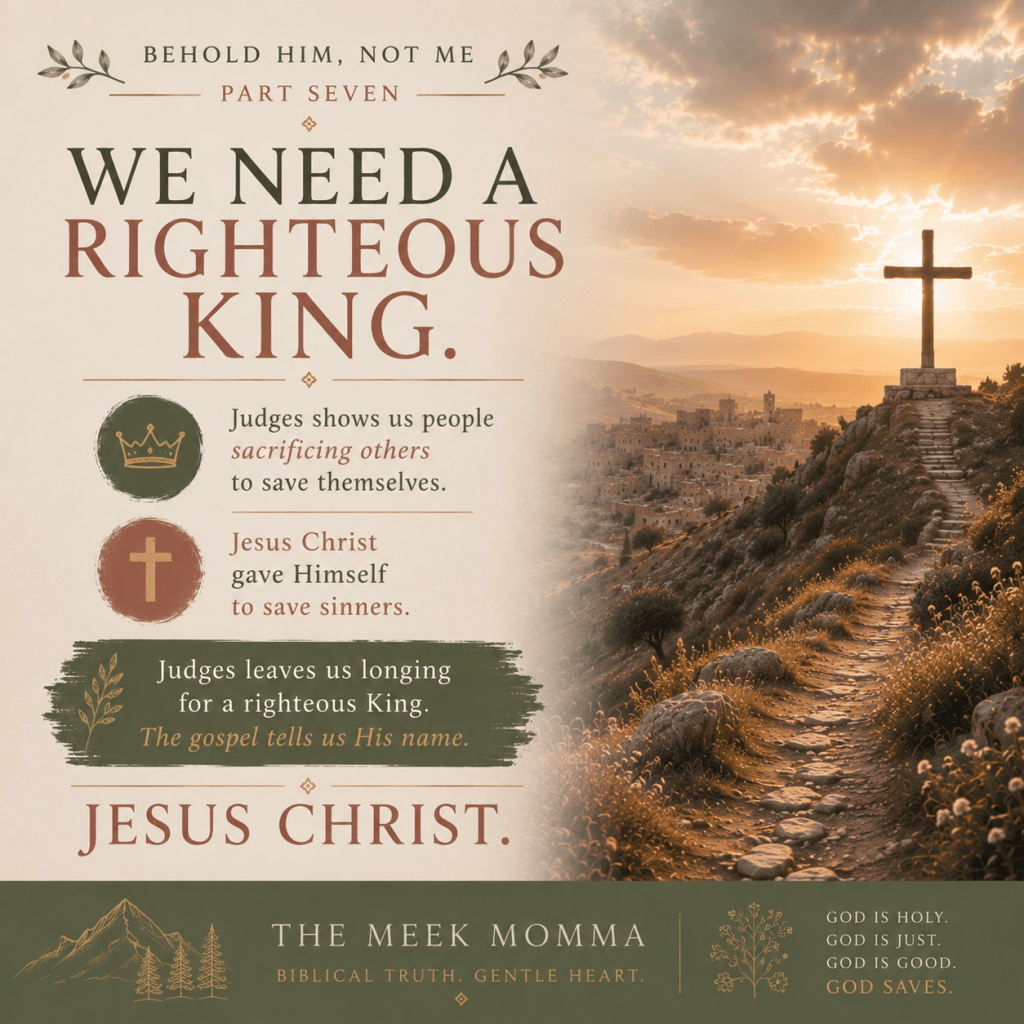
Judges 19 shows us human beings sacrificing others to save themselves.

The gospel shows us the Son of God giving Himself to save sinners.

Jesus Christ is the King Israel needed.

And He is the King we need.

The King Who Sees

Judges 19 reminds us that human beings can overlook suffering.

Communities can normalize injustice.

Religious people can become indifferent.

Powerful people can protect themselves.

Victims can remain unnamed.

But God sees.

God hears.

God knows.

And God will judge rightly.

The gospel does not ask us to pretend evil is less terrible than it is.

The gospel tells us that evil will not have the final word.

Jesus Christ was crucified.

Jesus Christ was buried.

Jesus Christ rose from the dead.

Jesus Christ reigns.

And one day the King who sees every injustice will judge the world in righteousness.

Every hidden thing will be brought into the light.

Every wrong will be answered according to perfect justice.

For those who belong to Christ, the promise of His kingdom means that suffering, violence, injustice, and death will not endure forever.

The King is coming.
Behold Him, Not Me

Judges 19 is difficult to read because it shows us what human beings become when we reject the rule of God.

Israel was called to be holy.

Israel was called to be different.

Israel was called to display the character of God among the nations.

Instead, Israel became Sodom.

The warning should humble us.

We should never assume that religious language, biblical knowledge, church attendance, ministry involvement, or spiritual heritage makes us immune to compromise.

We need more than outrage over the sins of the world.

We need more than moral reform.

We need more than better circumstances.

We need new hearts.

We need forgiveness.

We need righteousness we cannot produce for ourselves.

We need a King.

Judges leaves us searching for Him.

The rest of Scripture tells us His name.

Jesus Christ.

The righteous King.

The faithful Shepherd.

The One who sees the forgotten.

The One who judges with perfect justice.

The One who gave Himself to save sinners.

When everyone does what is right in his own eyes, look to the King.

When the world becomes accustomed to evil, look to the King.

When religious people fail, look to the King.

When human justice proves insufficient, look to the King.

When the darkness seems unbearable, look to the King.

Behold Him.


Heart Check

Am I more skilled at identifying the sins of others than examining the compromises within my own heart?

Have I become comfortable with things that Scripture calls evil?

Are there areas of my life where personal preference has become more authoritative than the Word of God?

Do I assume that being surrounded by Christian things is the same as faithfully following Christ?

How do I respond when obedience to Jesus requires me to protect, serve, or speak for people who have less power than I do?

Do I merely feel outrage over evil, or does the reality of sin lead me toward repentance, prayer, obedience, and trust in Christ?

Where am I tempted to protect myself at the expense of others?

Do I truly believe that Jesus is the righteous King I needโ€”not only to judge the evil around me, but to save me from the sin within me?


Prayer

Father,

Judges 19 is difficult to read.

The violence is horrifying. The suffering is real. The depth of human sin is difficult to comprehend.

Yet Your Word refuses to hide what happens when people reject Your rule and do what is right in their own eyes.

Search my heart.

Show me where I have become comfortable with compromise.

Show me where I am quicker to condemn the sins of others than to repent of my own.

Guard me from a faith that knows Your Word but refuses to submit to it.

Teach me to see people as those made in Your image.

Give me courage to protect the vulnerable, speak truth, pursue justice, and refuse to make peace with evil.

For those reading who carry wounds caused by the evil of others, draw near to them.

Help them know that You see.

Help them know that You hear.

Help them know that evil is not hidden from You and that Your justice will not fail.

Lead them to the Savior who receives sinners, binds up the brokenhearted, and will one day make all things new.

And when the darkness of human sin feels overwhelming, turn our eyes toward Christ.

Thank You for giving us the King we could never produce for ourselves.

Thank You that Jesus did not sacrifice others to save Himself, but willingly gave Himself to save sinners.

Thank You that He sees the forgotten, receives the repentant, judges rightly, and reigns forever.

Teach us to trust Him.

Teach us to follow Him.

Teach us to behold Him.

Not us.

In Jesusโ€™ name,

Amen.
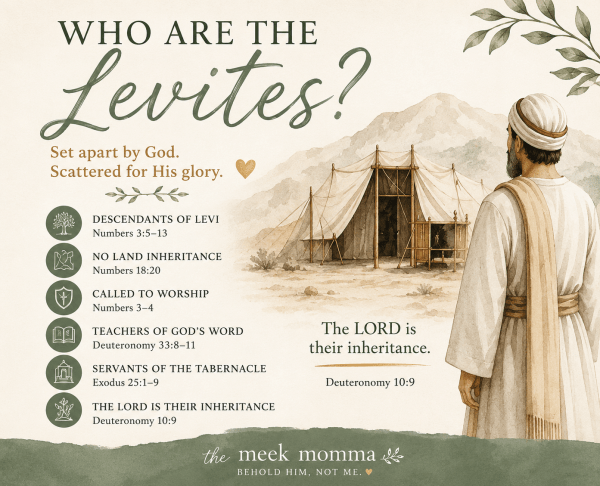
Bonus Material: Who Are the Levites?

Why Their Story Mattersโ€”Especially in the Book of Judges

โ€œIn those days there was no king in Israel. Everyone did what was right in his own eyes.โ€ โ€” Judges 21:25

If youโ€™ve been reading through the final chapters of Judges, youโ€™ve probably noticed something surprising.

The main characters arenโ€™t kings.

They arenโ€™t judges.

Instead, the narrative repeatedly places Levites at the center of Israelโ€™s darkest moments.

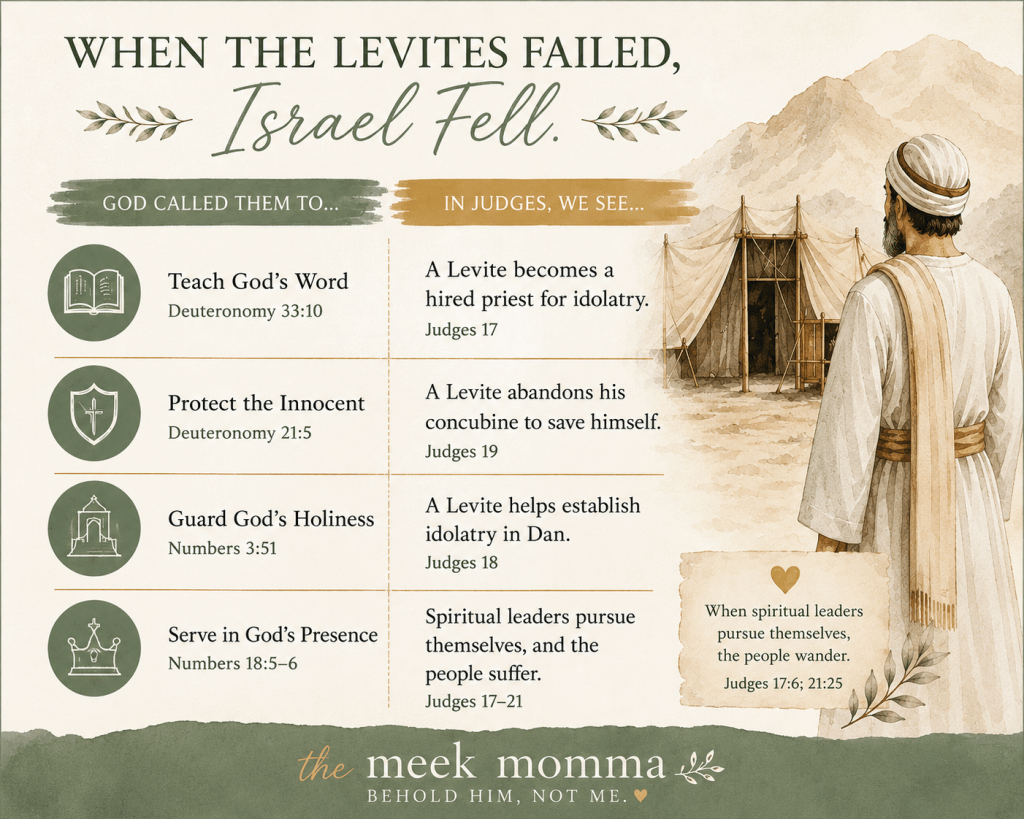
A Levite serves as priest in an idolatrous household (Judges 17โ€“18).

Another Levite abandons his concubine to protect himself (Judges 19).

Why?

Because the author wants us to see something deeper than political chaos.

He wants us to see spiritual collapse.

To understand why these stories are so shocking, we first need to understand who the Levites were and what God had called them to be.


Read the Passage

Primary Reading:

  • Genesis 49:5โ€“7
  • Exodus 32:25โ€“29
  • Numbers 3:5โ€“13
  • Numbers 8:5โ€“26
  • Deuteronomy 10:8โ€“9
  • Deuteronomy 33:8โ€“11
  • Judges 17โ€“21

Observe the Text

Before we ask what these passages mean, notice a few repeated themes.

  • God Himself chose the Levites.
  • They belonged to Him in a unique way.
  • They were scattered throughout Israel.
  • They had no tribal inheritance of land.
  • Their lives revolved around worship.
  • Their purpose was to help Israel remain faithful to the covenant.

Yet by Judges 17โ€“21โ€ฆ

they are doing the exact opposite.


Who Were the Levites?

The Levites were descendants of Levi, one of the twelve sons of Jacob.

Unlike the other tribes, they were never intended to become wealthy landowners.

Instead, God declared:

โ€œThe LORD is their inheritance.โ€

Think about that.

Every other tribe received fertile valleys, vineyards, fields, and cities.

The Levites received something far greater.

They received the privilege of belonging wholly to God.

Their identity wasnโ€™t rooted in possessions.

It was rooted in Godโ€™s presence.


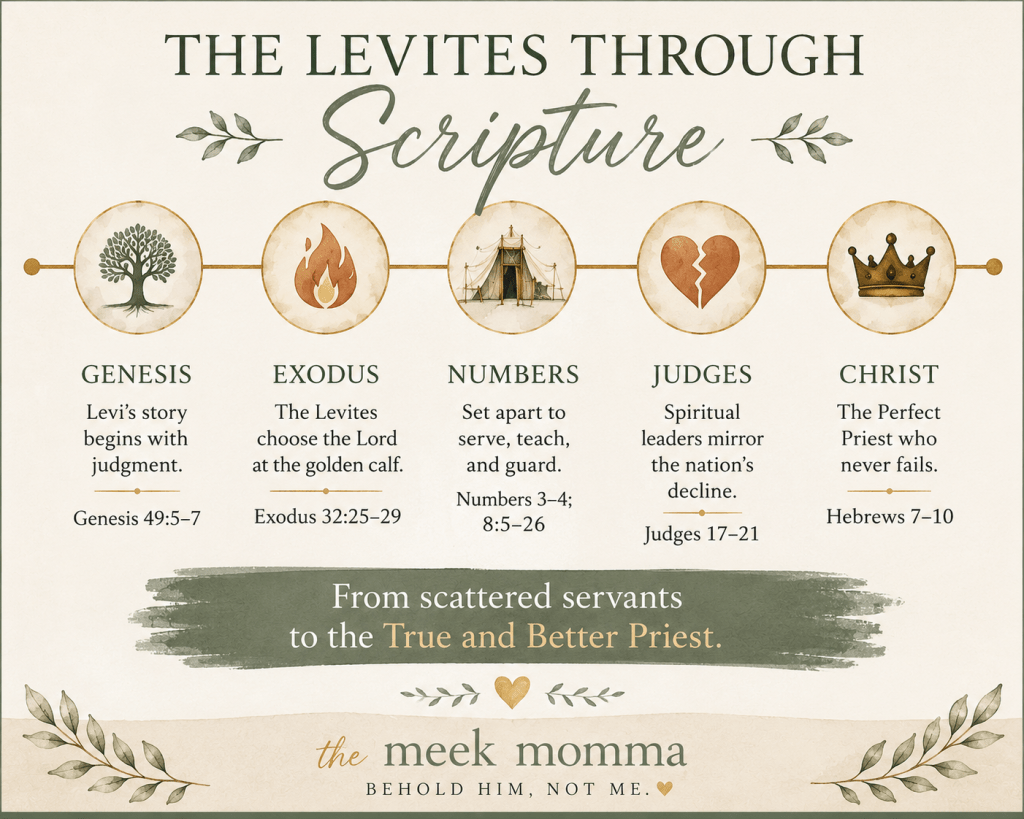
From Judgment to Grace

Leviโ€™s story doesnโ€™t begin well.

In Genesis 34, Levi and his brother Simeon responded to the assault of their sister Dinah by slaughtering an entire city.

Years later, Jacob declared:

โ€œI will divide them in Jacob and scatter them in Israel.โ€

At first glance, this sounds like nothing but judgment.

Yet God, in His mercy, transformed that judgment into a blessing.

Rather than being scattered in disgrace, the Levites were scattered throughout Israel so every tribe would have teachers of Godโ€™s Word living among them.

Only God can redeem a curse into a calling.


Why Did God Choose the Levites?

The defining moment comes after Israel worshiped the golden calf.

While the nation bowed before an idol, Moses cried out:

โ€œWho is on the LORDโ€™S side?โ€

Only the Levites responded.

Because of their zeal for Godโ€™s holiness, the Lord formally set them apart for His service.

They became Israelโ€™s ministers, teachers, guardians, and servants of the Tabernacle.


What Were They Called to Do?

The Levites werenโ€™t simply ancient church janitors.

Their responsibilities touched every part of Israelโ€™s spiritual life.

They guarded Godโ€™s dwelling.

They cared for the Tabernacle.

They transported it.

They protected it from being treated as ordinary.


They taught Godโ€™s Word.

The Levites instructed Israel in Godโ€™s Law.

They explained the covenant.

They answered difficult questions.

They helped people distinguish truth from error.


They preserved holiness.

Again and again, Scripture connects the Levites with the distinction between holy and common, clean and unclean.

Their lives continually reminded Israel:

God is holy.


They shepherded Godโ€™s people.

Though they held no throne, they exercised tremendous spiritual influence.

They were meant to lead Israel toward faithful worship.


Their Greatest Possession

Perhaps the most beautiful truth about the Levites is this:

They received no inheritance because God Himself was their inheritance.

This wasnโ€™t a punishment.

It was a privilege.

Their lives declared:

Nothing is greater than belonging to the Lord.


Then Comes Judgesโ€ฆ

Now everything changes.

The Levites who once destroyed idolsโ€ฆ

begin serving idols.

The Levites who once guarded holinessโ€ฆ

participate in profound wickedness.

The Levites who should have defended the vulnerableโ€ฆ

exploit them.

This is why the stories in Judges are so disturbing.

The author isnโ€™t simply showing us that Israel sinned.

Heโ€™s showing us that even Israelโ€™s spiritual leaders have become indistinguishable from the surrounding nations.

Israel hasnโ€™t merely failed to remove Canaanite influence.

Israel has become Canaanite.


The Tragedy of Judges

Notice the progression.

In Exodusโ€ฆ

the Levites answer Godโ€™s call.

In Judgesโ€ฆ

they answer the highest bidder.

In Exodusโ€ฆ

they defend true worship.

In Judgesโ€ฆ

they help establish false worship.

In Exodusโ€ฆ

they stand for Godโ€™s holiness.

In Judgesโ€ฆ

they abandon righteousness to protect themselves.

The nationโ€™s spiritual decline is visible in the very people who were supposed to lead it.


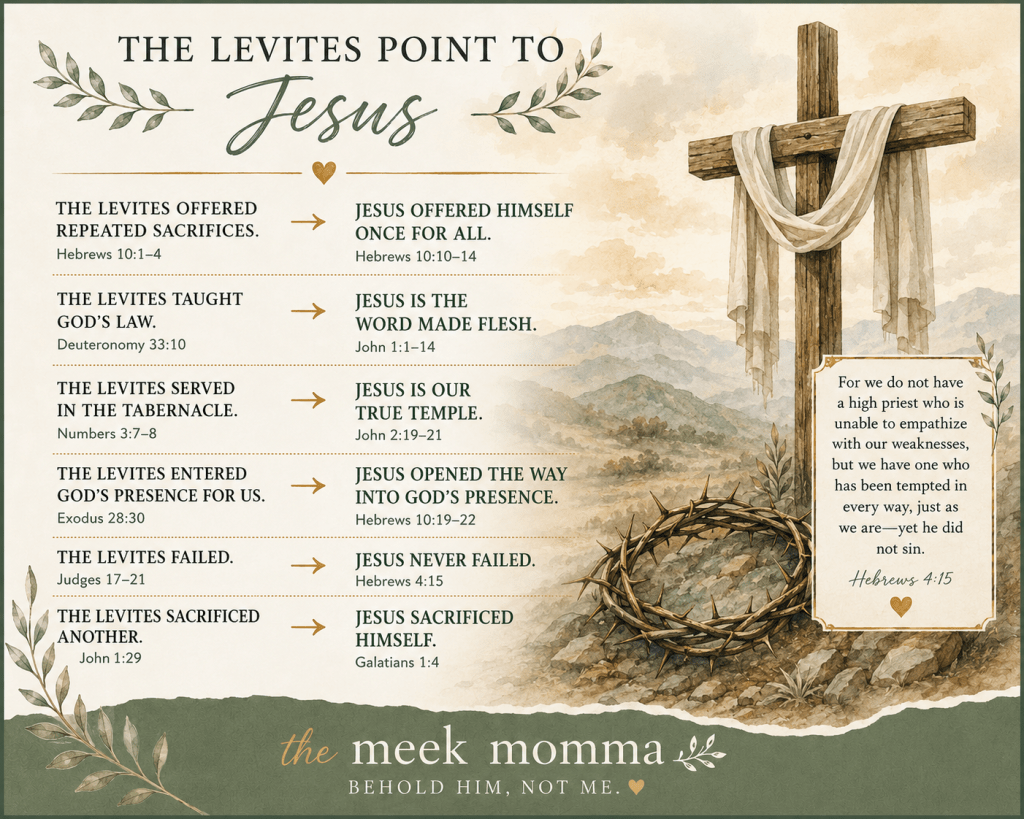
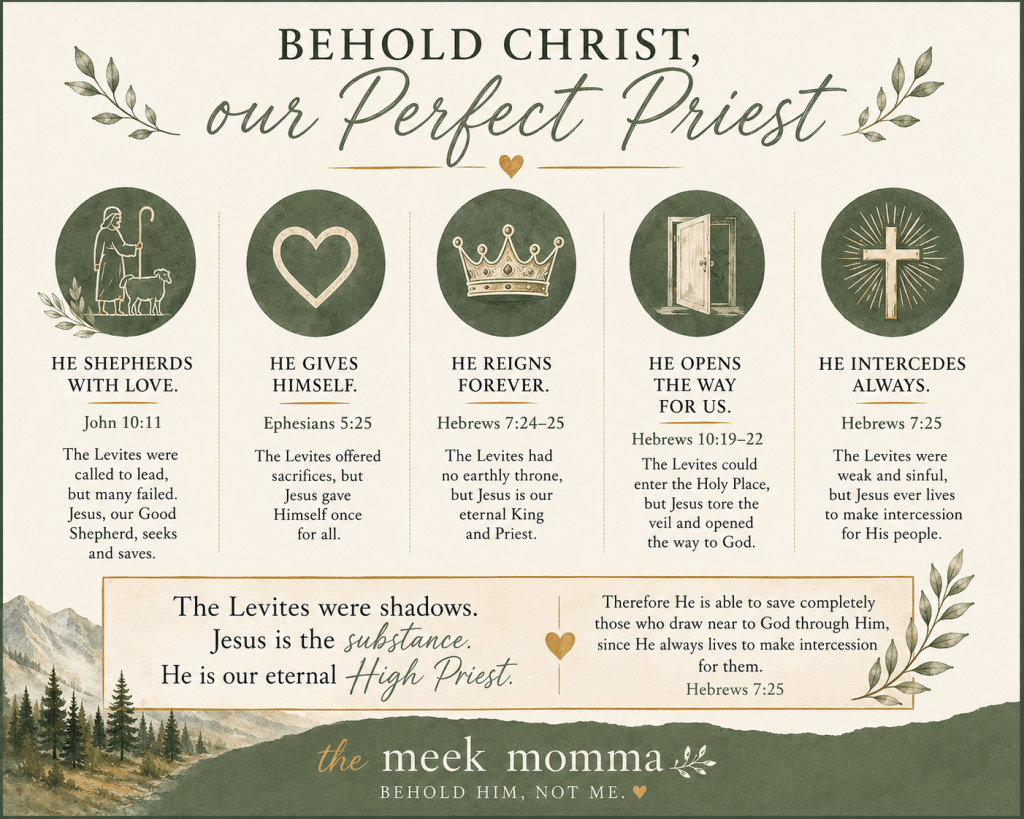
Behold Christ

Every faithful Levite pointed forward to a greater Priest.

Every corrupt Levite reminded Israel they still needed Him.

The Levites guarded Godโ€™s house.

Jesus is the true Temple.

The Levites offered sacrifices.

Jesus became the sacrifice.

The Levites taught Godโ€™s Law.

Jesus is the Word made flesh.

The Levites entered Godโ€™s presence on behalf of the people.

Jesus opened the way into Godโ€™s presence forever.

The Levites failed repeatedly.

Christ never failed once.

Where Judges leaves us longing for faithful spiritual leadership, the Gospel answers that longing in Jesus Christ, our perfect High Priest.


Examine Your Heart

As you reflect on the Levites, consider these questions:

  • Is my greatest inheritance God Himself, or have I come to treasure His gifts more than His presence?
  • Am I careful to distinguish between what God calls holy and what the world calls acceptable?
  • Where am I tempted to โ€œdo what is right in my own eyesโ€ rather than submit to Godโ€™s Word?
  • How am I using whatever influence God has given me to point others toward Him?

Respond

Repent: Confess any tendency to seek comfort, approval, or success above faithfulness to God.

Believe: Trust that Christ is the perfect High Priest who never abandons His people.

Obey: Ask God to make your life a testimony to His holiness and grace.

Pray:

Father, thank You for preserving Your Word so that we might learn from both the faithfulness and failures of those who came before us. Guard my heart from doing what is right in my own eyes. Help me treasure You above every earthly inheritance, and teach me to look to Jesus, my perfect High Priest, who never fails to lead His people into Your presence. Amen.

He Makes Everything Beautiful in Its Time

Finding Hope in Ecclesiastes 3

If youโ€™ve ever read Ecclesiastes, you know it can feel surprisingly heavy.

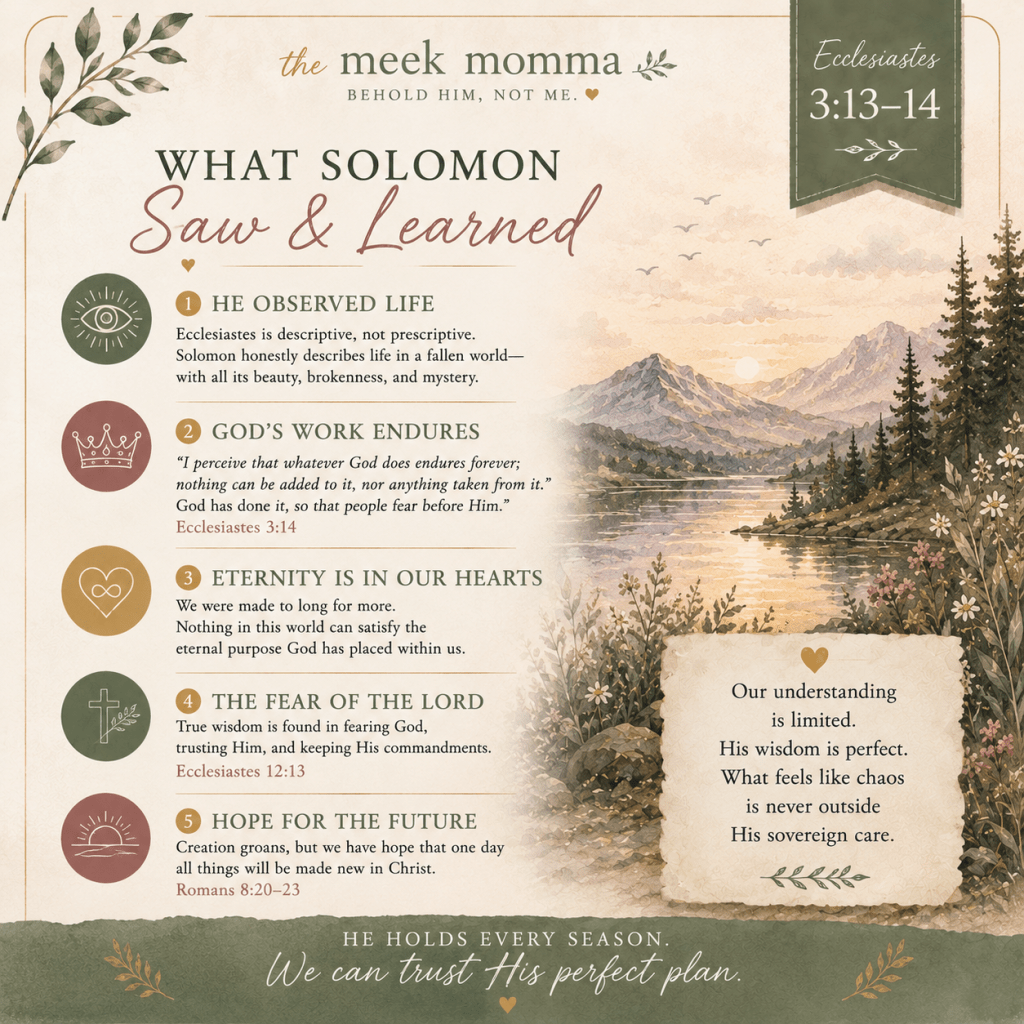
Traditionally attributed to Solomonโ€”the son of David and king of Israelโ€”Ecclesiastes is part of Scriptureโ€™s Wisdom Literature. It isnโ€™t a book of commands telling us to despair or to chase pleasure while we can. Rather, it is a Spirit-inspired record of one manโ€™s honest observations about life in a fallen world. Through poetic language, paradox, and reflection, Solomon invites us into holy wrestling with lifeโ€™s hardest questions.

He exposes the emptiness of pursuing wisdom, wealth, pleasure, or achievement apart from God while calling us to something far better: to fear the Lord and trust Him, even when we cannot understand all that He is doing (Ecclesiastes 12:9โ€“14).

This morning, I found myself lingering over Ecclesiastes 3.

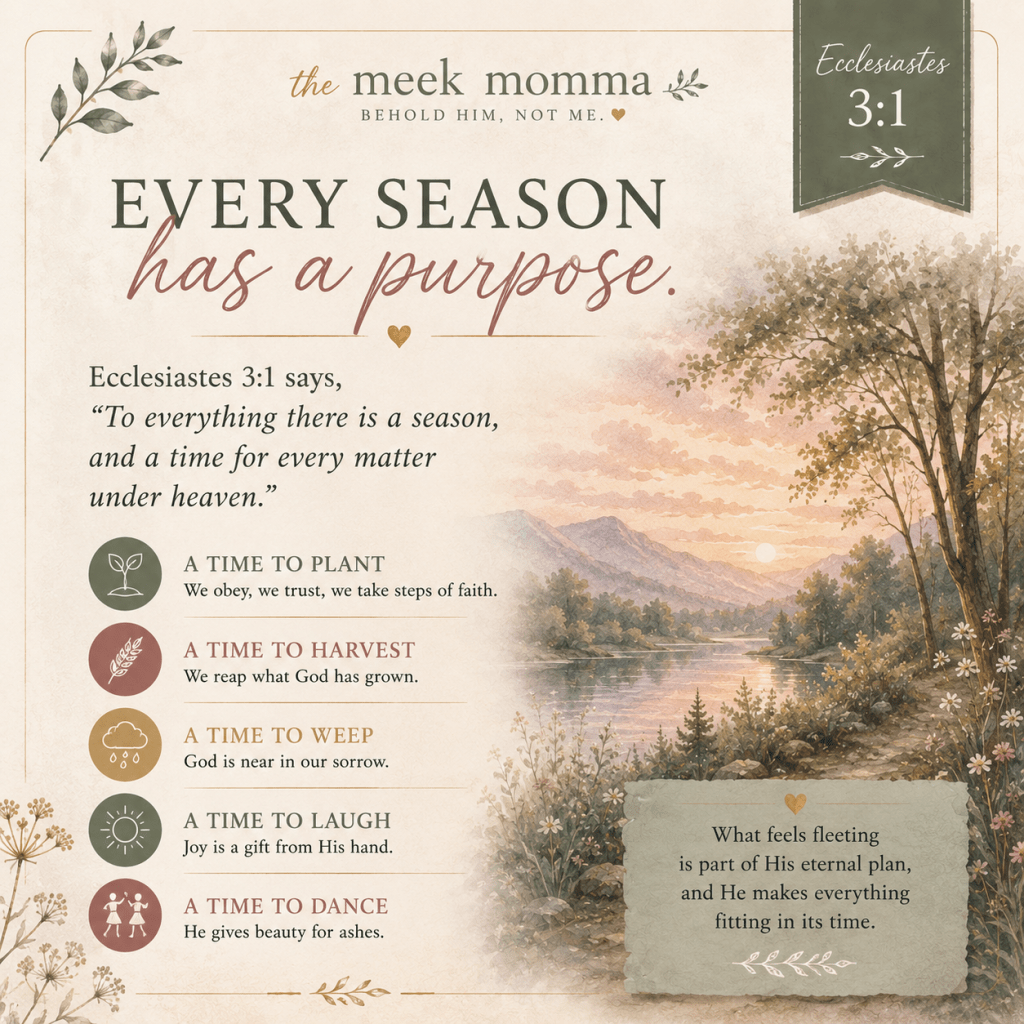
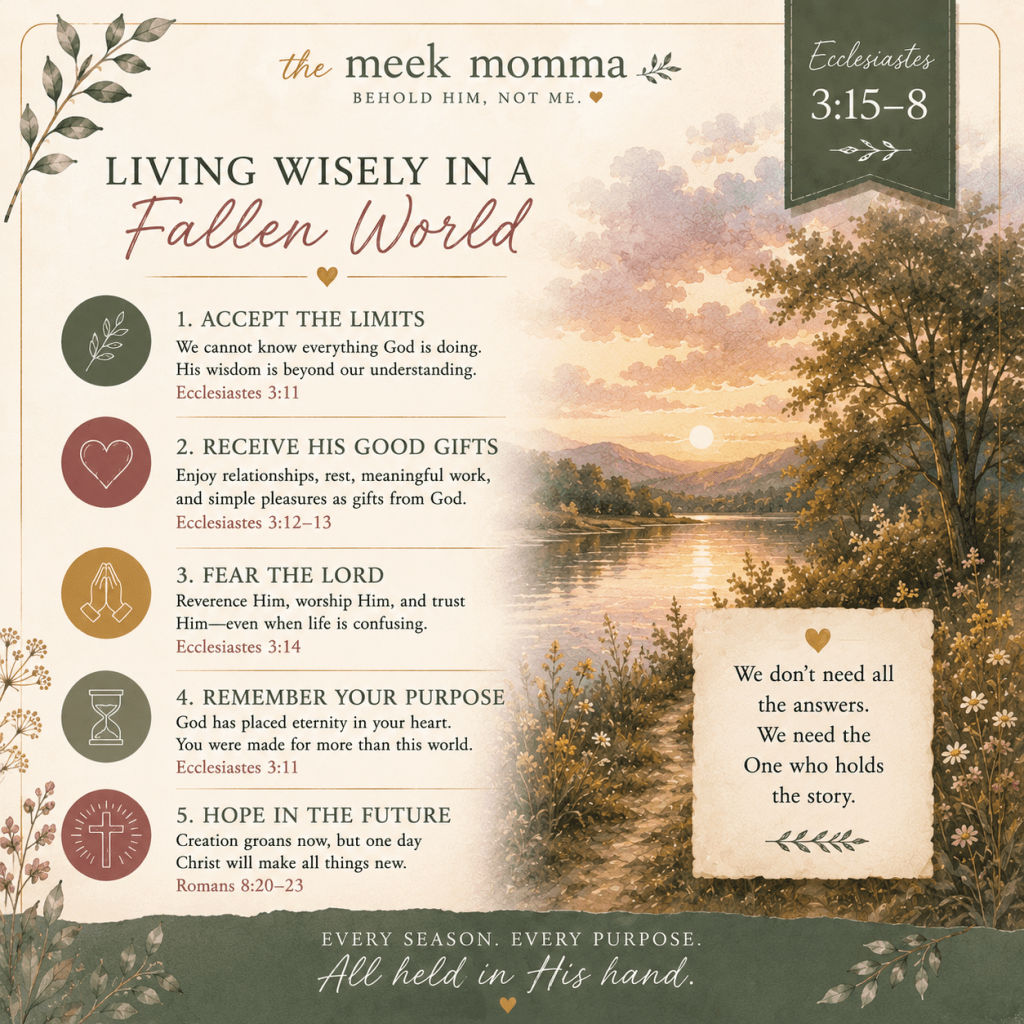
โ€œHe has made everything beautiful in its time. Also, he has put eternity into manโ€™s heart, yet so that he cannot find out what God has done from the beginning to the end.โ€
โ€” Ecclesiastes 3:11 (ESV)

The Hebrew word translated โ€œbeautifulโ€ is yฤpeh, which carries the idea of something that is fitting, appropriate, or timelyโ€”not merely attractive.

That changes how I read this verse.

God isnโ€™t promising that every season will feel beautiful.

He is promising that every season has a fitting place within His perfect plan.

There is a time to plant and a time to harvest.

A time to weep and a time to laugh.

A time to mourn and a time to dance.

While our lives often feel uncertain, fragmented, and fleeting, every season is held securely in the hands of a sovereign God.

Ecclesiastes also tells us that God has โ€œput eternity into manโ€™s heart.โ€ We were created to long for something this world can never fully satisfy. That longing isnโ€™t a flawโ€”itโ€™s evidence that we were made for more. We were created for God Himself.

This is why so much of life can feel like chasing the wind. No amount of success, comfort, possessions, or earthly wisdom can quiet the longing for eternity that God has placed within us.

Yet Solomon doesnโ€™t leave us in despair.

Just a few verses later he writes:

โ€œI perceived that whatever God does endures forever; nothing can be added to it, nor anything taken from it. God has done it, so that people fear before him.โ€
โ€” Ecclesiastes 3:14

Our work is temporary.

Godโ€™s work is eternal.

Our plans change.

His purposes never fail.

Our understanding is limited.

His wisdom is perfect.

What feels like chaos to us is never outside His sovereign care.

The Apostle Paul echoes this same hope when he reminds us that creation itself has been subjected to futility because of the Fall, yet it eagerly awaits the day of redemption (Romans 8:20โ€“23). One day, every longing will find its fulfillment in Christ, and what is now broken will be made whole.

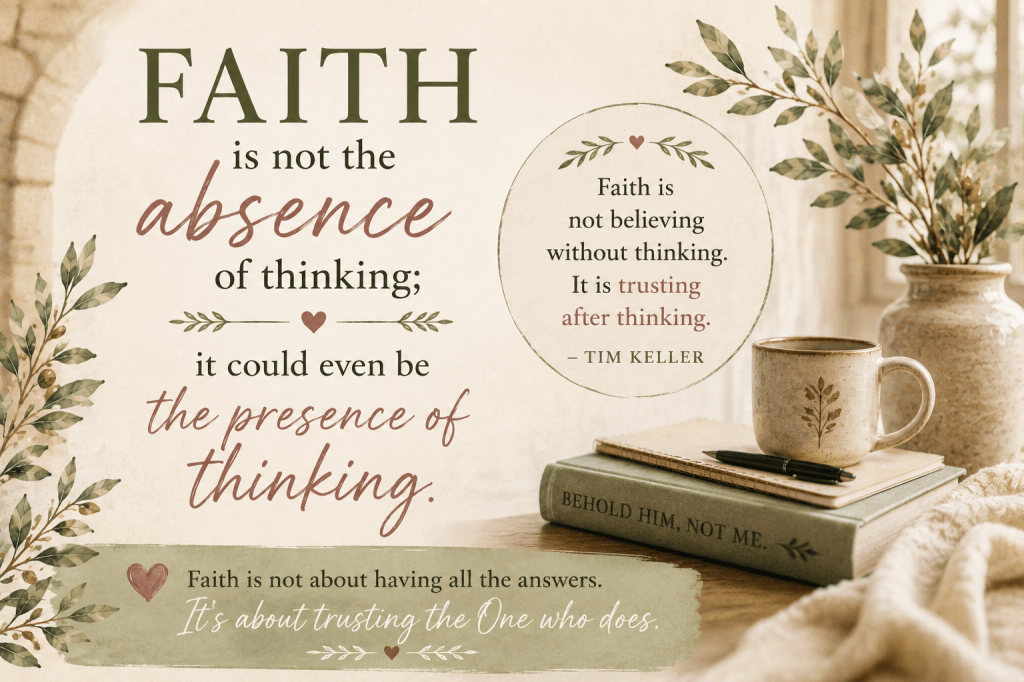
Until then, faith does not require us to understand everything.

It calls us to trust the One who does.

Todayโ€™s Takeaway

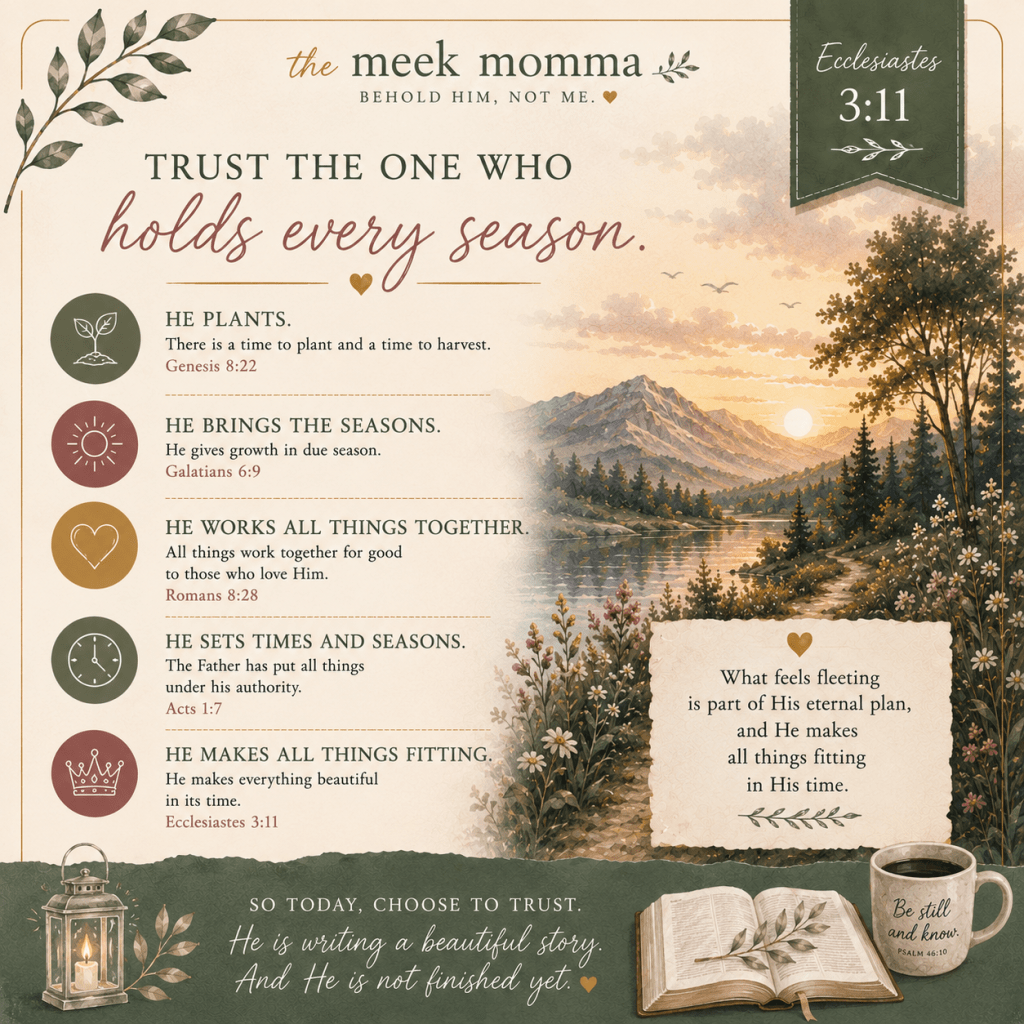
Every seasonโ€”from planting to harvesting, from mourning to dancingโ€”is held in Godโ€™s hands. What feels fleeting is part of His eternal plan, and in His perfect wisdom, He makes everything fitting in its time.

Sometimes the most faithful thing we can do is stop demanding to know the whole story and instead rest in the Author who is writing it.

Behold Him, Not Me: Part Three

When We Remake God

Judges 17:1โ€“6

โ€œThe most dangerous idols are often the ones we create in Godโ€™s name.โ€


A Note to Readers

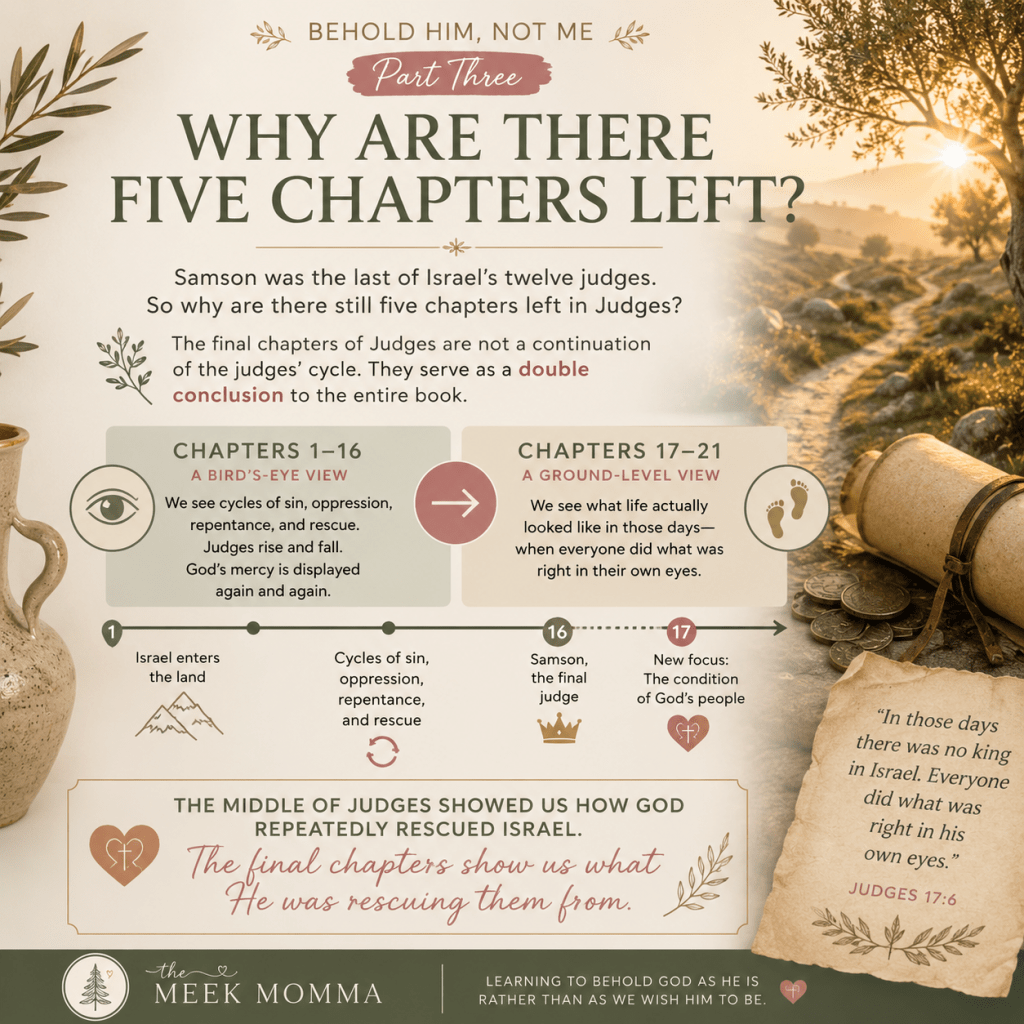
As we continue our journey through Judges, some readers may be wondering why there are still five chapters left in the book. After all, Samson was the last of Israelโ€™s twelve judges.

The answer is that the final chapters of Judges are not a continuation of the judgesโ€™ cycle. Instead, they serve as a double conclusion to the entire book.

Earlier chapters gave us a birdโ€™s-eye view of Israelโ€™s history. We watched cycles of sin, oppression, repentance, and rescue unfold across generations. We saw judges rise and fall. We witnessed Godโ€™s mercy displayed again and again toward a people who continually wandered from Him.

Now the author zooms in.

The final chapters provide a ground-level view of what life actually looked like during those dark days.

These stories are not primarily about foreign enemies.

They are about the spiritual condition of Godโ€™s people themselves.

The middle of Judges showed us how God repeatedly rescued Israel.

The final chapters show us what He was rescuing them from.

And what we find is sobering.

Again and again we will hear the refrain:

โ€œIn those days there was no king in Israel. Everyone did what was right in his own eyes.โ€ (Judges 17:6)

That verse is not merely describing Israel.

It is describing the human heart apart from Godโ€™s rule.

Judges 17 is our first case study.

And what makes this story so unsettling is that it is not a story about atheism.

It is a story about religion.

Lots of religion.

The problem is that it is religion shaped by human preference rather than Godโ€™s revelation.

It is worship that looks right but isnโ€™t.

It is devotion that sounds sincere but is fundamentally distorted.

And if we are honest, it is a temptation that remains just as dangerous today.


A Hollow Man

The story begins with a man named Micah from the hill country of Ephraim.

Micah had stolen eleven hundred shekels of silver from his mother. Later, after hearing her pronounce a curse upon the thief, he confesses and returns the money.

At first glance, Micah is difficult to categorize.

He does not appear thoroughly wicked.

After all, he returns the money.

Yet neither does he appear righteous.

A righteous man would never have stolen it in the first place.

The text gives us the impression of a weak man with weak convictionsโ€”a man moved more by fear than by conscience.

A man without much moral substance.

Perhaps that is what makes him so relatable.

Most people do not see themselves in Pharaoh.

Or Jezebel.

Or Judas.

But many of us can recognize compromise.

We recognize drift.

We recognize moments when fear of consequences moved us more than love for righteousness.

Micah is not a monster.

He is simply a man doing what seems right in his own eyes.

And that is exactly the problem.


Grace Without Repentance

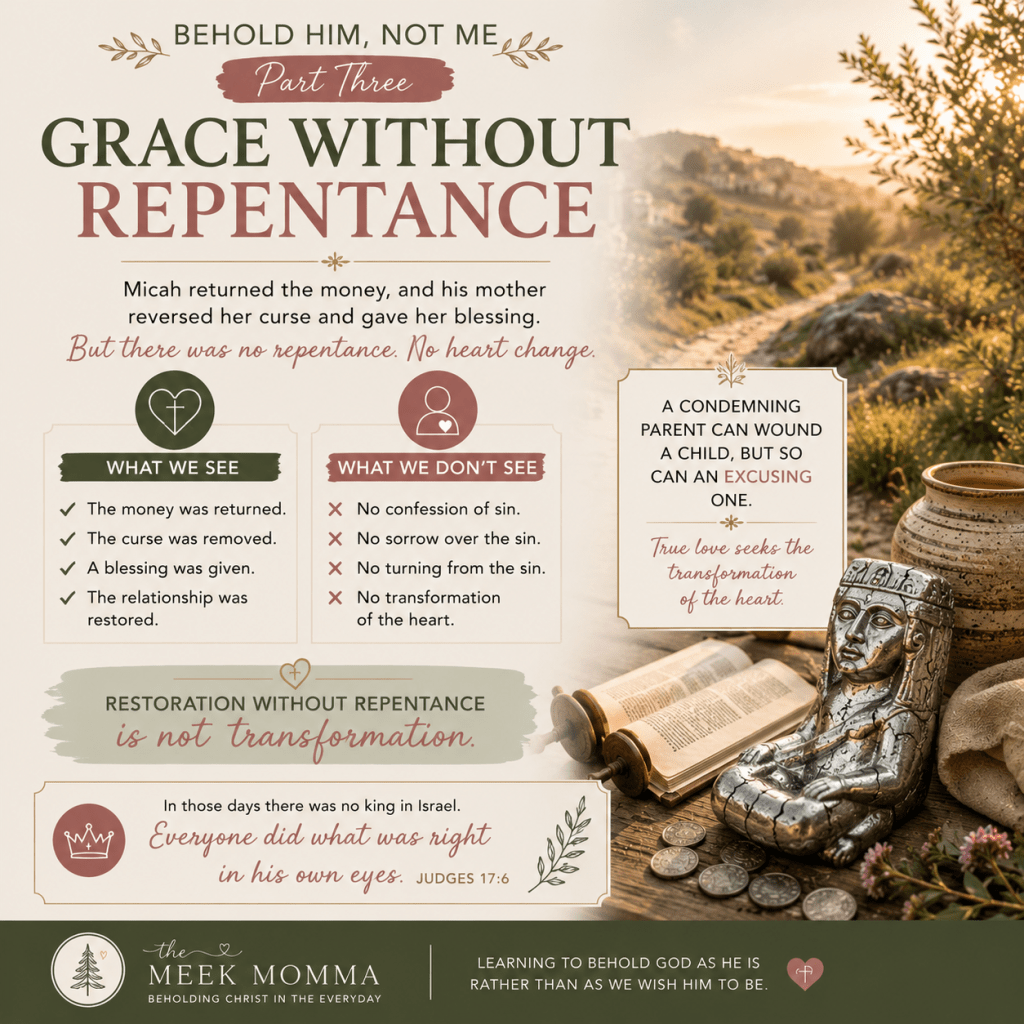
Micahโ€™s mother responds by reversing her curse and pronouncing a blessing over him.

There is something admirable in her willingness to forgive.

Yet there is also something deeply concerning.

She quickly restores the relationship without ever addressing the deeper issue.

There is blessing.

But no repentance.

Restoration.

But no transformation.

No examination of Micahโ€™s heart.

No discussion of why he stole the money.

No acknowledgment of his need for grace.

No call to humility.

As parents, this is an important warning.

A condemning parent can wound a child.

But an excusing parent can wound a child as well.

True love does not merely remove consequences.

It seeks the transformation of the heart.

Micahโ€™s mother appears eager to move past the offense, but in doing so she misses the opportunity to shepherd her son toward genuine repentance.

And as the story unfolds, we will see that Micah remains exactly the same man he was before.

Forgiveness is beautiful.

But biblical restoration always aims at something deeper than simply making conflict disappear.

It aims at reconciliation with God.


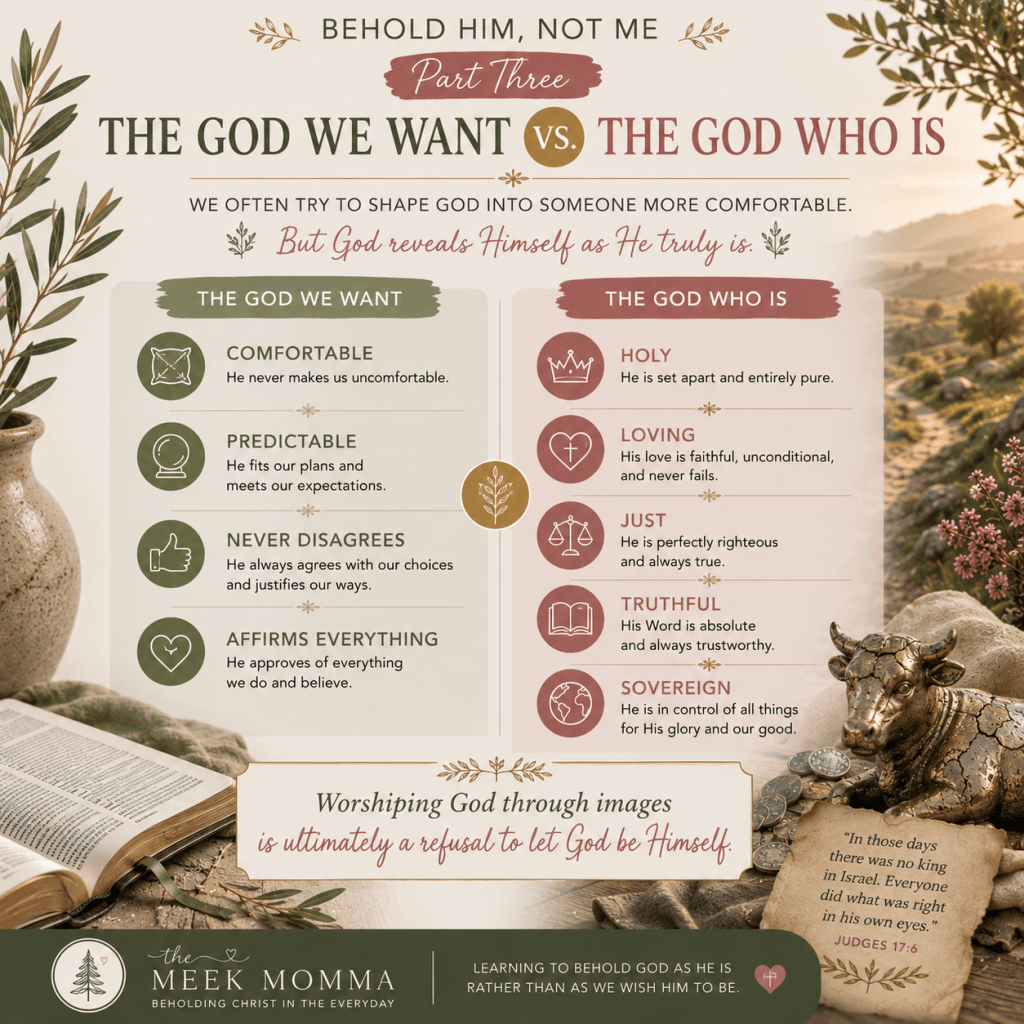
The God We Want vs. The God Who Is

The story takes an unexpected turn when Micahโ€™s mother declares:

โ€œI dedicate this silver to the Lord from my hand for my son, to make a carved image and a metal image.โ€ (Judges 17:3)

If that sounds contradictory, it should.

She claims to dedicate the silver to the Lord.

Then she uses it to violate one of His clearest commands.

God had explicitly forbidden the making of images for worship:

โ€œYou shall not make for yourself a carved imageโ€ฆโ€ (Exodus 20:4)

This was not a minor detail in Israelโ€™s faith.

It was the Second Commandment.

So why was God so concerned about images?

The issue was never artistic ability.

The issue was theological accuracy.

Any image of God automatically reveals one aspect of His character while concealing others.

Consider Aaronโ€™s golden calf in the wilderness.

The calf may have symbolized strength and power.

But it could not communicate Godโ€™s holiness.

His justice.

His mercy.

His wisdom.

His love.

Every image inevitably distorts what it attempts to represent.

God refuses to be reduced to something fashioned by human hands because He cannot be contained by human imagination.

Yet the deeper problem is not the image itself.

The deeper problem is the heart behind the image.

Worshiping God through images reveals a desire to reshape Him into someone we find more comfortable.

It is an attempt to edit God.

To soften the attributes we dislike.

To emphasize the attributes we prefer.

To create a version of God that fits our expectations.

Tim Keller observed that the fundamental problem behind idolatry is a refusal to let God be Himself.

In modern terms, it is a refusal to submit to God as He has revealed Himself.

And if weโ€™re honest, we do this all the time.

Most of us do not carve idols out of silver.

But we often create versions of God in our minds.

How often have we heard someone say:

โ€œI donโ€™t believe in a God who would do that.โ€

Or:

โ€œI like to think of God asโ€ฆโ€

At first those statements sound thoughtful.

But they reveal something dangerous.

They place us in the position of deciding who God should be.

Instead of allowing Scripture to reveal God to us, we attempt to recreate Him according to our preferences.

Like Micahโ€™s family, we begin shaping God instead of allowing God to shape us.


The Comfortable God

There are many ways we attempt to remake God.

Sometimes we do it intellectually.

We encounter something in Scripture that offends our modern sensibilities, so we quietly dismiss it.

We decide that God could not possibly mean what He says.

After all, our culture has progressed beyond such things.

Yet what we are really saying is that our culture has become the authority rather than God.

Other times we do it psychologically.

We simply avoid the parts of Godโ€™s character that make us uncomfortable.

Perhaps we love Godโ€™s grace but ignore His holiness.

Perhaps we celebrate His love but avoid His authority.

Perhaps we cling to His promises while neglecting His commands.

Still other times we do it practically.

We know what Scripture teaches.

Yet we follow our feelings instead.

We follow our desires instead.

We follow our culture instead.

And then we reassure ourselves by saying:

โ€œI prayed about it.โ€

โ€œI feel peace about it.โ€

But peace is not the measure of truth.

Godโ€™s Word is.

This is exactly what Micahโ€™s family is doing.

They are not abandoning religion.

They are customizing it.

They follow the commands they like.

They ignore the commands they dislike.

They keep enough of Godโ€™s truth to feel spiritual while discarding enough of it to remain comfortable.

The most dangerous idols are often the ones we create in Godโ€™s name.


Why This Matters

A counterfeit god can never save us.

More than that, a counterfeit god can never truly know us.

Real relationships require wrestling.

A real person can disagree with you.

Correct you.

Challenge you.

Say no to you.

The same is true in our relationship with God.

When Scripture confronts us, we have an opportunity to wrestle honestly with Him.

To submit where we disagree.

To grow where we are resistant.

To deepen our understanding of His character.

But if we simply ignore every truth we dislike, we are not relating to God at all.

We are relating to a projection of ourselves.

We may have created a more comfortable god.

But we have also created a nonexistent one.

And that may be the most sobering lesson in Judges 17.

Micahโ€™s greatest problem was not that he rejected God.

It was that he remade Him.


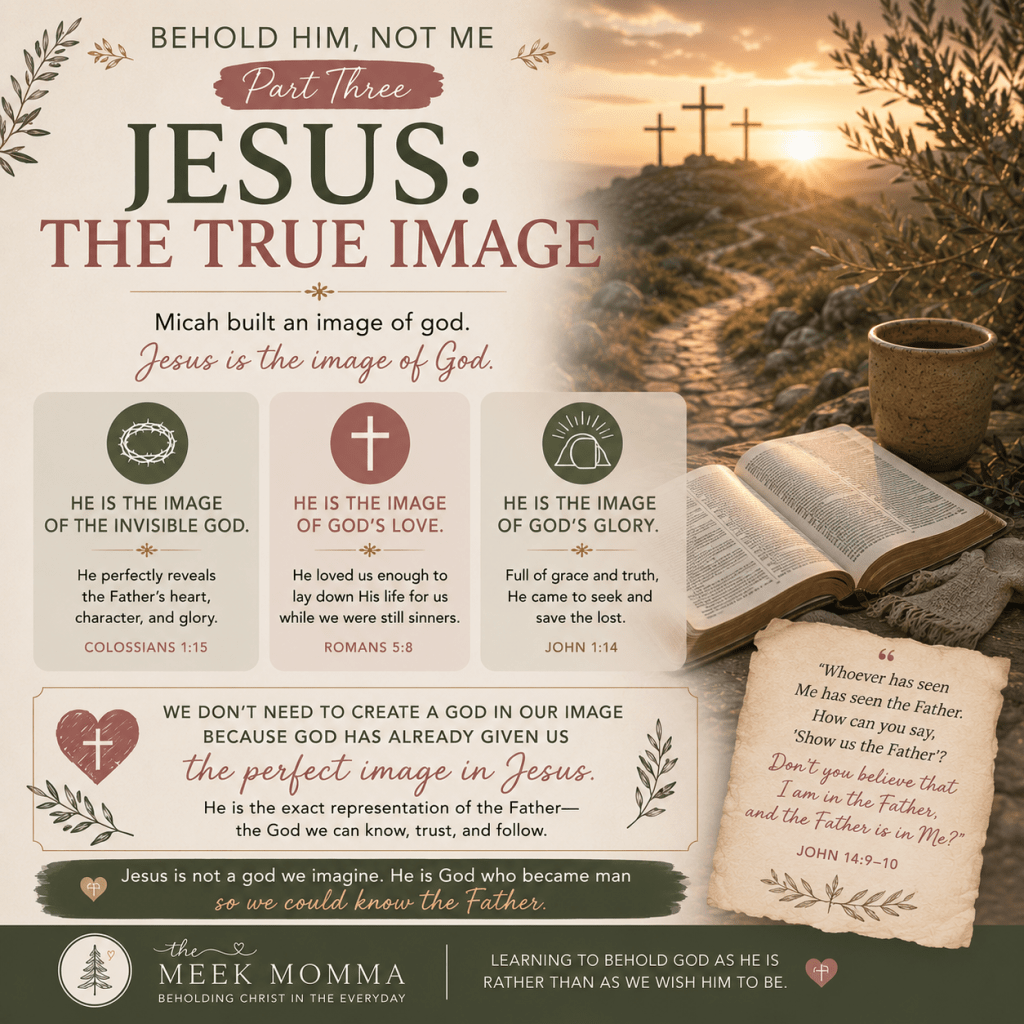
Jesus: The True Image

Micahโ€™s mother believed she could fashion something with silver that would help her worship God.

Yet every image created by human hands inevitably distorts the One it seeks to represent.

But in Jesus Christ, God has given us the perfect image of Himself.

Paul writes:

โ€œHe is the image of the invisible God.โ€ (Colossians 1:15)

Unlike Micahโ€™s idol, Jesus does not distort Godโ€™s character.

He reveals it perfectly.

If we want to know what God is like, we do not look at statues.

We look at Christ.

In Jesus we see Godโ€™s holiness.

His mercy.

His justice.

His compassion.

His truth.

His love.

Micah attempted to create an image of God.

God gave us the real thing.

We never need to imagine what God is like.

God has shown us.


Behold Him, Not Me

Micahโ€™s problem was not that he stopped worshiping.

His problem was that he wanted a version of God that fit comfortably inside his own preferences.

Every idol ultimately asks the same question:

Will I worship God as He is?

Or will I create a god I prefer?

The answer is not better religion.

The answer is Christ.

The true image of God.

As we continue through the closing chapters of Judges, may we learn to lay aside our preferences, our assumptions, and our attempts to remake God according to our own image.

May we instead allow God to reveal Himself through His Word and through His Son.

And may we learn, once again, to behold Himโ€”not ourselves.


Heart Check Questions

โ€ข What parts of Godโ€™s Word do I most wish were different?

โ€ข Have I been wrestling honestly with those truths or avoiding them?

โ€ข Are there attributes of God I emphasize while ignoring others?

โ€ข Where am I tempted to shape God according to culture rather than Scripture?

โ€ข Am I worshiping God as He isโ€”or as I would prefer Him to be?


Prayer

Father,

Forgive me for the ways I try to reshape You according to my preferences. Forgive me for the times I have emphasized the parts of Your character that comfort me while ignoring the parts that challenge me.

Thank You for revealing Yourself through Your Word and through Your Son. Thank You that I do not have to imagine what You are like because You have shown me in Jesus Christ.

Help me to worship You as You are, not as I wish You to be.

Give me humility where I resist Your truth.

Give me faith where I struggle to understand.

Give me courage to submit even when Your Word confronts my desires.

Teach me to behold Christ more clearly, trust Him more deeply, and follow Him more faithfully.

May I stop creating gods in my own image and instead be transformed into Yours.

In Jesusโ€™ name,

Amen.

The most dangerous idols are often the ones we create in Godโ€™s name.

Behold Him, not me.

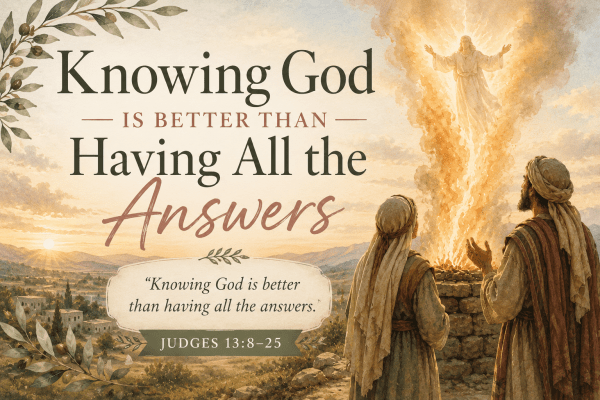
Knowing God Is Better Than Having All the Answers

Before We Dive In

You may notice some overlap between this study and the previous two Judges posts Iโ€™ve shared. Thatโ€™s intentional. In those studies, we looked at the broader movement of Judges 12โ€“13 and how the story points us forward to Christ. This time, I found myself lingering over a much smaller section of the textโ€”Judges 13:8โ€“25โ€”and discovering a lesson I wasnโ€™t ready to move past.

Sometimes Scripture is like that. We read a passage once and see the big picture. Then we come back and find the Lord gently pressing a particular truth deeper into our hearts. For me, that truth was this: knowing God is better than having all the answers.

So if some of these verses feel familiar, I hope youโ€™ll slow down with me and look again. Godโ€™s Word always has more to show us.

And perhaps thatโ€™s one of the greatest gifts of studying Scripture slowly. We donโ€™t simply gather more informationโ€”we come to know the Author more deeply. As always, my prayer is that through this study we would learn to behold Him, not ourselves, trusting that His character is enough even when we donโ€™t have all the answers.

Judges 13:8โ€“25

As I studied Judges 13 this week, I found myself identifying with Samsonโ€™s father, Manoah.

After hearing that his barren wife would bear a son, Manoah prayed:

โ€œPlease, Lord, let the man of God you sent to us come again to teach us how to bring up the boy who is to be born.โ€ (Judges 13:8)

His request is deeply relatable. He wants clarity, direction, and a plan for the future God has placed in his hands.

Iโ€™ve prayed the same way countless times.

As the mother of a son with autism, I have often asked God for guidance. Should I pursue this therapy or that one? Should I homeschool or choose public school? What does faithfulness look like in this situation?

If God would simply make the path clear, I would gladly follow it.

But Judges 13 reveals a better gift. The central lesson of Manoahโ€™s story is this:

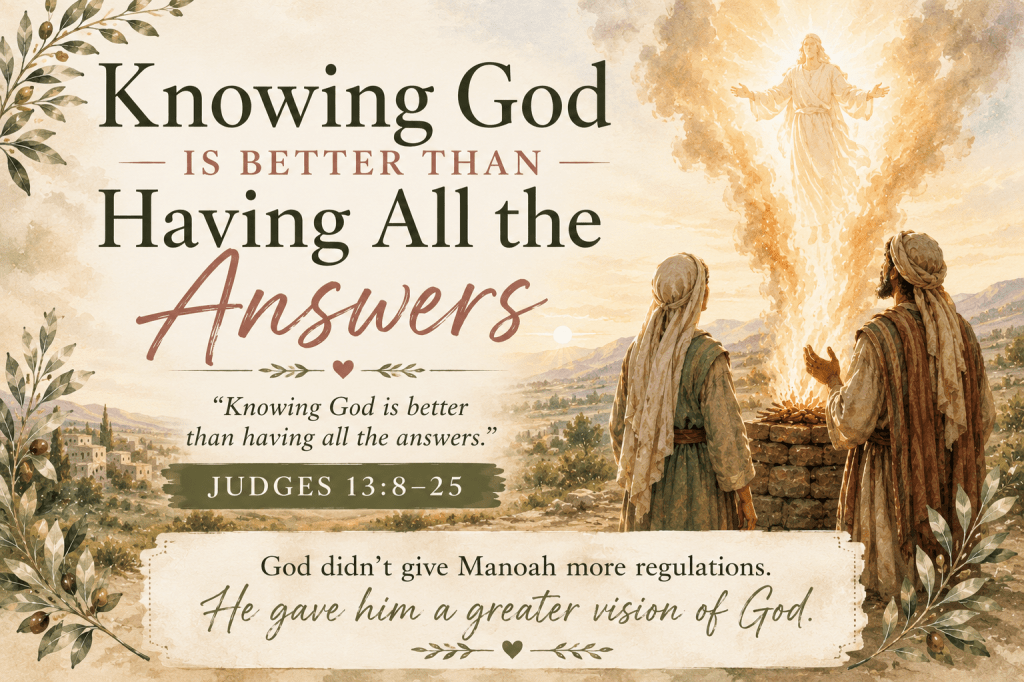
Knowing God is better than having all the answers.

Manoah asks for guidance, yet God gives him something deeperโ€”a greater revelation of Himself. And that is often how God works in our lives as well.

Faith That Believes the Impossible

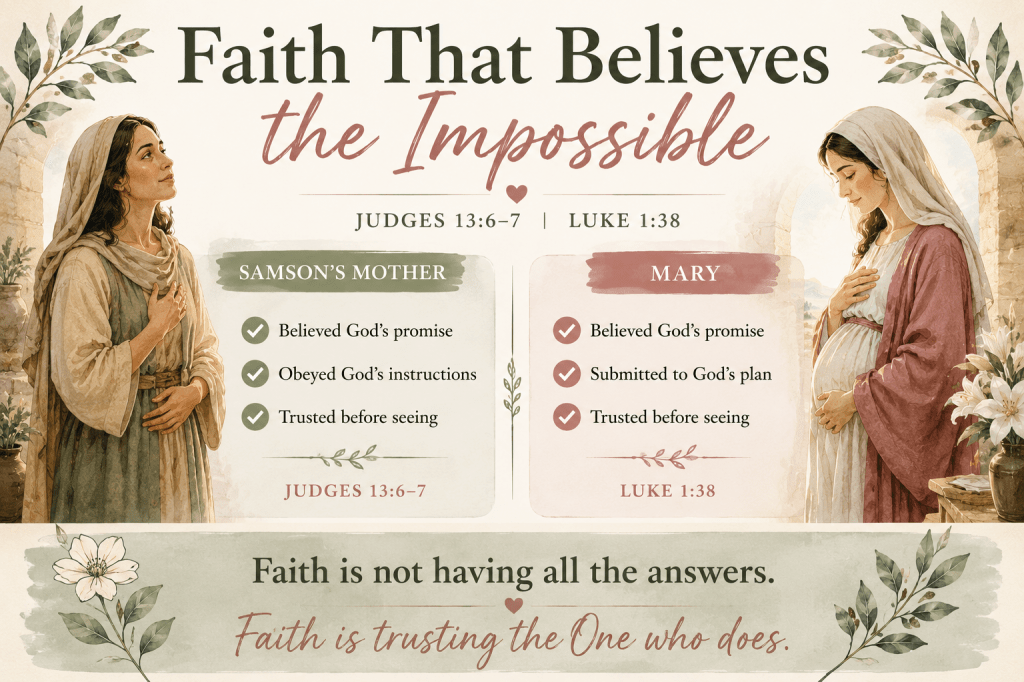
Before we look at Manoah, we must first notice the remarkable faith of Samsonโ€™s mother.

When the angel of the Lord appeared and announced that she would conceive and bear a son, she simply believed.

There is no recorded laughter as there was with Sarah when she heard she would bear Isaac in her old age (Genesis 18:9โ€“15).

There is no disbelief like Zechariah displayed when he learned John the Baptist would be born (Luke 1:13โ€“20).

Instead, Samsonโ€™s mother receives Godโ€™s word with faith:

โ€œA man of God came to me. He looked like an angel of God, very awesome.โ€ (Judges 13:6)

She believed the promise before she saw the fulfillment.

In this way, she reminds us of another woman who would receive impossible news more than a thousand years later.

When Gabriel announced the coming birth of Jesus, Mary responded:

โ€œMay it be to me as you have said.โ€ (Luke 1:38)

Both women trusted Godโ€™s promises.

Both women submitted themselves to Godโ€™s purposes.

Both women accepted personal cost in order to participate in Godโ€™s plan.

Samsonโ€™s mother embraced the Nazarite restrictions required during her pregnancy. Mary embraced the shame and misunderstanding that would accompany an unwed pregnancy.

Both women demonstrate that faith is not merely believing God can do the impossibleโ€”it is willingly placing ourselves at His disposal.

Manoahโ€™s Request

Unlike his wife, Manoah has questions.

And honestly, I appreciate that.

His response feels very human.

Notice that he doesnโ€™t ask whether Godโ€™s promise is true.

He assumes the child will come.

His request is not for proof but for guidance.

He wants to know:

โ€œWhat is to be the rule for the boyโ€™s life and work?โ€ (Judges 13:12)

How do we raise him?

What should we do?

What rules should we follow?

Again, I find myself nodding along.

As parents, we want certainty.

We want formulas.

We want detailed instructions.

We want guarantees.

Yet when the angel returns, something surprising happens.

He doesnโ€™t provide much new information at all.

The child will be a Nazarite.

Manoahโ€™s wife must continue obeying what she has already been told.

Thatโ€™s essentially it.

No parenting manual.

No detailed roadmap.

No step-by-step guide.

Why?

The Help Manoah Wanted Versus the Help He Needed

At first it seems like God ignored Manoahโ€™s request.

But He didnโ€™t.

God answered the prayer.

Just not in the way Manoah expected.

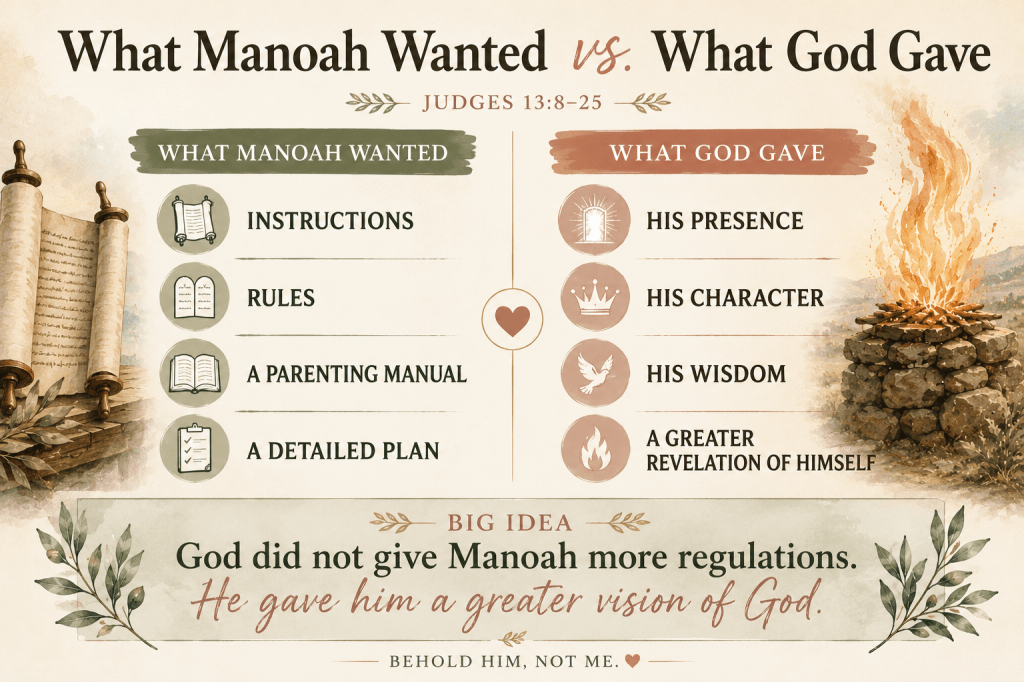
Manoah wanted information.

God gave revelation.

Manoah wanted rules.

God revealed His character.

Manoah wanted to know what to do.

God showed him who He was.

When Manoah asks the angelโ€™s name, the angel responds:

โ€œWhy do you ask my name? It is beyond understanding.โ€ (Judges 13:18)

Then the angel ascends into heaven in the flame of the sacrifice.

Suddenly Manoah realizes this was no ordinary visitor.

This was a divine encounter.

The angel of the Lord had come not merely to deliver information but to reveal Godโ€™s greatness.

That was the help Manoah truly needed.

And perhaps it is the help we need as well.

The Lesson I Keep Learning

This part of the story stopped me in my tracks.

Because I often approach God exactly the way Manoah did.

I want clarity.

I want confidence for the next step.

I want God to show me how to move forward.

As the mother of a child with autism, I have cried out to God with questions similar to Manoahโ€™s.

But Godโ€™s silence has not really been silence.

Like Manoah, I often discover that God is answering a deeper question than the one I am asking.

He is teaching me His character.

His goodness.

His faithfulness.

His wisdom.

His sovereignty.

Because the truth is this:

Knowing God is better than having all the answers.

No set of instructions can prepare us for every decision we will face.

Only a deep understanding of who God is can guide us through the countless twists and turns of life.

Faith Is Not the Absence of Thinking

After Manoah panics and assumes they are about to die because they have seen God, it is his wife who calmly reasons through the situation:

โ€œIf the Lord had meant to kill us, he would not have accepted a burnt offering and grain offering from our hands.โ€ (Judges 13:23)

Her response beautifully illustrates what Tim Keller wrote:

โ€œFaith is not the absence of thinking. It is thinking and acting on the basis of the Word and promises of God.โ€

She reflects on what God has already revealed.

She reasons from His character.

She trusts His promises.

That is biblical faith.

Not blind optimism.

Not wishful thinking.

But confidence rooted in who God is.

We Need God More Than More Rules

Tim Keller points out that mature relationships require fewer external rules and more internal wisdom.

Young children need constant instructions:

Donโ€™t touch that.

Donโ€™t go there.

Donโ€™t do this.

But as children mature, parents desire them to internalize wisdom and values so they can make good decisions even when specific instructions are absent.

The same is true spiritually.

Many Christians imagine Old Testament believers had a better system because they received more regulations.

Yet under the New Covenant, we have something far greater.

We have the Holy Spirit.

Paul writes:

โ€œBe transformed by the renewing of your mind.โ€ (Romans 12:2)

And:

โ€œWe have the mind of Christ.โ€ (1 Corinthians 2:16)

Rather than endless prescriptions, God gives us Himself.

Rather than merely telling us what to do, He transforms who we are.

What Manoah needed most was not more regulations.

It was a greater vision of God.

And the same is true for us.

Samsonโ€™s Birth and Our Need for a Greater Savior

Finally, just as God promised, Samson is born.

The promise was never in doubt because it rested on Godโ€™s word.

The child grows.

God blesses him.

The Spirit begins to stir within him.

Everything appears poised for success.

If anyone ever had spiritual advantages, it was Samson.

Miraculous birth.

Divine calling.

Godโ€™s blessing.

The Spiritโ€™s power.

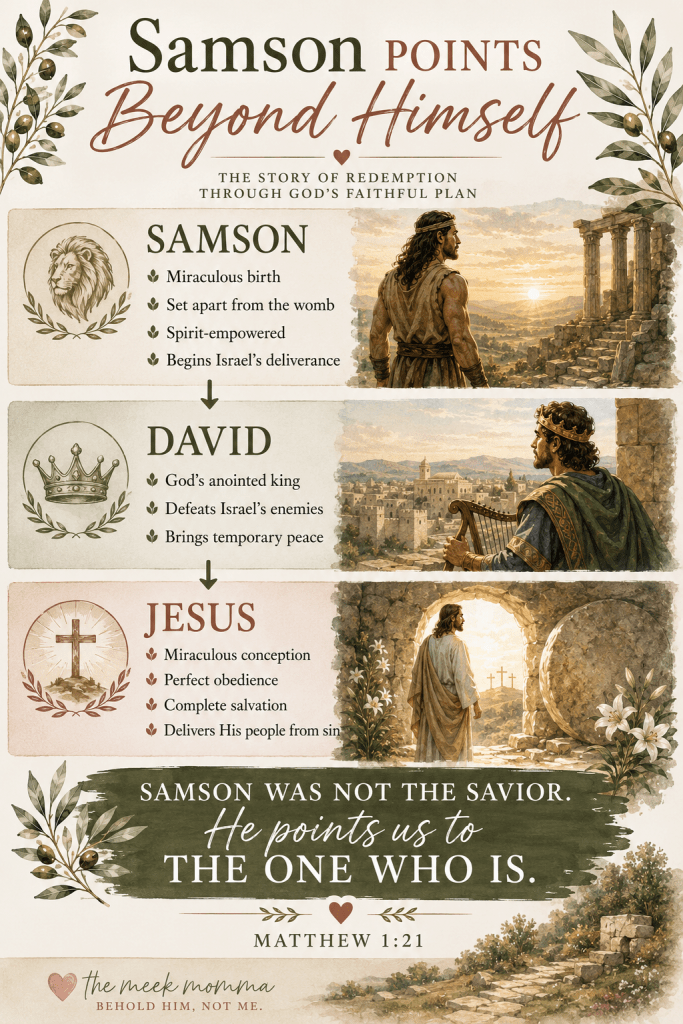
Yet as we continue through Judges, we will discover that Samson is not the Savior Israel needs.

He will disappoint us.

His flaws will become painfully evident.

And that disappointment is intentional.

Because Samson was never meant to be the final Deliverer.

He points beyond himself.

To David.

And beyond David.

To Jesus Christ.

The One who would perfectly obey.

The One who would perfectly trust.

The One who would perfectly save.

Heart Check

As I closed my Bible, one question lingered in my heart:

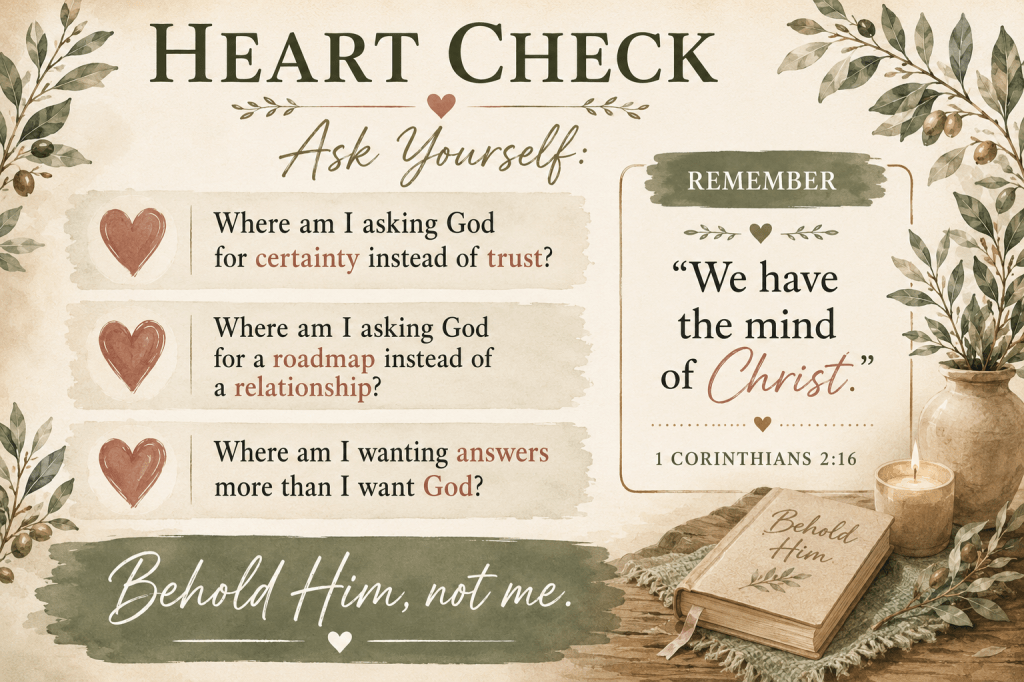
In what areas of my life would I rather have answers than God Himself?

Where am I asking for certainty instead of trust?

Where am I asking for a roadmap instead of a relationship?

Like Manoah, we often think we need more information.

But God knows what we truly need.

We need Him.

His character.

His wisdom.

His presence.

His promises.

Because in the end:

Knowing God is better than having all the answers.

Behold Him, not me.

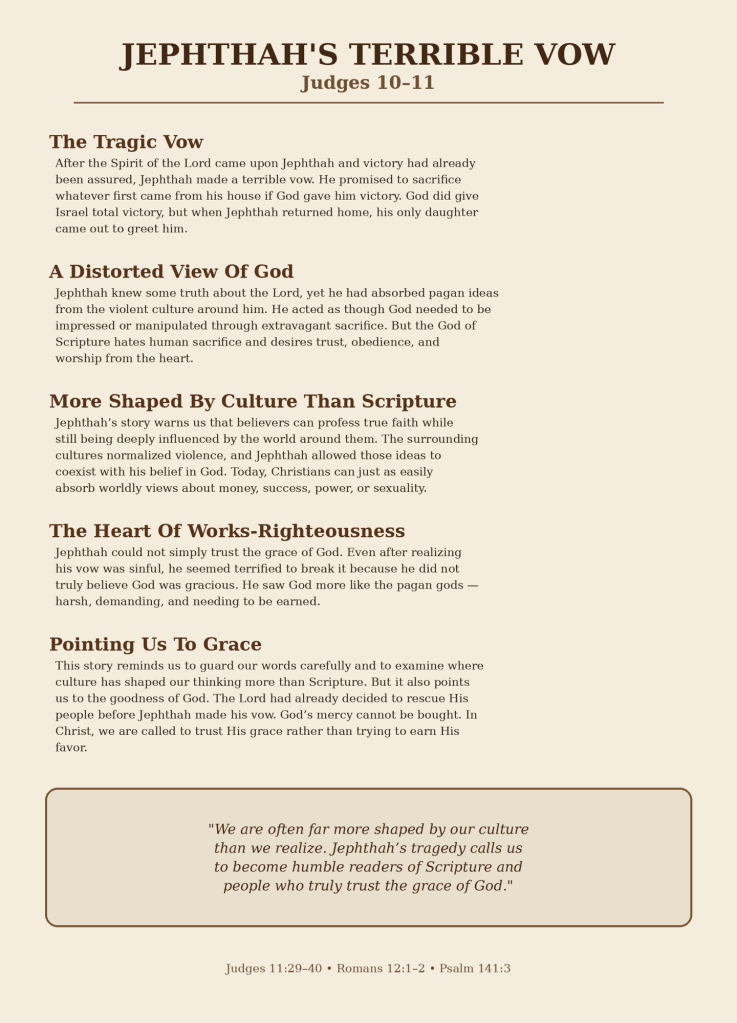
When Broken People Read Scripture Wrong: Jephthah, Grace, and Learning to Read the Bible Carefully

There is something both comforting and deeply unsettling about the story of Jephthah in Judges 10โ€“11.

Comforting, because God uses a rejected and broken man.
Unsettling, because that same man carries distorted beliefs about God that lead to devastating consequences.

For many women learning to study Scripture faithfully โ€” especially young mothers, homeschool moms, women rebuilding after hardship, or believers new to the faith โ€” Jephthahโ€™s story becomes more than history. It becomes a mirror.

Because one of the hardest truths to learn as Christians is this:

We can know some truth about God while still misunderstanding Him deeply in other places.

And if we are not careful readers of Scripture, we can begin mixing biblical truth with cultural assumptions, personal wounds, fear, and worldly thinking.

That is exactly what happens in the life of Jephthah.


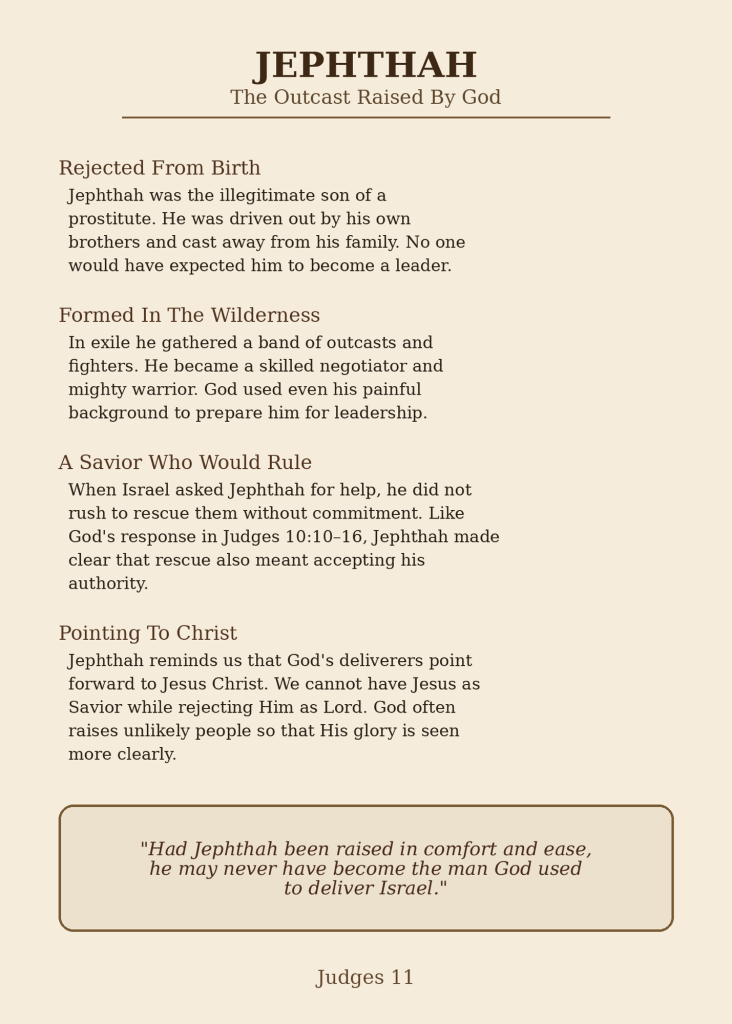
God Raises an Unlikely Savior

Jephthah is introduced in Judges 11 as a mighty warrior. But immediately we are told something painful about him:

He was the son of a prostitute.

His half-brothers drove him away from the family home, rejecting him and cutting him off from inheritance and belonging. He grew up as an outcast, living in the wilderness surrounded by what Scripture calls โ€œworthless fellowsโ€ โ€” essentially a band of violent men and raiders.

Humanly speaking, Jephthah is not the kind of man anyone would expect God to use.

And yet God does.

This is one of the repeated themes throughout the book of Judges: God continually rescues His people through deeply flawed deliverers.

Why?

Because the judges were never meant to be ultimate saviors. They were shadows pointing forward to the true Savior still to come โ€” Jesus Christ.

Jephthahโ€™s rejection points us toward Christ, who was also rejected by His own people.
Jephthahโ€™s suffering prepared him to lead hurting people.
His strength in battle reflected Israelโ€™s need for deliverance.

But unlike Jesus, Jephthah was deeply sinful and spiritually confused.

And Scripture does not hide that from us.

Character Profile

Learning Context Matters

One of the biggest mistakes new believers often make when reading the Bible is assuming that because the Bible describes something, God therefore approves of it.

But biblical narrative does not always equal biblical endorsement.

The book of Judges especially shows us what life looks like when โ€œeveryone did what was right in his own eyesโ€ (Judges 21:25).

The stories become darker and darker intentionally.

Judges is not simply recording heroic stories. It is showing the spiritual collapse of Israel when people drift from Godโ€™s Word.

That context matters tremendously when reading Jephthahโ€™s tragic vow.


Jephthahโ€™s Strength โ€” and His Blindness

Before battle with the Ammonites, Jephthah actually shows surprising wisdom.

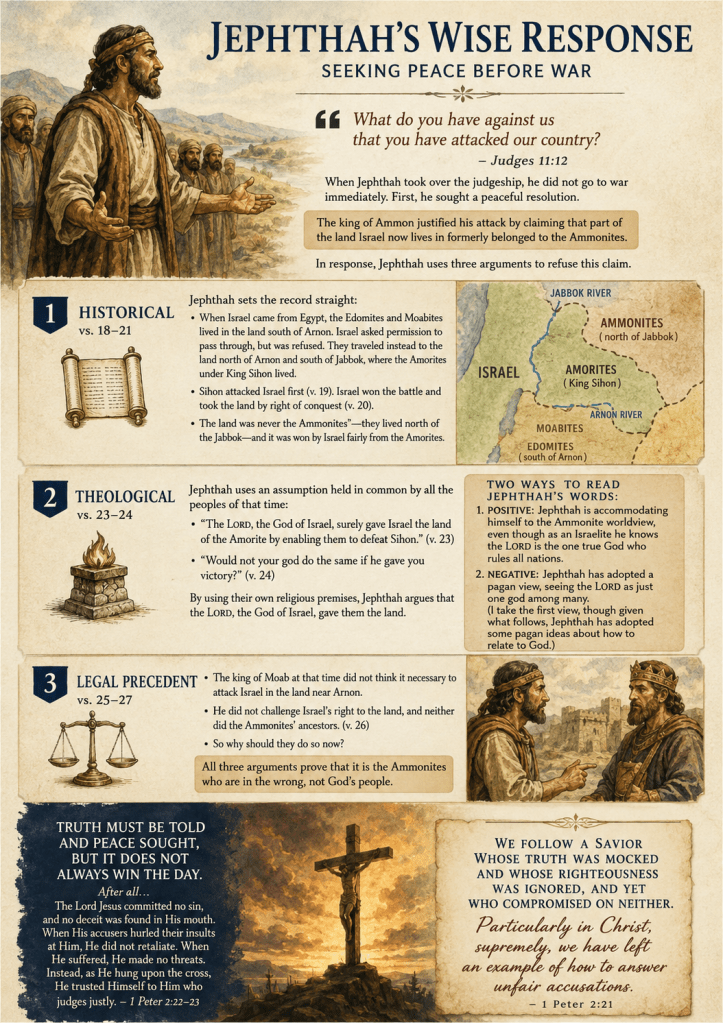
Instead of immediately rushing into war, he first pursues peace. He sends messengers, reasons carefully through Israelโ€™s history, and presents legal, theological, and historical arguments explaining why the Ammonites are in the wrong.

This matters because it shows Jephthah was not merely a reckless brute. He understood leadership, diplomacy, and negotiation.

God had even shaped his painful background into useful strength.

His suffering formed resilience.
His exile formed toughness.
His wilderness years formed leadership.

Sometimes the hardest parts of our lives become the very places God uses most powerfully.

But giftedness is not the same thing as spiritual maturity.

And this is where careful Bible reading becomes so important.

Because right after displaying wisdom, Jephthah makes one of the most horrific vows in all of Scripture.

Judges 11 study notes

The Terrible Vow

Judges 11:29 says:

โ€œThen the Spirit of the Lord was upon Jephthahโ€ฆโ€

That detail matters.

God had already determined to give victory.

The outcome was never dependent on Jephthah bargaining with God.

Yet Jephthah vows that if God gives him victory, he will sacrifice whatever first comes from his house upon returning home.

And tragically, his daughter comes out first.

This is one of the moments where Christians must slow down and read carefully.

Some try to soften the text into something symbolic. Others suggest his daughter was merely devoted to lifelong service.

But the passage itself points toward something far darker and more tragic.

Why would Jephthah even make such a vow?

Because although he knew about God, he still thought about God in many pagan ways.

Study Notes Continued

When We Mix God With The World

The surrounding pagan cultures practiced human sacrifice. Their gods were viewed as beings who had to be manipulated, impressed, or bribed through extravagant offerings.

Jephthah had absorbed some of that thinking.

And if we are honest, we often do the same thing.

Not usually through violence or sacrifice โ€” but through worldly beliefs about success, beauty, money, relationships, motherhood, control, or worth.

We often say we believe graceโ€ฆ

Yet live as though Godโ€™s love must constantly be earned.

We assume:

  • God will love us more if we perform better.
  • God is pleased only when we are productive.
  • Godโ€™s blessing depends entirely on our perfection.
  • Rest must be earned.
  • Weakness disqualifies us.

That is not the gospel.

And that is why studying Scripture carefully matters.

Because if we are not rooted deeply in Godโ€™s Word, culture will disciple us instead.

Romans 12:2 warns:

โ€œDo not be conformed to this world, but be transformed by the renewal of your mind.โ€

Jephthahโ€™s tragedy is not merely that he made a foolish vow.

It is that he fundamentally misunderstood the character of God.


Grace Is Harder To Believe Than Rules

Perhaps the saddest part of the story is this:

Even after realizing the horror of his vow, Jephthah still seems unable to trust Godโ€™s mercy enough to repent and stop.

Why?

Because he does not truly understand grace.

He seems trapped by fear โ€” believing God must be appeased rather than trusted.

And honestly, many believers live there too.

Grace feels unsafe to us.

We would often rather manage God through rules than trust Him relationally.

But the gospel tells us something radically different:

Godโ€™s favor cannot be bought.

The Father already decided to rescue His people long before Jephthah made his vow. Likewise, Christ came for sinners before we cleaned ourselves up.

Jesus is the better Judge.

Where Jephthah sacrificed his daughter because of his sinful misunderstanding, God the Father willingly gave His own Son out of perfect love and perfect wisdom to save sinners.

One sacrifice brought death through human sin.
The other brought life through divine grace.


How Do We Read Scripture Faithfully?

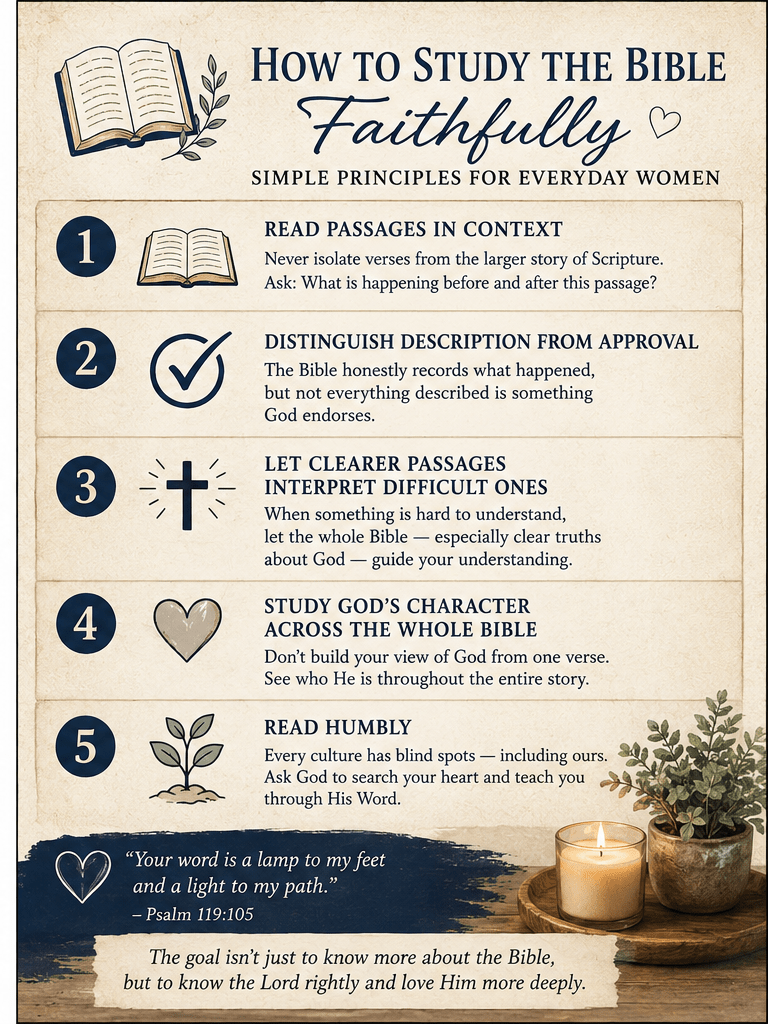
Stories like this teach us several important principles for Bible study:

1. Read passages in context

Never isolate verses from the larger story of Scripture.

2. Distinguish description from approval

The Bible often records sinful actions honestly without endorsing them.

3. Let clearer passages interpret difficult ones

Scripture already clearly condemns human sacrifice elsewhere.

4. Study Godโ€™s character across the whole Bible

One distorted view of God can shape an entire life wrongly.

5. Read humbly

Every culture has blind spots. We need Scripture constantly correcting us.


A Final Encouragement For Christian Women

If you are new to studying Scripture, please do not be discouraged by difficult passages like this.

Lean into them.

Some of the deepest growth happens when we slow down, ask questions, study context, and allow Scripture to reshape how we think about God.

The goal of Bible study is not merely gathering information.

It is learning to know the Lord rightly.

And that matters because what we believe about God shapes everything:

  • how we mother,
  • how we endure suffering,
  • how we handle failure,
  • how we rest,
  • how we repent,
  • and how we love others.

Jephthahโ€™s story is tragic.

But even tragedies in Scripture are gracious warnings meant to draw us closer to the true Savior โ€” the One who does not manipulate, crush, or abandon His people, but lovingly redeems them through grace.

Bible Study Principles

When We Let the Text Speak: Deborah, Barak, and the Importance of Faithful Hermeneutics

There is something both humbling and beautiful about coming to Scripture only to realize we may have been reading our assumptions into the text all along.

Recently, while studying Judges 4 and 5, I found myself doing exactly that.

For years, I had heard โ€” and repeated โ€” the common interpretation that Deborah had to step into leadership because Barak was weak, fearful, or unwilling to obey God without her. It is such a common conclusion that many of us barely stop to ask whether the text itself actually says that.

But when I slowed down, prayed, studied carefully, compared translations, looked into the original language, considered the historical context, and read the surrounding passages alongside Hebrews 11, I realized something important:

The text never explicitly says Barak lacked faith.

In fact, Hebrews 11 includes Barak among those commended for their faith.

That realization forced me to pause and ask a difficult but necessary question:

Had I allowed cultural assumptions and familiar commentary to speak louder than the actual words of Scripture?

Deborah Was Not an Emergency Substitute

One of the most striking observations in Judges 4 is that Deborah is already introduced as a leader before Barak even appears in the narrative.

Judges 4:4 identifies Deborah as both a prophetess and a judge in Israel. She was not functioning as a temporary stand-in because no man was available. Scripture presents her as someone God Himself had raised up and appointed.

She held court under the palm of Deborah, where the people of Israel came to her for judgment and counsel. This was not a queenโ€™s throne, but a courtroom. Israel trusted her wisdom, discernment, and leadership.

Unlike many of the judges before and after her, Deborah did not primarily lead through military strength or physical might. She led through wisdom, discernment, character, and faithful proclamation of Godโ€™s Word.

We see this clearly in Judges 4:6 when she tells Barak:

โ€œThe Lord, the God of Israel, commands youโ€ฆโ€

As a prophetess, Deborah faithfully declared the Word of God. She counseled, guided, and judged the people. In many ways, she comes closer than any judge before the monarchy to modeling a ruler who shepherds with wisdom and righteousness.

Deborahโ€™s role should not be minimized simply because Barak also played a role in Godโ€™s deliverance.

The text honors both.

The Danger of Bringing Assumptions Into Scripture

As women especially, I think many of us have been quick to frame Deborahโ€™s story as proof that she only led because Barak failed.

But that interpretation may reveal more about our assumptions than about the text itself.

When Barak tells Deborah in Judges 4:8:

โ€œIf you will go with me, I will go, but if you will not go with me, I will not go,โ€

many immediately read cowardice or disobedience into his response.

And certainly, some respected commentators understand the passage that way.

But others note that Deborahโ€™s response in verse 9 can also be translated differently. Rather than being a rebuke, it may simply be a prophetic statement that the honor for Siseraโ€™s defeat would ultimately go to a woman.

That distinction matters.

Because if Barak is not being rebuked, then his request for Deborahโ€™s presence may actually demonstrate faith rather than unbelief.

After all, why would he not want the Lordโ€™s prophet with him as he marched into battle against overwhelming odds?

Hebrews 11 forced me to wrestle honestly with this possibility. Scripture itself commends Barakโ€™s faith. That means we should be careful not to build an interpretation that ultimately contradicts the broader testimony of Godโ€™s Word.

Faithful Hermeneutics Requires Humility

This study reminded me how important good hermeneutics truly are.

Hermeneutics simply means the way we interpret Scripture.

It means asking questions of the text instead of assuming we already know the answers. It means studying passages in context. It means comparing Scripture with Scripture. It means considering grammar, historical background, original language, genre, and surrounding passages. Most importantly, it means approaching Godโ€™s Word prayerfully and humbly, willing to be corrected.

So often we come to the Bible looking for confirmation instead of truth.

We read through lenses shaped by culture, church traditions, personal experiences, social media discussions, or popular teaching. Sometimes we inherit interpretations we have never personally examined.

But faithful Bible study requires us to slow down enough to let the text speak for itself.

Not forcing Scripture to fit our narrative.

Not reading motives into people that God Himself never states.

Not minimizing one person in order to elevate another.

Simply letting God say what He intended to say.

The Glory Ultimately Belongs to God

One of the most beautiful things about Judges 4 and 5 is that there is not just one human hero.

There is Deborah.
There is Barak.
There is Jael.

And yet Judges 5 makes clear where the true glory belongs.

To the Lord.

The Lord is the One who delivered Israel.

The Lord is the One who routed Sisera.

The Lord is the One who used ordinary people in different ways for His purposes.

Deborah ruled and counseled.
Barak obeyed and fought.
Jael struck the final blow.

But God alone secured the victory.

Isnโ€™t that often how the Lord works?

He delights in using different people with different gifts for the accomplishment of His purposes so that no single person can claim the glory for themselves.

A Final Encouragement

One of the greatest acts of spiritual maturity is allowing Scripture to challenge us.

Not defending our assumptions.
Not clinging to familiar interpretations.
Not reading quickly.
Not approaching Godโ€™s Word to prove a point.

But prayerfully opening the Bible and saying:

โ€œLord, help me see what is actually there.โ€

The more I study Scripture, the more I realize how dangerous it can be to approach the text with conclusions already in place.

Good hermeneutics is not cold academics.
It is an act of humility.

It is loving God enough to want His meaning more than our own opinions.

And sometimes, faithful study means being willing to say:

โ€œI may have gotten this wrong before.โ€

That is not weakness.

That is reverence for the Word of God.

Word Study: Disciple

In Gospel of Mark 3:13โ€“14, we see something powerful about what it means to follow Jesus: He calls, and then He draws near. โ€œHe appointed twelveโ€ฆ so that they might be with Him and He might send them out to preach.โ€

Before anything elseโ€”before ministry, impact, or influenceโ€”there was presence. They were chosen to be with Him.

The word โ€œdiscipleโ€ comes from the Greek mathetes, meaning learner or studentโ€”someone shaped not just by what a teacher says, but by how they live. Interestingly, while followers of Jesus are called โ€œChristiansโ€ only a few times and โ€œbelieversโ€ a bit more, the word disciple appears over 200 times in Scripture. That repetition matters.

Key verses include: Matthew 28:19, John 8:31, Luke 14:27

Strongโ€™s Number: G3101

A disciple isnโ€™t just someone who believesโ€”itโ€™s someone who follows closely, learns deeply, and is formed daily.

And hereโ€™s the tension: we are all being discipled by something. What we give our time, attention, and affection to is quietly shaping who we become.

Jesus shows us the order clearly:
proximity comes before productivity.

So the question isnโ€™t just what are you doing for Christ?
Itโ€™s are you with Him?

What might it look like today to sit with Him a little longer, listen a little closer, and follow a little more intentionally?

Thatโ€™s where true discipleship begins.

Blog at WordPress.com.

Up ↑