Before We Dive In
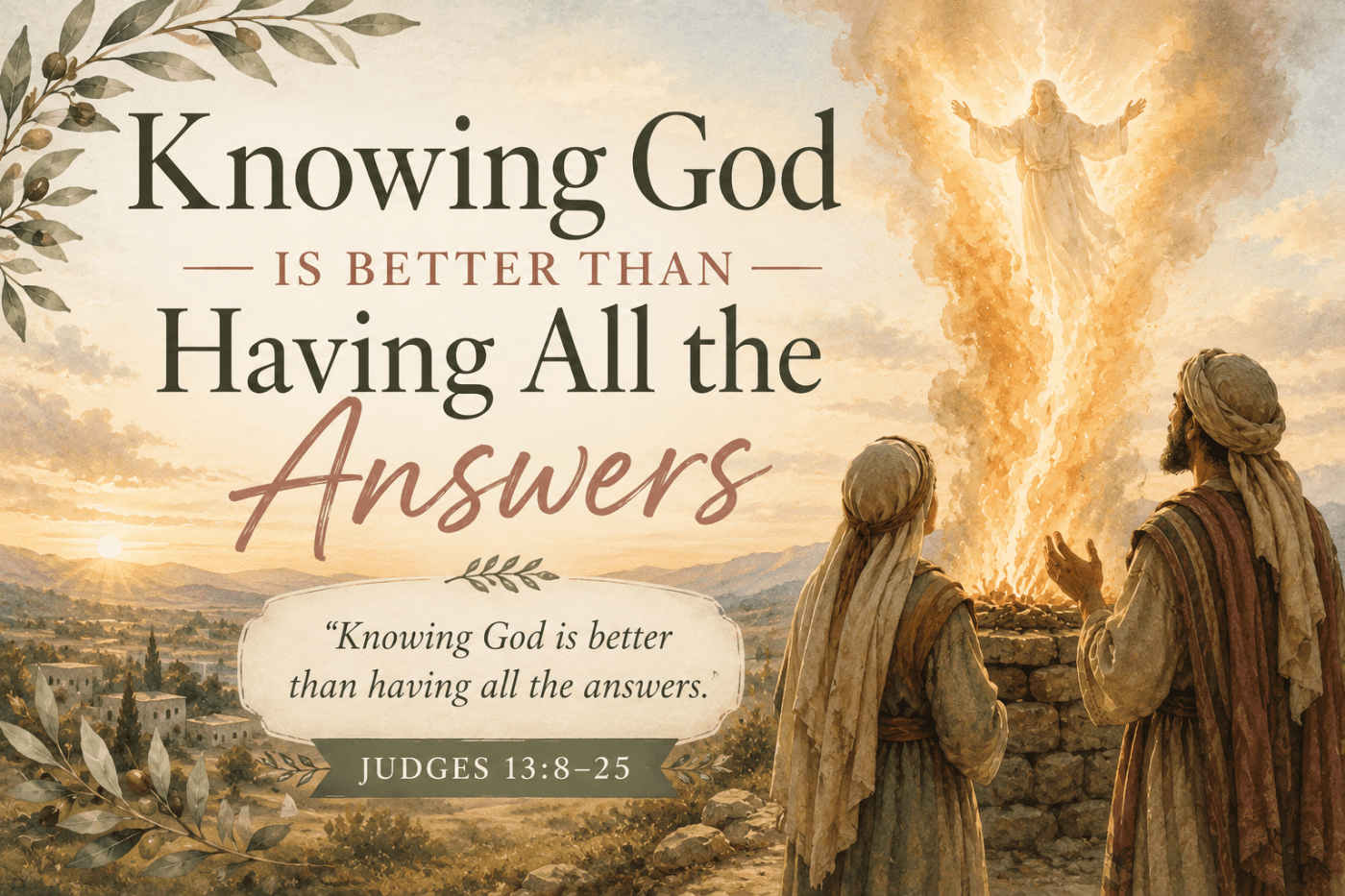
You may notice some overlap between this study and the previous two Judges posts I’ve shared. That’s intentional. In those studies, we looked at the broader movement of Judges 12–13 and how the story points us forward to Christ. This time, I found myself lingering over a much smaller section of the text—Judges 13:8–25—and discovering a lesson I wasn’t ready to move past.
Sometimes Scripture is like that. We read a passage once and see the big picture. Then we come back and find the Lord gently pressing a particular truth deeper into our hearts. For me, that truth was this: knowing God is better than having all the answers.
So if some of these verses feel familiar, I hope you’ll slow down with me and look again. God’s Word always has more to show us.
And perhaps that’s one of the greatest gifts of studying Scripture slowly. We don’t simply gather more information—we come to know the Author more deeply. As always, my prayer is that through this study we would learn to behold Him, not ourselves, trusting that His character is enough even when we don’t have all the answers.
Judges 13:8–25
As I studied Judges 13 this week, I found myself identifying with Samson’s father, Manoah.
After hearing that his barren wife would bear a son, Manoah prayed:
“Please, Lord, let the man of God you sent to us come again to teach us how to bring up the boy who is to be born.” (Judges 13:8)
His request is deeply relatable. He wants clarity, direction, and a plan for the future God has placed in his hands.
I’ve prayed the same way countless times.
As the mother of a son with autism, I have often asked God for guidance. Should I pursue this therapy or that one? Should I homeschool or choose public school? What does faithfulness look like in this situation?
If God would simply make the path clear, I would gladly follow it.
But Judges 13 reveals a better gift. The central lesson of Manoah’s story is this:
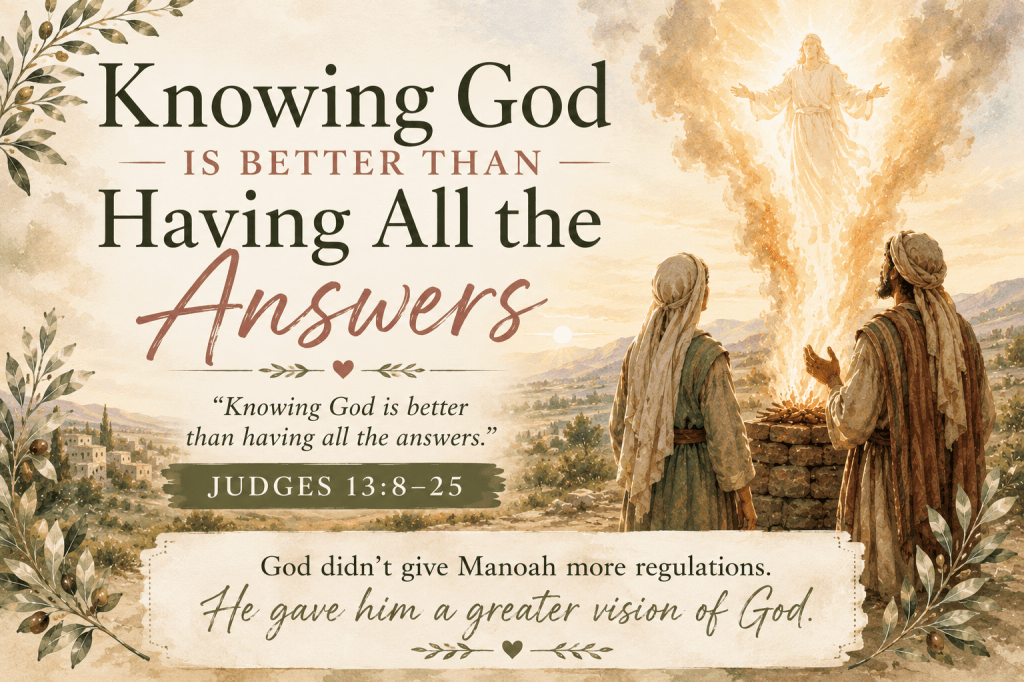
Knowing God is better than having all the answers.
Manoah asks for guidance, yet God gives him something deeper—a greater revelation of Himself. And that is often how God works in our lives as well.
Faith That Believes the Impossible
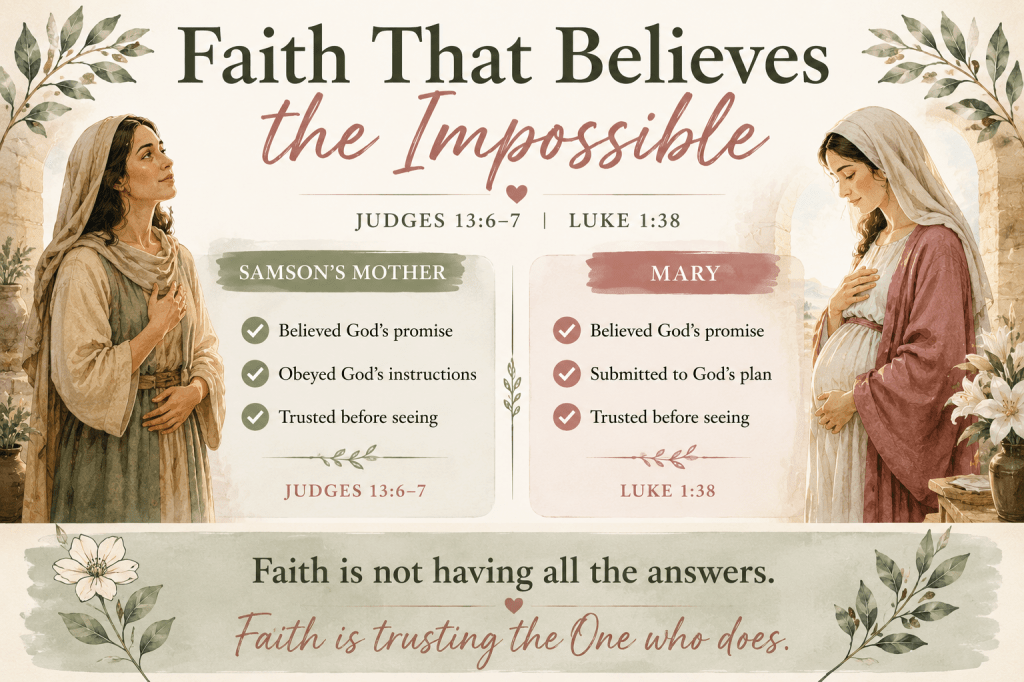
Before we look at Manoah, we must first notice the remarkable faith of Samson’s mother.
When the angel of the Lord appeared and announced that she would conceive and bear a son, she simply believed.
There is no recorded laughter as there was with Sarah when she heard she would bear Isaac in her old age (Genesis 18:9–15).
There is no disbelief like Zechariah displayed when he learned John the Baptist would be born (Luke 1:13–20).
Instead, Samson’s mother receives God’s word with faith:
“A man of God came to me. He looked like an angel of God, very awesome.” (Judges 13:6)
She believed the promise before she saw the fulfillment.
In this way, she reminds us of another woman who would receive impossible news more than a thousand years later.
When Gabriel announced the coming birth of Jesus, Mary responded:
“May it be to me as you have said.” (Luke 1:38)
Both women trusted God’s promises.
Both women submitted themselves to God’s purposes.
Both women accepted personal cost in order to participate in God’s plan.
Samson’s mother embraced the Nazarite restrictions required during her pregnancy. Mary embraced the shame and misunderstanding that would accompany an unwed pregnancy.
Both women demonstrate that faith is not merely believing God can do the impossible—it is willingly placing ourselves at His disposal.
Manoah’s Request
Unlike his wife, Manoah has questions.
And honestly, I appreciate that.
His response feels very human.
Notice that he doesn’t ask whether God’s promise is true.
He assumes the child will come.
His request is not for proof but for guidance.
He wants to know:
“What is to be the rule for the boy’s life and work?” (Judges 13:12)
How do we raise him?
What should we do?
What rules should we follow?
Again, I find myself nodding along.
As parents, we want certainty.
We want formulas.
We want detailed instructions.
We want guarantees.
Yet when the angel returns, something surprising happens.
He doesn’t provide much new information at all.
The child will be a Nazarite.
Manoah’s wife must continue obeying what she has already been told.
That’s essentially it.
No parenting manual.
No detailed roadmap.
No step-by-step guide.
Why?
The Help Manoah Wanted Versus the Help He Needed
At first it seems like God ignored Manoah’s request.
But He didn’t.
God answered the prayer.
Just not in the way Manoah expected.
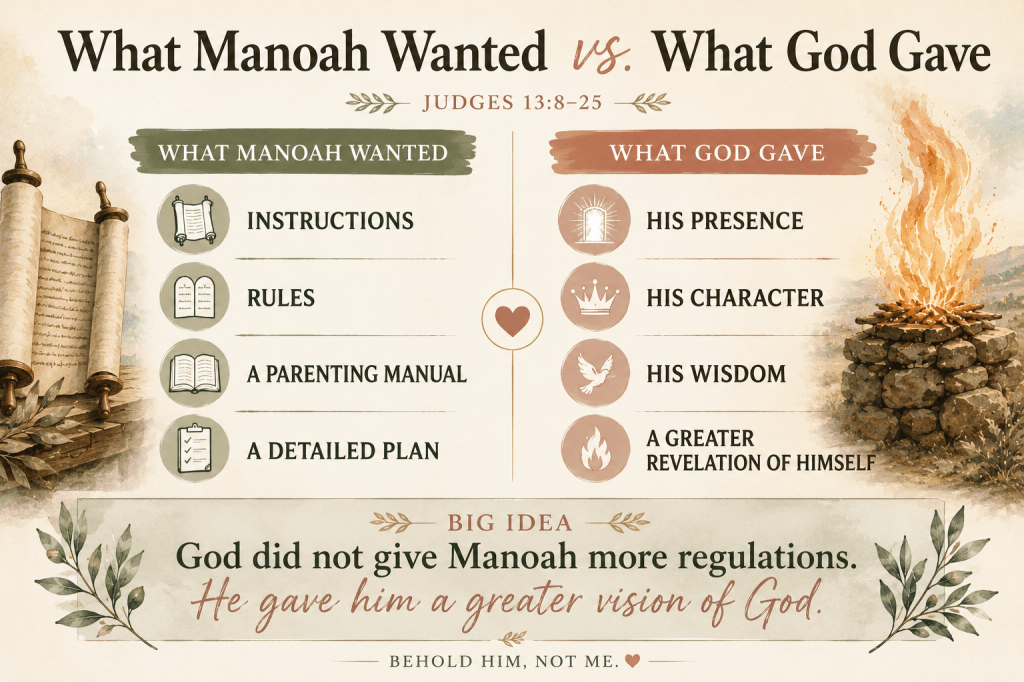
Manoah wanted information.
God gave revelation.
Manoah wanted rules.
God revealed His character.
Manoah wanted to know what to do.
God showed him who He was.
When Manoah asks the angel’s name, the angel responds:
“Why do you ask my name? It is beyond understanding.” (Judges 13:18)
Then the angel ascends into heaven in the flame of the sacrifice.
Suddenly Manoah realizes this was no ordinary visitor.
This was a divine encounter.
The angel of the Lord had come not merely to deliver information but to reveal God’s greatness.
That was the help Manoah truly needed.
And perhaps it is the help we need as well.
The Lesson I Keep Learning
This part of the story stopped me in my tracks.
Because I often approach God exactly the way Manoah did.
I want clarity.
I want confidence for the next step.
I want God to show me how to move forward.
As the mother of a child with autism, I have cried out to God with questions similar to Manoah’s.
But God’s silence has not really been silence.
Like Manoah, I often discover that God is answering a deeper question than the one I am asking.
He is teaching me His character.
His goodness.
His faithfulness.
His wisdom.
His sovereignty.
Because the truth is this:
Knowing God is better than having all the answers.
No set of instructions can prepare us for every decision we will face.
Only a deep understanding of who God is can guide us through the countless twists and turns of life.
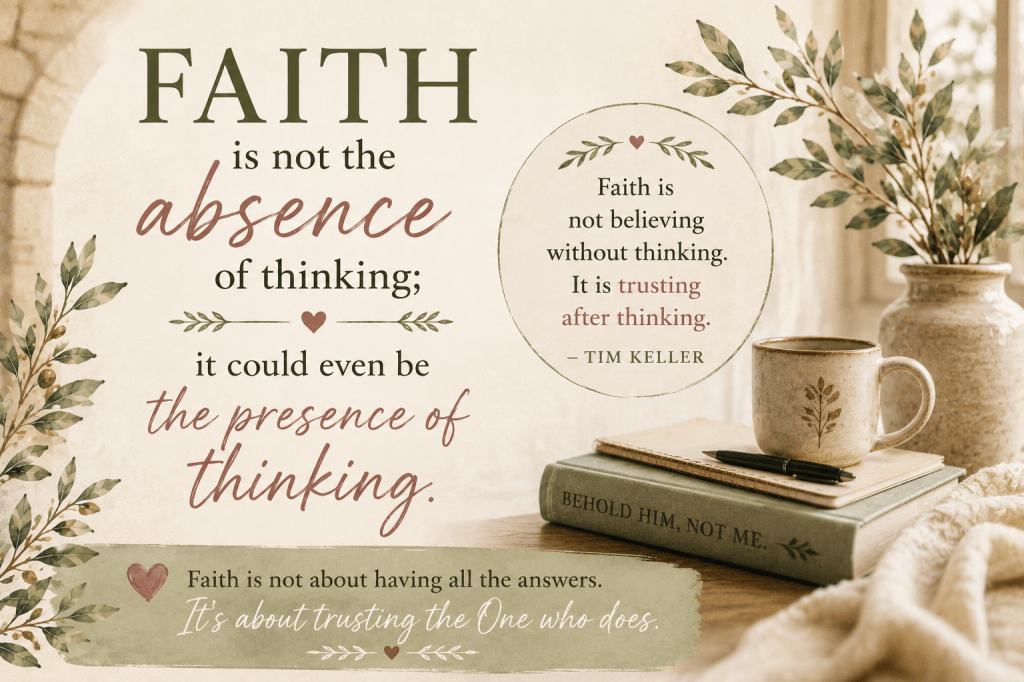
Faith Is Not the Absence of Thinking
After Manoah panics and assumes they are about to die because they have seen God, it is his wife who calmly reasons through the situation:
“If the Lord had meant to kill us, he would not have accepted a burnt offering and grain offering from our hands.” (Judges 13:23)
Her response beautifully illustrates what Tim Keller wrote:
“Faith is not the absence of thinking. It is thinking and acting on the basis of the Word and promises of God.”
She reflects on what God has already revealed.
She reasons from His character.
She trusts His promises.
That is biblical faith.
Not blind optimism.
Not wishful thinking.
But confidence rooted in who God is.
We Need God More Than More Rules
Tim Keller points out that mature relationships require fewer external rules and more internal wisdom.
Young children need constant instructions:
Don’t touch that.
Don’t go there.
Don’t do this.
But as children mature, parents desire them to internalize wisdom and values so they can make good decisions even when specific instructions are absent.
The same is true spiritually.
Many Christians imagine Old Testament believers had a better system because they received more regulations.
Yet under the New Covenant, we have something far greater.
We have the Holy Spirit.
Paul writes:
“Be transformed by the renewing of your mind.” (Romans 12:2)
And:
“We have the mind of Christ.” (1 Corinthians 2:16)
Rather than endless prescriptions, God gives us Himself.
Rather than merely telling us what to do, He transforms who we are.
What Manoah needed most was not more regulations.
It was a greater vision of God.
And the same is true for us.
Samson’s Birth and Our Need for a Greater Savior
Finally, just as God promised, Samson is born.
The promise was never in doubt because it rested on God’s word.
The child grows.
God blesses him.
The Spirit begins to stir within him.
Everything appears poised for success.
If anyone ever had spiritual advantages, it was Samson.
Miraculous birth.
Divine calling.
God’s blessing.
The Spirit’s power.
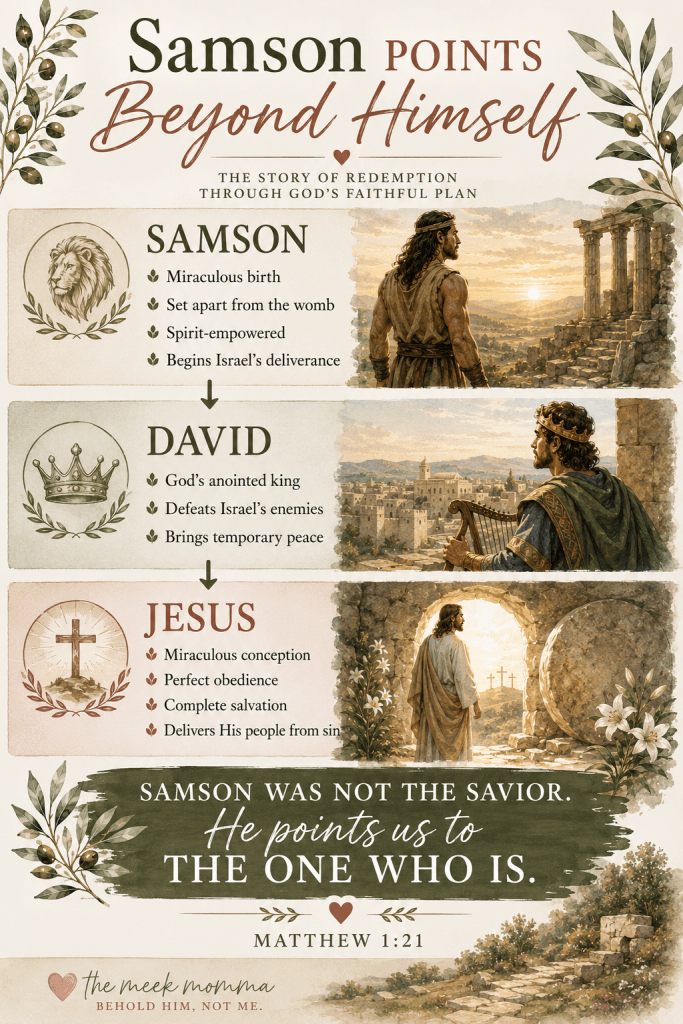
Yet as we continue through Judges, we will discover that Samson is not the Savior Israel needs.
He will disappoint us.
His flaws will become painfully evident.
And that disappointment is intentional.
Because Samson was never meant to be the final Deliverer.
He points beyond himself.
To David.
And beyond David.
To Jesus Christ.
The One who would perfectly obey.
The One who would perfectly trust.
The One who would perfectly save.
Heart Check
As I closed my Bible, one question lingered in my heart:
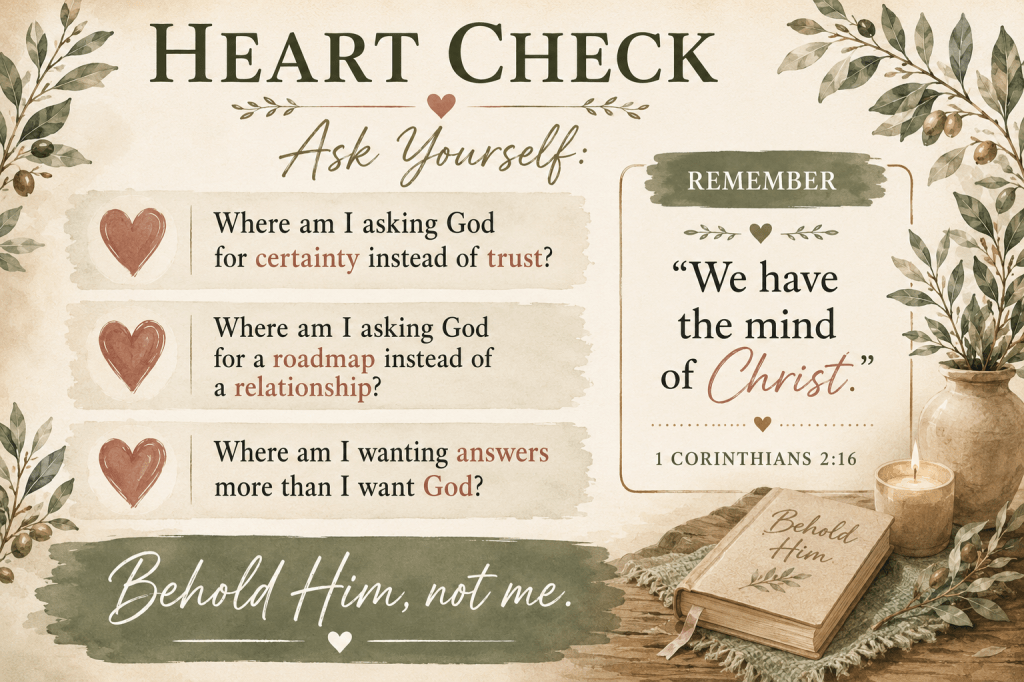
In what areas of my life would I rather have answers than God Himself?
Where am I asking for certainty instead of trust?
Where am I asking for a roadmap instead of a relationship?
Like Manoah, we often think we need more information.
But God knows what we truly need.
We need Him.
His character.
His wisdom.
His presence.
His promises.
Because in the end:
Knowing God is better than having all the answers.
Behold Him, not me.


I needed to read that this morning! Thank you my friend! I need to know God and His character, not have all the answers to my questions. So good.
LikeLiked by 1 person
God is so faithful! He is where our security and our refreshment can be found. Love you so much Friend!
LikeLike